
Items related to The Queer Sixties
Synopsis
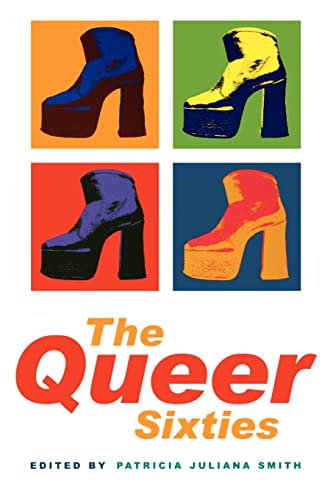
The Queer Sixties assembles an impressive group of cultural critics to go against the grain of 1960s studies, and proposes new and different ways of the last decade before the closet doors swung open. Imbued with the zeitgeist of the 60s, this playful and powerful collection rescues the persistence of the queer imaginary.
"synopsis" may belong to another edition of this title.
About the Author
Patricia Juliana Smith is Assistant Professor of English at UCLA.
Excerpt. © Reprinted by permission. All rights reserved.
The Queer Sixties
By Patricia Juliana SmithRoutledge
Copyright © 1999 Patricia Juliana SmithAll right reserved.
ISBN: 0415921694
Chapter One
PULP POLITICS
Strategies of Vision in Pro-Lesbian Pulp Novels,
1955-1965
Yvonne Keller
DESPITE THE ADVANCES in gay community formation encouraged by thedislocations of World War II, for lesbians, the 1950s and early 1960s in theUnited States were a difficult time. Dominant culture sought a return to amythical pre-War, pre-Depression "normality," visioned in ideologically conservativeterms in which "men were men and women were housewives"(Whitfield 43). This, alongside increased public discourse on homosexualityas a psychological disease and the Cold War notion that homosexuals were apressing political threat, made the fifties, as Lillian Faderman writes, "perhapsthe worst time in history for women to love women" (Odd Girls 157).Despite their benign Father Knows Best image, the 1950s and early 1960s were,to some extent, an age of paranoia, fed by deep fears of the bomb and communism.Both assuaging and mirroring such anxieties was a general atmosphereof voyeurism; for example, in popular culture Hugh Hefner beganPlayboy?displaying scantily clad women for the man who looks?and JamesBond's "license to look" (at women) was more important to the success of theIan Fleming thrillers than his license to kill (Denning 102). On a politicalfront, visual technologies of spying and surveillance dominated public lifeand discourse as the Julius and Ethel Rosenberg and Alger Hiss spy trialsthreatened every all-American boy's (and girl's) presumed innocence. Indeedtwo potent American fears?fear of the communist conspiracy and the fearthat a member of one's family might be homosexual?were linked in the perceivedthreat that homosexuals could be blackmailed into becoming communistspies (Epstein; Whitfield 43). As a result, even extremely closetedhomosexuals and lesbians were barred or dismissed from federal jobs and themilitary; the Federal Bureau of Investigation (FBI) began broad surveillanceof homophile organizations and gay gathering places; and urban policeheightened their harassment of homosexual citizens (D'Emilio 60).
Given the fierce public disapproval of homosexuality, lesbian representationwas scarce and lesbians of the time repeatedly attest to the frustrationof their desire for such images in popular culture. In every public art, lesbianismwas invisible: the Hays Code banned the depiction of homosexuality inHollywood films; the nascent television industry never showed recognizablehomosexuals; and mainstream New York book publishers offered only atrickle of covertly lesbian literary texts. Outside the pathological images profferedby psychiatry and occasional scandal magazine articles that capitalizedon the fear of homosexuality, lesbian pulp novels were the only medium thatafforded a large stock of these images. Marked by their explicitly lesbian, sensationalizedcovers, which advertised "twilight women," "forbidden love," orthe "limbo of lesbianism," these books were mass-market, cheaply madepaperbacks with lesbian themes. The genre of lesbian pulp novels came intoexistence thanks to the "paperback revolution" begun by Pocket Books,which in 1941 greatly increased its distribution channels, and thus sales.Book outlets?mostly bookstores?had numbered around 1,000 beforeWorld War II, but Pocket Books's new use of newspaper distribution outletssuch as newsstands and grocery store racks created an impressive 100,000outlets for cheap paperbacks. Pocket Books's success was imitated by manyother mainstream East Coast presses, notably Fawcett, Beacon, and Midland-Tower,which promoted paperback originals of genres such as Westerns,mysteries, thrillers, and, most important for my focus here, lesbian pulps,with astonishing success.
These new mechanisms of distribution meant, in essence, that morebooks with lesbian themes were cheaply and widely available during thistime than at any previous time in U.S. history. While their existence is onlybriefly noted in a few publishing histories, millions of lesbian-centered textswere bought during this time. Tereska Torres's Women's Barracks (1950), forexample, a story of a houseful of French women living in England duringWorld War II, quickly sold over 1 million copies; by 1968, over 3 millioncopies had been printed (Adams 259, 273), and as of 1975 it ranked as the244th best-selling American novel (Hackett 16). Even Radclyffe Hall's lesbianclassic, The Well of Loneliness, when reissued as a lesbian pulp completewith a sensationalist cover that proclaimed in large, red type: "Why can't I benormal?" achieved sales of over 100,000 copies a year. Claire Morgan's1952 The Price of Salt, a tale of two women who fall in love in New York City,had sold over a half-million copies by 1958, and by 1963, the Ladder estimatedthat there were over 1 million copies in print (Highsmith, pbk. cover;"Crosscurrents" 14). Given that best-selling hardcover novels in the 1950ssold an average of 30,000 copies and the sales of typical trade hardcoverstoday can be as little as 5,000 copies the first year, these figures are extremelyhigh. Clearly, the publishers had a new, successful genre on their hands.
Lesbian pulps thrived from 1950 to 1965. The genre began with thepublication of Women's Barracks in 1950, followed in 1952 by Vin Packer'sbest-seller Spring Fire, a story of love between two midwestern sorority sisters.These two relatively unhomophobic books, both written by women (one ofwhom described herself as a lesbian), made publishers aware of a potentiallylarge market that was (at least at first) assumed to consist of heterosexualmen. This belief led to the publication of many poorly written, fast-pacedtales involving frequent sex and written from a male point of view, a kind oflesbian pulp that I call "virile adventures." In contrast, my focus here is pro-lesbianpulps?a subset of lesbian pulps, often written by lesbians, with generallymore positive lesbian representation?which were published in quantityonly toward the end of the 1950s. Ann Bannon's famous Beebo Brinkerseries, for example, is a series of six books featuring the same characters,published between 1957 and 1962, and Randy Salem's ten books appearedbetween 1959 and 1965. After 1965, however, what some called "the goldenage" of lesbian paperbacks was over: mainstream publishers no longer publishedlesbian pulps because of the changing times and the increased incorporationof lesbian themes either in fiction of more established literary qualityor in the new openly pornographic fiction published by small, opportunistic,nonmainstream presses.
Clearly lesbian pulps flourished largely because of the publishingindustry's ability to make money from homosexual themes, but there areother reasons as well. First was the form: true, pulp novels made money, butthey were a devalued form of writing; and few of their editors were concernedabout their content. Second was gender: the lesbians depicted werestill women?which meant, to more men than just Hugh Hefner, that theywere still sexually available to men and, moreover, nonthreatening to depict(to heterosexual men, of course); not coincidentally, fewer pulp novels werepublished with gay male themes. Third was the use of vision: voyeurismin particular worked as a form of pleasure and reassurance over anxietiesabout social hierarchies; it reinstated the power of men over the objects oftheir gaze. While looking/surveillance was a precipitate of the culture at largeand expected for novels with sexual adventures, it also provided narrativestructures in which to "show" lesbians and often placed a man in the scenewith the two women. While he exists as an assumed reader/audience whennot explicitly in the narrative, more often he is a real character in the novel,as the man who always gets the girl?at least, the most feminine girl?inthe end.
While existing as a technology of power within the larger culture andwithin representation, voyeurism was also a technology of power in the realmof lesbians' lived experience. For example, lesbian bars from the forties to theearly sixties were subject to quite blatant heterosexual tourism. In their historyof the lesbian community in Buffalo, New York, Elizabeth Kennedy andMadeline Davis write that "most bars ... had straight observers. Lesbiansused humor to deal with the inevitable objectification and were successful atdeflecting the tension" (62). They go on to quote an interviewee, a lesbian,who says, "back then you had an awful lot of your soldiers, sailors, straightscome in, it was like going to the zoo and seeing the monkeys dance" (62).Lesbian-designed strategies for engaging with vision, in fiction and in life,were thus both necessary and difficult.
What were embattled lesbian readers to do, given their strong desirefor lesbian representation and the inevitable proximity of voyeurism andhomophobia in the only readily available books with lesbian themes? Theydid the only thing they could?they compromised and turned a blind eye, soto speak, to the homophobic looking relations installed in these texts. Forexample, when, at the end of the 1950s, a group of American, white, middle-classlesbian readers assembled a bibliography of lesbian titles, called simplyChecklist 1960, they were "not averse" to the representation of frequent sex inthe novels they listed, but rather developed a special designation for thebooks that incorporated frequent sex without a "reasonably well writtenstory":
[I]f the story is just a peg on which to hang up a lot of poorly written, gamy erotic episodes, with no literary value, and just evasive enough to keep the printer out of jail, then we have given it short shrift with the abbreviation "scv"?which cryptic letters are editorial shorthand for "Short Course in Voyeurism"?and have been the basis of a lot of jokes in the tedious business of passing reviews around the editorial staff. (Bradley and Damon, Checklist 1960 5)
The "scv" label seems to mean: do not bother to read this book; it borderson pornography and is not for "us." Though critical, the editors do not keep"scv" books out of their bibliography, saying "we shan't spoil your fun" (5).This reluctance to judge, plus the scarcity of lesbian fiction overall, precludedtheir rejection of these books. Voyeurism in some form pervaded so manylesbian novels?since the majority were lesbian pulps?that it could not serveas an effective basis of exclusion. In Checklist 1960, of all the novels listed,over thirty-five lesbian pulp novels were given the highest rating as "of considerablevalue"; of the total, thirty-eight were rated "scv," all of which werelesbian pulps.
The editors of Checklist 1960, like many lesbian readers of the time,were caught in a bind. On the one hand they felt discomfort at the evidentrepeated proximity of the two concepts of voyeurism and lesbianism in theirbook list. They write: "the paperback originals reek with drooling voyeuristicstripteases about lesbians, for the sake of men who like to enjoy pipe-dreamsabout lesbians making love, and about some Big Handsome Hero who eventuallyconverts the girls to `normality' with some secret formula of caresses"(Bradley and Damon, Checklist 1960 52). On the other hand, in their desirefor representation, they collected and read any books with lesbian themes,despite homophobia and voyeurism. Most lesbian pulps were virile adventuresaimed at a male readership, but there were also, beginning in the late1950s, a subset of pro-lesbian pulps, the set of books most often written bylesbians and characterized by the most positive lesbian representation. Likethe editors of the Checklist, lesbian writers who wrote lesbian pulps werecaught in a similar bind: they wanted to write about lesbians, which thegenre encouraged, but they were also compelled to conform to generic imperativessuch as homophobia, sexism, frequent and gratuitous sex, voyeurism,male-centeredness, and sad endings?typically, ones in which the lesbians donot end up happily together. Using an exemplary novel of the genre, RandySalem's Man among Women, this essay analyzes the representation of voyeurismin pro-lesbian pulps to argue that these pulp novels resisted and subvertedthe publishers' (and readers') expectations of how voyeurism shouldbe treated in the genre. I conclude by suggesting that the genre's opennessabout lesbianism, even though often voyeuristic and homophobic, opened upan important space in public discourse because it allowed more articulationof lesbian issues than the few literary novels with lesbian themes existent atthe time.
Subversion in Pro-Lesbian Pulps:
Randy Salem's Man among Women
Given the context of a homophobic, male-oriented genre, pro-lesbianauthors themselves have asserted (sometimes in the pages of the lesbian periodicalof the time, the Ladder, but also in a post-Stonewall context) theirdesire to improve the inaccurate and sensationalized depiction of lesbiansthat the virile adventures created. These authors were typically moreinvested in creating positive lesbian representation than other lesbian pulpauthors, often because they themselves were bisexual or lesbian. In 1989,pro-lesbian pulp author Valerie Taylor describes the late fifties:
There was suddenly a plethora of [gay novels] on sale in drugstores and bookstores, and most were absolute trash?many written by men who had never knowingly spoken to a lesbian.... I wanted to make some money, of course, but I also thought that we should have some stories about real people?women who had jobs, families, faults, talents, friends, problems; not just erotic mannequins. ("Those Wonderful" 1)
These authors' desire to write against the genre's norms also constituted arefusal of cultural norms: lesbianism as sick, immoral, or criminal. The writerstried to show "real," "true" depictions of normal, "well-adjusted" lesbiansto the public (Bradley, "Those Wonderful" 4; Christian, "Those Wonderful"4). However, publishers imposed strict limits on what they could do.Although Paula Christian claims that she "got away with quite a bit" (Amanda1), March Hastings tells of the basic limits: "[My editor said:] `The heroinescannot end up happily together.... It's against the moral code' ... I heardconviction here, not to be argued, not to be negotiated" ("Those Wonderful"8). While these authors' intentions, stated many years after the bookswere published, may be skewed in order to please a gay audience, their consistencyinvites belief. Overall, the multiple instances of tempered idealism,self-doubt, and self-censorship that are manifest in the encounters describedbetween lesbian writers and their publishers support a reading of these textsas contested, contradictory sites of self-representation. Overall, lesbianauthors' impulses to self-representation correlate with markedly more positivelesbian representation in their books.
Unlike post-Stonewall lesbian fiction today or literary fiction at thetime, pro-lesbian pulps are fully immersed within, and indeed obligated toattend to, the discourse of voyeurism because of the constraints of their mass-marketcultural form. Lesbian authors of lesbian pulps must have each takena "short course in voyeurism" themselves to publish successfully in the genre.How did they implement that knowledge? How did they navigate the simultaneousgeneric mandates for overt lesbianism and objectifying imagerywhile still portraying well-adjusted, perhaps even happy, women? In contrastto contemporaneous literary fiction, which rarely and only covertlyaddressed lesbian themes, pro-lesbian pulp writers could write openly aboutlesbian heroines, lesbian bars, and, to a lesser extent, cultural structures ofhomophobia. However, again in contrast to literary fiction, homophobia,racism, and sexism were also expected to be more overt in their texts. Despitetheir location in the middle of a homophobic discourse, pro-lesbian pulp novelsresisted the legacy of this genre. Their authors' tactics often resulted inobvious contradictions within the texts, such as perfectly content lesbianswho suddenly commit suicide or marry men at the very end of the book.From today's point of view, these efforts at resistance may well seem likefailures?their overall homophobia is easily recognizable. Nonetheless, pro-lesbianpulp writers did resist, and they did so in a genre that gave them morepossibilities for openness about lesbian issues than the more elite work of literarylesbian writers of the time.
The pro-lesbian pulp genre is comprised of almost 100 novels by overfifteen different authors. Their authors implemented three strategies in reactionto the conventional voyeurism of the genre: refusal to acknowledge itsexistence in their writing, appropriation, and subversion. In deploying thefirst, and least utilized, technique, refusal, some writers managed to ignorethe constraints of a sexy/erotic adventure tradition while still achieving publicationwithin the genre. The paradigmatic example here is Valerie Taylor,whose Erika Frohmann series, in books like A World without Men and Journeyto Fulfillment, successfully avoided sensationalism and extraneous sex scenesand worked to normalize, humanize, and desensationalize the lesbian characterswhile keeping them central to each story. The second strategy, deployedin books like Ann Bannon's I Am a Woman, embraces looking relations butdoes so in a female-centered context that reverses who looks and the meaningof the look. Randy Salem's Man among Women is representative of the thirdstrategy, subversion. Her novel is the most self-contradictory of these threetypes, in that it accommodates the genre's insistence on a male voyeurism butresists the male power that traditionally accompanies it.
Randy Salem is one of the five or six pro-lesbian pulp authors mosthighly regarded by the Ladder and its readers, and, according to BarbaraGrier, the woman behind this pseudonym is a lesbian (1991 interview). Herwork covers a wide range of texts, from Chris, an entertaining lesbian lovestory that remains sellable today (and indeed was republished by a lesbianpress in the 1980s), to titles like The Unfortunate Flesh and Tender Torment, whichare more like virile adventures. Her Man among Women (1960) is a useful andtypical example of a pro-lesbian pulp because it conforms in part to genericconstraints but nevertheless represents lesbians positively. Narrative voyeurismis both encouraged and subverted in this book; often the male protagonistis allowed to look at lesbians but always with painful consequences, fromjealousy to physical pain due to a fall after watching. In short, the text issimultaneously voyeuristic and antivoyeuristic.
Because of its history of engagement with issues of vision that also arecentral to these books, this essay in part uses film criticism to analyze thewritten text. For example, in Man among Women, Ralph, a photojournalist andthus a kind of voyeur by profession, is the hero of the book and narrates thestory. This structure of seeing the world through Ralph's eyes offers thereader an easily recognizable place of identification with the feelings, power,and gaze of the white, male protagonist. In her well-known article, "VisualPleasure and Narrative Cinema," Laura Mulvey makes the identification betweenprotagonist, spectator (reader), and vision explicit: "As the spectatoridentifies with the main male protagonist, he projects his look onto that of hislike, his screen surrogate, so that the power of the male protagonist as he controlsevents coincides with the active power of the erotic look, both giving asatisfying sense of omnipotence" (34). Mulvey here also draws our attentionto the issue of power, arguing for the identification of the spectator with themale protagonist, and thus with his sense of power. Randy Salem's work, Iwill argue, grants maleness as the gender of the look but aims to separate thislook from what Mulvey calls "active power" or "omnipotence" Thus, Ralphcan look, but his look carries no power.
The book's story is simple: boy meets girl but girl is already with girl,boy waits for girl, boy gets girl. Using a common pulp tactic, heterosexualsex starts the book, which is set in the "exotic" locale of the Bahamas. A sensitive,likable, handsome young man on foreign assignment who is bored byhis overly efficient fiancée back home, Ralph finds a beautiful woman namedAlison on a deserted tropical island, which is completely inaccessible exceptwith scuba equipment due to a ring of coral circling the island. They makelove, swim, and eat raw seafood in an extended romantic idyll, yet Alisonremains reticent, elusive about her past or future and mysteriously distant,Though the book tells the story of Ralph staying close to Alison and eventuallywinning her, the story emphasizes lesbian, not heterosexual, primaryrelationships, and this early sex is the book's only heterosexual lovemaking.Ralph in fact spends most of the book ancillary to, and jealous of, a successfullesbian relationship. The narrative depicts Alison and her lover, Maxine,showing their devotion to each other as well as their group of lesbian friends,who are working together to create an all-lesbian resort on the same tropicalisland where Ralph and Alison met. The lesbian relationship is not permittedto be seen as too wholesome, however?Maxine is also Alison's aunt. In addition,Maxine serves as the guardian of Alison's fortune until she turnstwenty-one ("in a year or two"), and the narrative implies that Maxine's useof Alison's fortune to establish the resort might be more in the aunt's interestthan the niece's.
While voyeurism occurs throughout Man among Women, it especially pervadestwo scenes in which Ralph sees Alison and Maxine having sex. In thefirst scene, after Ralph and Alison return from the island, Maxine and Alisonpay the hotel manager to make sure Ralph drinks too much liquor so that hewill pass out and wake the next morning to find Alison irrecoverably gone.Instead, Ralph drunkenly talks the maid into giving him the dinner thewomen had ordered from room service, and when they neglect to answer hisknock, he pushes his way into the room. Salem writes:
As he catapulted headfirst into the room, his eyes riveted on the bed. The two women lying together on it?naked and locked in a close embrace?struggled apart, wide-eyed in horror and shock.
One of them was Alison. (43)
This scene also constitutes the teaser page at the front of the book, evidenceof the publisher's belief in voyeurism (and lesbianism) as an effective hook.But after a single additional sentence that describes Maxine, Ralph and thereaders are cut off from further sights because the chapter immediately ends.Ralph has finally been rendered unconscious by the alcohol. The next day,unable to even think the word lesbian, he acknowledges that Alison "is a...."Realizing that he has a challenger, he asserts that he can win Alison awaysince he "knows firsthand" her "deep and fiery need for the male" (45). Inthis scene, Ralph's loss of consciousness?accompanied by a loss of sight?effectivelyhalts the structural power of his looking.
Sight is crucial to the narrative's progression. Maxine believes Ralphhas "seen more than he should," and decides she wants him under hercontrol. Jealous of him, she also cannot allow him to use his knowledge of thecouple's lesbianism against them since their group is composed of well-known,wealthy women whose plans for a lesbian resort would be a perfecttopic for the scandal magazines. Thus, after Ralph again tracks them down,Maxine decides to keep him close at hand and, since he has (conveniently)been robbed, she is able to keep him financially dependent on them:
[S]uddenly he knew what was expected of him. He shrugged.
"I'm willing to do whatever I can for you both."
Alison grinned with obvious amusement. Maxine nodded at the acceptance of her terms. (54)
After this, Ralph is kept under surveillance, his maleness used to propup the legitimacy of their business negotiations. He is given food, clothes,shelter, and cigarettes, but no money, symbolizing Maxine's continued controlover his life. While these are putatively Maxine's terms, they also giveRalph what he then most wants, access to Alison. With Ralph as a disempoweredadjunct, manifest control and power are thus kept by the women formost of the book.
Whereas Ralph's invasion of Maxine and Alison's hotel room allowshim sight but also knocks him out, the second voyeuristic episode, whichis the only scene of lesbian lovemaking described in the book, is similarlydouble-edged, allowing Ralph to look, but at the expense of realizing his owninadequacy. The scene occurs after Ralph has agreed to help the women setup the all-lesbian resort in the hopes that his extended proximity will allowhim to win Alison back. Angry that Maxine and Alison were retiring to theirhotel room (undoubtedly to make love) after a day in which he and Alisonhad become closer, Ralph decides to "throw away all scruples" and take alook at them, since he has to "know what he is fighting." Voyeurism is hereredoubled through fantasy and memory, as Ralph "pictur[es] what might behappening between the two women now that they were alone. With terriblevividness, he recalled the image of them naked together at the hotel" (93). Heis portrayed as desiring to own Alison:
There was no doubt in his mind that Maxine was even now preparing to possess the girl. His girl.... He had a sudden impulse to whirl around and bash down the door of the room. He wanted to do violence, to smash forever all the bonds between them.... He meant to get a look at them?at any cost. (93-94)
Note here that the narrative answer to Ralph's desire to smash lesbian bondsis to look. He finds a neighboring terrace, and "disgusted, yet hypnotically fascinated,he watched, dreading to see, yet not daring to leave" (94). Ralphhere is the ideal relay figure for the voyeuristic look. Fear and pleasure mix ashe looks at the women. He is fascinated yet disgusted; he watches, he dreads,yet he does not dare leave, preoccupied as he is with "demystifying the mystery"of woman, in Mulvey's terms (35).
The scene emphasizes, not the objects of the look (Maxine and Alison),but Ralph's reactions as a voyeur; the reader watches him watch them. Ralphis fascinated, yet looking hurts: "Blinded by emotions of loss and grief, overwhelmedby a murderous rage, he rushed in a daze from the terrace" (95).He is so shaken that "[h]e wanted to forget what he had seen. He wanted toerase it so completely that he would never recall it again." Paradoxically, hisstructural and cultural position as viewer is so painful that it has given him adesire not to see. The reader as relayed voyeur "sees" even less, since out ofthe episode's nineteen paragraphs, only four describe the women. In the end,this scene, which constitutes the most extended and dramatic episode of voyeurismin the book, depicts more the cost of Ralph's sight than sex betweenwomen or any pleasure in watching.
Looking results in pain, but also knowledge. Curiously, this knowledgeis all about Maxine, not about Alison?all about identification, rather thandesire. In a fashion typical of lesbian pulps, the older, "real" lesbian functionsas a "male" antagonist for the hero, whereas Alison, the "woman" (read:straight woman) is the "prize," someone without agency of her own. Theback cover confirms, even proclaims, this structure: "Calling into play allthe masculine weapons he possesses?and he has many?Ralph engages inall-out war with striking Maxine Carpentier, with Alison's body the prize."Maxine is an adversary with whom Ralph identifies?she is powerful, knowledgeable,and desires Alison just as he does. He concludes, despite his ownblinding homophobia, that she is a worthy opponent.
Maxine had been to him a creature to be pitied, one of life's misfits who had temporarily captured Alison through sheer accident. And just what was she now? Not pitiable, certainly. And certainly not someone to be lightly dismissed. She was a creature of power?a formidable enemy who could do anything he could do. Differently, perhaps, but maybe better. She was a person who knew more about Alison, more about pleasing her, more about teasing her, than he would be able to know for many a year.... [He wondered] if he really had a chance against Maxine after all. (95-96)
While lesbian lovemaking skills are not infrequently figured as threateningin pulp novels, the actual fact that Maxine can make love better thanRalph can is not the usual assessment of male heroes. His spying here rendersRalph figuratively impotent. His (in)sight in part becomes punishment?knowledgethat a man, privileged by a sexist homophobic culture, does not(want to) know. Ralph sees what his culture tells him is impossible: not onlyis the male not the hero, not the love of the beloved, but he is an inferiorlover. This rupture in the sanctioned formula must, of course, be recontained,with Ralph winning the woman by the end of the book.
The text offers a third scene about sight, though one completely lackingin sex, that perhaps says the most of any scene about this period's view ofvoyeurism. It is the only incident, significantly, that Ralph himself notes asvoyeuristic, and the results are again painful for him. While waiting to pickup Alison and her friends from a Greta Garbo film (the book's most noticeablesuch subcultural due), Maxine takes Ralph for a ride in her convertible.Maxine is in a good mood and chats with him about her favorite subject:
"[Alison's] plenty stubborn, all right," she said. The affection she had for
the girl was obvious in her tone and in the soft lines around her eyes....
Ralph listened to her as she spoke at length about Alison. She spoke with such evident relish and openness that one might have thought they were mother and daughter. It made Ralph distinctly uncomfortable. He felt like a Peeping Tom treated to a keyhole view. He wanted to shut Maxine up, to shout her down with the side of Alison he knew, that he alone knew. Miserably he realized that Maxine would not talk so freely if she considered him any kind of threat. (129)
In this passage again Ralph "peeps" yet deeply regrets seeing (actually, onlyhearing) what men are supposed to want to see. While he feels as if Maxine isoffering him the sexual thrill of a "keyhole view," in fact she is feeling openand generous and is simply talking about her lover's personality. The two arenot hidden in a hotel room or having sex as in previous scenes; only in hisrendering of the situation is this voyeurism. Yet this culturally sanctioned"treat" called voyeurism is not palatable. Ralph feels like a Peeping Tom inpart because he is in love with Alison himself and cannot bear to hear of herintimacy with someone else, but also because Salem here mocks the male(reader's) desire to see lesbians having sex by showing the love as "normal"and the looking as "perversion." The available conceptual frame to understandthe women's love is twisted so that an "open" display of the fact stillmakes Ralph feel like a voyeur. The text criticizes voyeurism as the culturallynormative mode of understanding lesbianism. In other words, the link betweenlesbianism and voyeurism here is so strong and automatic that themere image of a lesbian couple?structurally?makes a voyeur out of thenearest straight man. Alternately, the connection can only be figured as nongay,as a mother-daughter bond?evidently, the only other possible way tounderstand such "evident relish" and "openness" in the affection between twowomen. The culture mandates that either lesbians are not really lesbians orthey are sexual objects whose role is to satisfy the owners of the gaze. Thereis no possible community-sanctioned place for them to even inhabit, otherthan within a male-controlled economy of sex. It is, therefore, no wonder thattheir main form of representation is in pulp novels and no wonder that theyneed a remote island.
Lesbian Bars as Racial Sights/Sites:
Hierarchies of Looking
Representations of the lesbian bar, the only public lesbian space availablein the culture, is standard in lesbian pulps. In most lesbian pulp novels,heterosexual looks control even that space, which is typically figured as oneof heterosexual tourism. Virile adventures might show the lesbian bar fromthe point of view of a heterosexual couple that is there for a "thrill." Pro-lesbianpulps construct bar scenes that often refuse this normative structuring,recreating the bar as a lesbian-centered, liberating space despiteoccasional heterosexual patrons. Salem's bar in the Bahamas is an enjoyablespace where lesbians can dance, flirt, and talk with each other, despite a heterosexualpresence. But the refusal of male voyeurism exacts a toll?apparently,if lesbians are no longer to be the object of the gaze, the power vacuummust be filled, in this case by creating black people as spectacle instead.
In Man among Women's bar scene, lesbians, all of whom are wealthy andwhite, are in control of their own territory. While they are planning theresort, Alison, Maxine, their lesbian friends, and Ralph spend time in a tropical"closed" town in the Bahamas only for the very rich?idle white tourists,not rich natives, despite its location. Alison, her friends, and Ralph go to alocal bar that is mostly gay. Here Ralph, our supposedly masculine, stronghero, is in fact a "kept man," who is taken along only as nominal heterosexualcover for the women. When Ralph realizes that the bar is really more lesbianthan not, "He sighed and leaned back in the chair, his high spirits beginningto fade" (77). Ralph's gaze lacks an object or desire and the reader is given noimages of him looking at lesbians. Rather, we see looks between and amonglesbians. While Ralph gives up and leans back in his chair, Alison, in a similarbut opposing motion, "lean[s] forward eagerly and her eyes were amused"(77-78). The lesbian gaze is valorized as Alison looks, trying to pick a likelywoman out of the crowd for her friend Judy to approach.
In the beginning of this scene, Salem switches the location of spectaclefrom (white) lesbians to (heterosexual) blacks. Apparently to do somethingso daring as depict one group appropriating the white male look and refusingto function as its object, one must refocus the power of that look onto anotherOther: hierarchical looking relations must have an outlet. As they first enterthe bar, Salem describes at length three "Negroes" with bongos in the centerof the bar, with a fourth on a reed instrument, playing music. The beat getslouder and more intense as a "barefooted Negress" "pad[s]" out into the spotlightand dances in an erotically charged manner. The narrative animalizesand primitivizes the Bahamians with stereotyped racist, sexist, and colonialistimages. For example, the woman dances with "thighs flexed, ribs heavingand breasts hanging naked. Her stark white eyeballs rolled upward as herfrenzy mounted" (77). In Man among Women, the hierarchical look is displacedonto a convenient Other?the natives of the Bahamas. In racist fashion,Salem "softens" the blow to straight American (white) male readers causedby (white) lesbian rejection of the gaze by thrusting black people as spectacleonto the stage, thus creating a new and reassuringly familiar?also exotic anderotic?Other. As Judith Mayne writes about a film that works similarly,"The racial stereotype appears when the sexual hierarchy of the look isdeflected or otherwise problematized." Thus, Salem's move toward increasedracial objectification works in two ways: to reassure the reader that the basicstructures of dominant power remain intact, and, concomitantly, to allowsubversive, unobjectified images of a different "Other"?in this case, lesbians.The problems with, and futility of, reinforcing oppressive structures in oneplace while trying to break them in another are manifest.
The racist mechanism of the look is supported by other, more obviousracist assumptions. The natives of the Bahamas are consistently portrayed asinferior and as "types" rather than people. Whether the maid, the manager ofthe hotel, or the policeman, all are either subservient, docile, feminized, wily,and money hungry or alien and eroticized. Alison and Maxine have anAmerican black man working for them named Noah, who is portrayed as adomesticated Other; the epitome of the physically powerful, helpful servant,he is a noble, selfless, asexual, Uncle Tom figure. Nonverbal, gentle, andpatient, his is a masculinity domesticated for white female use. Alisonexplains Noah to Ralph in a way that establishes his?and her?historicallyunchanged (and implicitly unchangeable), structural positions: "Noah is ourman of all work. So was his father. We used to have lots of servants?but notanymore" (56). He does traditionally masculine tasks for the lesbian group,such as drive the boat. American maleness in the sense of sexuality, however,is defined as white, in that white males are sexual and have agency whereasblack men are helps or hindrances only. Noah's blackness renders him "notmale" in a culturally useful or privileged sense. For example:
[Ralph] felt a nudge at his back and turned to see Noah beside him, leading the dog on a chain. "You go with the lady" he said to Ralph, and nodded toward Maxine, walking ahead of them.
Ralph was about to refuse, but Alison ... smiled in agreement. "He's right," she said. "Maxine shouldn't go ahead unescorted" (69-70)
Thus, the black man knows, not only his place, but Ralph's: Noah cannot bethe (white, middle-class) "man" who should escort Maxine (neither can Alison).Noah knows that Ralph, even though despised by, and despising of,Maxine, can and should escort her. This repetitive fixing of structural positionsreassures the white, male reader that the dominant cultural structuresare or will be reasserted by the novel's end, as indeed they are.
The character of Noah is profoundly racist, yet in this lesbian text hischaracter is the only male needed for the heroines to succeed, unlike othermen such as Ralph or their gay male friends. According to the narrative,Noah provides the strength, the nonthreatening and domesticated maleness,needed to carry through the dream of a lesbian-only resort. Finally, by hisname and captaining of the boat, he recalls the biblical Noah and his ark. In atwist on that narrative, the new Noah's purpose is not heterosexuality incarnatein saving two (male and female) of each creature and not to start his ownclan (having no desire or independent agency); rather, he serves as a midwife.His function is to land white lesbians on their own island, presumablyto start the lesbian community anew.
Man among Women's Conventional Ending:
Male Sight Restored
Just as sight is diverted to benefit the women in the bar, the three scenesanalyzed here show voyeurism as evident, yet twisted to benefit the women.In the first, Ralph blacks out; in the second, he feels inferior; and the third, hewants not to have seen at all. In all three and for most of the narrative, Ralphsuffers because of what he has seen, as opposed to feeling omnipotent. In thelast episode of the book, however, Ralph becomes for the first time a culturally"successful" distanced observer, in that his sight is aligned with powerinstead of pain. The ending leaves Alison injured but safe and calling Ralph"darling"; Ralph having saved, and probably won, his girl; and Maxinesurely dead, having chosen to give her own life to divert a barracuda thatattacked Alison. Though successful, Ralph's viewing activity is the only"action" this passive hero takes to get the girl.
At the beginning of this final scene, Maxine, Alison, and Ralph are divingto film the easiest way through the coral reef that circles the island so thatthe film can serve as a guide to wreckers who will bomb the coral to allowboats to approach. Ralph had made vague plans to kidnap Alison on this tripbut Maxine thwarted him by coming along (there is no indication that Alisonwould have consented; she has not grown noticeably less enamored of Maxineor more enamored of Ralph). This sequence initially depicts Alison andMaxine as swimming together, and Ralph as separate, distanced from thecouple by his camera (150). Through Ralph's investment in photographingthe sea, the text uses vision to distance him from the action and he forgetseverything except his own ability to see. The camera?a device for lookingand, in fact, for eternalizing looking?marks the reinstatement of the malelook as powerful, not coincidentally in an event that occurs alongside theobligatory heterosexual ending. This scene recalls the beginning of the book,which also depicts Ralph as a professional underwater photographer. Ralphhad initially remained in the Bahamas longer than expected because he hadnot yet managed to photograph one of the sea's predators. At the end of thebook, suddenly, Ralph sees exactly his desire, in the form of a barracuda,through his viewfinder: "This was what he had been after. What a brute!"(150). Immersed in his work, Ralph had wrongly thought that the other fishappeared riled due to a recent tropical storm, not a barracuda. His mistakedeepens since he does not, even now, take cognizance of the possibledanger?he is too enthralled by the opportunity of shooting his prey (thus,with vision as shot, as gunshot, and as power).
Even after the barracuda snaps up a fish only a yard above Alison'sshoulder, Ralph remains absorbed in filming his beloved (the barracuda? Alison?)rather than saving her.
In his excitement, Ralph moved nearer, hoping for a close-up of the slanting head, the vicious teeth protruding from the lower jaw. The barracuda was floating just above the women with an ominous placidity that was like the lull before the storm. As if by telepathy, Ralph realized the sinister intent just a split second before it happened?and by then it was too late. (151)
Salem makes Ralph part of the sea, aligning him "telepathically" with the barracuda.While my rendering clearly shows Ralph's guilt in Alison's wounding,Salem is more subtle: the text scripts an ambivalent, ambiguous scenethat can be read by both her audiences, straight male and lesbian, with somedegree of pleasure (and displeasure).
Because of its underwater setting and the rendering of the sea as anextension of Ralph (doing his tacit bidding, as it were), the scene seems adream world, a fantasy in which Ralph finally gets what he wants: punishmentfor Maxine (and, incidentally, Alison, who is severely hurt), and Alisonwithout her lover and thus free to be with him. Maxine and Ralph realizethat only one of them can take Alison to safety while the other one must actas decoy, luring the barracuda away and in the process certainly dying. Sincethey are described as "equally" good swimmers, and both love Alison, thisdecision is left up to Alison. Curiously, this is the "woman's" only moment ofagency?bleeding, in shock, unable to talk since they are all underwater, shefirst looks deeply at Maxine and smiles, and then turns and puts her armsaround Ralph for him to carry her. The text leaves unclear the question ofwhether Alison knows she is sending Maxine to her death and showing asuddenly long-term preference for Ralph. Thus, even as Ralph "wins" hisgirl, the text grants agency to everyone and everything but the man?to Alison,Maxine, and even the barracuda.
Thus, with the exception of the final scene, Randy Salem twists ageneric convention to refuse the man the pleasures and power of the malegaze. Each moment of voyeurism becomes, not a moment of controlover/desire for the object seen, but of actual exclusion and forced impotence.Voyeurism is not simply about lust or objectification?rather it means pain,unwanted knowledge, looking without pleasure or power?the impotent theaterviewer or reader is thrust back in his seat, being separated from thepower of the gaze. Despite substantial concessions to a heterosexual maleaudience, Man among Women shows the structure of a system of looking and itscosts, and it begins to dismantle voyeurism as an uncontested place of powerfor straight men.
The white, middle-class lesbians who commented on Man among Womenwhen it first came out had contradictory responses to the book. In the Ladder,in June 1961, Barbara Grier calls it "superior," a "top-notch Lesbian paperback,"despite a "surprisingly ... male oriented" story ("Lesbiana" 22). Areview in Checklist Supplement 1961 offers split opinions: "Editors disagree;some liked this, some said `scv and gaah at that.' Read it yourself, if you canstand it" (Bradley and Damon 26). "Scv," as the reader will recall, stands for"short course in voyeurism"; "gaah" evidently is an expression of disgust.The conflicted nature of the opinion here, in labeling a title both "superior"and "scv," points to the text's central contradictions. Leaving aside the deathof the "real" lesbian, which readers might well have acknowledged as a necessityof the genre, male-centeredness and scenes of the hero looking at lesbiansare countered by an in-depth depiction of a supportive lesbian community,positive gay characters, and a strong, loving, long-term lesbian relationship.
Perhaps what Randy Salem has accomplished here is a simple publishingtrade-off: she was allowed to depict a strong community of lesbians if shemade the central character a male who got his girl in the end. Though I havenot discussed this community here, the book depicts a likable set of nonhomophobiclesbians, all of whom seem reasonably contented in their gayness,including a friendly doctor who lost her practice because of her lesbianismand an elite, upper-class woman who is Maxine's lawyer, some of whom arecoupled, and some single. The book looks ahead to the utopian and sciencefiction literature of 1970s lesbian feminism, envisioning the surprisinglyutopian in lesbian literature: the separatism and protected space of a lesbian-onlyresort. The book also resists homophobic generic constraints by refusingto sensationalize lesbian lives.
Readerly Ambivalence and Multiple Identifications
How might a lesbian reader negotiate the complex set of identificationsand desires proffered in Man among Women? What are the relations betweenreader and text? Many feminist and queer film critics since Mulvey have convincinglycritiqued her position and have insisted on multiple points of identificationand a desire for a range of spectatorial subject positions. Similarly,feminist literary, reader-oriented, and especially reader-response critics, aswell as some film critics, have convincingly argued for versions of a "wary,""resistant" or "perverse" reading position for the reader/viewer, allowing heror him flexibility in negotiating the ideologically hostile text or the text inwhich a certain subject position remains consistently invisible. Lesbian pulpnovels, especially the virile adventures but also, to a lesser degree, the pro-lesbianpulps, are so unsubtle that they initially beg for a strict Mulveyanreading, which would see these books as locking the male reader into avoyeuristic, sadistic position and the viewed woman as stuck in the positionof sexual object; they are all too obviously products of a dominant ideology.What I find especially useful when looking at pro-lesbian pulps, therefore, isto keep both Mulvey's idea and the multiple, actual possible identificationssimultaneously in mind.
In "Desire in Narrative," Teresa de Lauretis confirms the complexity ofpossible identifications for women as well as the different modes of identification:"Clearly, as least for women spectators, we cannot assume identificationto be single or simple. For one thing, identification is itself a movement, asubject-process, a relation: the identification (of oneself) with something other(than oneself)" (Alice Doesn't 141). A multiplicity and complexity of identificationsfor lesbians are thrown into relief in an early scene on Maxine's boat.First, the scene sets up the reader to identify with male voyeurism: "Ralphdecided to remain silent and stay where he was so that he could watch them"Second, taking up a position opposed to the first, the reader is also allowed toidentify with the women being watched: "The fingers caressed Alison'scheek and then slipped around to the back of her slim neck. Alison looked upat Maxine and smiled tenderly." Here one can identify with Ralph's, Alison's,or Maxine's desire. Third, in the text's clearest encapsulation of its dictatethat voyeurism causes pain, one can identify with the action?the punishmentfor looking:
Ralph could not take his eyes from Maxine's hand. He wanted to break it off at the wrist.... In his anger he half arose. As a wave careened the boat, his feet slid out from under him on the slippery deck and he crashed over the edge and down to the duckboards below, landing with a thud on his back. A wild pain tore through him. (62-63)
This third identification is not with a character, but with the sequence itself.The pleasure for a lesbian reader is ambivalent; she simultaneously likes beingable to see what Ralph sees and likes the serious pounding Salem inflicts onhim for daring to see it.
Though a lesbian reader may enjoy Salem's trouncing of the male gaze,the text also implicates her in the mechanisms of sight. Torn between differentidentifications, she will tend to vacillate between wanting to halt Ralph'sinvasive looking for the sake of the women's privacy (identification with lesbiancharacters), pleasure in a punishing feminist fantasy where a voyeur getswhat he deserves (identification with the action), and wanting to encourageRalph's voyeurism so that she can watch the progress of the story (identificationwith Ralph, but also with the lesbian characters). A lesbian reader ofSalem's narrative must align herself with Ralph's eyes, if not his motives?aperspective that channels, simultaneously, voyeurism, Ralph's love for Alison,and the lesbian reader's independent desire to see lesbian representation.For example, in one scene we are told, "They clung ecstatically and Maxinewhispered words into the girl's ear that did not reach Ralph" (95). If he doesnot hear them, neither do we?and "we" do want to hear them, even if wedo not particularly want them heard by Ralph. The lesbian reader is thuscomplicit. Despite this possible complicity with voyeurism, the choice to readpro-lesbian pulps, it must be remembered, was made in a cultural context inwhich these books were some of the only, and definitely some of the mostpositive, representations of lesbianism available. As Bertha Harris writes, indefense of her enjoyment of lesbian pulps, in an article on lesbian literature:"when you are starving, a soda cracker will do" (51). Though probably fewwanted a short course in voyeurism, many were eager for a short course inlesbianism. The proximity between the two, in sum, was fraught, yet couldnot be ignored.
A lesbian reader's ambivalent and complex reactions can be clarifiedthrough comparison with Kobena Mercer's thoughtful reconsideration of hisreaction as a black gay man to Robert Mapplethorpe's photos of black gaymen in his essay, "Skin Head Sex Thing: Racial Difference and the HomoeroticImaginary." Mercer argues that Mapplethorpe's photos possess undecidability:
[T]he difficult and troublesome question raised by Mapplethorpe's black male nudes?do they reinforce or undermine racist myths about black sexuality??is strictly unanswerable, since his aesthetic strategy makes an unequivocal yes/no response impossible. This is because the image throws the question back to the spectator, for whom its undecidability is experienced precisely as the unsettling shock effect. (Welcome 192)
Whereas Mapplethorpe's images remain undecidable and polyvalent, and inthis way shocking, the pro-lesbian pulps' images of lesbians are predominantlypolyvalent and predictable. That is to say, they are decidedly polyvalent,yet already "decided" in favor of the hegemonic. The form so embracesthe dominant ideology that discordant images are either hidden or, even whenobvious, overpowered by the weight of the popular form. Instead of a craftedpolyvalence that grates and demands attention, this is a polyvalence buriedunder stereotype and poor writing. Pro-lesbian pulps as a result are often bothhomophobic and not homophobic, for example regularly calling the same lesbianheroines "strange and twisted" in one paragraph and "noble and beautiful"in the next.
If the Mapplethorpe photos and the pulp texts are differently polyvalent,the reactions of the viewer/reader to each are similar in their polyvalence.Mercer elaborates a theory of readerly ambivalence that stresses theimportance of context, writing of the complex set of feelings he experienceswhen he admits both identification with, and desire for, the black gay men inthe photos of this white gay artist. He writes:
[S]haring the same desire to look as the author-agent of the gaze, I would actually occupy the position that I said [in previous work] was that of the "white male subject." ... I would say that my ambivalent positioning as a black gay male reader stemmed from the way in which I inhabited two contradictory identifications at one and the same time. ("Skin" 180)
Thus Mercer identifies simultaneously with the (white) gaze (of desire) andthe gay black men being (objectified and) imaged. Similarly, in the case of Managainst Women, the lesbian reader sees the object, lesbians, through a straightmale gaze, which offers her an ambivalent, contradictory set of locations foridentification, desire, and objectification.
Mercer has an advantage over 1950s pulp readers because he knowsmore about the artist than lesbian readers knew about Salem; in fact, attentionto the specific authorial location (Mapplethorpe as gay, white, and male)is crucial to how Mercer revisions and revalorizes the photos of which he hadpreviously been so critical. Mercer is ambivalent about identifying with thephotographer, while Salem's readers could not know the gender or sexualorientation, much less race, of this pseudonymous author. Mercer experiencesidentification with or desire for on two levels: with the photographerand with the black men photographed. The lesbian reader has three levelsfrom which to identify?with the lesbian couple, with the male protagonist,or with the pseudonymous author. These sometimes irreconcilable multiplicitiesmay account for the book's "scv-yet-superior" rating in the Checklist. Inthe end, neither Mercer nor the lesbian reader identifies with the subject positionof Mapplethorpe or Ralph, only with their desire. The white male is, ineach case, the most readily available point of entry to their own desire; thus,identification does not necessarily mean identity?though sharing a locationcan mean complicity. The difficulty, or even impossibility, of disentanglingthis complicity between lesbianism, voyeurism, and homophobia may be onereason why lesbian pulps have been generally ignored in contemporary lesbianliterary scholarship.
Conclusions: Pro-Lesbian Pulps
as Lesbian Literature, or,
The Advantages of the Obvious
What the pro-lesbian pulps offered at their best was a restructuring ordeflection of prevalent cultural representational norms; in this case, theexpectation of voyeurism. Some work, like Valerie Taylor's, showed that atext published within the pulp genre could contain an openly lesbian storyabout realistic lesbians without incorporating voyeurism into the text. Otherwork, like Ann Bannon's, seeks, not to refuse voyeuristic sight, but to harnessit to a pro-lesbian agenda, thus appropriating some of its cultural power.Salem's text in the end disempowers the heterosexual male gaze, despite representingthe voyeurism expected of the genre. In this way, pro-lesbian pulpsbegin to rework the structures of sight through refusal, escape, or refigurationso as to make a space for lesbian representation?and lesbian readers?otherthan the pre-established one.
Feminist film critic Carol Clover, in an article on slasher films, arguesthat the same characteristics that make these films "lowbrow" also allowthem to better bring to the surface the structures of the surrounding society.She writes, "[T]he qualities that locate the slasher film outside the usual aestheticsystem ... are the very qualities that make it such a transparent sourcefor (sub)cultural studies toward sex and gender in particular[,] ... giv[ing] usa clearer picture ... than do the legitimate products of the better studios"(188). By analogy, I would argue that the "low-brow" lesbian pulps displaythe very mechanics that structure society, as opposed to ignoring or simplyincorporating them. Lesbian pulps are blatant about power, voyeurism,racism, and homophobia. The ideology is so obvious that it may haveallowed lesbian readers of the time to see the structures of heterosexisminstead of simply internalizing them. The pro-lesbian pulp subgenre, specifically,also begins to undermine these oppressive structures, by offeringspaces, moments, and even whole stories with incipiently pro-lesbian representation.
In contrast to the era's literary lesbian novels, the fact that pro-lesbianpulps, following the lead of Radclyffe Hall's Well of Loneliness, named, confronted?andsometimes acceded to?dominant structure, also gave lesbianreaders of the time more of a language with which to name their oppression.Unfortunately, literary novels that eschewed the depiction of voyeurism altogetheroften also were unable to name homophobia. The literary novels withlesbian themes of the fifties and early sixties faced a different set of culturaland "generic" constraints than did their pulp counterparts. Generally, thesetexts, such as those by May Sarton, Mary Renault, Rosamond Lehmann, orBrigid Brophy, were made antihomophobic through the normalizing andhumanizing of the presence of a lesbian character in the text. Thus, while literarynovels do not have obviously voyeuristic scenes (voyeurism generally isseen as tied more closely to pornography than "high-brow" literature), I wantto look briefly at what they lose by this omission.
May Sarton's The Small Room (1961; rpt. 1976) narrates the lives of a lesbiancouple on a New England college campus, one a professor and the othera wealthy trustee, as a normal and accepted part of campus life. However,their status as lesbians is barely discussed by any of the characters themselves,including the couple, except for the general rumor that a specific professorhas power because she is "Olive Hunt's pet" and a quick defense: "Ithappens to be a real relationship. The fact is that they love each other andhave done so for twenty years. Beyond our recognition of that fact ... it isnone of our damned business" (151-52). Although lesbians are allowed inthis world, then, the word lesbian is never mentioned and homophobia, bywhich I mean any idea of structural oppression, is never raised. It is none ofpolite (middle-class, white) society's business?and thus, a sort of knowingsilence becomes the best for which a lesbian (reader) can hope. This mode ofliterary representation argues for an acceptance of lesbianism through a discourseof normality that works to make gayness a topic it is best to notice butnever discuss. In her review of The Small Room in October 1961, BarbaraGrier praises exactly this invisible presence: "Without exception this is thevery best novel yet written using the device of introducing in a whollynatural manner a major lesbian love affair treated in a completely frank, sympathetic,offhand, and unconcerned way" ("Lesbiana" 24). Yet the representationof lesbianism here is severely limited. Though these women arecharacters with depth and their love for each other is discernible, the mostconcrete evidence of their relationship is the fact that they call each other"darling." On the other hand, they are represented arguing, they never toucheach other, and by the end of the book their twenty-year relationship appearsdoomed. Homophobia is not even possible as an idea in this text. In otherwords, the fact of lesbianism is in the text, but with a closet around it. It is,both to the reader and to the other characters in the book, a "spectacle of thecloset," as Eve Sedgwick puts it in her discussion of Proust?a closet that isknown and seen, though not discussed. Another definition of closet, indeed,is, a very "small room."
Continues...
Excerpted from The Queer Sixtiesby Patricia Juliana Smith Copyright © 1999 by Patricia Juliana Smith. Excerpted by permission.
All rights reserved. No part of this excerpt may be reproduced or reprinted without permission in writing from the publisher.
Excerpts are provided by Dial-A-Book Inc. solely for the personal use of visitors to this web site.
"About this title" may belong to another edition of this title.
Search results for The Queer Sixties

Stock Image
The Queer Sixties
Seller: World of Books (was SecondSale), Montgomery, IL, U.S.A.
Seller rating 5 out of 5 stars

Paperback. Condition: Good. The Queer Sixties assembles an impressive group of cultural critics to go against the grain of 1960s studies, and proposes new and different ways of the last decade before the closet doors swung open. Imbued with the zeitgeist of the 60s, this playful and powerful collection rescues the persistence of the queer imaginary. Seller Inventory # 00107104776
Stock Image
The Queer Sixties
Seller: ThriftBooks-Dallas, Dallas, TX, U.S.A.
Seller rating 5 out of 5 stars
Paperback. Condition: As New. No Jacket. Pages are clean and are not marred by notes or folds of any kind. ~ ThriftBooks: Read More, Spend Less. Seller Inventory # G0415921694I2N00
Stock Image
The Queer Sixties
Seller: Better World Books, Mishawaka, IN, U.S.A.
Seller rating 5 out of 5 stars
Condition: Good. Pages intact with minimal writing/highlighting. The binding may be loose and creased. Dust jackets/supplements are not included. Stock photo provided. Product includes identifying sticker. Better World Books: Buy Books. Do Good. Seller Inventory # 4771739-6
Stock Image
The Queer Sixties
Seller: Anybook.com, Lincoln, United Kingdom
Seller rating 5 out of 5 stars
Condition: Good. This is an ex-library book and may have the usual library/used-book markings inside.This book has soft covers. In good all round condition. Please note the Image in this listing is a stock photo and may not match the covers of the actual item,500grams, ISBN:9780415921695. Seller Inventory # 4958993
Buy Used
£ 3.20
£ 13.04 shipping
Ships from United Kingdom to U.S.A.
Ships from United Kingdom to U.S.A.
Quantity: 1 available
Stock Image
The Queer Sixties
Seller: Zubal-Books, Since 1961, Cleveland, OH, U.S.A.
Seller rating 5 out of 5 stars
Condition: Very Good. 272 pp., Paperback, very good. - If you are reading this, this item is actually (physically) in our stock and ready for shipment once ordered. We are not bookjackers. Buyer is responsible for any additional duties, taxes, or fees required by recipient's country. Seller Inventory # ZB1336380
Seller Image
The Queer Sixties
Seller: Goulds Book Arcade, Sydney, Newtown, Sydney, NSW, Australia
Seller rating 5 out of 5 stars
Paperback. Condition: Very Good. The dust jacket is a little worn. The edges of the book are slightly foxed. 272 pages. Books listed here are not stored at the shop. Please contact us if you want to pick up a book from Newtown. Seller Inventory # 164479
Buy Used
£ 12.23
£ 18.90 shipping
Ships from Australia to U.S.A.
Ships from Australia to U.S.A.
Quantity: 1 available
Stock Image
The Queer Sixties
Seller: Moe's Books, Berkeley, CA, U.S.A.
Seller rating 5 out of 5 stars
Soft cover. Condition: Very good. No jacket. Cover corners are lightly worn. Pages are clean and unmarked. Seller Inventory # 1136712
Stock Image
The Queer Sixties
Published by
Taylor & Francis Ltd, 1999
ISBN 10: 0415921694
ISBN 13: 9780415921695
New
Paperback / softback
Seller: THE SAINT BOOKSTORE, Southport, United Kingdom
Seller rating 5 out of 5 stars
Paperback / softback. Condition: New. This item is printed on demand. New copy - Usually dispatched within 5-9 working days. Seller Inventory # C9780415921695
Buy New
£ 38.50
£ 15.75 shipping
Ships from United Kingdom to U.S.A.
Ships from United Kingdom to U.S.A.
Quantity: 5 available
Stock Image
The Queer Sixties
Print on DemandSeller: Majestic Books, Hounslow, United Kingdom
Seller rating 4 out of 5 stars

Condition: New. pp. 300 23:B&W 6 x 9 in or 229 x 152 mm Perfect Bound on White w/Gloss Lam This item is printed on demand. Seller Inventory # 7515792
Buy New
£ 50.59
£ 6.50 shipping
Ships from United Kingdom to U.S.A.
Ships from United Kingdom to U.S.A.
Quantity: 3 available
Stock Image
The Queer Sixties
Seller: Chiron Media, Wallingford, United Kingdom
Seller rating 5 out of 5 stars
Paperback. Condition: New. Brand new book, sourced directly from publisher. Dispatch time is 6-7 days from our warehouse. Book will be sent in robust, secure packaging to ensure it reaches you securely. Seller Inventory # 6666-IUK-9780415921695
Buy New
£ 52.46
£ 4.99 shipping
Ships from United Kingdom to U.S.A.
Ships from United Kingdom to U.S.A.
Quantity: Over 20 available