
Items related to Philosopher A Kind Of Life
Synopsis
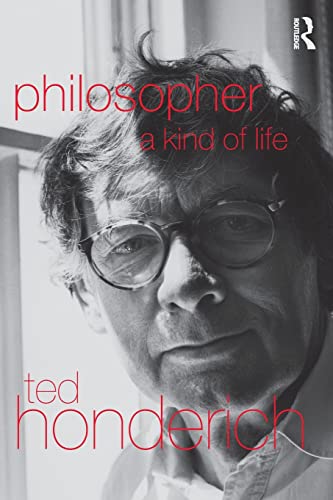
The story of Ted Honderich, philosopher, a story of a perilous philosophical life, marked by critical examination, and a compelling personal life full of human drama. This is the story of Ted Honderich's perilous progress from boyhood in Canada to the Grote Professorship of Mind and Logic at University College London, A. J. Ayer's chair. It is compelling, candid and revealing about the beginning and the goal, and everything in between: early work as a journalist on The Toronto Star, travels with Elvis Presley, arrival in Britain, loves and friendships, academic rivalries and battles, marriages and affairs, self-interest and empathy. It sets out resolutely to explain how and why it all happened.
It is as much a narrative of Ted Honderich's philosophy. He makes hard problems real. Philosophy from consciousness and determinism to political violence and democracy comes into sharp focus.
Along the way, questions keep coming up. Does the free marriage owe anything to the analytic philosophy? What are the costs of truth? Are the politics of England slowly making it an ever-better place? Is an action's rightness independent of the mixture of motives out of which it came?
"synopsis" may belong to another edition of this title.
About the Author
Prof Ted Honderich, Ted Honderich
Excerpt. © Reprinted by permission. All rights reserved.
Philosopher
A Kind of LifeBy Ted HonderichRoutledge
Copyright © 2003 Ted HonderichAll right reserved.
ISBN: 0415276314
Chapter One
THIS GREEN SUMMER
This is now a place where I am alone, a small room of recesses and bays,bright at the window. It is made calm by the green palisade of treesagainst the sky at the bottom of the gardens, a backdrop waiting for therest of the play. The room is freshly painted in its old colours, two lightand just different blues on the walls, the whiter one above the picture railunder the white ceiling. In the room there are now the things of only myown life, and only one kind of life. It is an orderly study again. A tablein the window without clutter, a brass clock on it that gets attention.Watercolours and paintings, two of them large and emotional impressionsof trees, framed by me. In place of women's radio programmes, there isquiet Bach and Mozart, or silence except for the birds. In a recess, aframed announcement recalling my inaugural lecture, `The Mind,Neuroscience, and Life-Hopes', not certain to escape the eye of a visitorrightly seated.
Up the few steps from the study and along the hallway, past theundetaining watercolours, past the empty space from which the toodetaining still-life departed with Jane, is the drawing room. I learned tocall it by that name, a little resolutely. It is large enough to have held afew dozen friends and acquaintances who trooped in once more to theChristmas drinks, perhaps some of them a little resolutely too.
Through three good windows, their slender glazing bars as wellpreserved as those of the study, the drawing room also looks out to thepalisade of trees. This room is still brighter than the study, beingsomewhat higher in the house. It has six sides, in two light and justdifferent greens, the nearly white one above. Wainscot rail reinstated invery living memory. Older urns and swales in relief on the fireplace. Oddpillars of books on the tables and on the carpet, next to the wicker setteeand chairs and the brown Victorian sofa. Flowers and candles, and somesmall brass vessels, nicely worked frowa caskets, brought back fromvisits as external examiner to the university in Ghana. Eleven smallportraits in a line around the room, some of eighteenth-century gents inruffs, several of Russian lads, the latter in memory of the Soviet UnionI was too sensible or respectable or timid to support.
I see again that the room is a bit contrived, perhaps a bit comic. Evenworse in the report of a guest of sceptical sensibility or with an eye forsocial aspiration? This does not much touch my simple pleasure in it. Inparticular, I do not follow persons of more rigorous taste who wouldexchange its decorous ease for, say, one of those white cells of the PalaisWittgenstein, those stern products of functional necessity and geometry,dutifully visited in Vienna the other week. The philosopher-architect,after arriving at the dimensions for his white shoeboxes, took moreaesthetic thought only to conceal the central heating and to determine theright height for the door handles. They look pretty high to me.
The third of my more easeful rooms is through two facing doors fromthe drawing room. It too is in accord with the principle of decorationalready noticed, owed to departed Janet: two just different yellows here.A good table and ten chairs. This dining room is heavy with morepictures, some above others, a motley but all in accord with anotherprinciple, my own. It is that the main value of art must surely have to dowith its being true of something, and so it is better when we are notleft wondering what that thing might be. Hence the reproduction of aportrait of Hume, patron saint of philosophers of my inclination, andalso, Victorian or later, the still-lifes, studies of women and landscapes,etchings on wood of lion, tiger and fox, profile of the Spanish lieutenantand so on, and portrait of the host. There are French doors to a prettybalcony. Some later Juliet could lean against that white balustrade. Anolder and wiser one might be best.
What remains to be noted in Flat B, this first-floor setting of my life,is a bedroom. One large window of sixteen panes, looking into theboughs of a great tree at the front of the house. A smaller room, twopinks, more pictures. In a section of the bookcase are the books I havewritten. Those once brave hopes, still not extinguished. They aresomewhat revived now by the growing company of their translations.There is space left for another two or three vols, including the onethat will do the trick, at last guarantee me a future. I made the solid bedtoo. It is in a new position now, against a different wall. For a time I avertmy eyes from it.
Out of the window and down below, in the garden between the houseand the street, in the shadow of the chestnut boughs, connected to thehouse by stained-glass porch and perambulator store, is something else.It is The Studio, as it says on its door, and as it is named, its definite articleintact, in five hundred letters about rent arrears and damp and keys. Anartist's studio of good size, added to the property, like the porch and pramstore, by some Victorian. Good-enough brickwork, chimney, slate roof,broad skylight over a good working space and two galleries. In it is anadversary, the socialist landlord's problem, the occupant who seized hermoment and would succeed the tenant. Does my life have an adversaryin it more often than others? Do I just make more of my ordinaryallotment of adversaries than others do? Let me look away from that fora time too.
The narrow street takes its short way down from St John's Church atthe top, cream and upstanding, to the shops and Hampstead Heath at thebottom. The street is still quiet enough, save for the morning cars. Its citedcharm has not been too much touched by garden designers and by thedetermination of new residents to floodlight their Regency stucco, forpurposes of night security as they say. Once Albion Grove, it now has aname not writ in water, Keats's. In it, when it was a village path, he wroteand lived a part of his brief life, the best part and some of the rest. Thenightingale in the garden, other odes, beauty and troth, love of Fanny, thedrop of blood on the pillow, and the parting. I pedal past his house eachmorning to the other place of my life. Down the hill through BelsizePark, Chalk Farm, Primrose Hill, Camden Town and Euston, toBloomsbury and my other room.
It too can seem closer to being my life than just a setting of it, closerto being the stuff of my life than just a principal location of it. Can therebe some sense in this, some plain truth? Some actual philosophy, someEnglish philosophy, not only fancy or feeling or French performance?
The room is one of pride and success, history, work, many lecturesand papers, fewer pleasures, argument in good temper and bad, strategiesand alliances, beginnings and endings of careers, hurt and sad drama. Themain hurt and sad drama was also a stabbing, some say. It is of a sizeowed to the good opinion that was had, by himself and others, of anearlier and larger Grote Professor of the Philosophy of Mind and Logicat University College London. A. J. Ayer, Professor Sir Alfred, Freddie,known to me in all those roles, all attacked with practised panache. Inthe first, he wrote the book Language, Truth and Logic. It inspired myretorts to teachers of my late boyhood who tried to lead me into deepthinking. Along with the decency of the Welfare State, which lingers onfar less well, and placenames, and the lure of a past, and not muchsusceptibility to the American way of life, the book brought me toEngland.
University College London, as resistant to the inclusion of a commain its name as The Studio is to the loss of its definite article, stands asfirmly and as godlessly in Gower Street as it did in 1828, when it first setout to awaken Oxford and Cambridge from their dogmatic slumbers. Itwas the original University of London. Its Corinthian portico andmeasured dome, partly paid for by the worthy Grote, welcomed atheists,Dissenters, Catholics, Utilitarians, Jews, women, and other lower orders.It was a breath of fresh air. It still is, despite being effectively a universityitself, with some thousands of students and with a good sense of itsachievements and of the worth of respectability. Such a breath wasJeremy Bentham himself, its presiding spirit and household god. Thegreat Utilitarian also had self-regard, presumably even more thanFreddie. His auto-icon, which is to say his mummified skeleton, remainswith us in a college cloister, according to his instructions. The beadlesunlock his box to tourists with moderate gravity.
My room is away from the portico and dome, on the other side of thecollege, in Gordon Square, where blue plaques recall the Bloomsburypast. In particular those Stracheys, Bells, Carringtons, Morrells andWoolfs, not quite immortal, officially committed to the pleasures ofhuman intercourse and the enjoyment of beautiful objects. The room islarge, L-shaped and suited to a worthy Victorian. It is all of the first floorof the house of the philosophers of the college, my colleagues, theDepartment of Philosophy. Six floors of Lecturers, Senior Lecturers andReaders, working their way down from the attic or up from the basementby patience and publications.
In the settled scheme of things, the room is both the Grote's own studyand teaching room and also a place for other lectures, seminars andmeetings. Thus it welcomes visiting philosophers, up from Oxford to doa turn on this metropolitan stage, or in from Berkeley to bring confidentnews of California and the future. The ring of soft armchairs and sofa,now green, has behind it rows of upright and serviceable chairs, 45 ofthem. Undergraduates or postgraduates hear about and may find themselvesin only the company of only a philosophical subject-matter.Time and space, causation, possible worlds, the Redundancy Theory ofTruth, modal logic, mind and brain, or Functionalism. Scepticism, MoralRealism, the values of art, the rationality of the free market, what it is liketo be a bat, or, once in a long while, the proprietary doctrines of Aristotle,Kant and other greats of the past. No longer, I am pleased to say, Freud'stheory of sexuality, which, after an extended appearance, slipped off thecurriculum.
The rest of life just comes to a stop for a while as various propositionsare laid out and turned over by me or by the visitors, or by my departmentalcolleagues when they book my room in the hope that their ownsmaller rooms will be insufficient for their audience. But the room haslong had another part to play in our lives as well. Here we have had ourdepartmental meetings. Occasions for the sharing out of labours, thegathering of opinions on undergraduates, and the massed interviewing ofcandidates for lectureships. Who is to join us and who not? Very seriousmatter. Here too the Headship of the department has been our unofficialor official subject. That was the hurt and the sad drama, maybe a stabbing.
In a distant corner, a personal computer and a steamer trunk. Thecomputer delivers my thoughts of yesterday back to me for furtherrevision, and also the e-mail, often from my daughter in Princeton. Myson, not having an ocean between us, preserves his independence moresternly. The steamer trunk has past in it. A thousand dated notes, manyof self-mortification or self-justification, an official complaint or two ofinjustice, histories of academic struggles and transactions, and also verymany letters, some of them sweet letters of love, desire and marriage.Safer here than in Hampstead. A small archive of the struggle.
I admit to the usual amount of interest in myself and my thinking, butam reassured that this self-interest may issue in something more general.My aim, of course, is not another autobiography. Who in my authorialsituation does not promise more? The first of my two aims is to open upa kind of life. It is to make plain a kind of life by a good means, quitepossibly the very best means. That is getting into view and telling thetruth about a suitable instance or example of the thing. My life, althoughnotable in parts, is not much more than middle-sized. I do not have thesatisfaction and misfortune of being a real individual, so impressivelyand uselessly different that to learn of me is to learn only of me.
The kind of life in question is that of a working, academic or universityphilosopher. Not real life, they say. Still, carried on quite as fullyelsewhere as in studies, lecture rooms, common rooms and committeerooms. We do not leave our natures behind in leaving our places of work.
Of course this example of the full-time professional philosopher willbe different from other examples of the kind, even greatly different,perhaps to their relief. But will it not be more enlightening as to the kind,nevertheless, than any general distillation, composite, constructedaverage member, survey, or group photo? Particularly if I really make useof my unique knowledge of the example from the inside, really try to tellthe truth? Rousseau left a lot out in his confessions, and not just the bitabout baring his bum in the street in the hope of a spanking. May I, inthis more confessional age, be different from him not only in beingmiddle-sized but by leaving less out?
My second aim is explanation. How do I and my kind get to places likethis? What explains the rest of what else needs saying of me in this greensummer — about my philosophical commitments and tendencies, my dailyround, and my inner life? They say philosophy doesn't come fromnowhere, summoned into being by pure reason and reading good books.Also, why did those non-philosophical things in the recent past happenas they did? Could it be that the philosophy and the habits in it explainmore of the rest of my life than the rest of life explains them? Out of whatprehistory did the philosophy and its habits and the rest of life come? Butperhaps this aim of explanation is too brave — even before it turns to tryingto explain itself.
I see from the philosophical quotations book of Jane and Freddie thatit was Kierkegaard, gloomy sod that he was, who said that life must beunderstood backwards, but has to be lived forwards, and so it can neverbe understood at all. No moment can have the complete stillness neededfor a real view backwards. Is it true? Or, before we get to that, there isthat old reflex question. What does it actually mean that might be true?And if we have to be content with an answer about the reach ofexplanation, the extent to which a life and a kind of life can be explained,that in itself will be to find out something.
The philosophical furniture of my mind consists in fewer pieces than arein my rooms, heavier ones. Whatever their history, and whether theystand to love, beds, rent and adversaries as effects or causes or neither,they do not seem external to me, but internal. They are not goods forsale, for example, or means of getting on in the world, helpful thoughthey have been. Do these pieces hang together themselves? They arecertainly no three-piece suite. I have had a thought or two of adding andrearranging things, if not of getting rid of any. Well, maybe even gettingrid of something.
One large item of my inner furniture is determinism, or rather one kindof thing that goes under that heavy name. I expound it to the first-yearundergraduates who drift into my college room for their GeneralIntroduction to Philosophy, Mondays at 11, the more incredulous takingthemselves to deserve the soft armchairs. We use the heavy name`determinism' in a certain way, for theories that say nothing aboutfreedom or responsibility or hopes, but leave all that to later.
What the theories do say, very roughly, is that each of the actions inour lives and also the choosing and willing of it is an effect. It is the effectof a sequence of events or states or properties, each of these also beingan effect. The sequence starts further back than any first thought orfeeling about the action, let alone the choosing or willing of it. Indeedthe sequence goes back to events that are not thoughts or feelings at all.Each effect is what it sounds like, something that had to happen. Therewas no other possibility. It wasn't just probable, to any degree. If a storyof this kind is clear enough to be true or false, and if it is true, then thereis a sense in which everything is fixed or settled in advance, all choicesand decisions and all actions, and thus a sense in which everything couldhave been predicted. All of it, if you subtract the mythology from theword, was fated.
I am the somewhat reluctant owner of such a theory, a philosophy ofmind in itself, worked out in more detail than some of my fellow workershave valued. 644 pages of detail. Some people say it is clear enough,and many say that any such thing is false — falsified by the physics ofEinstein et al. They say Quantum Theory settles the matter. Determinismis now history, quite a good piece of history since it has Spinoza, Hume,Newton and indeed Einstein himself and most of science in it, but stillhistory. The fact of the matter is that we now know there are things thathappen that are not effects. Ask any physicist.
This has been hard for me to believe, partly because the interpretationof Quantum Theory, the understanding of what it comes to in terms ofthe world, is allowed by most of its users to be a mess. Certainly it is amess, and has remained so for too long. Sometimes verbiage andenthusiasm conceals this, but not very much. What is the mathematicsor formalism of the theory about? Certainly not particles or waves ofmatter in any ordinary or plain senses of the words, as is readily admitted,even celebrated. The fundamental question of what the theory is aboutgoes without a decent answer. So another question arises. Are the thingsin the theory that are said not to be effects in fact things which wedeterminists say are effects? We only say events are effects. There arecertainly things that are irrelevant to determinism, these being non-eventsin general, starting with numbers, propositions and locations. We don'tsay 7 is an effect.
There is also some other trouble for the disprovers of determinism.Suppose, despite my sensible doubt, that we take up the commoninterpretation of Quantum Theory. Suppose there really are real eventsthat are uncaused or random, truly unpredictable events, down wherethey are supposed to be, at the physicist's micro-level of reality. They areso small as to be way below the level of ordinary things and events,including the electrochemical events in a brain that seem to go withchoices and decisions. There is a troublesome question.
Do any random events at the micro-level translate upwards into eventsat the level with which determinism is concerned, the level of the brainevents, choices, actions and so on? It is good sense to doubt it, for anexcellent reason. It is that we encounter no random events at all in theworld we experience. No planet leaves its orbit without explanation. Nobicycle tyre goes flat for no reason. No spoon ever levitates at breakfast.But then it seems that determinism may be unaffected by QuantumTheory even if the theory is interpreted in the common way. The smallevents of Quantum Theory are irrelevant.
Still, I am somewhat happier in having a view about somethingseparate from the determinism problem. This is the problem of theconsequences of determinism. If determinism is clear enough and true,what follows from it? What is its consequence or import for our lives?In my view not the heavy proposition that we are unfree. A regiment ofphilosophers has said that — or rather that if determinism were true, whichit isn't, we would be unfree. They have thought so on account of beingconvinced that freedom by definition consists in Free Will, daily miraclesof true origination, mental events somehow under our control butuncaused. The regiment is wrong.
But it doesn't seem to me either that if determinism is true, wenevertheless can still be fully free — because determinism and freedomare wholly compatible propositions. Another regiment of philosophershas cheerily said that, being convinced that freedom consists just in beingable to do what you want, which you can be even if everything is caused.It is a touch discomfiting that the blessed Hume is among them.
My own view is at least new. Professor Daniel Dennett of TuftsUniversity, agreeably doughty though he is, did not endear himself to mewhen he let the readers of his review in The Times Literary Supplementsuppose he had thought of it too. It is in part that freedom is not so simpleas either regiment supposes, a matter of a right definition, but is aboutattitudes and feelings. If determinism is true, we lose some of what wewant, but not everything. This, as you will hear later, is where the realproblem of determinism starts. It is coming to terms with things, makingthe right response. Affirmation of a kind.
My second piece of philosophical furniture is a conviction aboutminds, which is to say mainly about consciousness. The two problemshere are the nature of consciousness itself and the relation of thisconsciousness to the brain. My conviction is that conscious events, statesor properties involve what it is easier to name than analyse, a fundamentalsubjectivity. That is their essential nature. They are not anything less.This conviction about subjectivity, much more so than determinism, hasa fortifying history. It also has a majority of sympathizers amongcontemporary philosophers generally — albeit that some have beenfrightened into hiding by the brash public relations and clutter oftechnicalities on the other side.
The ideas on that other side derive partly from two things I share. Oneof these is a kind of naturalism. It is the outlook that the natural world,in some sense the physical world, is all that there is. Hence all there iscan be studied by unmysterious methods, the main ones being science,cool philosophy, good sense, and an empirical kind of literature and art.The mind, then, whatever it is, must be natural or physical and open tosuch study. The second and more particular thing I share is our newrealization of the closeness of mind and brain, of conscious and neuralevents. A demonstrated fact of psychoneural intimacy, as I was pleasedto name it, is the gift of neuroscience to philosophy. A better gift, as itseems to me, than anything from muddled physics.
From such sources has come the brash idea, of no great history, thatthe mind is the brain, that they are one thing — where this ambiguity isnot taken to mean something innocuous, but that the mind has only theproperties of the brain. Or rather, that our human minds have onlythe properties of our brains, which is to say electrochemical properties.Putting aside computers and other unlikely possessors of consciousness,consciousness is cells, those particular cells that are neurons. This ideagives a solution to the problem of the nature of consciousness that is alsoa quick solution of the problem of the mind-brain relation. The idea isin accord with naturalism all right. And it could not be more in accordwith the fact of psychoneural intimacy. Nothing could make mind andbrain more intimate than this particular way of making them identical.It is also an idea for those who are too averse to mystery, too frightenedof it, too hooked on the sweet drug of simple clarity.
This identity idea takes a number of forms. The simplest version isindeed that consciousness is cells — Eliminative Materialism. Except inAustralia and Southern California, those places of strong sunlight wherepowers of belief are evidently greater, the pill is always sweetened. Onesweetener is that despite what has just been reported, that our consciousevents are just brain events, what they really are in their essences issomething else. They are functional events, so-called. They are eventsthat function in a certain way. That is to say nothing mysterious, indeednothing more than that they are certain causes and certain effects. Theycome from input and they issue in output. This thought could have begunin, but gets out of sight of, certain truisms. One is that a good definitionof a particular desire will include, but of course not only include,something about a thing perceived, say a glass of wine, and someresulting behaviour, say an arm-movement — input and output. Thethought also owes a lot to computers, those mesmerizing converters ofinput into output.
This imperfectly consistent story of the mind, then, is that the essentialnature of our conscious events is not that they are just neural or material,although they are, but that they are things in the right causal relations.This is Functionalism boiled down or rather decluttered, which it criesout to be. Or, as you can also say, computerized philosophy of mind orcognitive science with philosophical ambition. As it has seemed to me,the coating doesn't make the pill swallowable. I think of what I had amoment ago, an uneasy feeling about my past. The idea that it had onlyneural properties isn't made better by the addition that it had causes andeffects, and these were of the essence. There was a lot more essence tothe feeling, which was its fundamental subjectivity. That is somethingeasy to say, but a lot harder to say something clear about.
To admit the great difficulty is not to give up the truth that consciousnessis other than neural properties in bare causal relations. As surely allmust know? Nor is it to give up the conviction that conscious events arein intimate relation with neural events. Psychoneural intimacy. My ownultimate working out of that is that they are in a kind of union, as a matterof necessity or law. Or, rather, two different kinds of properties of ourselvesgo together in this way. And I haven't given up naturalism. Consciousproperties in their real subjectivity must also somehow be physicalproperties, despite not being neural ones. What else could they be? Therearen't ghosts, and there aren't ghostly properties in the head either.
Continues...
Excerpted from Philosopherby Ted Honderich Copyright © 2003 by Ted Honderich. Excerpted by permission.
All rights reserved. No part of this excerpt may be reproduced or reprinted without permission in writing from the publisher.
Excerpts are provided by Dial-A-Book Inc. solely for the personal use of visitors to this web site.
"About this title" may belong to another edition of this title.
Search results for Philosopher A Kind Of Life

Stock Image
Philosopher A Kind Of Life
Seller: BooksRun, Philadelphia, PA, U.S.A.
Seller rating 5 out of 5 stars

Paperback. Condition: Very Good. It's a well-cared-for item that has seen limited use. The item may show minor signs of wear. All the text is legible, with all pages included. It may have slight markings and/or highlighting. Seller Inventory # 0415276314-11-1
Stock Image
Philosopher A Kind Of Life
Seller: ThriftBooks-Dallas, Dallas, TX, U.S.A.
Seller rating 5 out of 5 stars
Paperback. Condition: Very Good. No Jacket. May have limited writing in cover pages. Pages are unmarked. ~ ThriftBooks: Read More, Spend Less. Seller Inventory # G0415276314I4N00
Stock Image
Philosopher A Kind Of Life
Seller: WorldofBooks, Goring-By-Sea, WS, United Kingdom
Seller rating 5 out of 5 stars
Paperback. Condition: Very Good. The book has been read, but is in excellent condition. Pages are intact and not marred by notes or highlighting. The spine remains undamaged. Seller Inventory # GOR002927552
Buy Used
£ 4.56
£ 5.60 shipping
Ships from United Kingdom to U.S.A.
Ships from United Kingdom to U.S.A.
Quantity: 4 available
Stock Image
Philosopher A Kind Of Life
Seller: A Squared Books (Don Dewhirst), South Lyon, MI, U.S.A.
Seller rating 5 out of 5 stars
Paperback. Condition: Very Good. New York, 2002; illustrated paper covers; corners slightly rolled; 8vo - over 7 3/4" to 9 3/4" tall; Interior is clean and unmarked; 441 pages. Seller Inventory # SKU1134096
Seller Image
Philosopher A Kind Of Life
Seller: WeBuyBooks, Rossendale, LANCS, United Kingdom
Seller rating 5 out of 5 stars
paperback. Condition: Very Good. Most items will be dispatched the same or the next working day. A copy that has been read, but is in excellent condition. Pages are intact and not marred by notes or highlighting. The spine remains undamaged. Seller Inventory # rev1286908739
Buy Used
£ 7.15
£ 6.75 shipping
Ships from United Kingdom to U.S.A.
Ships from United Kingdom to U.S.A.
Quantity: 1 available
Stock Image
Philosopher A Kind Of Life
Seller: HALCYON BOOKS, LONDON, United Kingdom
Seller rating 5 out of 5 stars
Paperback. Condition: Very Good. NEW EU 3 EURO CHARGE FOR IMPORTS IS INCLUDED IN OUR SHIPPING PRICE. ALL ITEMS ARE DISPATCHED FROM THE UK, ALL OVERSEAS ORDERS SENT BY TRACKABLE AIR MAIL. IF YOU ARE LOCATED OUTSIDE THE UK PLEASE ASK US FOR A POSTAGE QUOTE FOR MULTI VOLUME SETS BEFORE ORDERING. Seller Inventory # mon0000826807
Buy Used
£ 5.50
£ 18 shipping
Ships from United Kingdom to U.S.A.
Ships from United Kingdom to U.S.A.
Quantity: 1 available
Stock Image
Philosopher: A Kind of Life
Seller: Mesquite Booksellers, Tucson, AZ, U.S.A.
Seller rating 5 out of 5 stars
Soft cover. Condition: As New. Softcover. x+441pp. As new condition. (If you order this from outside the United States, we are likely to request an additional payment to help cover the postage.) Every order includes tracking and is wrapped and robustly packaged with care in Tucson, AZ. ~Mesquite Booksellers. Seller Inventory # 74478
Stock Image
Philosopher A Kind Of Life
Seller: GoldBooks, Denver, CO, U.S.A.
Seller rating 5 out of 5 stars
Paperback. Condition: new. New Copy. Customer Service Guaranteed. Seller Inventory # 30F54_35_0415276314
Seller Image
Philosopher: A Kind of Life
Seller: Leura Books, Bowral, NSW, Australia
Seller rating 5 out of 5 stars
Softcover. Condition: Very Good. This is the story of Ted Honderichâs perilous progress from boyhood in Canada to the Grote Professorship of Mind and Logic at University College London, A. J. Ayerâs chair. It is compelling, candid and revealing about the beginning and the goal, and everything in between: early work as a journalist on The Toronto Star, travels with Elvis Presley, arrival in Britain, loves and friendships, academic rivalries and battles, marriages and affairs, self-interest and empathy. It sets out resolutely to explain how and why it all happened. It is as much a narrative of Ted Honderichâs philosophy. He makes hard problems real. Philosophy from consciousness and determinism to political violence and democracy comes into sharp focus. Along the way, questions keep coming up. Does the free marriage owe anything to the analytic philosophy? What are the costs of truth? Are the politics of England slowly making it an ever-better place? Is an actionâs rightness independent of the mixture of motives out of which it came? Philosopher sets brave new standards for the telling of a life. It is not filtered, veiled or varnished. It contains desire, hurt and drama. 441 pages. Inscription to previous owner on inside cover. Quantity Available: 1. Shipped Weight: Under 1 kilo. Category: Autobiography; Biography & Autobiography; Philosophy. ISBN: 0415276314. ISBN/EAN: 9780415276313. Inventory No: 279620. Seller Inventory # 279620
Seller Image
Philosopher : A Kind of Life
Seller: GreatBookPrices, Columbia, MD, U.S.A.
Seller rating 5 out of 5 stars
Condition: As New. Unread book in perfect condition. Seller Inventory # 1406289