
Items related to The Myth of Rescue: Why the Democracies Could Not Have...
Synopsis
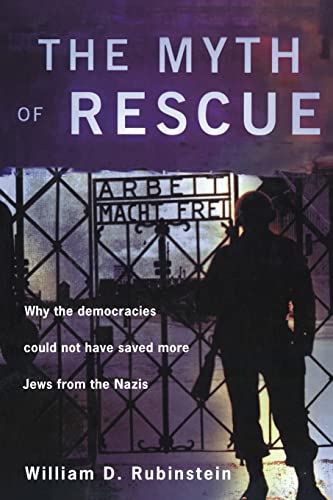
In this controversial book the author challenges the convention that the allies did little or nothing to rescue Europes Jews. The author responds to the controversy caused by his views in a new introduction to this edition.
"synopsis" may belong to another edition of this title.
About the Author
William D.Rubinstein
Excerpt. © Reprinted by permission. All rights reserved.
The Myth of Rescue
Why the Democracies Could Not Have Saved More Jews from the NazisBy William D. RubinsteinRoutledge
Copyright © 1999 William D. RubinsteinAll right reserved.
ISBN: 0415212499
Chapter One
THE HISTORIOGRAPHY OF RESCUE
There can be few subjects in the whole range of modern history on whichcontemporary opinion differed so sharply from the views of laterhistorians and authors than the topic of the rescue of Jews by thedemocracies during the Nazi Holocaust. During the Second World War, Jews(and non-Jewish anti-Nazis) looked upon the celebrated leaders of thegreat democracies at war with Nazi Germany--Winston Churchill and FranklinD. Roosevelt--as the heads of the armies of liberation which would freethe whole world, and the Jewish people in particular, from the Naziscourge. In December 1944, Joseph Hertz, the British Chief Rabbi, issued abirthday message to Winston Churchill which read:
But for your wisdom and courage there would have been a Vichy England lying prostrate before an all-powerful Satanism that spelled slavery to the western peoples, death to Israel, and night to the sacred heritage of man. May Heaven grant you many more years of brilliant leadership in the rebuilding of a ruined world.
American Jews constituted `the most loyal and loving' of Franklin D.Roosevelt's constituencies; to American anti-semites, Roosevelt's policieswere so philosemitic and influenced by `Jewish power' as to constitute the`Jew Deal'. A Jewish Republican Congressman of the 1930s, Jonah J.Goldstein, concluded that `the Jews have three velten [worlds]: die velt[this world], yene velt [the next world], and Roosevelt'. Yet recentlymuch has changed. Commenting upon `the strange turn in the attitude ofAmerican Jews towards Franklin D. Roosevelt in the recent past', thefamous historian Arthur M. Schlesinger Jr noted that:
For a long time [Roosevelt] was a hero. No president had appointed so many Jews to public office. No president had surrounded himself with so many Jewish advisers. No president had condemned anti-Semitism with such eloquence and persistence. Jews were mostly liberals in those faraway days, and a vast majority voted four times for FDR.
This great and profound change in the perception of the Allies andtheir leaders arose fairly abruptly between the late 1960s and themid-1980s, wholly as a result of a near-universal perception that theAllies did virtually nothing to rescue Europe's Jews during the Holocaust.By the late 1980s, every examination of the Allied response to theHolocaust was compelled to take into account the belief, by then virtuallyuniversal, that the democracies `did nothing' during Hitler's `FinalSolution', and were--to many--guilty of being virtual accomplices in theHolocaust. The list of alleged Allied failures is long, ranging fromclosing their doors to Jewish refugee emigration prior to and during theHolocaust, forestalling the creation of a Jewish state in Palestine whenthis was most necessary as a place of refuge, failing to bomb Auschwitz orany other death camp, failing to engage in negotiations with the Naziswith the aim of bartering for Jewish life and failing, until early 1944,to create any specialised government agency to save Jewish lives,oblivious to the fact that Hitler was engaged in a `war against the Jews'.The alleged reasons for these failings were also manifold, includingstrong and pervasive anti-semitism and anti-Zionism among both theAmerican and British opinion-makers and masses, ignorance of Naziintentions, bureaucratic inertia and an inability to internalise theunbelievable horrors of the Holocaust during the war itself. As well, itis widely suggested that the Jewish communities of the democracies were,by later standards, extraordinarily supine during Jewry's hour of greatestneed, deeply divided and afraid to become overly visible or demonstrativeduring a world war.
These are seemingly powerful arguments, repeatedly reiterated by experthistorians and by now entrenched in the popular imagination. Yet all ofthese arguments in my opinion are wrong and lacking in merit; the rest ofthis work will show why they are grossly misleading and inaccurate. It isfirst worth examining how the historiography of rescue emerged, in itscontemporary form, and how the Jewish and anti-Nazi view of Churchill andRoosevelt as supreme heroes and liberators changed so radically.
For the first twenty years or so after the end of the Second World War,probably no historical work on the Holocaust criticised the actions of theAllies or suggested that much more could have been done which was notdone. All of these early works on the Holocaust, not surprisingly,focused upon the guilt of the Nazis and their allies. Perhaps the firstconsidered work to attack the Allies for their failures in rescuing Jewswas a little-noted article by Reuben Ainsztein, a Holocaust survivor whowas well known as a historian of Jewish revolt in the ghettos andconcentration camps, entitled `How Many More Could Have Been Saved?'Ainsztein's article, which appeared in the British periodical JewishQuarterly in 1967, contained a surprisingly large component of thecritique of Allied policy which has since become standard, years beforeother historians made the same point. For instance, it offered an accurateexamination of when news of the `Final Solution' first became known in theWest, more than a decade before this question was examined in detail byother historians. Ainsztein's claim (p. 17) that
the racist and antisemitic elements in the United States, allied with the still powerful isolationist forces, were strong enough even in 1943 to provide President Roosevelt and his State Department with excuses for not doing anything that might be interpreted as making the rescue of Jews one of America's war aims
has been echoed in dozens of subsequent examinations of this question. Yetit must also be said that, remarkably early, Ainsztein managed to makevirtually every historical and logical error one could possibly make inexamining this question, including the fons et origio mali, the convictionthat the limited number of refugees accepted by the United States afterthe war began was due to its restrictive immigration laws, rather than tothe fact that Hitler prevented these Jews from emigrating, prior togenocide. Perhaps only the alleged failure to bomb Auschwitz--notmentioned by Ainsztein--is absent from the now-standard bill ofindictment.
Ainsztein's unnoticed article appeared shortly before the first booksto take the failure of the Allies as their themes: Arthur Morse's WhileSix Million Died: A Chronicle of American Apathy (New York, 1968) andDavid S. Wyman's Paper Walls: America and the Refugee Crisis, 1938--1941(Boston, 1968). The 1970s saw yet more books on this theme, among them thebalanced and scholarly monograph by Henry L. Feingold, The Politics ofRescue: The Roosevelt Administration and the Holocaust, 1938--1945 (NewBrunswick, NJ, 1970), a work which is, nonetheless, critical of Americanpolicy and already aware of the new, negative interpretation of thistopic, and also such works as Saul Friedman's No Haven For the Oppressed:United States Policy Toward Jewish Refugees, 1938--1945 (Detroit, 1973)and Herbert Druks' The Failure to Rescue (New York, 1977), whose titlesaccurately indicate their perspective.
In the late 1970s and early 1980s there appeared the writings whichprobably had the most significant impact upon the notion that the Alliesfailed to rescue Jews during the Holocaust. They were by David S. Wyman, anon-Jewish historian at the University of Massachusetts--Amherst. In `WhyAuschwitz Was Never Bombed', published in the influential and widely readAmerican Jewish monthly Commentary in May 1978, Wyman did two significantthings: he almost single-handedly originated the notion that the Alliescould have easily bombed and destroyed the Auschwitz extermination camp in1944 but, for a variety of thoroughly inadequate reasons, chose not to doso; and he made the alleged Allied failure to bomb Auschwitz intoIndictment Number One in the list of American and British failures duringthe Holocaust. Dramatic and easy for non-historians to comprehend, thebombing of Auschwitz quickly seized the imagination of Jews and non-Jewsalike, just at the time when the Holocaust was becoming accepted by almosteveryone of good will as perhaps the lowest point ever touched by thehuman race, as incomprehensible as it was evil, and at a time when theHolocaust came virtually to dominate contemporary Jewish thought.
Six years later, in 1984, Wyman published his considered work onalleged American failure during the Holocaust, The Abandonment of theJews: America and the Holocaust, 1941--1945 (New York, 1984), offering adetailed account of America's manifold failings during the `FinalSolution', superficially as disturbing as it was convincing. The villainof the book was clearly President Franklin D. Roosevelt, and some of itspopularity was obviously due to its seemingly persuasive evidence that theformer god of American liberalism and of the American Jewish communityhad--to say the least--feet of clay. Wyman also accepted the notion thatRevisionist Zionists, Strictly Orthodox Jews and other `outsiders' withinthe American Jewish community offered realistic and radical plans for therescue of Europe's Jews which were rejected by the conservative andunctuous American Jewish `Establishment'. He repeated, with more details,his suggestion that Auschwitz could successfully have been bombed by theAmerican military in 1944, and offered a seemingly considered and detailedlist of points of `what might have been done'. His book--taken inconjunction with the others which appeared at around the same time-- hasbeen tremendously influential, greatly shaping our interpretation ofAllied action and inaction during the Holocaust.
On every significant point he makes, it is my considered opinion thatWyman is not merely wrong, but egregiously and ahistorically inaccurate:in a sense, this book is a response to Wyman's work, although it alsocovers areas such as Britain's role in rescue, not discussed in TheAbandonment of the Jews. Wyman's book strikes me as wrong-headed in threeseparate ways, apart from any matter of specific detail. First, theevidence Wyman amasses, when interpreted correctly, in virtually everycase goes to show the precise opposite of the interpretation he placesupon it. The reason for this consistent inaccuracy is that the situationfacing European Jewry after the war began is virtually the opposite ofthat which underlies his interpretation: the Jews of Nazi-occupied Europewere prisoners, not refugees--the prisoners of a psychopath who was goingto kill all of them if he could. Second, many of Wyman's suggestions as towhat might have been done to rescue Jews were simply not proposed byanyone at the time. In this work, we will consider in detail the ways torescue Jews that were actually proposed in the democracies, and it willbecome consistently plain that these proposals were futile and useless.Third, Wyman seems in the final analysis to understand this perfectlywell. He therefore argues that even schemes whose success was unlikely`should have been tried ... If that had been done, even if few or no liveshad been saved, the moral obligation would have been fulfilled', mindlessof the fact that no government, in wartime, will direct scarce andvaluable resources from successfully pursuing a war of liberation intoprojects whose success was dubious. He is also heedless of the fact thatmost of his proposals which `should have been tried' were not proposed atthe time.
Wyman's work, together with the previous body of scholarship in thisfield and the increasing visibility of this question, themselves generatedfurther books and articles with remarkably similar themes and premises:Monty N. Penkower's The Jews Were Expendable: Free World Diplomacy andthe Holocaust (Chicago, 1983), and his `In Dramatic Dissent: The BergsonBoys' (American Jewish History, 69, 1981); Haskel Lookstein's, Were We OurBrothers' Keepers? The Public Response of American Jews to the Holocaust,1938--1944 (New York, 1985); and Aaron Berman's Nazism, the Jews andAmerican Zionism, 1933--1948 (Detroit, 1990), as well as a spate ofsimilar works on Britain and the Commonwealth.
The notion that American Jewry `did nothing' during the Holocaust,acquiescing in the mass murder of their kinsmen in Europe, becamesomething of an obsession among many American Jews at this time. AmericanJews contrasted the ever-vigorous, ever-vigilant and often highlysuccessful activities in Washington, DC of the legendary post-war `Jewishlobby' over such issues as American support for the State of Israel, withthe complete lack of success of American Jewry in deterring the NaziHolocaust, and -- with the evidence apparently provided by such works asthose by Wyman--drew the understandable but completely erroneousconclusion that it was the American Jewish community and the Rooseveltadministration which had failed European Jewry in their hour of greatestneed, rather than the more accurate inference that stopping Hitler'sgenocide was impossible without destroying Nazi Germany. There werecurious manifestations of this conviction, such as the so-called `GoldbergReport' of 1984, an attempt by a commission of American Jewish politiciansand academics, headed by former Supreme Court Justice Arthur Goldberg, toaddress the question of `why were so many American Jews passive orrelatively unconcerned about the plight of European Jews?' (thusprejudging the very question the commission was presumably supposed toexamine), which arrived at the conclusion that, in effect, if AmericanJewry had acted in the 1940s as its progeny acted in the 1980s, more Jewscould have been saved a dubious finding on several grounds. The `GoldbergReport' includes statements endorsing its findings by several Jewishpoliticians of the day, including New York City Comptroller Harrison J.Goldin and Brooklyn District Attorney Elizabeth Holtzman, surely the firstoccasion since the death of Stalin when a controversial historicalinterpretation was deemed to be true because some political office-holderssaid it was true. A number of renowned historians of the Holocaust such asYehuda Bauer and Lucy S. Dawidowicz pointedly declined to join the`Goldberg Commission'; both Bauer and Dawidowicz wrote scathingly of thiscommission and its findings.
The thesis that America and American Jewry `did nothing' during theHolocaust has since been further expounded in a variety of other media forums,including a 1994 American Public Broadcasting System documentary, Americaand the Holocaust: Deceit and Deception, and a `public trial' held inJerusalem in 1990: `Why Auschwitz Was Not Bombed.' Many Holocaust museums,including the US Holocaust Memorial Museum in Washington, DC, containexhibits or publications on this subject. Most recent histories andgeneral accounts of the Holocaust now contain a chapter on the passivityand indifference (if not far worse) of the `bystanders' who knew what wasgoing on but chose to `do nothing'. To cite one very typical example, theexcellent work by Michael R. Marrus on the historical questions raised bythe Holocaust and discussed by historians, The Holocaust in History,contains a section on the `Bystanders' (pp. 157-83) which, while clearlynoting that `to many it will ... seem that these exercises are profoundlyunhistorical', nevertheless concludes that `clearly more could have beendone--by Jews as well as by non-Jews'.
As well, beyond Wyman and his school there has emerged since the 1980sa semi-scholarly, semi-popular group of writings which accuse America andthe Western Allies of complicity in carrying out the Holocaust, assigningthem a share in the guilt which seems to exceed that of the Nazisthemselves. It often seems that some of these authors would frankly havebeen happier if the bullet-proof glass cage in Jerusalem in 1961 had notheld Adolf Eichmann, but Winston Churchill or (if he were still alive)Franklin D. Roosevelt. In 1989 William Perl, an Austrian refugee who holdsa doctorate in law from the University of Vienna, published The HolocaustConspiracy: An International Policy of Genocide (Shapolsky Publishers, NewYork, 1989), whose aim, according to the book's dust-jacket, is to show
that it was not apathetic inaction of the world's powers which made the Holocaust... so tragically effective ... [but] deliberate action on the part of many nations [i.e., the Western Allies] that kept millions of those destined for murder, prisoners in a hostile Europe. Those deliberate actions are conclusively shown to result from conspiracies within individual governments as well as between governments.
The tenor of this work may be gauged by the author's reference (p. 80) toAnthony Eden as `a Jew-hater'--this of a man who, next to Churchill, wasthe foremost opponent of Appeasement during the 1930s; the man whoofficially announced on behalf of the British Government in the House ofCommons that the Holocaust was taking place; in 1956 a military ally ofIsrael.
Two years before, in 1987, Shapolsky Publishers had also producedRafael Medoff's The Deafening Silence: American Jewish Leaders and theHolocaust. This is, in some respects, a valuable and well-researchedwork, but one whose basic thesis is quite untenable: that American Jewry'smainstream leaders deliberately failed to assist European Jewry during theHolocaust (often, according to Medoff, lobbying against changes whichmight have aided Europe's Jews), because of their `immigrant psychology'and their fear of `lifting the lid off a simmering American anti-Jewishbacklash'. Not surprisingly, Medoff's heroes are Peter Bergson and hisZionist Revisionist group. (Bergson and his group had no practical plansof any kind to rescue Europe's Jews, as will become clear in Chapter 3 ofthis work.) What is the bottom line of Medoff's work? What should AmericanJewry have done? Needless to say, Medoff is here at his absolute weakest,and his answer to this most fundamental of questions is ludicrouslyinadequate. Medoff compares American Jewry's allegedly inadequatepolitical response with that of American blacks during the war in 1943-4,whose pressures on Roosevelt led to an Executive Order banningdiscrimination in government defence industries, and with Polish-Americanlobbying groups which `skilfully' influenced Roosevelt's `policy towardPoland at the same time'. Ignoring the fact that Jim Crow continued inAmerica for another twenty years, and that Poland fell into the hands ofthe Communists (because, it is often suggested, of Roosevelt's ineptperformance at Yalta), Medoff never addresses the question of whatAmerican Jewry should have lobbied Roosevelt to do, or how anythingRoosevelt could realistically have done in 1943-4--apart from win the warmore quickly--could have saved Europe's Jews.
Another source of extremist claims about the guilt of the Allies and ofthe Jewish communities of the democracies is the Strictly Orthodox worldin the United States. David Kranzler's Thy Brother's Blood: The OrthodoxJewish Response During the Holocaust (published by Mesorah Publicationsin Brooklyn, New York, in 1987), has as its theme the claim that OrthodoxJews `demanded action now, to correspond virtually minute-by-minute withthe deepening mire in Europe'. Thy Brother's Blood opens with a lengthydenunciation of Jewish `secularists', secular Zionists and`assimilationists', and continues with a long account of the role ofStrictly Orthodox leaders (according to the author) in effecting rescue.There is, superficially, a case to be made: Rabbi Michael Dov BerWeissmandel of Slovakia, praised throughout the book, was probably thefirst person to call for Allied bombing of the Kosice-Preskov railway lineleading to Auschwitz in order to prevent the deportation of HungarianJewry, and Strictly Orthodox Jews used mainly unofficial means, especiallybribery, to save lives where they could. Their story should, certainly, betold. Still more, however, it should be told accurately, and it wasregrettably the case that Strictly Orthodox Jews probably perished ingreater numbers during the Holocaust than adherents of any other Jewishideology. Their leaders could no more protect them from Hitler's genocidethan could the Zionists, assimilationists and secularists whom Kranzlerdenounces. The Strictly Orthodox specialist presses in the United Stateshave produced a steady stream of similar works, whose aim is to show thatthe Strictly Orthodox effected rescue more vigorously than other Jews, andmore successfully. Both claims--alas--are simply untrue.
Many historians have been deeply disturbed by these extreme tendencies,even historians who accept that in some respects the Allied governmentsdid little or nothing. Yehuda Bauer has made the point that:
The wrath and frustration of the Jewish people finally turned against itself. Ever since the Holocaust, an increasing number of books and articles have accused the Jewish wartime leadership of failing to rescue, of negotiating with the enemy, of pandering to hostile `Allies.' The Nazis murdered the Jews--everyone knows that. The Allies did little to help. But who was really responsible? In accordance with `good' Jewish tradition, many Jewish historians, writers, and journalists blamed Chaim Weizmann, Stephen Wise, David Ben-Gurion, Nahum Goldmann, Yitzhak Grunbaum, Moshe Shertok, and all the rest of the Jews who tried to rescue their fellows. They were responsible because they had failed. This suicidal tendency in historiography is typical of a frustrated public refusing to recognize its essential helplessness in the face of overwhelming force. This tendency is especially pronounced because the situation has changed since the war with the establishment of the State of Israel; now, paradoxically, a much smaller number of Jews wield more, though still not very impressive, power, just like so many other small nations or peoples. Why did Joel Brand fail? We can almost hear the argument that the Israeli Air Force should have dropped him behind German lines. Anachronistic solutions are offered to the problem of rescuing millions of people being murdered by an implacable enemy.
Because of the untenability of the charges levelled against the Allies,and notwithstanding either the ubiquity of the notion that the Allies `didnothing' or the growth of an extremist fringe which virtually lumpstogether the Allies and the Jewish communities of the democracies with theNazis, it is probably also fair to say that, during the past fifteen yearsor so, something of a reaction to the extreme views of Allied guilt,voiced by Wyman and others, has taken place. Some of this research hasbuilt upon an older tradition, dating from the 1970s, of scholarshipwhich emphasised the positive aspects of Allied efforts on behalf ofEurope's Jews. This reaction has been limited among academics and scholarsto a number of particular facets of the Allied response, and exclusivelyto the American rather than the British reaction to the Holocaust.
Four areas might be noted where recent historians have offered a morefavourable view of the Allied response. The alleged supineness andinaction of the American Jewish community has been much more realisticallycontextualised by historians like Yehuda Bauer and Henry L. Feingold, whoargue that the constraints of the American political system during the1930s and 1940s, prior to the legitimacy of ethnic groups lobbying ontheir own behalf, severely limited the response of both the Rooseveltadministration and the Jewish community, making impossible the kind ofbold action which American Jewry would surely have undertaken a generationlater. This view is especially associated with Professor Feingold,probably the most eminent historian of the recent American Jewishcommunity, in works like The Politics of Rescue: The RooseveltAdministration and the Holocaust, 1938--1945 (New Brunswick, NJ, 1970),his contribution to a magisterial five-volume history of American Jewry, ATime For Searching: Entering the Mainstream, 1920--1945 (Baltimore, 1992),and especially in a recent book of his essays, Bearing Witness: HowAmerica and Its Jews Responded to the Holocaust (Syracuse, NY, 1995). Itwill be seen from the relevant chapters in the present book thatFeingold's viewpoint, although much more reasonable than those who claimthat American Jewry `did nothing' is, in my opinion, also inaccurate, andit differs essentially from the argument of this work. American Jewryproduced committee after committee and plan after plan to rescue the Jewsof Nazi-occupied Europe; they had a surprising degree of immediate accessto the President and to congressmen and government officials. What theylacked, alas, was a plan which could actually rescue the Jews ofNazi-occupied Europe, the millions who were prisoners of a murderouslunatic and who were unreachable by any means. Professor Yehuda Bauer'sAmerican Jewry and the Holocaust (Detroit, 1981), a detailed account ofthe activities of the American Jewish Joint Distribution Committee (aleading relief body, founded in 1914, which had long been involved inefforts to ameliorate the conditions of oppressed Jewry) during theHolocaust, emphasised its many-faceted efforts on behalf of EuropeanJewry, stymied not by any lack of will but by the relentless nature ofNazi genocide. Bauer's positive view of American rescue efforts hascarried over to other writings on this subject, for instance his A Historyof the Holocaust (New York, 1982).
The second area where the notion of American indifference has beenusefully challenged is in the debate about the failure to bomb Auschwitz.The alleged failure by the Allies to destroy that extermination camp in1944, despite the fact that (it is often suggested) this was bothlogistically possible and widely urged, is perhaps the best-known singlecomponent of David Wyman's critique of American policy during the war, andis likely to be known--and accepted--by lay persons with little or nospecialist knowledge of this field. Yet, despite the ubiquity with whichthis criticism is voiced, recent analysis by expert military historians,vastly better informed about the technical aspects of this question thanProfessor Wyman, have emphasised the near-impossibility of a successfulAmerican bombing raid on Auschwitz in 1944. This expert revisionistopinion has been put most cogently by Dr James H. Kitchens III, anArchivist of the United States Air Force Historical Research Centre, in a1994 article in The Journal of Military History and in articles by him andby Dr Richard H. Levy, a nuclear engineer who has closely researched thistopic, in FDR and the Holocaust (Newton, ed.). There can simply be no doubtthat the criticisms raised by Kitchens, Levy and others have underminedthe case made by Wyman that the bombing of Auschwitz was a realisticpossibility in 1944; there are also a host of other reasons, which Iexamine in Chapter 4, why recent criticism of the Allied `failure' to bombAuschwitz is profoundly unrealistic and ahistorical.
Yet--as with so much about this topic--acceptance of the morefavourable view is a painfully slow uphill struggle, even among historianswho do not engage in a general indictment of the Allies. For instance,Professor Feingold, in his 1995 book of essays Bearing Witness, reprintedhis 1979 article `Who Shall Bear Guilt for the Holocaust?' which containsthe statement, unaltered since its original appearance, that `An articlein Commentary by Professor David Wyman and another by Roger M. Williams inCommonweal demonstrate beyond doubt that, by the spring of 1944, thebombing of Auschwitz was feasible'. (In light of the research by Kitchensand others, this statement is simply untrue, especially if made in thebald form of Feingold's wording.) That the Allies could have bombedAuschwitz if they wished, and that this action could have certainly savedthe lives of thousands of Jews, has by now been disseminated in everyconceivable medium--books and articles, television documentaries, museumexhibits, academic and non-academic lectures--and it will probably takedecades before this piece of folk disinformation loses its popular hold.
Some recent research has also looked more positively at Americanrefugee policy before the war, a subject which had hitherto receivedcomparatively little revisionist attention. The most useful correctivework here has been Richard Breitman and Alan Kraut's American RefugeePolicy and European Jewry, 1933--1945 (Bloomington, Ind., 1987), a verydetailed examination of the actual operation of America's policies towardsGerman Jewish refugees, especially prior to the war. Yet it seemsindisputable that the pre-war phase of this question has not received thesearching, critical examination which it obviously needs; for this reason,The Myth of Rescue opens with an account of international refugee policytowards Germany's Jews during the 1930s which will show that, far frombeing restrictive and harsh, it was one of the more liberal, generous and,most of all, successful attempts to rescue oppressed refugees in modernhistory.
The fourth area of critical scholarly attention has been an analysis ofthe various attempts at `ransoming' Jews (the so-called`blood-for-trucks' deal, proposed by Eichmann in 1944, being thebest-known) apparently advanced by senior Nazis, especially HeinrichHimmler, in the closing phases of the war, although possibly suggested aswell on a smaller scale before that, for instance in Slovakia in 1942-4.Historians have been sharply divided between those who view `ransom' as agenuine lost opportunity and those who believe that these proposals werethoroughly disingenuous. Recently, Yehuda Bauer's Jews For Sale?:Nazi-Jewish Negotiations, 1933-1945 has examined these proposals indetail. While Professor Bauer apparently believes that the Nazis were inpart sincere in their offers, he is forced to admit that such proposalscould not have succeeded; nevertheless, many Jews (and non-Jews) deservecredit for attempting to `ransom' Jews and succeeding on a limited scale.In this work, I offer an original but fundamental reason for believingthat no significant attempts at `ransom' could possibly have succeeded.
All these revisionist views, it should be carefully noted, are partialand specific: historians have argued that one or another aspect of rescuewas impossible (or very difficult), in contrast to Wyman and others whoargue that America did little or nothing, too little and too late. Evensomeone like Professor Feingold has claimed that `tens of thousands' ofJews who perished in the Holocaust could have been saved by more directAllied action (Wyman puts the figure at 200,000 or more). So far as I amaware, no historian has argued--as I do here--that American efforts atrescue during the Holocaust were ipso facto impossible, given the Nazipolicy of genocide and what was actually proposed at the time. Perhaps thetwo historians who most closely approach the interpretation offered inthis book are Frank W. Brecher and Lucy S. Dawidowicz. Brecher's article`David Wyman and the Historiography of America's Response to theHolocaust: Counter-Considerations' is an important critique of Wyman'sviews, emphasising the lack of `factual evidence' and the `dubiousvalidity' for many of his attacks on American Jewry, in some key respectsparalleling the points made in this book. Nevertheless, it is farnarrower, failing to discuss (for instance) the question of bombingAuschwitz or British rescue efforts, and apparently accepting that `thedifficult problem of finding ... suitable places of refuge' for the Jewsof Hungary and elsewhere was an important factor in the failure of theAllies to rescue Jews, rather than a non sequitur.
The historian whose viewpoint perhaps came closest to that advancedhere was the late Lucy S. Dawidowicz, whose essays on the possibility ofrescue by America during the Holocaust (collected in her posthumousanthology What Is The Use of Jewish History?) are models of sanity andclarity. Unlike most American historians of the Holocaust, Dawidowicz hadactually lived among eastern European Jewry, spending a year at the famousYIVO Institute in Vilna as a young woman in 1938-9 just as Hitler wasabout to strike; her 1989 account of these experiences, From that Time andPlace, is as valuable as it is moving. For Dawidowicz, the Second WorldWar was literally Hitler's `war against the Jews', its traditionalterritorial and strategic dimensions secondary to the Fuhrer's central aimto rid Europe of Jewry. The Nazis bore complete responsibility forplanning and executing the Holocaust; Hitler was bent on exterminatingEuropean Jewry and could not be moved from his goal by any means; the onlyrole of America (and the other Western Allies) in the Holocaust was toliberate Europe from the Nazi scourge.
These conclusions seem self-evident and unarguable; as with so manyunarguable truths, however, many intelligent people refuse to believethem. It was Lucy Dawidowicz's gift to see the facts of the matterclearly. Nevertheless, in this work I would go much further even than shedid: I disagree with her on many secondary points and also about thepossible role of a Jewish state, if it had existed during the war, insaving European Jews.
The evolution of recent British historiography on the question ofrescue during the Holocaust has exhibited all the worst features ofAmerican writing on this subject, with little in the way of a dissentingview. The British pattern of negative commentary was set in 1979 byBernard Wasserstein, in his Britain and the Jews of Europe (Oxford, 1979),the first work to use newly declassified Foreign Office and othergovernment documents. Wasserstein found what he took to be a persistentpattern of British government reluctance--often obstruction to allow moreGerman Jewish refugees to flee to British territory, especially, ofcourse, Palestine. Most of his evidence--necessarily--related to the firsttwo years of the war, before the Nazi policy of genocide had begun (or wasknown in the West); from that time it was virtually impossible to flee,and the British always accepted fleeing Jewish refugees, offering themsafety in a territory outside the reach of the Nazi death machine, if notin Palestine. Many of Wasserstein's examples date from the period 1940-1,when Britain rightly feared that a Nazi invasion was imminent, and normalBritish standards of liberalism and tolerance--for instance, towardsinterned refugees--temporarily disappeared. By focusing on this period (inparticular) Wasserstein enhanced the sense that Britain's refugee policywas hallmarked by rigid obstructionism, if not anti-semitism, diminishingits generous record in the settlement of refugees before the war(especially after Kristallnacht) and the extraordinary degree ofsensitivity towards Jewish suffering shown by Britain's elites during thewar. As in so many other accounts of rescue during the Holocaust,Wasserstein assumes that many more Jews could have been rescued and thatthe failure to rescue was caused by high entry barriers put up by Britainand the democracies, rather than by insurmountable exit barriers erected,after mid-1940, by Nazi Germany.
Wasserstein's book predated the growth of a powerful school in recentAnglo-Jewish historiography which views Britain as an illiberal society,Anglo-Jewish history as marked by high levels of intolerance andanti-semitism and the typical response of the British Jewish community asone of supine acquiescence in its subordinate role. This school of youngerAnglo-Jewish historians thus differed almost totally from the prevalentopinion of the previous generation, for whom Britain was a liberal societypar excellence and the course of Anglo-Jewish history an archetypalexample of Whig progress towards universal toleration. To this school, theattitude of both British society as a whole and the Anglo-Jewish communityduring the Holocaust is ripe for reevaluation. The younger school has beenunsparingly critical of both, perhaps more critical than critics ofAmerican policy during the Holocaust. Possibly the most extreme work onthis subject is Richard Bolchover's British Jewry and the Holocaust(Cambridge, 1993), which contrasts `the politics of fear' of the Jewishmainstream, the `assimilationists' of the Board of Deputies of BritishJews and the mainstream Zionist movement with `the exceptions'--defined byBolchover as `socialists, Strictly Orthodox Jews, academics, andRevisionist Zionists', whose active and positive plans to rescue EuropeanJewry were thwarted by the Jewish mainstream. (The parallels of this tomuch recent American writing on the American Jewish community during theHolocaust is, of course, clear.) Strangely, however, Bolchover neglects tostate what these plans for rescue by the `exceptions' actually comprised.In Chapter 3 we will explore their plans in some detail, reaching theinescapable conclusion that the plans were totally without merit andincapable of rescuing anyone; we shall also find that their plans werevirtually identical with those offered by the Anglo-Jewish mainstream.
Bolchover's view of the reaction of both Britain and of Anglo-Jewry tothe Holocaust is closely reflected in such works as Geoffrey Alderman'sModern British Jewry (Oxford, 1992), and, less directly, in the variouswritings on this topic by Tony Kushner, such as The Holocaust and theLiberal Imagination (Oxford, 1994). Alderman's work, though deeply learnedand often incisive, may be read as an extended attack upon the Board ofDeputies of British Jews and the United Synagogue, the two pillars of theAnglo-Jewish mainstream. According to Alderman `on the most delicate[sic] question of possible attempts by the allies to halt the planneddestruction of European Jewry, British Jewry was decidedly ambivalent',claiming that `by 1944 Auschwitz and other death camps were within easyrange of allied bomber aircraft ... [yet] no pressure of any significancewas ever exerted upon the British government on this question'. Thisstatement, typical of Alderman's discussion, is deeply misleading, as willbe seen in Chapter 4. Kushner's essays, though more balanced and nuanced,compare Britain adversely with America, praising the creation of theAmerican War Refugee Board in contrast with British inaction. Britain'stradition of `liberalism' made it unable to comprehend the necessity tocreate bodies to respond to the `particularistic' needs of oppressedJewry.
There has been very little in the way of an opposing opinion,especially in the recent past. In the first years after the war, a numberof books appeared, such as Norman Bentwich's The Rescue and Achievement ofRefugee Scholars (The Hague, 1953) and his They Found Refuge (London,1956), dealing sympathetically with British efforts at admitting GermanJewish refugees during the 1930s. The essential scholarly work on thisquestion, A.J. Sherman's Island Refuge: Britain and Refugees From theThird Reich (Berkeley, 1973), presents a largely favourable view of thissubject, while many other accounts of German Jewish migration to Britainare probably more favourable than their American equivalents. For the waritself, Martin Gilbert's well-known Auschwitz and the Allies (London,1981), often seen as highly critical of the Allies' failure to bombAuschwitz (and regularly cited by historians for that purpose) is actuallya sympathetic and well-balanced explanation of the reasons why the Allies`did nothing', as befits Churchill's official biographer. New evidence(presented in Chapter 4 of this work), available since Gilbert wrote,makes clear the insurmountable technical difficulties inherent in any planto bomb Auschwitz, even in 1944. Gilbert's book has probably been ascentral to the debate on this question in Britain as have Wyman's writingsin America, albeit in a way which has misconstrued the author's aim. Myrecent book, A History of the Jews in The English-Speaking World: GreatBritain (London, 1996) contains a chapter entitled `Anglo-Jewry and theHolocaust' which augments the arguments made in the present work.
Elsewhere in the English-speaking democracies the picture is mixed.Scholarship on Canada--most notably Irving Abella and Harold Troper's Noneis Too Many (Toronto, 1982) is unrelievedly negative. In Australia,however, a lively debate has emerged about the generosity of Australianrefugee policy. (Obviously, neither country could possibly have had theslightest direct effect upon Nazi policy as such.) Recent Israelischolarship available in English has been marked by an unusual degree ofintelligence, especially two fine works, Dalia Ofer's Escaping theHolocaust: Illegal Immigration to the Land of Israel, 1939-1944 (Oxford,1990) and Dina Porat's The Blue and Yellow Stars of David (London, 1992).Both works show that, beyond doubt, the failure of the Yishuv to `do more'was chiefly if not entirely due to the impossibility of rescuing Jews fromNazi-occupied Europe, and not to any lack of intention.
The Myth of Rescue differs from all previous works on this subject inthat it rejects as impossible any further rescue efforts on behalf ofEurope's Jews entailing more than the most minor and insignificantnumbers. The reasons why this is so have never been made clearly (or,indeed, at all) by previous historians, while the arguments used byhistorians to indict the Allied governments, or the Jewish communities ofthe democracies, are--invariably--specious, ahistorical and egregious.There is, in other words, no case to answer.
Continues...
Excerpted from The Myth of Rescueby William D. Rubinstein Copyright © 1999 by William D. Rubinstein. Excerpted by permission.
All rights reserved. No part of this excerpt may be reproduced or reprinted without permission in writing from the publisher.
Excerpts are provided by Dial-A-Book Inc. solely for the personal use of visitors to this web site.
"About this title" may belong to another edition of this title.
Search results for The Myth of Rescue: Why the Democracies Could Not Have...

Stock Image
The Myth of Rescue : Why the Democracies Could Not Have Saved More Jews from the Nazis
Seller: Better World Books, Mishawaka, IN, U.S.A.
Seller rating 5 out of 5 stars

Condition: Very Good. Pages intact with possible writing/highlighting. Binding strong with minor wear. Dust jackets/supplements may not be included. Stock photo provided. Product includes identifying sticker. Better World Books: Buy Books. Do Good. Seller Inventory # 8820039-6
Stock Image
The Myth of Rescue: Why the Democracies Could Not Have Saved More Jews from the Nazis
Seller: ThriftBooks-Dallas, Dallas, TX, U.S.A.
Seller rating 5 out of 5 stars
Paperback. Condition: Good. No Jacket. Pages can have notes/highlighting. Spine may show signs of wear. ~ ThriftBooks: Read More, Spend Less. Seller Inventory # G0415212499I3N00
Stock Image
The Myth of Rescue: Why the Democracies Could Not Have Saved More Jews from the Nazis
Seller: ThriftBooks-Atlanta, AUSTELL, GA, U.S.A.
Seller rating 5 out of 5 stars
Paperback. Condition: Fair. No Jacket. Readable copy. Pages may have considerable notes/highlighting. ~ ThriftBooks: Read More, Spend Less. Seller Inventory # G0415212499I5N00
Stock Image
The Myth of Rescue: Why the Democracies Could Not Have Saved More Jews from the Nazis
Seller: ThriftBooks-Atlanta, AUSTELL, GA, U.S.A.
Seller rating 5 out of 5 stars
Paperback. Condition: Very Good. No Jacket. Missing dust jacket; May have limited writing in cover pages. Pages are unmarked. ~ ThriftBooks: Read More, Spend Less. Seller Inventory # G0415212499I4N01
Stock Image
The Myth of Rescue: Why the Democracies Could Not Have Saved More Jews from the Nazis
Seller: Books From California, Simi Valley, CA, U.S.A.
Seller rating 4 out of 5 stars

paperback. Condition: Good. Contains underlining. Seller Inventory # mon0003726541
Seller Image
The Myth of Rescue: Why the Democracies Could Not Have Saved More Jews from the Nazis
Seller: WeBuyBooks, Rossendale, LANCS, United Kingdom
Seller rating 5 out of 5 stars
paperback. Condition: Very Good. Most items will be dispatched the same or the next working day. A copy that has been read, but is in excellent condition. Pages are intact and not marred by notes or highlighting. The spine remains undamaged. Seller Inventory # rev4414475984
Buy Used
£ 2.74
£ 6.75 shipping
Ships from United Kingdom to U.S.A.
Ships from United Kingdom to U.S.A.
Quantity: 1 available
Stock Image
The Myth of Rescue : Why the Democracies Could Not Have Saved More Jews from the Nazis
Seller: Better World Books Ltd, Dunfermline, United Kingdom
Seller rating 5 out of 5 stars
Condition: Very Good. Former library copy. Pages intact with possible writing/highlighting. Binding strong with minor wear. Dust jackets/supplements may not be included. Includes library markings. Stock photo provided. Product includes identifying sticker. Better World Books: Buy Books. Do Good. Seller Inventory # 14521312-6
Buy Used
£ 4.91
£ 5 shipping
Ships from United Kingdom to U.S.A.
Ships from United Kingdom to U.S.A.
Quantity: 1 available
Seller Image
The Myth of Rescue Why the Democracies Could Not Have Saved More Jews from the Nazis
Seller: Dan Glaeser Books, Modesto, CA, U.S.A.
Seller rating 5 out of 5 stars
Paperback. Condition: Very Good+. Text is clean. Cover shows only limited wear. ; 155.956 X 0.68 X 233.934 inches; 298 pages. Seller Inventory # 41293
Stock Image
The Myth of Rescue: Why the Democracies Could Not Have Saved More Jews from the Nazis
Published by
Routledge, London, 1999
ISBN 10: 0415212499
ISBN 13: 9780415212496
Used
Soft cover
First Edition
Seller: Alexander Books (ABAC/ILAB), Ancaster, ON, Canada
Seller rating 5 out of 5 stars
Soft cover. Condition: As New. 1st Edition. 298 Pages, Map. Seller Inventory # 044688
Stock Image
THE MYTH OF RESCUE; Why the Democracies Could Not Have Saved More Jews from the Nazis
Seller: AVON HILL BOOKS, Cambridge, MA, U.S.A.
Seller rating 5 out of 5 stars
Softcover. Condition: Near Fine. 8vo 8" - 9" tall; 298 pages. Seller Inventory # 59865