
Items related to LONG RECESSIONAL: The Imperial Life of Rudyard Kipling
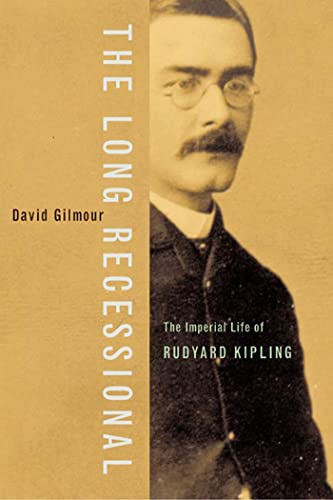
Synopsis
"Readable and reliable . . . [Gilmour's] assessment of the political background of Kipling's writings is exemplary." --Earl L. Dachslager, Houston Chronicle
David Gilmour's superbly nuanced biography of Rudyard Kipling, now available in paperback, is the first to show how the great writer's life and work mirrored the trajectory of the British Empire, from its zenith to its final decades. His great poem "Recessional" celebrated Queen Victoria's Diamond Jubilee in 1897 and his last poems warned of the dangers of Nazism, while Kipling himself, an icon of the empire, was transformed from an apostle of success to a prophet of national decline. As Gilmour makes clear, Kipling's mysterious and enduring works deeply influenced the way his readers saw both themselves and the British Empire, and they continue to challenge our own generation."synopsis" may belong to another edition of this title.
About the Author
Sir David Gilmour is one of Britain's most admired and accomplished historical writers and biographers. His books include The Last Leopard, The Long Recessional (FSG, 2002), and The Ruling Caste (FSG, 2006).
Excerpt. © Reprinted by permission. All rights reserved.
The Long Recessional
The Imperial Life of Rudyard KiplingBy David GilmourFarrar Straus Giroux
Copyright © 2003 David GilmourAll right reserved.
ISBN: 0374528969
Chapter One
Ejections from Paradise
* * *
Rudyard Kipling never wasted time investigating his roots. He as 'not a bit interested' in his ancestry, he reflected in old age, and only wished that a pestering inquirer would desist from hunting down his 'pedigree'.
Rootlessness is in the essence of Kipling's work. He lived in four continents and wrote about six. He crossed the great oceans; he knew the Mediterranean on all its sides; his favourite landscapes were in adverse angles of the Pacific (New Zealand and British Columbia) and in opposite corners of the Atlantic (New England and Cape Colony). At the halfway point of his life he planted laborious roots in Sussex, but it was illness rather than the forests of the Weald that restrained his enthusiasm for travel. In the popular imagination he became ? and remains ? an English jingoist with his heart in India. Yet it would be as accurate to think of him as a citizen of the world in love with France while sometimes still yearning for a previous mistress, South Africa.
Kipling took occasional pride in being a Yorkshireman, a ?tyke? whose family had lived for 200 years in the West Riding. Yet even though he enjoyed hearing 'the good meaty Yorkshire tongue', he was seldom moved to visit the paternal homeland. He believed his ancestors included clock-makers, bell-founders and yeoman farmers, but he knew nothing else about them except that their sons were christened John and Joseph in alternate generations. He was happy in principle to be identified as a Yorkshireman so long as he was not required to assume that identity.
He was not happy, however, to be identified as a Celt. Celtishness suggested affinities with Lloyd George or Irish nationalists, two of Kipling's least favourite organisms. Yet his mother's family were Jacobite Macdonalds who had left the Hebrides after 1745 and settled in Ulster. Inspired by John Wesley, his great-grandfather James joined the Methodist Church and went to England, where his son married Hannah Jones, thereby introducing Welsh blood into the family, a detail about which Rudyard did not boast.
In middle age Kipling became Rector of St Andrews University where he commended the traditional East Coast, non-Celtic Scottish virtues of thrift, common sense and hard work. He could never have been a Calvinist, either in doctrine or in temperament. But he admired the society he believed Presbyterianism had created in Scotland: the system of education, the making of a 'portentous, granite-gutted, self-sufficient community'.
Kipling's innate romanticism, never as submerged as is sometimes thought, surfaced as soon as he saw the heather or read Stevenson and remembered the Jacobites. Although he was incurious about the origins of his Macdonald forebears, he was a partisan of their clan's historic feud with the Campbells. His mother, he told a Highlander during the Boer War, had 'taught [me] never to like a Campbell', and he followed her precept half-seriously ever after: travelling in the ?enemy? territory of Argyllshire in 1919, he found himself ?cursing all Campbells? and admitting that, despite their scenery, he could never love them. If it was strange to dismiss roots yet accept rooted ancestral prejudice, at least he was consistent in the matter. Attempting to explain his highly partisan stance on Ireland in 1911, he wondered half-humorously whether it had anything to do with his ?great-great grandfather buried at Ballynamallard in a grim methody churchyard?.
Methodism flowed into his veins from Yorkshire as well as from the Celtic fringe. Both of Kipling's grandfathers were Methodist ministers. So were his mother's brother and her grandfather: their Macdonald ministry lasted unbroken for three generations and 144 years. Yet these were relaxed strains of Methodism. Kipling's uncle, Frederic Macdonald, may have become President of the Wesleyan Methodist Conference, but his four married sisters all had Anglican weddings. Alice Macdonald, Kipling's mother, is even said to have thrown a lock of John Wesley's hair on to the fire with the cry, ?See! A hair of the dog that bit us!? Kipling's father, Lockwood, was equally disrespectful of his religious heritage, a sceptic who found it ?grievously demoralising? to meet parsons, especially at teatime with their wives. The result was that Rudyard was no more a Methodist than he was a Calvinist. In his adult poems he often invoked a Divinity ? whom he vaguely believed in ? and certainly he respected other people's religions. But he was never, in any real sense, a practising Christian. Whatever bigotries he may have collected in the course of his life, religious ones were absent.
Alice Macdonald was an attractive, vivacious and mildly mischievous girl. She was also a flirt: her youngest sister remarked that she seemed unable ?to go on a visit without becoming engaged to some wild cad of the desert?. Impetuous, musical and tartly humorous, in personality she was very unlike Lockwood, the serene, tolerant, slow-moving man whom she married in March 1865. But as friends pointed out, they had ?congenial tastes and contrasted temperaments?; they shared similar interests, were ?most excellent company? and could ?see persons and events from the humorous side?.
As a matrimonial catch, Lockwood was not in the same league as her sisters' husbands: the painters Edward Burne-Jones and Edward Poynter, and the wealthy ironmaster Alfred Baldwin, the father of Stanley. But this short, bearded and prematurely venerable man had much charm and wisdom. A friend used to refer to him as Socrates because he resembled sculptures of the Athenian philosopher, although she later felt that his ?intense interest in the world of man and nature? made Chaucer a more appropriate comparison. A sculptor and craftsman of skill and diligence, he was dispatched to Bombay soon after his wedding to teach at the School of Art and Industry. As a natural ally of the Arts and Crafts Movement in Britain, he was well suited to a post intended to preserve and rejuvenate the crafts of India.
Rudyard inherited far more from his father than from his mother. Poor Alice had no success in transmitting her musical talent to a boy who admitted near the end of his life that Allah had excluded all music from his ?make-up except the brute instinct for beat, as necessary for the manufacture of verse?. But from Lockwood, Rudyard acquired a love of craft skills and the belief that craftsmanship is the essential basis of all great art. 'He treated me always as a comrade,' Kipling recalled in old age, 'and his severest orders were at most suggestions or invitations.' No doubt it was this approach that made his son so receptive to his ideas: the love of animals and France and India; the dislike of Germans and missionaries; the sceptical views on religion and the conservative opinions on politics. Most of Rudyard's tastes and prejudices were in the blood. After his parents died within a few weeks of each other in the winter of 1910-11, he wrote: 'Dear as my mother was, my father was more to me than most men are to their sons: and now that I have no one to talk or write to I find myself desolate.'
At the beginning of his autobiography, Something of Myself, Kipling quoted the Jesuits' demand, 'Give me the first six years of a child's life and you can have the rest.' Some time earlier he had told a French admirer that he had lived in Bombay during 'those terrible first years of which the Jesuits know the value'. The implication, that India was the crucial factor in his childhood development, approaches the borders of myth-making. It was influential, of course, much more so than ancestral roots, yet his crucial experience of India did not end when he went to England in his sixth year but started on his return there at the age of 16.
Joseph Rudyard Kipling was born in Bombay on the penultimate day of 1865. His first impressions, he recalled seventy years later, were of ?daybreak, light and colour and golden and purple fruits?. He was in the Bombay market at dawn with his native ayah, who used to kneel before Catholic shrines, and a Hindu bearer, who took him into wayside temples. Sometimes they walked to the 'edge of the sea where the Parsees waded in and prayed to the setting or rising sun'.
Our evening walks were by the sea in the shadow of palm-groves ... When the wind blew the great nuts would tumble, and we fled ? my ayah, and my sister in her perambulator ? to the safety of the open. I have always felt the menacing darkness of tropical eventides, as I have loved the voices of night-winds through palm or banana leaves, and the song of the tree-frogs.
In old age he tried to communicate his infant enthusiasms to a young godson in Bombay. Did he like mangoes? Did he eat sugar-cane? Had he 'tasted red peppers yet on the [plants]? I did once and it made me howl and my Daddy spanked me for it.'
His ayah used to remind him to speak English to his parents because, like many Anglo-Indian children, he spent most of his time with servants and spoke Hindustani as his first language. Since he was below the age of Hindu caste restrictions, he could accompany members of the household wherever they went, becoming 'as wise as any native child' about the 'elementary facts of life' and on good terms with 'Hindu deities with garlands round their necks'. Few children remembered their native servants without intense affection. As Kipling's friend Walter Lawrence later recalled, their parents' Indian employees crooned incomparable lullabies, invented endless games and played ?patiently for hours with the baba log [the sahib's children], never reproaching them for their desultory, changing moods?.
Such indulgence naturally made the baba log rather spoilt and, as one of Lockwood's acquaintances put it, 'badly in need of a basting'. Rudyard's father tried to be more philosophical. 'We are willing slaves to our small emperors,' he wrote, 'feeling that the best we can give them is but poor compensation for the loss of their birthright of English air.'
The Macdonalds were less philosophical when his wife brought their 2 1/2-year-old son to England for the birth of her daughter Alice ('Trix) in 1868. The pampered little sahib with his blue eyes and dark, podgy, strong-jawed face, was loud, aggressive and prone to tantrums. In Bewdley, the village of his maternal grandparents, he walked down the street shouting, ?Out of the way, out of the way, there's an angry Ruddy coming.? One of his aunts called him an ?ill-ordered child?, another blamed him for hastening their father's death, and his grandmother complained that he was a 'self-willed rebel'. After several months of disruption, 'screaming tempers' and turning their houses into a 'bear garden', they were happy to see him return to Bombay. His mild and charitable Uncle Fred hoped that Lockwood would become 'very firm with him for dear Alice [is] as wax in his small fists'.
The cure turned out to be firmer than anyone could have intended: Ruddy and Trix were exiled to England at the ages of 5 and 3, and prevented from seeing their mother for over five years and their father for nearly seven. Exiles and separations were usual in Anglo-India, for it was claimed that the climate was unsuitable for children of Rudyard's age. If that had been the only reason, children could have been sent to boarding-schools in the hill stations. But Kipling implied there were other considerations when recalling later that it was thought 'inexpedient and dangerous for a white child to be reared [in India] through youth'. It was 'inexpedient' to create little orientalized pashas coddled by servants, enervated by the climate and thinking of India as 'home'. Expediency required them to be sent to real 'Home', learn austere Victorian virtues and get the stuffing knocked out of them at boarding-school.
The unusual feature in this case is that the Kipling children were not sent to either of their grandmothers or to any of their eight aunts. One of Alice's sisters offered to have Trix, another suggested sharing Rudyard with her brother, but nobody volunteered to have both together or to keep the 'self-willed rebel' all the time. Perhaps Alice was too embarrassed to inflict him on her relations again; perhaps she was reluctant to become dependent on her richer and younger sisters. In any case, insisting that Ruddy and Trix should not be separated, she took them to Southsea on the south coast of England and deposited them at a grim boarding-house. It was a terrible mistake, swiftly compounded by another. In November 1871, after six months in Britain, Alice and Lockwood returned to India without explanation, thus leaving, besides the anguish and loneliness, a sense of uncomprehending betrayal.
The boarding-house, Lorne Lodge, became the House of Desolation in Kipling's memoirs, a place ?smelling of aridity and emptiness? inhabited by a couple called Holloway and their son. Rudyard liked ?Captain? Holloway, a retired midshipman and coastguard officer who took him for walks to look at ships. But the old sailor died midway through the children's Southsea exile, leaving them entirely in the hands of his wife, a tyrant who ran her establishment with the ?full vigour of the Evangelical as revealed to the Woman?. Mrs Holloway reacted to Rudyard, who was doubtless still rude and undisciplined, by beating him at the slightest provocation and ordering him to his bedroom where her son, a bullyboy twice his age, continued the treatment. Once she sent him through the streets to his day school with the placard ?Liar? between his shoulders ? a punishment that some authors, despite corroboration by Trix, have suggested Kipling invented on the grounds that a similar humiliation was inflicted on David Copperfield. But there is no reason why Mrs Holloway should not have read Dickens and been inspired by this imaginative torture. Lord Curzon's governess had been similarly inspired when she made the future Viceroy of India parade around his ancestral village in a conical cap and a calico petticoat with the words ?liar?, ?sneak? and ?coward? attached to the costume.
Kipling recalled his five and a half years in the House of Desolation in his autobiography and in ?Baa Baa, Black Sheep?, a bitter and harrowing story that understandably upset his parents. He may have exaggerated his degree of abandonment and the relentlessness of his persecution ? some Macdonalds did occasionally visit the children at Southsea. But the essence of the narratives is true, and the experience marked Kipling forever. As one acute critic observed, it did not leave him a cruel man but it gave him an ?emotional comprehension of cruelty and an intellectual interest in it?. It must also have been at least partly responsible for his most endearing quality ? his deep understanding of the vulnerabilities of children.
Each December Rudyard was allowed to escape Hell and spend a month in Paradise, The Grange in Fulham, where his Aunt Georgy Burne-Jones lived with her Pre-Raphaelite husband. On arrival he had to jump to reach its iron bell-pull, ?a sort of "open sesame" into a House Beautiful?, a world of cousins and rocking-horses and ?wonderful smells of paints and turpentine? wafting down from his uncle's studio. He climbed the mulberry tree with his cousins, he listened to his aunt reading Scott or The Arabian Nights, he encountered poets and artists all willing to talk to him and play except an ?elderly person called "Browning", who took no proper interest? in the children skirmishing in the hall. Each January Paradise ejected him, and he returned to ?misery and Evangelical brutality and childish fears?. But the bell-pull remained a combination of ?Rosebud? and ?madeleine?. Many years later, when the Burne-Jones family left The Grange, he begged for it to hang on his own front door ?in the hope that other children might also feel happy when they rang it?. It is still at his house at Bateman's.
Continues...
Excerpted from The Long Recessionalby David Gilmour Copyright © 2003 by David Gilmour. Excerpted by permission.
All rights reserved. No part of this excerpt may be reproduced or reprinted without permission in writing from the publisher.
Excerpts are provided by Dial-A-Book Inc. solely for the personal use of visitors to this web site.
"About this title" may belong to another edition of this title.
Search results for LONG RECESSIONAL: The Imperial Life of Rudyard Kipling

Stock Image
The Long Recessional: The Imperial Life of Rudyard Kipling
Published by
Farrar, Straus and Giroux (edition Reprint), 2003
ISBN 10: 0374528969
ISBN 13: 9780374528966
Used
Paperback
Seller: BooksRun, Philadelphia, PA, U.S.A.
Seller rating 5 out of 5 stars

Paperback. Condition: Very Good. Reprint. It's a well-cared-for item that has seen limited use. The item may show minor signs of wear. All the text is legible, with all pages included. It may have slight markings and/or highlighting. Seller Inventory # 0374528969-11-1
Stock Image
LONG RECESSIONAL
Published by
Farrar, Straus and Giroux, 2003
ISBN 10: 0374528969
ISBN 13: 9780374528966
Used
paperback
Seller: Once Upon A Time Books, Siloam Springs, AR, U.S.A.
Seller rating 4 out of 5 stars

paperback. Condition: Acceptable. This is a used book. It may contain highlighting/underlining and/or the book may show heavier signs of wear . It may also be ex-library or without dustjacket. This is a used book. It may contain highlighting/underlining and/or the book may show heavier signs of wear . It may also be ex-library or without dustjacket. Seller Inventory # mon0000617855
Stock Image
The Long Recessional: The Imperial Life of Rudyard Kipling
Published by
Farrar, Straus and Giroux, 2003
ISBN 10: 0374528969
ISBN 13: 9780374528966
Used
Softcover
Seller: Hawking Books, Edgewood, TX, U.S.A.
Seller rating 4 out of 5 stars
Condition: Very Good. Very Good Condition. Five star seller - Buy with confidence! Seller Inventory # X0374528969X2
Stock Image
The Long Recessional : The Imperial Life of Rudyard Kipling
Published by
Farrar, Straus & Giroux, 2003
ISBN 10: 0374528969
ISBN 13: 9780374528966
Used
Softcover
Seller: Better World Books, Mishawaka, IN, U.S.A.
Seller rating 5 out of 5 stars
Condition: Good. Reprint. Pages intact with minimal writing/highlighting. The binding may be loose and creased. Dust jackets/supplements are not included. Stock photo provided. Product includes identifying sticker. Better World Books: Buy Books. Do Good. Seller Inventory # 7913973-6
Stock Image
The Long Recessional: The Imperial Life of Rudyard Kipling
Published by
Farrar, Straus and Giroux, 2003
ISBN 10: 0374528969
ISBN 13: 9780374528966
Used
paperback
Seller: HPB-Ruby, Dallas, TX, U.S.A.
Seller rating 5 out of 5 stars
paperback. Condition: Very Good. Connecting readers with great books since 1972! Used books may not include companion materials, and may have some shelf wear or limited writing. We ship orders daily and Customer Service is our top priority! Seller Inventory # S_473520629
Stock Image
The Long Recessional: The Imperial Life of Rudyard Kipling
Published by
Farrar, Straus and Giroux, 2003
ISBN 10: 0374528969
ISBN 13: 9780374528966
Used
paperback
Seller: Magers and Quinn Booksellers, Minneapolis, MN, U.S.A.
Seller rating 5 out of 5 stars
paperback. Condition: Very Good. May have light to moderate shelf wear and/or a remainder mark. Complete. Clean pages. Seller Inventory # 1469018
Stock Image
LONG RECESSIONAL
Published by
Farrar, Straus and Giroux, 2003
ISBN 10: 0374528969
ISBN 13: 9780374528966
New
Softcover
Seller: Lakeside Books, Benton Harbor, MI, U.S.A.
Seller rating 5 out of 5 stars
Condition: New. Brand New! Not Overstocks or Low Quality Book Club Editions! Direct From the Publisher! We're not a giant, faceless warehouse organization! We're a small town bookstore that loves books and loves it's customers! Buy from Lakeside Books! Seller Inventory # OTF-S-9780374528966
Stock Image
The Long Recessional
Print on DemandSeller: Majestic Books, Hounslow, United Kingdom
Seller rating 4 out of 5 stars
Condition: New. Print on Demand pp. 368. Seller Inventory # 6825503
Buy New
£ 31.49
£ 6.50 shipping
Ships from United Kingdom to U.S.A.
Ships from United Kingdom to U.S.A.
Quantity: 4 available
Stock Image
The Long Recessional
Print on DemandSeller: Books Puddle, Woodside, NY, U.S.A.
Seller rating 4 out of 5 stars
Condition: New. Print on Demand pp. 368 Index. Seller Inventory # 262070976
Stock Image
The Long Recessional
Print on DemandSeller: Biblios, Frankfurt am main, HESSE, Germany
Seller rating 4 out of 5 stars
Condition: New. PRINT ON DEMAND pp. 368. Seller Inventory # 182070986