
Items related to Gender Differences in Human Cognition (Counterpoints:...
Synopsis
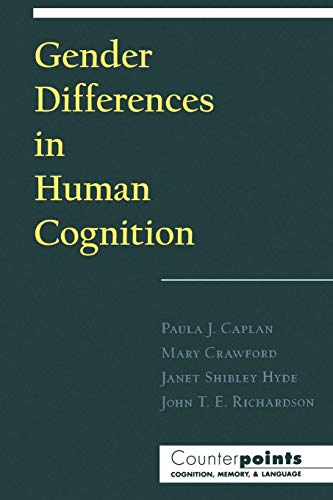
This new volume in the Counterpoints series not only summarizes and addresses the validity (or invalidity) of research into gender differences, it also questions the ideology behind this research, and its consequences.
"synopsis" may belong to another edition of this title.
Review
"This evaluation of current research in gender studies as they relate to cognition should be of particular interest to psychologists, educators, and policy-makers."--Shirley R. Rausher, Readings
"Within the first pages, the authors focus their scholarly energies on verbal, spatial, and mathematical abilities because, we are told, researchers typically have searched for individual differences within such test domains. All four authors provide highly readable 30-page chapters, each taking a
variation on the same perspective, i.e., that whatever cognitive differences you thought had been demonstrated between males and females should not be considered biological . . . This reviewer found the book's contents highly stimulating and informative, providing both valid and pseudoarguments to
reject the very existence of sex differences in verbal, spatial, mathematical, and scientific abilities. . . . future researchers ignore the message of this text at their peril."--Journal of the International Neuropsychological Society
"Results of some research suggest that gender differences have been growing smaller over recent decades. Here, five contributions discuss whether women and men differ in terms of their intellectual abilities; and, if there are differences, what are the origins--biology, childhood influences,
cultural stereotypes? If there are no differences, why do people continue to assert that differences do exist? The essays discuss relevant research using the techniques of meta-analysis, pitfalls in the conception and execution of research on the topic, and the negative consequences of a focus on
differences."--Reference & Research Book News
"This evaluation of current research in gender studies as they relate to cognition should be of particular interest to psychologists, educators, and policy-makers."--Shirley R. Rausher, Readings
"Within the first pages, the authors focus their scholarly energies on verbal, spatial, and mathematical abilities because, we are told, researchers typically have searched for individual differences within such test domains. All four authors provide highly readable 30-page chapters, each taking a
variation on the same perspective, i.e., that whatever cognitive differences you thought had been demonstrated between males and females should not be considered biological . . . This reviewer found the book's contents highly stimulating and informative, providing both valid and pseudoarguments to
reject the very existence of sex differences in verbal, spatial, mathematical, and scientific abilities. . . . future researchers ignore the message of this text at their peril."--Journal of the International Neuropsychological Society
"Results of some research suggest that gender differences have been growing smaller over recent decades. Here, five contributions discuss whether women and men differ in terms of their intellectual abilities; and, if there are differences, what are the origins--biology, childhood influences,
cultural stereotypes? If there are no differences, why do people continue to assert that differences do exist? The essays discuss relevant research using the techniques of meta-analysis, pitfalls in the conception and execution of research on the topic, and the negative consequences of a focus on
differences."--Reference & Research Book News
"This evaluation of current research in gender studies as they relate to cognition should be of particular interest to psychologists, educators, and policy-makers."--Shirley R. Rausher, Readings
"Within the first pages, the authors focus their scholarly energies on verbal, spatial, and mathematical abilities because, we are told, researchers typically have searched for individual differences within such test domains. All four authors provide highly readable 30-page chapters, each taking a variation on the same perspective, i.e., that whatever cognitive differences you thought had been demonstrated between males and females should not be considered biological . . . This reviewer found the book's contents highly stimulating and informative, providing both valid and pseudoarguments to reject the very existence of sex differences in verbal, spatial, mathematical, and scientific abilities. . . . future researchers ignore the message of this text at their peril."--Journal of the International Neuropsychological Society
"Results of some research suggest that gender differences have been growing smaller over recent decades. Here, five contributions discuss whether women and men differ in terms of their intellectual abilities; and, if there are differences, what are the origins--biology, childhood influences, cultural stereotypes? If there are no differences, why do people continue to assert that differences do exist? The essays discuss relevant research using the techniques of meta-analysis, pitfalls in the conception and execution of research on the topic, and the negative consequences of a focus on differences."--Reference & Research Book News
"This evaluation of current research in gender studies as they relate to cognition should be of particular interest to psychologists, educators, and policy-makers."--Shirley R. Rausher, Readings
"Within the first pages, the authors focus their scholarly energies on verbal, spatial, and mathematical abilities because, we are told, researchers typically have searched for individual differences within such test domains. All four authors provide highly readable 30-page chapters, each taking a variation on the same perspective, i.e., that whatever cognitive differences you thought had been demonstrated between males and females should not be considered biological . . . This reviewer found the book's contents highly stimulating and informative, providing both valid and pseudoarguments to reject the very existence of sex differences in verbal, spatial, mathematical, and scientific abilities. . . . future researchers ignore the message of this text at their peril."--Journal of the International Neuropsychological Society
"Results of some research suggest that gender differences have been growing smaller over recent decades. Here, five contributions discuss whether women and men differ in terms of their intellectual abilities; and, if there are differences, what are the origins--biology, childhood influences, cultural stereotypes? If there are no differences, why do people continue to assert that differences do exist? The essays discuss relevant research using the techniques of meta-analysis, pitfalls in the conception and execution of research on the topic, and the negative consequences of a focus on differences."--Reference & Research Book News
"This evaluation of current research in gender studies as they relate to cognition should be of particular interest to psychologists, educators, and policy-makers."--Shirley R. Rausher, Readings
"Within the first pages, the authors focus their scholarly energies on verbal, spatial, and mathematical abilities because, we are told, researchers typically have searched for individual differences within such test domains. All four authors provide highly readable 30-page chapters, each taking a variation on the same perspective, i.e., that whatever cognitive differences you thought had been demonstrated between males and females should not be considered biological . . . This reviewer found the book's contents highly stimulating and informative, providing both valid and pseudoarguments to reject the very existence of sex differences in verbal, spatial, mathematical, and scientific abilities. . . . future researchers ignore the message of this text at their peril."--Journal of the International Neuropsychological Society
"Results of some research suggest that gender differences have been growing smaller over recent decades. Here, five contributions discuss whether women and men differ in terms of their intellectual abilities; and, if there are differences, what are the origins--biology, childhood influences, cultural stereotypes? If there are no differences, why do people continue to assert that differences do exist? The essays discuss relevant research using the techniques of meta-analysis, pitfalls in the conception and execution of research on the topic, and the negative consequences of a focus on differences."--Reference & Research Book News
Synopsis
This volume in the "Counterpoints Series" summarizes and addresses the validity of research into gender differences. It also questions the ideology behind this research, and its consequences. The work is intended for researchers and students in the field of cognitive psychology and women's studies, and psychologists interested in gender issues.
"About this title" may belong to another edition of this title.
Search results for Gender Differences in Human Cognition (Counterpoints:...

Stock Image
Gender Differences in Human Cognition
Published by
Oxford University Press, 1997
ISBN 10: 0195112911
ISBN 13: 9780195112917
Used
Paperback
Seller: ThriftBooks-Atlanta, AUSTELL, GA, U.S.A.
Seller rating 5 out of 5 stars

Paperback. Condition: Very Good. No Jacket. May have limited writing in cover pages. Pages are unmarked. ~ ThriftBooks: Read More, Spend Less. Seller Inventory # G0195112911I4N00
Stock Image
Gender Differences in Human Cognition
Published by
Oxford University Press, Incorporated, 1997
ISBN 10: 0195112911
ISBN 13: 9780195112917
Used
Softcover
Seller: Better World Books, Mishawaka, IN, U.S.A.
Seller rating 5 out of 5 stars
Condition: Good. Former library copy. Pages intact with minimal writing/highlighting. The binding may be loose and creased. Dust jackets/supplements are not included. Includes library markings. Stock photo provided. Product includes identifying sticker. Better World Books: Buy Books. Do Good. Seller Inventory # 2005122-6
Stock Image
Gender Differences in Human Cognition
Published by
Oxford University Press, Incorporated, 1997
ISBN 10: 0195112911
ISBN 13: 9780195112917
Used
Softcover
Seller: Better World Books, Mishawaka, IN, U.S.A.
Seller rating 5 out of 5 stars
Condition: Very Good. Former library copy. Pages intact with possible writing/highlighting. Binding strong with minor wear. Dust jackets/supplements may not be included. Includes library markings. Stock photo provided. Product includes identifying sticker. Better World Books: Buy Books. Do Good. Seller Inventory # 13811746-20
Stock Image
Gender Differences in Human Cognition (Counterpoints: Cognition, Memory, and Language)
Published by
Oxford University Press, 1997
ISBN 10: 0195112911
ISBN 13: 9780195112917
Used
paperback
Seller: Half Price Books Inc., Dallas, TX, U.S.A.
Seller rating 5 out of 5 stars
paperback. Condition: Very Good. Connecting readers with great books since 1972! Used books may not include companion materials, and may have some shelf wear or limited writing. We ship orders daily and Customer Service is our top priority! Seller Inventory # S_398883405
Seller Image
Gender Differences in Human Cognition (Counterpoints: Cognition, Memory, and Language)
Published by
Oxford University Press, 1997
ISBN 10: 0195112911
ISBN 13: 9780195112917
Used
paperback
Seller: WeBuyBooks, Rossendale, LANCS, United Kingdom
Seller rating 5 out of 5 stars
paperback. Condition: Very Good. Most items will be dispatched the same or the next working day. A copy that has been read, but is in excellent condition. Pages are intact and not marred by notes or highlighting. The spine remains undamaged. Seller Inventory # rev2880028467
Buy Used
£ 7.34
£ 5.55 shipping
Ships from United Kingdom to U.S.A.
Ships from United Kingdom to U.S.A.
Quantity: 1 available
Stock Image
Gender Differences in Human Cognition
Published by
Oxford University Press, 1997
ISBN 10: 0195112911
ISBN 13: 9780195112917
Used
Softcover
Seller: Anybook.com, Lincoln, United Kingdom
Seller rating 5 out of 5 stars
Condition: Poor. This is an ex-library book and may have the usual library/used-book markings inside.This book has soft covers. In poor condition, suitable as a reading copy. Please note the Image in this listing is a stock photo and may not match the covers of the actual item,400grams, ISBN:9780195112917. Seller Inventory # 8596924
Buy Used
£ 2.50
£ 13.04 shipping
Ships from United Kingdom to U.S.A.
Ships from United Kingdom to U.S.A.
Quantity: 1 available
Stock Image
Gender Differences in Human Cognition
Published by
Oxford University Press, 1997
ISBN 10: 0195112911
ISBN 13: 9780195112917
Used
Softcover
Seller: Anybook.com, Lincoln, United Kingdom
Seller rating 5 out of 5 stars
Condition: Fair. This is an ex-library book and may have the usual library/used-book markings inside.This book has soft covers. In fair condition, suitable as a study copy. Please note the Image in this listing is a stock photo and may not match the covers of the actual item,400grams, ISBN:9780195112917. Seller Inventory # 9109031
Buy Used
£ 2.50
£ 13.04 shipping
Ships from United Kingdom to U.S.A.
Ships from United Kingdom to U.S.A.
Quantity: 1 available
Stock Image
Gender Differences in Human Cognition (Counterpoints: Cognition, Memory, and Language)
Published by
Oxford University Press, 1997
ISBN 10: 0195112911
ISBN 13: 9780195112917
Used
Paperback
Seller: Robinson Street Books, IOBA, Binghamton, NY, U.S.A.
Seller rating 4 out of 5 stars

Paperback. Condition: As New. Prompt Shipment, shipped in Boxes, Tracking PROVIDEDFine. Seller Inventory # ld8944
Stock Image
Gender Differences in Human Cognition (Counterpoints - Cognition, Memory and Language)
Published by
Oxford University Press, USA, 1997
ISBN 10: 0195112911
ISBN 13: 9780195112917
New
Paperback
Seller: Poverty Hill Books, Mt. Prospect, IL, U.S.A.
Seller rating 4 out of 5 stars
Paperback. Condition: New. BRAND NEW COPY, Perfect Shape, Not a Remainder, No Black Remainder Mark MH61-907Fast Shipping With Online Tracking, International Orders shipped Global Priority Air Mail, All orders handled with care and shipped promptly in secure packaging, we ship Mon-Sat and send shipment confirmation emails. Our customer service is friendly, we answer emails fast, accept returns and work hard to deliver 100% Customer Satisfaction! Seller Inventory # 0710040021
Seller Image
Gender Differences in Human Cognition
Published by
Oxford University Press, 1997
ISBN 10: 0195112911
ISBN 13: 9780195112917
Used
Softcover
Seller: GreatBookPrices, Columbia, MD, U.S.A.
Seller rating 5 out of 5 stars
Condition: As New. Unread book in perfect condition. Seller Inventory # 70613