
Items related to The Sagas of the Icelanders (World of the Sagas) (Rough...
Synopsis
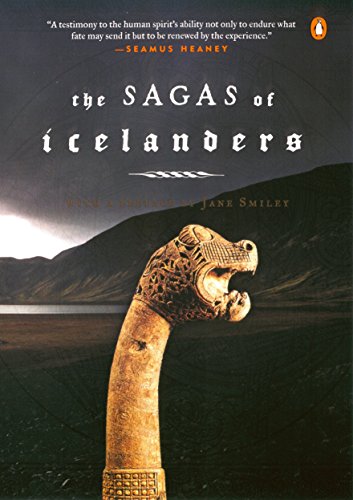
In Iceland, the age of the Vikings is also known as the Saga Age. A unique body of medieval literature, the Sagas rank with the world’s great literary treasures – as epic as Homer, as deep in tragedy as Sophocles, as engagingly human as Shakespeare. Set around the turn of the last millennium, these stories depict with an astonishingly modern realism the lives and deeds of the Norse men and women who first settled in Iceland and of their descendants, who ventured farther west to Greenland and, ultimately, North America. Sailing as far from the archetypal heroic adventure as the long ships did from home, the Sagas are written with psychological intensity, peopled by characters with depth, and explore perennial human issues like love, hate, fate and freedom.
Note: This book is rough-cut, which means the pages will be unevenly cut to give the book and unique look and feel.
"synopsis" may belong to another edition of this title.
About the Author
Jane Smiley's ten works of fiction include The Age of Grief, The Greenlanders, Ordinary Love and Good Will, Moo, A Thousand Acres (which won the Pulitzer Prize), and most recently the bestselling Horse Heaven.
Excerpt. © Reprinted by permission. All rights reserved.
Sagas of Icelanders, the (Classics Deluxe Edition)
Penguin Classics Deluxe EditionBy Jane SmileyPenguin Books
Copyright ©2001 Jane SmileyAll right reserved.
ISBN: 0141000031
Chapter One
EGIL'S SAGA
Egils saga Skallagrímssonar
Time of action: 850-1000
Time of writing: 1220-40
Egil's Saga is acknowledged as one of the masterpieces of the genre, amagnificently wrought portrait of poet, warrior and farmer Egil Skallagrimsson,loosely contained within the framework of the family saga, but with anunusual twist ? the feud that Egil and his forebears wage is with the kingsof Norway.
Spanning some 150 years, much of the action takes place outside Icelandand repeatedly returns to Norway, where the saga starts and where its mainthemes are laid out against the background of King Harald Fair-hair'smerciless unification of the realm. Egil's grandfather Kveldulf and fatherSkallagrim refuse allegiance to the king, while Kveldulf's other son Thorolfenters his service but dies at the king's own hands, the victim of maliciousslanders. Beyond the closely mapped sites in Norway, the setting extendsinto vaguer territory elsewhere in Scandinavia, deep into the Baltic andEast Europe, far north to Finnmark, and to England ? much of the knownViking world at that time. Often the adventures and heroics are larger thanlife, but are outrageous and delightfully gross rather than implausible orfantastic. Egil's enemies are motivated by treachery, self-interest and malice,and he confronts them as his forebears did, with the family traits of obstinacy,ruthlessness, animal strength and an instinctive inability to accept authority.To his friend and advocate Arinbjorn in Norway, however, and to otherswhose favour he wins, Egil shows loyalty and unswerving devotion, and heheroically adheres to a brutal but not entirely unappealing sense of justice.
The action in Iceland falls into several phases. Skallagrim settles at Borgand is an ideal of pioneer and craftsman, but the social order which he buildsis threatened by the unruly and rebellious Egil. When Egil many years laterinherits his farm, he becomes a respected figure of authority himself, anddoes not engage in feuds in Iceland; his main involvement in a disputeoccurs when he rules in his son Thorstein's favour, acting as a figure ofauthority rather than of force. However, the trick he plans to humiliate thegreedy thingmen in his eighties shows that his relish for provocation hasnever been entirely lost. At intervals he had been drawn away from Borgto pursue his feud with the Norwegian royal family, which escalates into asheer battle of personalities with King Eirik Blood-axe and Queen Gunnhild.After their deaths he seems to realize that Norway is gradually changinginto a world in which he can never be accepted, and Iceland becomes forhim, as for so many other saga heroes, a kind of retirement home for ageingVikings.
Although the objective style of the sagas does not allow direct revelationof the characters' thoughts, the portrayal of Egil is exceptionally rich inpsychology. His gestures are dramatic, almost ritualistic, as he sulks orbroods, suffers personal sorrow in silence, flies into a rage or succumbs tochildlike joy on receiving a noble gift. And while the saga is clearly a man'sworld in which Egil fears no adversary, he is timid and submissive towardswomen, as shown by his almost blushing love for his brother's widow Asgerd,who later becomes his wife, and by the way he allows his daughter Thorgerdto trick him out of his sympathy-seeking act of pining away after the deathof his sons.
Scholars have pointed out the psychological tension between the uglyEgil and his `exemplary' brother Thorolf, the jealousy which sometimesmanifests itself in irresponsible pranks and then turns into self-reproachafter Thorolf's death in battle. Egil seems to have inherited this jealousyfrom his father, who was always overshadowed by his own brother, alsonamed Thorolf, in the first part of the saga. Macabre tension between fatherand son is another psychological theme: Skallagrim even comes close tokilling the young Egil once in a savage, shape-shifter's fury.
Another window into Egil's psyche is his poetry, which ranks with themost personal as well as the most accomplished in the sagas. We see Egilglorifying his own ugliness as if it were an archetypal landscape, depictingthe living forces of nature and mythology in brisk, dramatic strokes, andexalting the values he cherishes most. The scene where Egil saves his lifein York by reciting his `Head Ransom' to King Eirik abounds in irony, sincethe poem has an empty, tongue-in-cheek ring to it compared to his otherverse and seems, so to speak, to go over the king's head anyway. By contrast,the eulogy for Arinbjorn is heartfelt, engaged, stacked with monumentalmetaphor and tinged with nostalgia for the lost Viking lifestyle. In `TheLoss of My Sons' Egil lays his soul bare, delves into thwarted ambition forhis family and unrealized affection in the bonds that have been lost, andbreaks with the god Odin who has given him gifts in both poetry and war,but deprived him of personal fortune.
Egil's Saga is preserved in a number of vellum manuscripts and fragmentsdating from the second half of the thirteenth century onwards, although themost important is Möðruvallabók (AM 132 fol., dated 1330-70). Composed inthe second quarter of the thirteenth century, the saga is generally attributedon stylistic and other grounds to Iceland's greatest medieval historian, SnorriSturluson (1179-1241), who was a descendant of Egil. If the attribution iscorrect, Egil's Saga is the only one whose author is known. It is translatedhere by Bernard Scudder from the version printed in Íslendinga sögur, vol. l(Reykjavík 1987), and incorporates a number of emendations based on BjarniEinarsson's new reading of Möðruvallabók and paper manuscripts derivingfrom it.
1
There was a man named Ulf, the son of Bjalfi and of Hallbera, thedaughter of Ulf the Fearless. She was the sister of Hallbjorn Half-trollfrom Hrafnista, the father of Ketil Haeng. Ulf was so big and strong that noman was a match for him; and he was still only a youth when he became aViking and went raiding. His companion was Kari from Berle, a man ofhigh birth who had the strength and courage to perform great deeds. Kariwas a berserk. He and Ulf shared all they owned and were close friends.
When they gave up plundering, Kari returned to his farm on Berle, avery wealthy man. Kari had three children, two sons called Eyvind Lamband Olvir Hump, and a daughter named Salbjorg. She was a beautiful womanof firm character. Ulf married her, then he too returned to his farm. He wasrich in both lands and possessions. He became a landholder like his ancestorsand was a powerful figure.
Ulf is said to have been a very clever farmer. He made a habit of gettingup early to inspect what his farmhands or craftsmen were doing and to keepan eye on his cattle and cornfields. Sometimes he would talk to people whowere in need of his advice, for he was shrewd and always ready to makeuseful suggestions. But everyday towards evening he would grow so bad-temperedthat few people dared even address him. He always went to sleepearly in the evening and woke up early in the morning. People claimed hewas a shape-shifter and they called him Kveldulf (Night Wolf).
Kveldulf and his wife had two sons. The elder one was named Thorolfand the younger one Grim, and they both grew up to be big, strong menlike their father. Thorolf was an attractive and highly accomplished man.He took after his mother's side of the family, a cheerful, generous man,energetic and very eager to prove his worth. He was popular with everyone.Grim was swarthy and ugly, resembling his father in both appearance andcharacter. He turned out to be an active man; he was gifted at working inwood and iron, and grew to be a great craftsman. In winter he would often setoff on a fishing boat to lay nets for herring, taking many farmhands withhim.
When Thorolf was twenty, he made ready to go raiding, and Kveldulfgave him a longship. Kari's sons Eyvind and Olvir joined him, with a largeband of men and another longship. In the summer they went raiding andtook plenty of booty which they shared out among themselves. They wentraiding for several summers, spending the winters at home with their fathers.Thorolf brought many precious things back to give to his parents, for inthose days it was easy to win both wealth and renown. Kveldulf was veryold by then, and his sons had reached full manhood.
2
Audbjorn was king of Fjordane at this time. One of his earls wasHroald, who had a son named Thorir.
Atli the Slender, another earl, lived at Gaular and had three sons, Hallstein,Holmstein and Herstein, and a daughter called Solveig the Fair.
One autumn when there was a great gathering at Gaular for the autumnfeast, Olvir Hump saw Solveig and began courting her. Later he asked forher hand, but the earl, not considering him worthy enough, would not marryher to him. Afterwards, Olvir composed many love poems and grew soobsessed with her that he gave up raiding, leaving Thorolf and Eyvind togo by themselves.
3
King Harald inherited the titles of his father Halfdan the Black andswore an oath not to cut or comb his hair until he had become soleking of Norway. He was called Harald Tangle-hair. He did battle with theneighbouring kings and defeated them, as is told in long accounts. Afterwardshe took over Oppland, and proceeded northwards to Trondheim where hefought many battles before gaining full control of all Trondheim district.
After that he intended to go north to Naumdal and take on the brothersHerlaug and Hrollaug, who were kings there, but when they heard that hewas on his way, Herlaug and eleven of his men went into the mound theyhad spent the past three years building, and had it closed upon them.Hrollaug tumbled from power and took the title of earl instead, thensubmitted to Harald and handed over his kingdom. King Harald therebytook over Naumdal province and Halogaland and appointed men to governthere in his name.
Leaving Trondheim with his fleet of ships, he went south to More wherehe won a battle against King Hunthjof, who was killed there. Then Haraldtook over North More and Romsdal.
Meanwhile, Hunthjof's son Solvi Chopper, who had escaped, went toKing Arnvid in South More and asked for his help.
`Although this misfortune has befallen us now,' he said, `it will not bevery long before the same happens to you, because I think Harald will behere soon, once he has brought slavery and suffering to everyone he choosesin North More and Romsdal. You will face the same choice we had: eitherto defend your property and freedom by staking all the men you can hopeto muster ? and I will provide my forces too against such aggression andinjustice ? or to follow the course taken by the people of Naumdal whovoluntarily entered servitude and became Harald's slaves. My father felt itan honour to die nobly as king of his own realm rather than becomesubservient to another king in his old age. I think you will feel the same,and so will any other stalwarts who want to prove their worth.'
Persuaded by such words, the king resolved to muster forces and defendhis land. He and Solvi swore an alliance and sent word to King Audbjorn,who ruled Fjordane province, to join forces with them. When the messengersdelivered this message to King Audbjorn he discussed it with his friends,all of whom advised him to gather forces and join the people of More as hehad been asked. King Audbjorn sent around an arrow of war as a signal tocall men to arms throughout his kingdom and dispatched messengers topowerful men asking them to meet him.
But when the messengers told Kveldulf that the king wanted him to bringall the men on his farm to join him, he replied, `The king would considerit my duty to go with him if he had to defend his land and battles had tobe fought in Fjordane province. But I don't think it's any duty of mine togo up north to More and fight there to defend other people's land. Tellyour king straight out when you meet him, that while he rushes off to battleKveldulf will be staying at home, and will not muster any forces or set offto fight Harald Tangle-hair. I have a feeling Harald has plenty of goodfortune in store for him, but our king doesn't have enough to fill the palmof his hand.'
The messengers went back to the king and told him how their errandhad turned out, and Kveldulf stayed at home on his farm.
4
King Audbjorn took the band of men he had gathered and went northto More, where he met King Arnvid and Solvi Chopper, and togetherthey amassed great forces. By then, King Harald had arrived from the northwith his forces, and the two sides clashed on the fjord near Solskjel Island.A fierce battle ensued, with heavy losses on both sides. On Harald's side,the two earls Asgaut and Asbjorn were killed, along with two of Earl Hakonof Lade's sons, Grjotgard and Herlaug, and many other great men, whileKing Arnvid and King Audbjorn were killed on the side from More. SolviChopper escaped by fleeing and became a great Viking, and often raidedin Harald's kingdom, which was how he earned his nickname. Afterwards,King Harald conquered South More.
King Audbjorn's brother Vemund kept control of Fjordane province andbecame its king. This happened late in autumn, and King Harald's menadvised him not to head south past Stad at that time, so Harald appointedEarl Rognvald to rule North and South More and Romsdal, and returnedto Trondheim, keeping a large band of men with him.
The same autumn, Earl Atli's sons attacked Olvir Hump's farm, intendingto kill him. They had far too many men for Olvir to fend off, so he fled. Hewent to More, met King Harald and became one of his men, then wentnorth to Trondheim with the king that autumn and became close friendswith him. He stayed with the king for a long time and became his poet.
That winter, Earl Rognvald travelled inland across lake Eidesjo and southto Fjordane, and received word about King Vemund's movements. Rognvaldturned up one night at a place called Naustdal where Vemund was at afeast. He stormed the house and burned the king and ninety men inside.Kari from Berle joined Earl Rognvald with a fully manned longship andthey went to More together. Rognvald took the ship that King Vemund hadowned, and all the possessions he could manage. Then Kari travelled northto Trondheim to meet King Harald, and entered his service.
The following spring King Harald sailed southwards along the coast withhis fleet, conquering the Fjordane and Fjaler provinces and appointing hisown men to rule them. He put Earl Hroald in charge of Fjordane province.
Once King Harald had taken over the kingdoms he had recently won, hekept a close watch on the landholders and powerful farmers and everyoneelse he suspected would be likely to rebel, and gave them the options ofentering his service or leaving the country, or a third choice of sufferinghardship or paying with their lives; some had their arms and legs maimed.In each province King Harald took over all the estates and all the land,habited or uninhabited, and even the sea and lakes. All the farmers weremade his tenants, and everyone who worked the forests and dried salt, orhunted on land or at sea, was made to pay tribute to him.
Many people fled the country to escape this tyranny and settled variousuninhabited parts of many places, to the east in Jamtland and Halsingland,and to the west in the Hebrides, the shire of Dublin, Ireland, Normandy inFrance, Caithness in Scotland, the Orkney Isles and Shetland Isles, and theFaroe Islands. And at this time, Iceland was discovered.
5
King Harald stayed with his army in Fjordane, and sent out messengersthrough the countryside to meet the people that he felt he had reasonto contact but who had not joined him.
The king's messengers went to Kveldulf's and received a warm welcome.
They told him their business, saying that the king wanted Kveldulf to goto see him: `He has heard that you are a man of high birth and standing,'they said. `You have the chance to receive great honour from the king,because he is eager to be joined by people who are renowned for theirstrength of body and heart.'
Kveldulf replied that he was too old for going on fighting ships: `So I willstay at home now and give up serving kings.'
`Then let your son go to see the king,' the messenger said. `He's a bigand brave man. The king will make you a landholder if you serve him.'
`I don't want to be a landholder while my father is still alive,' Grim said,`because he is my superior for as long as he lives.'
The messengers departed, and when they reached the king they told himeverything Kveldulf had said to them. The king grew surly, remarking thatthese must be arrogant people, and he could not tell what their motivationwas.
Olvir Hump was present then and asked the king not to be angry.
`I will go and see Kveldulf,' he said, `and he will want to meet you whenhe knows how important it is to you.'
So Olvir went to see Kveldulf and, after describing the king's rage, toldhim he had no choice but to go to the king or send his son in his place, andthat they would be shown great honour if they obeyed. He spoke at length,and rightly so, about how well the king repaid his men with both wealthand status.
Kveldulf said he had an intuition that `this king will not bring my familymuch good fortune. I won't go to meet him, but if Thorolf comes home thissummer it will be easy to persuade him to go and become one of the king'smen. So tell the king that I will be friendly towards him and encourage everyonewho sets store by my words to do the same. As far as acting on his behalfgoes, I will maintain the same arrangement I had under the previous king,if that is what he wants, and then see how the two of us get along together'.
Olvir returned to the king and told him that Kveldulf would send himone of his sons, but that the more suitable one was not at home at that time.The king let the matter rest there. In the summer he crossed Sognefjord,and when autumn came he prepared to go north to Trondheim.
6
Kveldulf's son Thorolf and Eyvind Lamb returned from their Vikingexpedition that autumn, and Thorolf went to stay with his father.
When they were talking together, Thorolf asked about the business ofHarald's messengers. Kveldulf told him that the king had sent word orderinghim or one of his sons to join him.
`What did you tell them?' asked Thorolf.
`I said what I was thinking, that I would never join King Harald, norwould you or your brother, if I had any say in the matter. I think we willend up losing our lives because of that king.'
`That is quite different from what I foresee,' said Thorolf, `because I feelI will earn great honour from him. I'm determined to go and see the kingand join him, for I know for a fact that there are nothing but men of valouramong his followers. Joining their ranks sounds a very attractive proposition,if they will take me. They live a much better life than anyone else in thiscountry. And I'm told that the king is very generous to his men and no lessliberal in granting advancement and power to people he thinks worthy ofit. I've also heard about all the people who turn their backs on him andspurn his friendship, and they never become great men ? some of them areforced to flee the country, and others are made his tenants. It strikes me asodd for such a wise and ambitious man as you, Father, not to be grateful toaccept the honour that the king offered you. But if you claim to have anintuition that this king will cause us misfortune and want to become ourenemy, why didn't you join the one you had sworn allegiance to, and dobattle against him? Being neither his friend nor his enemy seems to me themost dishonourable course of all.'
`My foreboding that no one would triumph in battle against HaraldTangle-hair in More came true,' replied Kveldulf. `And likewise it is truethat Harald will do great harm to my kinsmen. But you decide what youwant to do for yourself, Thorolf. I have no worries about your not beingaccepted as their equal if you join King Harald's men, or being a match forthe best of them in the face of any danger. Just avoid aiming too high orcontending with stronger men than yourself, but never give way to themeither.'
When Thorolf was making ready to leave, Kveldulf accompanied himdown to his ship, embraced him and wished him farewell, saying they shouldmeet in good health again. Then Thorolf went north to meet the king.
7
There was a man named Bjorgolf who lived on Torgar Island inHalogaland, a powerful and wealthy landholder who was descendedfrom a mountain giant, as his strength and size bore witness. His son, Brynjolf,resembled him closely. In his old age, when his wife had died, Bjorgolfhanded over all control of his affairs to his son and found him a wife. Brynjolfmarried Helga, daughter of Ketil Haeng from Hrafnista. Their son Bardturned out to be tall and handsome at an early age and became a man ofgreat accomplishments.
One autumn Bjorgolf and his son invited a lot of people to a feast, andthey were the most noble of all those present. According to custom theycast lots every evening to decide which pairs would sit together and sharethe drinking horns. One of the guests was a man named Hogni who had afarm at Leka. He was wealthy, outstandingly handsome and wise, but camefrom an ordinary family and had achieved his position through his ownefforts alone. He had an attractive daughter named Hildirid, who was allotteda seat next to Bjorgolf. They talked together at length that evening and hethought the girl was beautiful. A short while later the feast ended.
The same autumn old Bjorgolf set off from home on a boat that he owned,with a crew of thirty men. When they reached Leka, twenty of them wentup to the farm, leaving the other ten behind to guard the boat. Hogni cameout to meet him at the farmhouse and greeted him warmly, inviting himand his men to stay there. Bjorgolf accepted the offer and they went intothe main room. After they had changed their sailing clothes for tunics, Hognihad vats of ale brought in and his daughter served the guests.
Bjorgolf called Hogni over and said, `The reason I have come here is totake your daughter home with me and I will celebrate our wedding herenow.'
Hogni saw he had no other choice than to let Bjorgolf have his way.Bjorgolf paid an ounce of gold for Hildirid and he shared a bed withher afterwards. She went home with him to Torgar, but his son Brynjolfdisapproved of the whole business.
Bjorgolf and Hildirid had two sons, Harek and Hraerek.
Then Bjorgolf died, and when he had been buried, Brynjolf made Hildiridand her two sons leave Torgar, and she returned to her Father's farm at Lekawhere she brought them up. They grew up to be handsome men, small butclever, like their mother's side of the family. Everyone called them Hildirid'ssons. Brynjolf held them in low regard and did not let them have any oftheir inheritance. Hildirid was Hogni's heir, and she and her sons inheritedthe farm at Leka where they lived in plenty. Brynjolf's son Bard and Hildirid'ssons were about the same age.
For a long time, Brynjolf and his father Bjorgolf had travelled to Finnmarkcollecting tribute.
In the north, in Halogaland, there is a large, fine island in Vefsna fjord calledAlost, with a farm on it called Sandnes. A wise landholder named Sigurdlived there, the richest man in that part of the north. His daughter Sigrid wasconsidered the finest match in Halogaland; as his only child, she was his heir.
Brynjolf's son Bard set off from home on a boat with a crew of thirtymen, and sailed north to Alost where he visited Sigurd at Sandnes. Bardannounced that his business was to ask for Sigrid's hand in marriage. Hisproposal was answered favourably and Bard was promised her for his bride.The wedding was set for the following summer; when Bard was to go backnorth to fetch his bride.
8
That summer King Harald sent word to the powerful men in Halogalandand summoned all those who had not yet been to meet him.Brynjolf decided to go and took his son Bard with him, and in the autumnthey went south to Trondheim and met the king. He welcomed them andmade Brynjolf a landholder, granting him revenues in addition to those healready had, as well as the right to collect tribute and trade in Finnmarkand collect taxes in the mountain regions. Afterwards Brynjolf returned tohis land, leaving Bard behind with the king's men.
Of all his followers, the king held his poets in highest regard, and letthem sit on the bench opposite his high seat. Farthest inside sat Audun theUninspired, who was the oldest and had been poet to King Harald's father,Halfdan the Black. Next to him sat Thorbjorn Raven, and then Olvir Hump.Bard was given the seat next to him and was nicknamed Bard the White orBard the Strong. He was popular with everyone and become a close companionof Olvir's.
The same autumn, Kveldulf's son Thorolf and Eyvind Lamb, son of Karifrom Berle, came to the king and were well received by him. They arrivedwith a good crew on a twenty-seater swift warship that they had used on Vikingraids, and were given a place to stay in the guests' quarters with their men.
After staying for what they thought was a suitable length of time, theydecided to go to see the king. Kari and Olvir Hump accompanied them andthey greeted the king.
Continues...
Excerpted from Sagas of Icelanders, the (Classics Deluxe Edition)by Jane Smiley Copyright ©2001 by Jane Smiley. Excerpted by permission.
All rights reserved. No part of this excerpt may be reproduced or reprinted without permission in writing from the publisher.
Excerpts are provided by Dial-A-Book Inc. solely for the personal use of visitors to this web site.
"About this title" may belong to another edition of this title.
Search results for The Sagas of the Icelanders (World of the Sagas) (Rough...

Stock Image
The Sagas of the Icelanders
Seller: World of Books (was SecondSale), Montgomery, IL, U.S.A.
Seller rating 5 out of 5 stars

Paperback. Condition: Very Good. A collection of stories, which depicts the lives and deeds of the Norse men and women who first settled in Iceland and of their descendants, who ventured farther west to Greenland and, ultimately, North America. Seller Inventory # CIN0141000031VG
Stock Image
The Sagas of Icelanders: (Penguin Classics Deluxe Edition)
Seller: Indiana Book Company, Marion, IN, U.S.A.
Seller rating 5 out of 5 stars
Condition: Acceptable. Ships same or next business day with delivery confirmation. Acceptable condition. Contains highlighting. Expedited shipping available. Seller Inventory # 1000011543416-300
Stock Image
The Sagas of Icelanders: (Penguin Classics Deluxe Edition)
Seller: Indiana Book Company, Marion, IN, U.S.A.
Seller rating 5 out of 5 stars
Condition: Good. Ships same or next business day with delivery confirmation. Good condition. May or may not contain highlighting. Expedited shipping available. Seller Inventory # 1000011119182-1566
Seller Image
The Sagas of Icelanders: (Penguin Classics Deluxe Edition)
Seller: Goodwill Books, Hillsboro, OR, U.S.A.
Seller rating 5 out of 5 stars
Condition: acceptable. Fairly worn, but readable and intact. If applicable: Dust jacket, disc or access code may not be included. Seller Inventory # GICWV.0141000031.A
Stock Image
The Sagas of the Icelanders
Seller: World of Books (was SecondSale), Montgomery, IL, U.S.A.
Seller rating 5 out of 5 stars
Paperback. Condition: Fair. A collection of stories, which depicts the lives and deeds of the Norse men and women who first settled in Iceland and of their descendants, who ventured farther west to Greenland and, ultimately, North America. Seller Inventory # 00109411653
Stock Image
The Sagas of the Icelanders
Seller: World of Books (was SecondSale), Montgomery, IL, U.S.A.
Seller rating 5 out of 5 stars
Paperback. Condition: Good. A collection of stories, which depicts the lives and deeds of the Norse men and women who first settled in Iceland and of their descendants, who ventured farther west to Greenland and, ultimately, North America. Seller Inventory # 00108620045
Stock Image
The Sagas of Icelanders: (Penguin Classics Deluxe Edition)
Seller: ThriftBooks-Atlanta, AUSTELL, GA, U.S.A.
Seller rating 5 out of 5 stars
Paperback. Condition: Fair. No Jacket. Readable copy. Pages may have considerable notes/highlighting. ~ ThriftBooks: Read More, Spend Less. Seller Inventory # G0141000031I5N00
Seller Image
The Sagas of Icelanders: (Penguin Classics Deluxe Edition)
Seller: ZBK Books, Carlstadt, NJ, U.S.A.
Seller rating 5 out of 5 stars
Condition: very_good. Fast & Free Shipping â" Very Good condition book with a firm cover and clean pages. Shows normal use and some light wear or limited notes markings. A solid, nice copy to enjoy. Seller Inventory # ZWV.0141000031.VG
Seller Image
The Sagas of Icelanders: (Penguin Classics Deluxe Edition)
Seller: Greenworld Books, Arlington, TX, U.S.A.
Seller rating 5 out of 5 stars
Condition: very_good. Fast Free Shipping â" Very Good condition book with a firm cover and clean pages. Shows normal use and some light wear or limited notes markings. A solid, nice copy to enjoy. Seller Inventory # GWV.0141000031.VG
Stock Image
The Sagas of Icelanders: (Penguin Classics Deluxe Edition)
Published by
Penguin Classics (edition 59821st), 2001
ISBN 10: 0141000031
ISBN 13: 9780141000039
Used
Paperback
Seller: BooksRun, Philadelphia, PA, U.S.A.
Seller rating 5 out of 5 stars
Paperback. Condition: Very Good. 59821st. It's a well-cared-for item that has seen limited use. The item may show minor signs of wear. All the text is legible, with all pages included. It may have slight markings and/or highlighting. Seller Inventory # 0141000031-11-1