Synopsis
Sebald's On the Natural History of Destruction explores German writers' silence about a moment of mass destruction
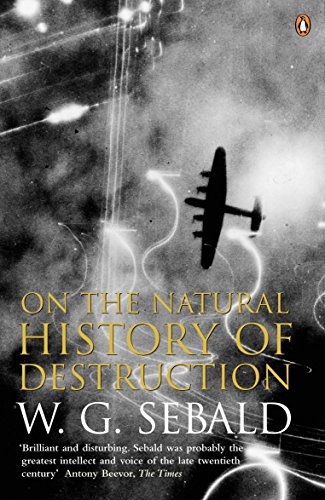
In the last years of World War II, a million tons of bombs were dropped by the Allies on one hundred and thirty-one German towns and cities. Six hundred thousand civilians died, and three and a half million homes were destroyed. When it has cast such a very dark shadow over his life and work, Sebald asks, how have so many writers allowed themselves to write it out of their experience and avoid articulating the horror? W.G. Sebald's On the Natural History of Destruction sparked a wide-ranging debate in the German press.
'Sebald makes exquisite art out of vile history' Boyd Tonkin, Independent
'One of the most important writers of our time' A.S. Byatt, New Statesman
'Demands to be read for its grand emotional power ... it absorbs and horrifies and illuminates' Scotsman
'Brilliant and disturbing' Antony Beevor, The Times
W . G. Sebald was born in Wertach im Allgäu, Germany, in 1944 and died in December 2001. He studied German language and literature in Freiburg, Switzerland and Manchester. In 1996 he took up a position as an assistant lecturer at the University of Manchester and settled permanently in England in 1970. He was Professor of European Literature at the University of East Anglia and is the author of The Emigrants, The Rings of Saturn, Vertigo, Austerlitz, After Nature, On the Natural History of Destruction, Campo Santo, Unrecounted, For Years Now and A Place in the Country. His selected poetry is published in a volume called Across the Land and the Water.
"synopsis" may belong to another edition of this title.
About the Author
W. G. Sebald was born in Germany in 1944 and died in 2001. He is the author of The Emigrants, The Rings of Saturn, Vertigo, Austerlitz, After Nature, On the Natural History of Destruction, Unrecounted, Campo Santo and Silent Catastrophes among other publications.
From the Back Cover
Sebald's On the Natural History of Destruction explores German writers' silence about a moment of mass destruction
In the last years of World War II, a million tons of bombs were dropped by the Allies on one hundred and thirty-one German towns and cities. Six hundred thousand civilians died, and three and a half million homes were destroyed. When it has cast such a very dark shadow over his life and work, Sebald asks, how have so many writers allowed themselves to write it out of their experience and avoid articulating the horror? W.G. Sebald's On the Natural History of Destruction sparked a wide-ranging debate in the German press.
'Sebald makes exquisite art out of vile history' Boyd Tonkin, Independent
'One of the most important writers of our time' A.S. Byatt, New Statesman
'Demands to be read for its grand emotional power ... it absorbs and horrifies and illuminates' Scotsman
'Brilliant and disturbing' Antony Beevor, The Times
W . G. Sebald was born in Wertach im Allgäu, Germany, in 1944 and died in December 2001. He studied German language and literature in Freiburg, Switzerland and Manchester. In 1996 he took up a position as an assistant lecturer at the University of Manchester and settled permanently in England in 1970. He was Professor of European Literature at the University of East Anglia and is the author of The Emigrants, The Rings of Saturn, Vertigo, Austerlitz, After Nature, On the Natural History of Destruction, Campo Santo, Unrecounted, For Years Now and A Place in the Country. His selected poetry is published in a volume called Across the Land and the Water.
"About this title" may belong to another edition of this title.
Other Popular Editions of the Same Title

Search results for On The Natural History Of Destruction: by Winfried...

Stock Image
On the Natural History of Destruction
Seller: World of Books (was SecondSale), Montgomery, IL, U.S.A.
Seller rating 5 out of 5 stars

Condition: Very Good. Item in very good condition! Textbooks may not include supplemental items i.e. CDs, access codes etc. Seller Inventory # 00085376349
Stock Image
On The Natural History Of Destruction
Seller: PBShop.store UK, Fairford, GLOS, United Kingdom
Seller rating 5 out of 5 stars
PAP. Condition: New. New Book. Shipped from UK. Established seller since 2000. Seller Inventory # GB-9780140298000
Seller Image
On The Natural History Of Destruction
Seller: Rarewaves.com USA, London, LONDO, United Kingdom
Seller rating 5 out of 5 stars
Paperback. Condition: New. Sebald's On the Natural History of Destruction explores German writers' silence about a moment of mass destructionIn the last years of World War II, a million tons of bombs were dropped by the Allies on one hundred and thirty-one German towns and cities. Six hundred thousand civilians died, and three and a half million homes were destroyed. When it has cast such a very dark shadow over his life and work, Sebald asks, how have so many writers allowed themselves to write it out of their experience and avoid articulating the horror? W.G. Sebald's On the Natural History of Destruction sparked a wide-ranging debate in the German press.'Sebald makes exquisite art out of vile history' Boyd Tonkin, Independent'One of the most important writers of our time' A.S. Byatt, New Statesman 'Demands to be read for its grand emotional power . it absorbs and horrifies and illuminates' Scotsman'Brilliant and disturbing' Antony Beevor, The TimesW . G. Sebald was born in Wertach im Allgäu, Germany, in 1944 and died in December 2001. He studied German language and literature in Freiburg, Switzerland and Manchester. In 1996 he took up a position as an assistant lecturer at the University of Manchester and settled permanently in England in 1970. He was Professor of European Literature at the University of East Anglia and is the author of The Emigrants, The Rings of Saturn, Vertigo, Austerlitz, After Nature, On the Natural History of Destruction, Campo Santo, Unrecounted, For Years Now and A Place in the Country. His selected poetry is published in a volume called Across the Land and the Water. Seller Inventory # LU-9780140298000
Seller Image
On The Natural History Of Destruction (Paperback)
Published by
Penguin Books Ltd, London, 2004
ISBN 10: 0140298002
ISBN 13: 9780140298000
New
Paperback
Seller: Grand Eagle Retail, Bensenville, IL, U.S.A.
Seller rating 5 out of 5 stars
Paperback. Condition: new. Paperback. W. G. Sebald has become one of the most admired European writersIn the last years of World War II, the Allies dropped a million tons of bombs on Germany. Yet the German people have been silent about the resulting devastation and loss of life, failing to recognise the terrible shadow that destruction from the air cast over their land. Here W. G. Sebald, one of the most brilliant writers of the twentieth century, asks why it is we turn our backs on the horrors of war, and, in addressing our response to the past, bravely offers insights into how we live now. In the last years of World War II, a million tons of bombs were dropped by the Allies on one hundred and thirty-one German towns and cities. This title explores German writers' strange silence about a moment of mass destruction. Shipping may be from multiple locations in the US or from the UK, depending on stock availability. Seller Inventory # 9780140298000
Stock Image
On The Natural History Of Destruction: by Winfried Georg Sebald
Published by
Penguin Books Ltd, United Kingdom, London, 2004
ISBN 10: 0140298002
ISBN 13: 9780140298000
Used
Paperback
Seller: WorldofBooks, Goring-By-Sea, WS, United Kingdom
Seller rating 5 out of 5 stars
Paperback. Condition: Very Good. Sebald's On the Natural History of Destruction explores German writers' silence about a moment of mass destruction In the last years of World War II, a million tons of bombs were dropped by the Allies on one hundred and thirty-one German towns and cities. Six hundred thousand civilians died, and three and a half million homes were destroyed. When it has cast such a very dark shadow over his life and work, Sebald asks, how have so many writers allowed themselves to write it out of their experience and avoid articulating the horror? W.G. Sebald's On the Natural History of Destruction sparked a wide-ranging debate in the German press. 'Sebald makes exquisite art out of vile history' Boyd Tonkin, Independent 'One of the most important writers of our time' A.S. Byatt, New Statesman 'Demands to be read for its grand emotional power . it absorbs and horrifies and illuminates' Scotsman 'Brilliant and disturbing' Antony Beevor, The Times W . G. Sebald was born in Wertach im Allgau, Germany, in 1944 and died in December 2001. He studied German language and literature in Freiburg, Switzerland and Manchester. In 1996 he took up a position as an assistant lecturer at the University of Manchester and settled permanently in England in 1970. He was Professor of European Literature at the University of East Anglia and is the author of The Emigrants, The Rings of Saturn, Vertigo, Austerlitz, After Nature, On the Natural History of Destruction, Campo Santo, Unrecounted, For Years Now and A Place in the Country. His selected poetry is published in a volume called Across the Land and the Water. The book has been read, but is in excellent condition. Pages are intact and not marred by notes or highlighting. The spine remains undamaged. Seller Inventory # GOR003048163
Stock Image
On the Natural History of Destruction
Seller: Anybook.com, Lincoln, United Kingdom
Seller rating 5 out of 5 stars
Condition: Poor. This is an ex-library book and may have the usual library/used-book markings inside.This book has soft covers. Book contains pen, pencil & highlighter markings. In poor condition, suitable as a reading copy. Please note the Image in this listing is a stock photo and may not match the covers of the actual item,300grams, ISBN:9780140298000. Seller Inventory # 3718903
Stock Image
On The Natural History of Destruction
Seller: Books Puddle, New York, NY, U.S.A.
Seller rating 4 out of 5 stars

Condition: New. pp. 224. Seller Inventory # 2642962262
Stock Image
On The Natural History of Destruction
Seller: Majestic Books, Hounslow, United Kingdom
Seller rating 4 out of 5 stars
Condition: New. pp. 224. Seller Inventory # 49820297
Stock Image
On The Natural History Of Destruction: by Winfried Georg Sebald
Seller: Kennys Bookstore, Olney, MD, U.S.A.
Seller rating 5 out of 5 stars
Condition: New. In the last years of World War II, a million tons of bombs were dropped by the Allies on one hundred and thirty-one German towns and cities. This title explores German writers' strange silence about a moment of mass destruction. Translator(s): Bell, Anthea. Num Pages: 224 pages, b&w illustrations. BIC Classification: 1DFG; 2ACG; DSBH; HBJD; HBTB; HBWQ; JW; KNTJ. Category: (G) General (US: Trade). Dimension: 197 x 130 x 17. Weight in Grams: 162. 2004. 1st Edition. paperback. . . . . Books ship from the US and Ireland. Seller Inventory # 9780140298000
Stock Image
On The Natural History Of Destruction
Seller: Revaluation Books, Exeter, United Kingdom
Seller rating 5 out of 5 stars
Paperback. Condition: Brand New. 224 pages. 7.64x5.08x0.83 inches. In Stock. Seller Inventory # __0140298002