
Items related to Managing the Mobile Workforce: Leading, Building, and...
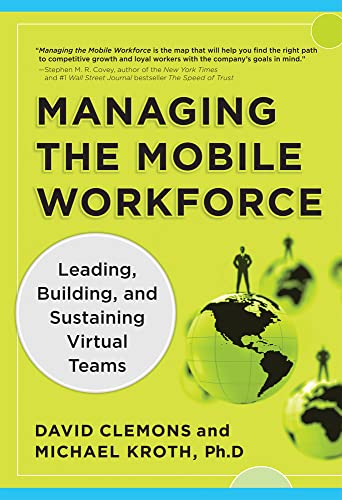
Managing the Mobile Workforce: Leading, Building, and Sustaining Virtual Teams (BUSINESS SKILLS AND DEVELOPMENT) - Hardcover
Synopsis
In the global marketplace, people can work practically anywhere and anytime. Managing the Mobile Workforce shares stories about organizations that have taken the risk to unleash--literally--their workers from the chains of daily commutes, 9-to-5 business hours, and the same old cubicles they have sat in day after day, year after year, and even decade after decade.
David Clemons, an entrepreneur within the enterprise mobile and online training industry, and Michael Kroth, an expert and author on how leaders can create highly motivating work environments, together deliver rock-solid guidance on the essentials for building, leading, and sustaining a highly productive virtual workforce. Clemons and Kroth present the real-life relationships between managers and employees through interviews of thought leaders and executives that will engage your thinking about how the right leadership, combined with technology, can make all the difference.
,
Tools, tips, and strategies for hiring, training, supporting, and motivating the modern mobile workforceIDC has estimated that mobile workers worldwide will surpass one billion by 2011. This isn't just a trend, but the direction that business is heading. Managing the Mobile Workforce gives managers and executives at all levels key essentials for coping with this new reality, empowering them to create, sustain, support, and reward a highly passionate and productive mobile work force. Managing the Mobile Workforce- Shares startling facts and figures indicating how many workers already are and will be working
- Explains why trust is the glue that binds managers and workers together across vast distances―and how to achieve it
- Provides strategies to manage performance in a virtual world--and why mobility can actually increase productivity
- Reveals how technology and great leadership can reduce the virtual distance between you and your mobile workers
- Gives eight motivational principles and tools for mobile leaders
- Suggests a new way of looking at the virtual team development process
Stories from top execs at Samsung, Deloitte LLP, Hewlett-Packard, LEGO, and the Federal Office of Personnel Management, along with thought leaders like Joel Barker and Stephen M. R. Covey and other key industry experts will show you how the mobile workforce is changing the very landscape of business--and what you can do starting today to recreate their successes in your own organization.
David Clemons has provided 20 years of executive leadership and innovation to the digital education industries. Today, as the CEO of Achieve Labs Inc., David is speaking nationally and internationally within the mobile industry. David lives in Eagle, Idaho, as a true mobile worker and employs a large "mobiForce," including international partners and content specialists.
Michael Kroth, Ph.D., is an assistant professor at the University of Idaho in Adult/Organizational Learning and Leadership. He has authored Transforming Work: The Five Keys to Achieving Trust, Commitment, and Passion in the Workplace (2001), co-authored with Patricia Boverie; The Manager as Motivator (2006) and Career Development Basics (2009) with McKay Christensen. He is a memeber of the National Speaks Association and speaks nationally and internationally.
Learn more about this book and David and Michael's work at www.managingthemobileworkforce.com.
"synopsis" may belong to another edition of this title.
About the Author
David Clemons has provided 20 years of executive leadership and innovation to the digital education industries. Today, as the CEO of Achieve Labs Inc., David is speaking nationally and internationally within the mobile industry. David lives in Eagle, Idaho, as a true mobile worker and employs a large "mobiForce," including international partners and content specialists.
Michael Kroth, Ph.D., is an assistant professor at the University of Idaho in Adult/Organizational Learning and Leadership. He has authored Transforming Work: The Five Keys to Achieving Trust, Commitment, and Passion in the Workplace (2001), co-authored with Patricia Boverie; The Manager as Motivator (2006) and Career Development Basics (2009) with McKay Christensen. He is a memeber of the National Speaks Association and speaks nationally and internationally.
Excerpt. © Reprinted by permission. All rights reserved.
MANAGING THE MOBILE WORKFORCE
Leading, Building, and Sustaining Virtual Teams
By DAVID CLEMONS, MICHAEL KROTHThe McGraw-Hill Companies, Inc.
Copyright ©2011 The McGraw-Hill Companies, Inc.
All rights reserved.
ISBN: 978-0-07-174220-7All rights reserved.
Contents
| Acknowledgments | |
| Introduction: Why Should You Read This Book? | |
| Part One: Thinking Strategically about the Mobile Workforce | |
| Chapter One: Moving to Mobility | |
| Chapter Two: Discovering a New Workforce Paradigm | |
| Chapter Three: Presence | |
| Chapter Four: Trust or Bust | |
| Chapter Five: Strategic Leadership in a Virtual World | |
| Part Two: Performance Management and the Mobile Workforce | |
| Chapter Six: Autonomy or Not Autonomy? That Is the Question | |
| Chapter Seven: The Mobile Performance Management Process | |
| Chapter Eight: Hiring and Preparing Great Mobile Talent | |
| Chapter Nine: The Eight Principles Model | |
| Part Three: Technology, Tools, and Teams | |
| Chapter Ten: Keeping Up with the Phoneses | |
| Chapter Eleven: Developing Your Virtual Team | |
| Notes | |
| Index |
Excerpt
CHAPTER 1
Moving to Mobility
Creating Mobile Urgency—Let's Get started!
This is not just being on the phone anymore. This is now about an extensionof my life. This is an extension of my personality. If you look at the declineof traditional land lines from the carriers, the trends are compelling. Peopleare using this as their primary device. It is functional that way.
—Peter Denagy, Samsung Telecommunications America, Senior Director andGeneral Manager, U.S. Enterprise Mobility Enablement
The world is in the midst of a mobile feeding frenzy. The explosion of wirelessbroadband networks, mobile devices, social networking, cloud computing, and aglobal economy is changing communications and computing at an unprecedentedpace. Organizations of all kinds will find the prospects of lower costs, morelocalized service, and ultra-motivated mobile workers to be exhilarating. Forbusinesses, the stage is set to take advantage of the incredible opportunity toapply new forms of work and technologies that will lead to competitive advantagein their markets. It's not about getting your hands on the latest toy; instead,it's about getting your head wrapped around a corporate mobile strategy thatworks for your organization. How can you exploit mobile technologies to leverageyour business? How do you transition your workforce into a mobile environment inways that competitors cannot easily replicate?
Take out your mobile phone. Yes, it's okay to do so right now. Text the word"MOBIFORCE" to 878787 to register in our Mobile Workforce Registry. When youregister, you will instantly receive a text message with content from usregarding building your mobile workforce. Open the text message, and click onthe link that's provided within the SMS message. Within seconds, you will beconnected to a mobile world of content.
You will find what we call "freemiums" like this in each chapter of the book.Just look for icons similar to what you see here and then experience what mobileworkers throughout the world now have access to—globally available, usefulknowledge that can be accessed and applied immediately.
THERE'S AN APP FOR THAT—THIS BOOK!
C level executives (CEOs, CFOs, COOs, and other top corporate officers) need torethink their businesses from the perspective of a mobile workforce environment.How can products or services be differentiated with mobile technologies? Arethere cost advantages? Can business cycle times be reduced? Customer serviceimproved? How can your workforce be transitioned so workers excel in a mobileenvironment? How will you sustain that new paradigm? A robust mobile technologyinfrastructure is foundational, but, ultimately, achieving competitive advantagewill depend upon your people, not your technology.
Let's begin by exploring the current mobile ecosystem and why it's so importantto rethink what you are doing and how you might push forward with a new mobilestrategy.
UNPLUGGED: BUSINESS STRATEGY AND THE MOBILE TECHNOLOGY ENVIRONMENT
It is almost impossible to overstate the mobile revolution. The ability tocommunicate quickly, to receive and send information at a moment's notice, andto collaborate on urgent company issues easily from anywhere in the world isessential in today's business environment. The Internet surrounds us like theoxygen we breathe, saturating our personal and professional space. Having thecapacity to connect 24 hours a day, 7 days a week (24/7) is now an expectation,just as is turning on a radio and assuming music will emerge, or flippingthrough channels on your digital TV with your remote. It's always on. You arewithin reach of a mobile network from a mobile carrier or local Wi-Fi hot spotjust about anywhere you go. The Internet has become a lifeline for all of us.Moving at the speed of life, we expect technology to keep up with us,with the consequence that we too are "always on." When we finally sit down witha tasty cup of java or at our favorite deli, we know we can connect with ourcompany, our employees, our partners, and our personal network of contacts.
Always-on broadband connections set us free, but they also create a new set ofbusiness rules and business expectations. In the last five minutes, how manytimes has your mobile device alerted you of incoming e-mails, a personal textmessage, a Twitter message, or a news alert? We now expect information to be,literally, at our fingertips at all times. Instant information is pushed at usfrom everywhere on a global scale. Some people consider this to be an intrusion,a total interruption of their focus. Others recognize the unlimitedopportunities inherent in mobile technology, mobile applications, and mobilemanagement strategies that can be leveraged to achieve sustainable competitiveadvantage.
Connections alone don't solve the total puzzle. It takes an ocean of technologyand supporting hardware to connect the dots. Technology needs to be managed,monitored, updated, and easily used. The better the solution, the less trainingand information technology (IT) support users need. Technology today can beimplemented at every organizational level and for almost every business processneeded.
Technology controls the Internet and the massive amounts of communicationflowing from city to city, country to country, and even from globe to globe. Andit just keeps getting better. How? Well, for one, technology seems to have takenon human characteristics. It's friendlier than ever before. It's smart enough towork in the ways we think and behave. It anticipates our desires. It's proactiveenough to stay just a bit in front of our needs by delivering information almostimmediately, with more relevance, with content more targeted to what weneed—sometimes even before we know we need it. And it does all thisanywhere and anytime through the mobile devices we hold in our hands.
You can't help but observe the growth of Twitter racing over the planet with abillion "tweets" per month, or the hundreds of millions of LinkedIn memberssharing professional career information, or the millions of digital books beingdownloaded through Amazon or Barnes & Noble, or the billions of downloads of theApple iPhone applications that entertain us and provide very useful applicationsto make our lives easier.
Who would have thought that Apple Inc. could have driven a mobile market vastenough to inspire three billion mobile app downloads by January of 2010? Thispower brand is unlike any other, and its innovation and ability to deliver thebest user experience has been a fascinating success story that is exciting towatch. It has us "iTuned" for new announcements. By launching the iPad in 2010,Apple primed the pump for all its other products and services. Applereconfigured the business it is in, but, more powerfully and pervasively, itdestroyed assumptions about what constrains the way all organizations andsectors might communicate and interact with one another and the world. There isnow a riot of creative, innovative activity capitalizing on the opportunity thathas become newly visible—just like it always does when there is a majorparadigm shift in the way people view the world.
The fact is that mobile connectivity is rapidly becoming the standard ratherthan the exception. Remember the dinosaurs? That's your product or service ifyou aren't carefully considering how you might apply connectivity to it. Newproducts with broadband connection to the Internet that are now showing up atconsumer stores such as Target, Best Buy, and Staples are replacing thoseproducts that don't have it. Manufacturers who know how to produce technologyproducts that integrate wireless may survive; those that don't, surely won't.Consumers of the past uploaded and moved information in raisin-sized Internetbytes compared to consumers today, who can move truck-loads of data, videomedia, and urgent communications over VoIP (Voice Over Internet Protocol) infast, easy-to-use services.
Mobility lives on the Internet. It breathes on terabytes of information andserves billions of people at the same time. We seemingly can't live without ourInternet connections and the fanfare we receive on our favorite social mediasites, such as Facebook, MySpace, Twitter; video portals, such as YouTube; orour personal blogging sites. Like it or not, most of us have become dependent onthe Internet to help us keep up with our friends and family, not to mention ourwork.
There is no question that, whether we like it or not, the Internet connects usto urgent, important information; provides us a lifestyle filled withindividualized products and services that entertain, educate, and inform uson demand; and introduces us to new ideas, ways of thinking, and people.
The mobile phone industry, and others, have powered up the perfect solutions forall of us if what we want is to stay connected to work and play. Technologydevices give us the freedom and power to live and work where we want. Mobilityis not just for the rich or for executives or for powerful people anymore.Everyone wants to connect, to call, to text, to search, to navigate, to listen,to translate, to coach, to train, to collaborate, to upload, to share (and dojust about anything else you can think of)—and they can!
WHAT IS MOBILITY?
Someone with mobility has the ability to move from room to room, building tobuilding, city to city, or country to country without losing the ability tofunction successfully. Even when we are moving outside the wired-in serviceterritory, the disconnect is only temporary. Even when service is weak orspotty, we can quickly connect with our family or our boss. Even when we aresharing confidential information a continent away, we know it is secure.
Already there are large pools of Wi-Fi installations and Wi-Fi towers that allowpeople to move seamlessly among mobile carriers. It won't be too long beforemost or all of the planet will have seamless connectivity. Then how will youhide from your boss? (Or from your employees ...)
Most people couldn't care less about the technology that under-girds theirmobile devices. They just want them to work. It won't matter much to youremployees that you spent thousands of hours and millions of dollars to get themjust the right device, software, and knowledge management system. All they wantto know is whether all that stuff will help them to get the job done or whetherit will be an obstacle.
Technology is complex, but your customers and employees expect it to beintuitive. They want technology that is simple, works the way they think, andsupports the way they act. Technology—for the average worker—hasto understand us a lot more than we need to understand it. It needs to followour behaviors and interests, not to dictate them. This is a very complexrequest, but the winners of the technology race will be those that get thisright. They will study deeply the connection between the human interface withtechnology. The more effortless that interaction, the better.
A WORKFORCE THAT CAN EXECUTE A MOBILE BUSINESS STRATEGY
How can you differentiate your workforce from competitors who are chasing thesame competitive advantage? It won't be accomplished simply by scooping up thelatest technology. Sure, knowing what technology investments to buy and how touse the latest software and hardware are fundamental competencies just to stayin the game. But that will not give you long-term competitive advantage.
Let's assume you have developed a business strategy to exploit the enormouspotential of mobile technologies. Let's assume you've identified ways toleverage this strategy to achieve competitive advantage. While the strategy andthe technologies are essential, technology is nothing more than competitiveparity. Your competitors have or soon will have access to the same mobiletechnologies you have. So how do you turn parity into competitive advantage? Itcomes only by leveraging the use of technology to advance core businessstrategies. And, that depends on your people. Without a companion mobileworkforce strategy, the best mobile business strategy will falter.
WHAT TO CALL IT?
Deciding the terminology to describe your mobile workforce is important so thatyour company understands whom you are talking about. The terms "mobileworkforce," "tele-workforce," "distributed workforce," and "virtual workforce"are used interchangeably on a global basis. In this book, we refer toindividuals who are not physically located within a centralized physicalbuilding and those who move between work locations within a centralizedlocation, and who are able to access company resources through private networks,the Internet, and mobile networks as "mobile workers." More than one mobileworker (such as a manager with several mobile workers) would be considered a"mobile workforce." The mobile workforce can include both employees andcontractors who provide valuable services to either not-for-profit or for-profitentities.
DEVELOPING A MOBILE WORKFORCE STRATEGY
Developing a high-level mobile workforce strategy can be broken down into fourspecific steps.
Step One: Evaluate for Strategic Fit
Some organizations are going to be more likely candidates to move to a mobilework environment than others. Some parts of an organization may bebetter candidates than others. Here are some factors to take into account whenconsidering a move to mobility:
* What are your competitors doing? If everyone in your industry ismoving to mobility and you aren't, that's a red flag.
* How might moving to mobility change the competitive playing field in yourindustry? If all your foes are making customers come into a centrallocation, could you provide on-location service if you had a mobile workforce?Could you become the low-cost provider if you didn't have to pay for officespace?
* In what ways could workforce mobility further your competitivestrategy? If you want to expand to additional markets, would having a mobileworkforce make it easier? If you are developing core competence in a particulararea, would access to mobile talent worldwide make a difference?
Step Two: Assess the Costs and Benefits
There are many potential benefits to having a mobile workforce; here are a few:
* It opens a window to competitive advantage over competitors.
* It improves customer relationships.
* It reduces costs of salespeople, travel, and facilities.
* It increases employee productivity. (Employees are less distracted and moremotivated, and they use time more efficiently.)
* It locates employees geographically near customers.
* It improves work–life balance and employee flexibility, includingreduced commute time.
There are potential costs involved as well; here are a few:
* It requires an investment in technology, both hardware and software. (Whatwill this cost you? An estimate of the hard numbers is necessary.)
* Time for managing is increased. For example, more communication is needed.Many executives we interviewed told us there is an appreciable amount of "extrawork" associated with day-to-day communication for a mobile workforce. So thequestion becomes: how much time is needed to "replace" face-to-face meetings andother interactions that occur naturally in a colocated environment?
* There are additional nontechnology costs. As the mobile workforce develops,the enterprise leadership and management teams needs to accept the added coststo hire, train, and support a mobile workforce. If sufficient resources are notdedicated to these initiatives, the company risks high employee turnover,decreased loyalty, and lost productivity—the opposite of what shouldoccur!
* There might be employee and managerial resistance. If you don't handle thistransition well, you might hurt the organizational structure and create adysfunctional workforce.
Step Three: Plan and Align the Organization
Aligning people with new initiatives can be a daunting task even for the mostseasoned executive. Transitioning to a mobile workforce requires significantchanges you'll have to plan for in human resource management policies andprocedures, information systems, legal issues, and training capacity. And that'snot all. You'll need buy-in from each of the affected business units. Eachdepartment stakeholder needs to play an important role in the identification ofobjectives, opportunities, and the risks inherent in a mobile workforce. Eachbrings a unique perspective in transitioning from a traditional workforce to amobile workforce. You are going to want advocates who understand the businessstrategy, objectives, alignments, and requirements of the company. Your managersmay be the most important constituency you need to consider, because managing amobile workforce takes a lot of time and dedication. You'll have to motivate andtrain your managers to lead this newly organized workforce.
Stakeholder collaboration optimizes the efficiency and effectiveness of thetransition to a mobile workforce. Here are some alignment issues you'll need toconsider:
* Written policies. These policies are updated based on the needs andobjectives of the business unit. The value of written policies is that theyeasily can be distributed for compliance requirements and signed by theemployees, to confirm receipt of the policies.
* Management. Sales and IS/IT must work together regarding the cross-management needs of hardware, software, and support.
* Software and hardware applications. Selection and purchase of softwareshould be considered a cross-business unit concern. Training and support arecost centers to the enterprise that get heavy hit with support needs if theapplications selected are hard to learn and/or the hardware fails.
You will want to plan this transition carefully, perhaps piloting the proposedchanges and thereby developing early adopter advocates.
Step Four: Execute and Improve
After all the assessing, planning, and aligning, it's time to step off the edgeand give it a try. That's the only way you'll learn what works and what needsimprovement. Again, pilot projects can mitigate your risk and add advocates forthe change.
(Continues...)
(Continues...)
Excerpted from MANAGING THE MOBILE WORKFORCE by DAVID CLEMONS, MICHAEL KROTH. Copyright © 2011 by The McGraw-Hill Companies, Inc.. Excerpted by permission of The McGraw-Hill Companies, Inc..
All rights reserved. No part of this excerpt may be reproduced or reprinted without permission in writing from the publisher.
Excerpts are provided by Dial-A-Book Inc. solely for the personal use of visitors to this web site.
"About this title" may belong to another edition of this title.
Search results for Managing the Mobile Workforce: Leading, Building, and...

Stock Image
Managing the Mobile Workforce: Leading, Building, and Sustaining Virtual Teams
Published by
McGraw-Hill Education - Europe, 2010
ISBN 10: 0071742204
ISBN 13: 9780071742207
Used
Hardcover
Seller: World of Books (was SecondSale), Montgomery, IL, U.S.A.
Seller rating 5 out of 5 stars

Hardback. Condition: Fair. Tools and strategies for hiring, training, supporting, and motivating the more than 1 billion mobile workers worldwide. Seller Inventory # 00102980243
Stock Image
Managing the Mobile Workforce: Leading, Building, and Sustaining Virtual Teams
Published by
McGraw-Hill Education - Europe, 2010
ISBN 10: 0071742204
ISBN 13: 9780071742207
Used
Hardcover
Seller: World of Books (was SecondSale), Montgomery, IL, U.S.A.
Seller rating 5 out of 5 stars
Hardback. Condition: Good. Tools and strategies for hiring, training, supporting, and motivating the more than 1 billion mobile workers worldwide. Seller Inventory # 00104399947
Stock Image
Managing the Mobile Workforce: Leading, Building, and Sustaining Virtual Teams
Seller: Your Online Bookstore, Houston, TX, U.S.A.
Seller rating 5 out of 5 stars
hardcover. Condition: Fair. Seller Inventory # 0071742204-4-37735391
Seller Image
Managing the Mobile Workforce: Leading, Building, and Sustaining Virtual Teams
Seller: Zoom Books Company, Lynden, WA, U.S.A.
Seller rating 5 out of 5 stars
Condition: very_good. Book is in very good condition and may include minimal underlining highlighting. The book can also include "From the library of" labels. May not contain miscellaneous items toys, dvds, etc. . We offer 100% money back guarantee and 24 7 customer service. Seller Inventory # ZBV.0071742204.VG
Stock Image
Managing the Mobile Workforce: Leading, Building, and Sustaining Virtual Teams
Published by
McGraw-Hill Education - Europe, 2010
ISBN 10: 0071742204
ISBN 13: 9780071742207
Used
Hardcover
Seller: World of Books Inc, Montgomery, IL, U.S.A.
Seller rating 4 out of 5 stars

Hardback. Condition: Good. Tools and strategies for hiring, training, supporting, and motivating the more than 1 billion mobile workers worldwide. Seller Inventory # CIN0071742204G
Stock Image
Managing the Mobile Workforce: Leading, Building, and Sustaining Virtual Teams
Published by
McGraw-Hill Education - Europe, 2010
ISBN 10: 0071742204
ISBN 13: 9780071742207
Used
Hardcover
Seller: World of Books Inc, Montgomery, IL, U.S.A.
Seller rating 4 out of 5 stars
Hardback. Condition: Fair. Tools and strategies for hiring, training, supporting, and motivating the more than 1 billion mobile workers worldwide. Seller Inventory # CIN0071742204A
Stock Image
Managing the Mobile Workforce: Leading, Building, and Sustaining Virtual Teams
Seller: ThriftBooks-Phoenix, Phoenix, AZ, U.S.A.
Seller rating 5 out of 5 stars
Hardcover. Condition: Very Good. No Jacket. May have limited writing in cover pages. Pages are unmarked. ~ ThriftBooks: Read More, Spend Less. Seller Inventory # G0071742204I4N00
Stock Image
Managing the Mobile Workforce: Leading, Building, and Sustaining Virtual Teams
Seller: ThriftBooks-Dallas, Dallas, TX, U.S.A.
Seller rating 5 out of 5 stars
Hardcover. Condition: Very Good. No Jacket. Missing dust jacket; May have limited writing in cover pages. Pages are unmarked. ~ ThriftBooks: Read More, Spend Less. Seller Inventory # G0071742204I4N01
Stock Image
Managing the Mobile Workforce: Leading, Building, and Sustaining Virtual Teams
Seller: ThriftBooks-Atlanta, AUSTELL, GA, U.S.A.
Seller rating 5 out of 5 stars
Hardcover. Condition: Very Good. No Jacket. May have limited writing in cover pages. Pages are unmarked. ~ ThriftBooks: Read More, Spend Less. Seller Inventory # G0071742204I4N00
Stock Image
Managing the Mobile Workforce: Leading, Building, and Sustaining Virtual Teams
Seller: ThriftBooks-Dallas, Dallas, TX, U.S.A.
Seller rating 5 out of 5 stars
Hardcover. Condition: Very Good. No Jacket. May have limited writing in cover pages. Pages are unmarked. ~ ThriftBooks: Read More, Spend Less. Seller Inventory # G0071742204I4N00