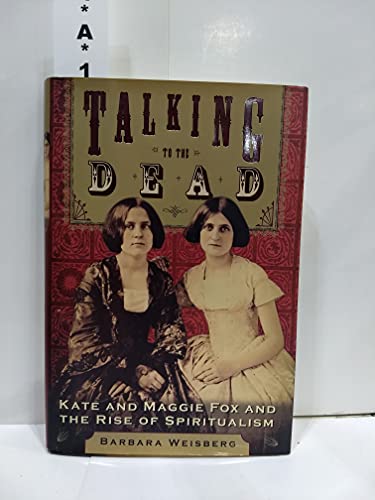
March 1848. Mysterious knocks are heard in a little house in rural New York, throwing the community into turmoil. Are the children who live there -- Kate and Maggie Fox, sisters aged eleven and fourteen -- making the raps to trick their parents? Or are the girls mediums for otherworldly messages? From a battery of strange sounds and the excitement they create, modern Spiritualism is born.
Talking to the Dead: Kate and Maggie Fox and the Rise of Spiritualism follows the remarkable story of the Fox sisters, who were catapulted to fame after word spread that they communicated with spirits. Within a few years, tens of thousands of Americans were flocking to seances. An international movement developed. Yet forty years after those first knocks, the sisters shocked the country by denying that they had ever been in contact with the dead. Shortly after, in another stunning reversal, they changed their story again and reaffirmed their faith in the spirit world. Were the Fox sisters con artists who had taken a childhood prank too far? Or were they really in touch with "voices from beyond"?
In this riveting biography, Barbara Weisberg traces not only the lives of Kate, Maggie, and their family -- including the girls' shrewd and charismatic sister, Leah -- but also the social, religious, economic, and political forces that helped shape the Spiritualist movement. A vivid, compelling overview of a remarkable period in U.S. history, Talking to the Dead provokes questions about belief systems, the power of celebrity, the wish to reconcile faith and science, and the timeless quest for knowledge about life after death.
Talking to the Dead
By Weisberg, BarbaraHarperSanFrancisco
ISBN: 0060566671Chapter One
"A Large, Intelligent and Candid Community"
Two weeks before Christmas 1847 a blacksmith named JohnDavid Fox, accompanied by his wife, Margaret, and their twoyoungest daughters, Kate and Maggie,moved to the rural community ofHydesville, New York. One of the worst winters in recent memory waspummeling the region, a windy, fertile plain in the northwest corner ofthe state.
"The almost unparalleled bad weather which we have experiencedsince 'cold December' set in," complained the Western Argus, a local newspaper,"nearly diverted our attention from the fact that Christmas isalmost at hand." The writer regretted that residents were staying homeby the fire instead of venturing out, by wagon or sleigh, to make the customaryholiday calls.
The weather not only dampened good cheer, it also stalled constructionon the new home that John and Margaret were building two milesfrom Hydesville, next to their son David's farm. Since work wouldn't resume until spring, the couple had rented a modest, one-and-a-half-storyframe house to wait out the winter.
Today Hydesville has vanished from all but the most detailed localmaps, but it was -- and is -- part of the township of Arcadia, located inNew York's Wayne County. Farmhouses, barns, and steeple-capped villagesdot the surrounding countryside; here and there flat-topped hills,called drumlins, rise up like ancient burial grounds. The county's northernboundary is Lake Ontario, which separates western New York fromCanada. In August, fields of peppermint, a major crop, blossom with pinkflowers that release a faint, delicious scent, but winters like the one of1847 bring month after month of slate skies and snow.
Slight but sturdy, a country girl, Maggie was an ebullient fourteen-year-old with glossy dark hair, a broad-boned face, and frank brown eyes.Black-haired Kate was slim and soulful, at ten years old still very much achild, with compelling eyes that struck some people as deep purple andothers as black or gray. The girls were the youngest of six children, theonly two still living at home with their parents, and they were oftenthrown back on each other for company.Their four siblings, Leah, Elizabeth,Maria, and David, were already adults with families of their own.
The girls' father, John, was a wiry man who peered out at the worldthrough brooding eyes, his spectacles balanced on his hawk nose. Sometimesconsidered disagreeable by people other than his children, he wasintense and inward, an impassioned Methodist who knelt each morningand night in prayer.
His wife, the former Margaret Smith,was in most respects his opposite.A kindly matron with an ample bosom and a double chin, she was aschatty and sociable as her husband was withdrawn. In the uncharitableopinion of one Hydesville neighbor, sweet-faced Margaret was superior toJohn "in weight and good looks" and in personality "the best horse in theteam by odds."
Already in their fifties, the weary survivors of economic reversals andmarital crises, John and Margaret undoubtedly hoped that when theirnew home was finished it would be their last: a permanent, comfortableplace to complete the tasks of child-rearing. They even may havelooked forward to help from their grown children who lived nearby.
Raising two young daughters was a responsibility that must haveweighed increasingly on them as they aged. What would happen if theyfell ill? Or if they died? How would Kate and Maggie manage, and whowould care for them?
The couple had accumulated little in the way of land or money, andgirls who grew up without either eventually needed to find a devotedhusband or a decent livelihood.Teaching was one alternative for a youngwoman, the drudgery of factory labor another. It was possible to slipdown the ladder of opportunity as well as to climb up it.
A close-knit family, however, could provide refuge in times of trouble,and despite a history of geographical dislocations and separations, Johnand Margaret's six children had remained remarkably attached to oneanother. With the exception of Elizabeth, who lived in Canada with herhusband, they had settled down within an easy radius of one another,having forged what Maggie called "tender ties" to western New York.
Twenty-seven-year-old David Smith Fox, a farmer, lived in Arcadiawith his wife and three children in the house that had once belonged tohis maternal uncle, John J. Smith. Surrounded by the peppermint fields,filled with good conversation and well-thumbed books, the farm was aplace where friends and family liked to gather. Maria, who lived only afew miles from her brother, had done her part to solidify family bonds bymarrying one of her cousins, Stephen Smith.
Leah, the oldest of the six Fox siblings, had settled farther away, thirtymiles west of Arcadia in the thriving young city of Rochester, New York,but she too retained close ties to her family. Her adolescent daughter,Lizzie, spent almost as much time in Hydesville with her young aunts,Kate and Maggie, as she did with her mother in Rochester.
Officially a hamlet within Arcadia's borders, Hydesville was an ordinarylittle cluster of farms and establishments that served the farmer: asawmill, gristmill, and general store, along with a few artisans' workshopssuch as the cobbler's. The hamlet had been named for Henry Hyde, adoctor who arrived in Arcadia by wagon in 1810, in the days beforephysicians needed either a license or formal training.
Death was a constant fact of life. The reaper struck with fire anddrowning; typhus, malaria, yellow fever, and a host of other diseases; accidents that ranged from the swift shock of a horse's kick to a slowspreadinginfection from a cut finger; and suicide and murder. More thanone-fifth of the children born died before their first birthday; at birth theaverage life expectancy for an adult was little more than forty ...
Continues...Excerpted from Talking to the Deadby Weisberg, Barbara Excerpted by permission.
All rights reserved. No part of this excerpt may be reproduced or reprinted without permission in writing from the publisher.
Excerpts are provided by Dial-A-Book Inc. solely for the personal use of visitors to this web site.