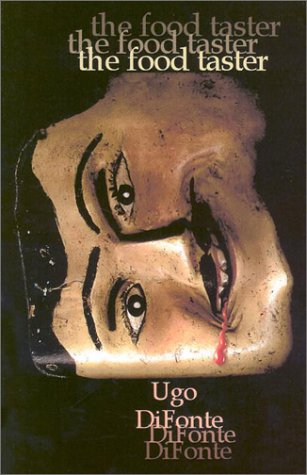
When the starving peasant, Ugo DiFonte and his eleven-year-old daughter Miranda are snatched from their farm by the despot Duke Federico Basillione DiVincelli, Ugo thinks life can't get any worse. He is sadly mistaken. The Duke orders Ugo to be his new foodtaster, a hazardous job made even more so by the Duke's many enemies.
Ugo quickly acquaints himself with the tools of his profession: poisons, antidotes, and every type of cuisine. Thus equipped, and with his own much needed wit, imagination, and, most of all, coraggio (guts), he attempts to survive a series of deadly intrigues, all the while trying to protect his strong-willed daughter from her own adolescent desires and the lustful cravings of powerful and dangerous men.
Veering from sumptuous descriptions of the food Ugo must taste but cannot enjoy, to lavish portraits of the court and its residents, Ugo's first person narrative gives us a finely detailed account of the High Renaissance from a peasant's perspective. He also shows us the little seen underbelly where poverty, disease, and cruelty are the order of the day.
Filled with moments of tenderness, unexpected humor, and painful candor, The Foodtaster is the story of a man rising to the occasion, and in doing so, finds his true purpose in life.
The Food Taster
the story of my incredible life
By Ugo DiFonte
Translated by Peter Elbling
THE PERMANENT PRESS
Copyright © 2002 Peter Elbling.
All rights reserved.
ISBN: 1-57962-047-7
Chapter One
i
April, 1534
For years after my mother hanged herself, I wished I had been older or stronger so that I could have stopped her. But since I was only a child who could not even reach her waist I had to watch helplessly until it was over.
The day before, we had celebrated the feast of San Antony stuffing ourselves on roast pig, cabbage, beans, polenta, and dried chestnuts. We stuffed ourselves because the plague had been walking through the valley for weeks, striking whomever it pleased, and no one knew if they would live to see the sun rise.
Now it was evening and mamma and I were stating at the hilltops where my father and my older brother, Vittore, were lighting bonfires. I preferred to stay with my mother. I liked it when she scratched my head, put her arms around me and called me "my little Prince." Besides, that afternoon that bastard Vittore had banged my head against a tree and it still hurt.
It was dark, there was no moon, but I could hear my father's bellowing over everyone else's. The wind teased the fires this way and that as a man teases a dog by pulling on a stick in its mouth. Then the flames shot straight into the air and for the blink of an eye I could see the men standing like ants on the very top of the hills. Suddenly, one of the bonfires toppled over and bounced down the hill, a huge fiery ball, spinning over and over, faster and faster, leaping in the air, flattening bushes and crashing into trees as if the devil himself was guiding it.
"Holy Mother of God!" my mother cried. "It will eat us alive," and, grabbing my arm, pulled me into our house. A moment later the flaming wheel passed right over the very spot where we had been standing, and in the center of its fire I saw the face of Death staring straight at us. Then it disappeared down the hill leaving a trail of burning leaves and grasses behind it.
"Maria? Ugo? Are you all right?" My father shouted. "Are you hurt? Answer me!"
"Stupido!" my mother screamed, racing out of our house. "You could have killed us. C'e uno bambino qui. May the devil shit on your grave!"
"I missed," my father yelled to much laughter. My mother kept on shouting until she ran out of curses. They say I take after her because I use my tongue as others use a sword. Then my mother turned to me and said, "I'm tired, I want to lie down."
When my father stumbled home, the sheepish expression on his face pulling his big curved nose even closer to his pointed chin, my mother had boils the size of eggs under her armpits. Her eyes had sunk into her head, her teeth were rising up from her gums. Everything I loved about her was slipping away in front of my very eyes so I clasped her hand tightly so she would not vanish completely.
When the sun rose Death was waiting in the doorway. My father sat on the floor by the bed, his big face in his hands, weeping silently.
"Vicente, lay me outside" my mother whispered. "Go. Take the boys with you."
I climbed up the chestnut tree outside our house and straddled one of the branches. My father lay my poor mama on the ground and placed a bowl of polenta and water next to her. My brother Vittore told me to come down to watch the sheep with him.
I shook my head.
"Come down!" my father yelled.
"Ugo, my angel, go with him," my mother pleaded.
But I would not. I knew that if I left I would never see her alive again. My father tried to climb up after me but he couldn't and since Vittore was afraid of heights he threw stones at me instead. They hit my back and cracked my head, but though I cried bitterly, I stayed where I was.
"Go without him," my mother said.
So my father and Vittore climbed the hill, stopping every now and again to shout at me, but the wind twisted their words until they were no more than the cries of a distant animal. My mother coughed up blood. I told her I was praying for her and she would soon get better.
"Mio piccolo principe," she whispered. She winked at me and said she knew a secret cure. She took off her shift, tore it in half, threw one end up to me and told me to tie it round the branch. I was happy to help her. It was only when she wrapped the other end around her neck that I sensed something was wrong. "Mamma, mi dispiace!" I cried, "Mi dispiace!" I tried to untie the knot but my hands were too small and besides my mother was making it tighter by jumping into the air and pulling her knees up to her chest. I screamed for my father, but the wind threw my cries back in my face.
The third time my mother jumped there was a crack like a piece of wood snapping, Her tongue shot from her mouth and the smell of shit curled up to me.
I don't know how long I screamed. I only know that, unable to move, I stayed on the branch all night, whipped by the wind, ignored by the stars and engulfed by the stench of my mother's decaying body until my father and Vittore returned the following morning.
ii
Until the death of my mother, I had known only one sort of hunger, but now my heart was emptier than my stomach and only night brought my weeping mercifully to an end. Then I prayed to join her because after she died my father became more bitter than wormwood. Nothing I did pleased him. He said I burnt the polenta. He said I let birds escape from his traps. Whatever I did or said made him angry. "You have your mother's tongue," he shouted at me, "you will come to a bad end."
To avoid his temper I spent my days minding our flock, sometimes taking Vittore's turn. Vittore was five years older than me and looked older still because he was tall and thin. He had a long nose like my father, but my mother's small flat chin which threatened to crumble under the weight of his face. When he boasted how he had won at cards or screwed some girl my father clapped him on the back. When they went fishing I had to spend the night alone with the sheep. I didn't mind. I knew them all by name. I talked to them. I sang to them. Christ! later on I even fucked one of them. I am not proud of it, but it's the truth and what's the point of writing all this if I don't write the truth.'? Besides, all shepherds have fucked sheep and if they say they haven't, then trust me, they're liars and they'll burn in hell. Anyway, compared to Vittore I was a saint. Whenever the sheep saw him coming, they would run the other way.
I built fires to warm myself at night and if the sheep did not talk to me they did not beat me either, although I was nearly bitten by a wolf who snatched a lamb. I was blamed for that, too.
Five years after my mother died, famine struck our valley. Our crops died, our chickens were too thin to lay eggs, and since our sheep belonged to the Lord of the valley we were forbidden to even eat their turds. I had often prayed for sleep to forget my hunger, but now my stomach ached all the time and my knees were so weak I couldn't stand. My father made a pie out of chestnut flour and grass and baked it on the stones by the fire. He sang a song which went,
"Cut the loaf of bread in half, The first half to eat, The second to shove up my bunghole To stop what I ate from coming out."
I dreamed my mother was making my favorite pies stuffed with figs and apples. The smell of the hot apples excited me and I asked her if I could have some, a small slice. She smiled and broke off a piece of crust for me. But as I reached out for it I woke up to find that my father and Vittore were already eating. "Where is mine?" I asked.
My father pointed to a small black glob of pie on one of the stones.
"That's it?"
"You were asleep."
Tears welled in my eyes.
"Do you want it or not?" Vittore shouted at me. I grabbed it. His hand closed over my fist.
"It's mine," I screamed. The pie burnt my palm but I wouldn't let go. My father shouted "Basta!" and opened my fist up. The piece had been squeezed into a ball half its size. He broke it in two and gave half to Vittore. "He is bigger than you," he said. "Now eat before I give it all to him."
"One day I will have as much food as I like," I shouted. "You will be starving and I won't give you a crumb."
"You're no son of mine," my father said, and smacked me across the face. The pie flew out of my mouth. Vittore laughed and my father joined in. My father's words carved themselves into my heart even as the picture of the two of them laughing etched themselves into my memory. No matter how many things have happened to me since then I have never forgotten that moment. My mother used to say, ‘He who bears a grudge will be buried beneath it.’ But I thank God for giving me a grudge! I thought of it every single day and prayed for the time when I could have my revenge. Now God in His mercy has rewarded my patience.
iii
After my mother died, my father carried the weight of his sorrows on his back. In time they bent him double. When he could no longer walk to the pastures, Vittore inherited the flock. Since I had cared for them so often I asked Vittore for a few sheep to start my own farm somewhere else. He refused. That cursed, miserable fallo! I knew better than to ask him again, so the next morning before it was light, I bundled my clothes together, and without a word to Vittore or my father I left. I was about fourteen although I cannot be sure. I remember standing on top of the hills watching the clouds scurry across the skies as if they were late for church. I said, "They are blowing away my old life," and my spirits lifted immediately.
The sun was shining, the hills were dizzy with the smell of rosemary and fennel. God had blessed me! I began to sing and I would have sung all the way to Gubbio where I hoped to find work, had I not seen a girl on the path in front of me.
I noticed her hair first of all. It was as dark as the soil and tied in a plait which swayed down her back like a great horse's tail. I don't now why, but I wanted to grasp it in my hands. I wanted to bite it and rub its silky warmth against my face. Can you blame me? I was fourteen. I had spent all my life with sheep.
I did not know what to say to the girl so I crept behind a mulberry bush to see her better. She was about my own age with big dark eyebrows which matched her hair. Her lips were red and full, her nose straight and her cheeks as round as apples. She was wearing a loose blouse, but I could not see her breasts or if she had any. Her hands, which were quite small, were picking fennel and blue geraniums, lifting them up to her nose to smell before placing them in her basket. I had heard people talk and sing about love, but until that moment I didn't know what it was. Now, as if I was suddenly bewitched, every part of me was aching to be close to her.
Excerpted from The Food Taster by Ugo DiFonte. Copyright © 2002 by Peter Elbling. Excerpted by permission. All rights reserved. No part of this excerpt may be reproduced or reprinted without permission in writing from the publisher.