
Items related to Mad Dog Killers: The Story of a Congo Mercenary
Synopsis
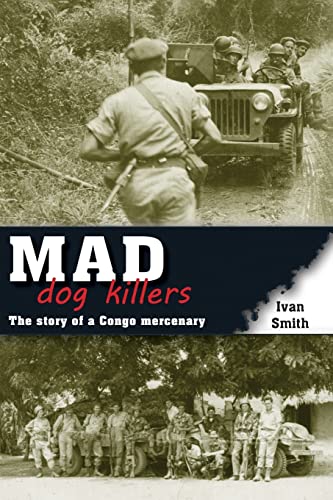
During that long, hot summer of 1964, Ivan Smith, a mercenary volunteer in the Armée Nationale Congolais, came to witness and understand fear, the law of the jungle and the lust for killing that permeates Africa.
A member of 'Mad Mike' Hoare's 5 Commando Group, he and his companions were nominally soldiers but there was little in the way of campaigns, tactics and discipline. Of conventional warfare there was none. Loyalty to country or unit did not exist and the fear of death was the only commander. Many more mercenaries died from an accidental discharge, in a drunken shoot-out or from a bullet in the back than were ever killed in action by Simba rebels. Nearly half a century later, Ivan Smith re-lives the nightmare that was the Congo.
About the Author
Ivan Smith was born 1941 in Fort Victoria, Rhodesia. He grew up on a farm before doing his national service after leaving school in 1958. After some cowboy and mining work he spent two years in London and Copenhagen. In 1964 he signed up for a six-month contract as a mercenary in the Congo. He joined the British South Africa Police in 1965 and served fourteen years in the paramilitary Support Unit and the Police Anti-Terrorist Unit during the protracted Rhodesian 'bush war'. He emigrated to South Africa in 1984 where he worked in the security department at the University of Cape for 16 years. A lover of hunting and fishing, he has written for various outdoor magazines for over 40 years. He lives in the small village of Joubertina in the Western Cape of South Africa.
"synopsis" may belong to another edition of this title.
About the Author
Ivan Smith was born 1941 in Fort Victoria, Rhodesia. He grew up on farm before doing his national service after leaving school in 1958. After some cowboy and mining work he spent two years in London and Copenhagen. In 1964 he signed up for a six-month contract as a mercenary in the Congo. He joined the British South Africa Police in 1965 and served fourteen years in the paramilitary Support Unit and the Police Anti-Terrorist Unit during the protracted Rhodesian 'bush war'. He immigrated to South Africa in 1984 where he worked in the security department at the University of Cape for sixteen years. A lover of hunting and fishing, he has written for various outdoor magazines for over forty years. He lives in the small village of Joubertina in the Western Cape of South Africa.
Excerpt. © Reprinted by permission. All rights reserved.
Mad Dog Killers
The Story of a Congo Mercenary
By Ivan SmithHelion & Company Limited
Copyright © 2012 Ivan Smith
All rights reserved.
ISBN: 978-1-907677-78-6All rights reserved.
CHAPTER 1
On the south-east coast at the bottom end of Africa, inland from what is known as the Garden Route in the Republic of South Africa, is the rural village of Joubertina. It stands in a valley that runs for over a hundred kilometres between the mountains that rim the ocean to the south and the mountains that rise in serried ranks to the north. It is about 20 kilometres from the sea; very far south in Africa. I retired to this village by chance, but as the clock turns Africa back to medieval times I am glad to be so far from it all.
An extended family from the fruit lands of Germany travelled in a wagon train heading towards the Eastern Cape in the early 1800s. They were skilled in fruit growing, knew about peaches, plums, apples and pears; fruit that needs cold winters and water to irrigate the orchards. The Kritzinger families were on the way north on the old inland wagon trail that avoided the deep river gorges along the coast. They saw the valley, approved and stayed. The chosen place is semi-desert, where the endless mountain flanks are bare of trees. Black-stemmed aloes and shrubs grow on the stony hillsides with small tufts of tough grass. It is cold and rainy in winter so ideal for apples and other pomes fruit.
A prevailing east wind often blows off the sea and picks up moisture which drops as rain as it crosses the mountains to the south of the valley. From these southerly, seaboard mountains run streams of crystal clear water, and along which bracken and heather grow at higher altitude and then as they gurgle down the lower valley, lush reeds and grass line the rivulets. The German family knew the value of the desert land with available water and founded the village and planted orchards. Those orchards now spread through the long valley and in this 21st century those who live in the valley still depend on the fruit industry. The fruit farms and the pack stores give work to most residents. Some families have worked the fruit farms for generations and are of mixed race, with German and Bushman antecedents. Those two races were the only humans living in the semi-desert for many decades. The fruit industry supports only a sparse population and in the village of Joubertina a few merchants' buildings are scattered along the one town road.
Traffic on the main highway that runs along the mountainside above the village is light. The sounds of cattle calling, tractors working, geese fighting in the sky and distant dogs barking substitute the roar of big city traffic. In the new century, the year 2000, I came to live here in rural quiet after the sprawl and smog of Cape Town and sixteen years with the security department at the University of Cape Town. The proceeds of selling my house in the pretty little west coast suburb of Flamingo Vlei bought a rambling, broken-down, thatched farmhouse with ramshackle outbuildings on a hectare of land in the southern slopes above the village, the slopes opposite to where the main road runs and outside the municipal boundary.
My early years were spent on my grandfather's farm in the midlands of what was then Rhodesia. The family was poor and lived in hard circumstances and so I am comfortably at home here in the long fruit valley in an old farmhouse. Some of my family live nearby.
An old friend, Armand, lives in a mobile home and recently drove it from a wet summer in Scotland down to Derbyshire where it was warmer and drier. He does not like England's weather. He is a man of Africa and once we were stationed together in the remote Zambezi Escarpment. We drank a lot and seduced a lot of women and sometimes attended to our police duties. He doesn't like England either and roams the continent of Europe a lot. He tried Bermuda or one of those places, maybe Jamaica, once, but found a Caribbean paradise too close, in all respects, to black Africa. He sometimes phones me, and we talk of distant days in that ShangriLa that was the country of my birth, Rhodesia, and to where my soul yeans to return. The country Mugabe has ground down is one of the poorest, worst-run countries in the world, but still the African rulers give him standing ovations when he struts at their talk-shops and forums.
"I have just the thing for you," Armand says, talking loudly on his cell phone while sitting in some English summer field. He is excited. He always is. "You should write a book about mercenaries."
"How did you come to that conclusion?"
"You were a Congo mercenary."
Funny how he always adds 'Congo' to 'mercenary' believing it gives an added touch of menace to the word. Funny that thing about mercenaries giving a tingle of dread, because mercenary is what most professional soldiers are. Many soldiers in peacetime are motivated by money, even those who say they are in it to serve the country. Very few western armies do not employ men from other lands. Surely if you are not a native of the land in whose army you serve you are a mercenary? The British army has many South Africans, Indians and others from ex-colonial lands in it. The Americans in Iraq have thousand of paid foreign staff. So the question is why does 'Congo mercenary' cause such interest in others? Maybe the media built a bogeyman; or maybe the Congo really is the heart of darkness. Those who have been there, even for a few days, will know if the description is valid. Certainly the hot fetid jungles of the Congo have refined the practice of man-on-man cruelty.
"That was a hell of a long time ago, Armand. And I was there only for a short time."
That conversation was forgotten until a visit to the bank which is across the road from the now disused railway station where a crumbling, vandalized steam engine stands next to the deserted station. Once again the septic tank was spilling sewerage down the main road, so my truck had to be parked on the uphill side of the bank. It was necessary to walk on the north side broken pavement so as not to soil my shoes. Crossing the road a thought came to me. Was the Congo of 1964 catching up with me again? That long-ago decaying chaos is mostly forgotten. Had it come down to the most southern tip of Africa? Maybe it was time to revisit a short spell of life that once had a major influence on me. Maybe putting it down on paper will allow me to see the situation here in a different light.
As the biblical age touted as the end of life is reached, all around are echoes from the Congo of 1964. Those in power display rampant greed and no day goes by without some corrupt official being exposed by the media. Looting, be it graft by the elected politicians, or by large gangs of heavily armed men rampaging through shopping malls, or battering cash-in-transit vans off the road, is rampant. Unlike in the Congo there is still some law and order. It seems to me looting is the trademark of Africa. Power and phone lines are stolen on a regular basis; even railway tracks are uprooted and sold. Here sometimes there are arrests, unlike the Congo, but for how much longer law and order will be enforced is uncertain, as time and again politicians breaking the laws are ignored by enforcers. In Africa the law does not apply to ruling politicians.
In the days of Shaka, and other African kings, anyone who had better crops or cattle than a neighbour was pointed out as a witch and impaled in the cattle kraal and his possessions were then shared between the ruler and his accusers. In modern Africa things have not changed much. In Africa people are still being identified as witches and killed and their possessions looted. Nearly every month the South African press reports such cases; normally well-off and elderly people in rural areas are pointed out and stoned. There are also regular ritual murders reported where body parts are harvested for black magic. Such conduct would make world headlines if it happened in the West. Witches? So what, it is only Africa! Of course, in South Africa the whites are all witches; in the rest of Africa anyone with assets is.
The decay in the village brings to me a feeling of inevitable, impending doom. Most of my life was spent fighting to keep my country, Rhodesia, out of black hands. Failure to do so destroyed hundreds of thousands of lives. While with the British South Africa Police my service included spells with the paramilitary Support Unit, and the Police Anti-Terrorist Unit, both dedicated to fighting terrorism. Rhodesia is no more. Zimbabwe is also no more, the mass murderer and master looter Mugabe has totally decimated it by his greed. Now South Africa, the country of my ancestors, is beginning to show all the symptoms of rule by black despots. I hope my dread is but prejudice.
These then are the paths that lead to the primordial forests of the Congo where butterflies do duty as vultures.
Violence came into my life at a very young age. At junior school one childish game was trying to recall earliest memory, trying to remember the earliest days. I regressed in my mind back as far as possible. There was a dew-wet fallow maize field filled with spear grass and the early morning sun made diamonds of the dewdrops stuck on the spiderwebs. It was cold and I was wearing a bib and a pair of dungarees. My brother, who is three years older than me, was aiming the .22 rifle at a dove cooing in a nearby tree. I must have been about four years old. Did we eat that dove? That early image stuck in my mind so today the details can still be recalled, but I fixed only the image of me in the dew-wet field. If the dove was shot it would have been eaten; using guns and killing began very, very early on.
My father's family emigrated from England to South Africa in the 1820s and established a farm where they introduced chicory and grew rich in the little Eastern Cape village of Alexander. My paternal grandfather and his four sons moved to Rhodesia before the Second World War, and founded another farming dynasty there. My mother's family were Afrikaans farmers who moved to Rhodesia in the early founding years of that country, in the late 1800s. As a child I spoke only Afrikaans and Shona, first learning English at school. The early days were spent on a farm in the midlands of Rhodesia, where the house was built of thatched poles and mud walls and there was no running water, telephone or electricity.
There is another early childhood memory of running down the steps of the old tin and thatch homestead, which was built under tall blue gums to look up at the sky at thunder passing overhead and the metallic grey shape of a massive four-engined bomber. There was shouting and excitement as the bomber roared overhead and then vanished behind the ridge where the neighbours lived, about five kilometres away. Soon there was the sound of metal tearing and then a rumbling, a booming earthshaking explosion and in the distance behind the far ridge a tall column of black smoke mushroomed skywards. That must have been at about the same time as my earlier memory. I was born in 1941 and that crashed airplane was on a practice flight from Gwelo airfield laden with training bombs. World War Two was still ongoing. How did I know it was an aircraft? It must have been the first one I ever saw, that big old war bird. Maybe someone told me what it was afterwards. A monument was built to the dead, a propeller from the bomber mounted on a plinth in the mealie field where it fell. We visited the crash site and the field smelt of blood and gunpowder; the smell of death. That familiar smell has been with me often over the years.
We grew up wild and untamed, barefoot and hunting the animals in the veldt with catapult, sling, bow and gun. When the school insisted shoes had to be worn it was with reluctance that I complied. The farmhome was left behind for boarding school at the age of ten. By that age guns and death were familiar and I could be trusted to shoot an ox and then skin, gut it and process the meat for the house. I knew very well what a gun was for. Death was familiar and death fed the family. Predators do not pity food. Much later I learnt of the other, very different death: that of man. Progress from hunter to trained man-killer was also at a young age.
Boarding school was Government subsidized and so children of the poor went to boarding school. We travelled by train from Salisbury to Que Que, a steam train which took all day to do the 150 kilometres, and we arrived smelling of coal. Once on the way to school my elder brother wanted the top bunk, but I beat him to it so he yanked me off by my leg. The steel ashtray that folded out from the cabin wall on a bottom swivel gouged my thigh as I fell and a chunk of meat ended up in the ashtray. When punched on the nose he did nothing because he was feeling guilty. That day I first felt the power and freedom of being strong and self-reliant. That scar on my thigh is still there sixty years on and always reminds me not to fear other men.
After final exams I never once returned to visit that high school where I learnt about girls and not much else. The strongest memory of high school is awakening sexual desire. Because of girls my shoes were regularly worn and my hair combed. The rules and regulations and studying and learning were hated intrusions. I was no good at any of it; it interfered with freedom and independence too much
There is part of me, a part that never leaves, that yearns for those youthful days and the freedom of the open veldt and the limitless horizon, the yellow moon rising over a stark baobab tree, a flooded river thundering rain-swollen between banks. No other man's rules to tie me down. Jump into the flooded river and let the current go where it would and paddle only hard enough to keep the head above water. I wandered the vast, wild area of the family farm in school holidays, staying out for days, sleeping in caves and eating doves and wild fruit. At boarding school I wanted that back, and that is where my soul still lives. I am a child of the African veldt and would be as untamed as any bush animal if given the choice. But today the animals are gone from the forests of Africa, and the forests themselves are going to the charcoal ovens and I am caged by convention like most modern city-living men are.
Elvis Presley, rock and roll, stove-pipe jeans, leather jacket and hair slicked back with Brylcreem. Every night jiving and seeking the woman who might say yes, fighting and being cool. My mother was already in despair and worried about my future. I was staying at home and so had to take heed of her concerns. She booked me into the University of Cape Town on a bursary from the State Lottery as the son of a war veteran. My father had been with the Ghurkhas during the Second World War in Burma and India. That meant the British Government, who then ruled Rhodesia, would sponsor my education. Would my life have turned out differently with a university education or had Britain not thrown Rhodesia to the wolves? The future and past are not reachable.
The winds of change began blowing but were not heard because none of us colonialists were listening. While waiting to go to university, my mate Errol drove down the road in an Austin Healy 300/6. His hair was slicked back and he wore white-rimmed dark glasses. His big six cylinder, shark-bonneted, open sports car growled and burbled as he waved. Right then, more than anything, that big, long sports car and lots of money and all that went with it, became all that mattered. With only that, a man could pick and choose the girls; they would queue up. The Healy and money was the answer to the good life. An education was nothing, money was all. That same lust drove me for many years after leaving school.
At the time I was working as an assessor in the Tax Department. My need for a job, and a notice of vacancies on a pin-board in the post office, coincided. The job consisted of sitting in an office looking at forms all day. The Tax Department was in a big building and so there were lots of young woman to keep me interested and sane for a while. Life was then music, booze and girls. The salary was £360 a year, £30 a month. That bought a bicycle to get to work, back for lunch and then home again at 4.30pm. Affording a bicycle was considered lucky; many could only afford the bus. Those who have nothing are always satisfied with little.
Physical fitness is something that is essential for a long, enjoyable life. Fitness was part of my life and has always been so; ten miles each way, 40 miles a day on the bicycle. The previous year I had been captain of the rugby, water polo and gymnastics teams at school and also cricket and boxing. Forty miles a day on a bicycle was nothing. By the age of twelve my body was already fully grown to six foot two and 200lbs; working as hard as a grown man on the farm made sure of that. Club rugby and swimming remained a passion after school. Playing sport to stay fit gave way to other things, but a morning run was a lifetime habit. At a rock and roll session we talked, Errol and me, and he told me how to get that Healy Six. A job on the Copper Belt on the Northern Rhodesian mines was the answer to the Holy Grail.
(Continues...)
Excerpted from Mad Dog Killers by Ivan Smith. Copyright © 2012 Ivan Smith. Excerpted by permission of Helion & Company Limited.
All rights reserved. No part of this excerpt may be reproduced or reprinted without permission in writing from the publisher.
Excerpts are provided by Dial-A-Book Inc. solely for the personal use of visitors to this web site.
"About this title" may belong to another edition of this title.
Search results for Mad Dog Killers: The Story of a Congo Mercenary

Stock Image
Mad Dog Killers: The Story of a Congo Mercenary
Seller: HPB Inc., Dallas, TX, U.S.A.
Seller rating 5 out of 5 stars

paperback. Condition: Very Good. Connecting readers with great books since 1972! Used books may not include companion materials, and may have some shelf wear or limited writing. We ship orders daily and Customer Service is our top priority! Seller Inventory # S_452125612
Stock Image
Mad Dog Killers: The Story of a Congo Mercenary
Seller: Half Price Books Inc., Dallas, TX, U.S.A.
Seller rating 5 out of 5 stars
Paperback. Condition: Very Good. Connecting readers with great books since 1972! Used books may not include companion materials, and may have some shelf wear or limited writing. We ship orders daily and Customer Service is our top priority! Seller Inventory # S_471032083
Stock Image
Mad Dog Killers: The Story of a Congo Mercenary
Seller: ThriftBooks-Dallas, Dallas, TX, U.S.A.
Seller rating 5 out of 5 stars
Paperback. Condition: Good. No Jacket. Pages can have notes/highlighting. Spine may show signs of wear. ~ ThriftBooks: Read More, Spend Less. Seller Inventory # G190767778XI3N00
Stock Image
Mad Dog Killers: The Story of a Congo Mercenary
Seller: ThriftBooks-Atlanta, AUSTELL, GA, U.S.A.
Seller rating 5 out of 5 stars
Paperback. Condition: Good. No Jacket. Pages can have notes/highlighting. Spine may show signs of wear. ~ ThriftBooks: Read More, Spend Less. Seller Inventory # G190767778XI3N00
Seller Image
Mad Dog Killers (Paperback)
Published by
Helion & Company, Solihull, 2012
ISBN 10: 190767778X
ISBN 13: 9781907677786
New
Paperback
Seller: Grand Eagle Retail, Bensenville, IL, U.S.A.
Seller rating 5 out of 5 stars
Paperback. Condition: new. Paperback. Mad Dog Killers: The Story of a Congo Mercenary During that long, hot summer of 1964, Ivan Smith, a mercenary volunteer in the Armee Nationale Congolais, came to witness and understand fear, the law of the jungle and the lust for killing that permeates Africa. Shipping may be from multiple locations in the US or from the UK, depending on stock availability. Seller Inventory # 9781907677786
Stock Image
Mad Dog Killers: The Story of a Congo Mercenary
Seller: Revaluation Books, Exeter, United Kingdom
Seller rating 5 out of 5 stars
Paperback. Condition: Brand New. 160 pages. 9.29x6.18x0.55 inches. In Stock. Seller Inventory # 190767778X
Buy New
£ 41.43
£ 10 shipping
Ships from United Kingdom to U.S.A.
Ships from United Kingdom to U.S.A.
Quantity: 1 available
Seller Image
Mad Dog Killers (Paperback)
Published by
Helion & Company, Solihull, 2012
ISBN 10: 190767778X
ISBN 13: 9781907677786
New
Paperback
Seller: CitiRetail, Stevenage, United Kingdom
Seller rating 5 out of 5 stars
Paperback. Condition: new. Paperback. Mad Dog Killers: The Story of a Congo Mercenary During that long, hot summer of 1964, Ivan Smith, a mercenary volunteer in the Armee Nationale Congolais, came to witness and understand fear, the law of the jungle and the lust for killing that permeates Africa. Shipping may be from our UK warehouse or from our Australian or US warehouses, depending on stock availability. Seller Inventory # 9781907677786
Buy New
£ 24.14
£ 37 shipping
Ships from United Kingdom to U.S.A.
Ships from United Kingdom to U.S.A.
Quantity: 1 available
Seller Image
Mad Dog Killers (Paperback)
Published by
Helion & Company, Solihull, 2012
ISBN 10: 190767778X
ISBN 13: 9781907677786
New
Paperback
Seller: AussieBookSeller, Truganina, VIC, Australia
Seller rating 5 out of 5 stars
Paperback. Condition: new. Paperback. Mad Dog Killers: The Story of a Congo Mercenary During that long, hot summer of 1964, Ivan Smith, a mercenary volunteer in the Armee Nationale Congolais, came to witness and understand fear, the law of the jungle and the lust for killing that permeates Africa. Shipping may be from our Sydney, NSW warehouse or from our UK or US warehouse, depending on stock availability. Seller Inventory # 9781907677786