
Items related to Too Far from Home: The Selected Writings of Paul Bowles
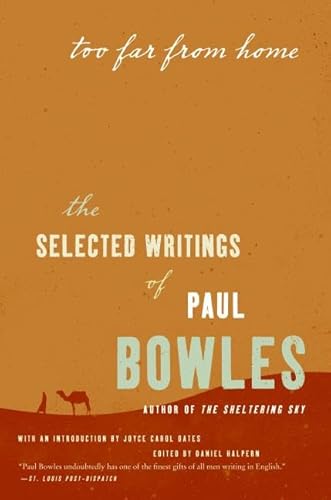
Synopsis
The definitive Paul Bowles readera summing up of a brilliant and diverse literary career, featuring an introduction by Joyce Carol Oates.
"Bowles is one of the most important writers of our times." Madison Smartt Bell, Chicago Tribune
Too Far From Home brings together a dozen of Paul Bowles' best stories; excerpts from three novels, Let It Come Down, The Spider's House, and Up Above the World; excerpts from nonfiction works like Points in Time, Their Heads are Green and Their Hands are Blue, Days, and Without Stopping; the entire text of the novel The Sheltering Sky; as well as a group of poems, a selection of previously unpublished letters, and an interview conducted by Daniel Halpern.
A striking collection from one of the most revered authors of the twentieth century, Too Far From Home is the perfect introduction to the work of Paul Bowles.
"synopsis" may belong to another edition of this title.
About the Author
Paul Bowles was born in 1910 and studied music with composer Aaron Copland before moving to Tangier, Morocco. A devastatingly imaginative observer of the Wests encounter with the East, he is the author of four highly acclaimed novels: The Sheltering Sky, Let It Come Down, The Spiders House, and Up Above the World. In addition to being one of the most powerful postwar American novelists, Bowles was an acclaimed composer, a travel writer, a poet, a translator, and a short story writer. He died in Morocco in 1999.
From the Back Cover
A striking collection of stories, poems, letters, travel essays, journal entries, excerpts from three novels, and more--including the complete text of The Sheltering Sky--from one of the most revered authors of the twentieth century
Excerpt. © Reprinted by permission. All rights reserved.
Too Far from Home
The Selected Writings of Paul BowlesBy Paul BowlesHarperCollins Publishers, Inc.
Copyright © 2006 Paul BowlesAll right reserved.
ISBN: 0061137405
Chapter One
From: The Sheltering Sky
He walked through the streets, unthinkingly seeking the darker ones, gladto be alone and to feel the night air against his face. The streetswerecrowded. People pushed against him as they passed, stared from doorwaysand windows, made comments openly to each other about him-whetherwith sympathy or not he was unable to tell from their faces-and theysometimes ceased to walk merely in order to watch him.
"How friendly are they? Their faces are masks. They all look a thousand years old. What little energy they have is only the blind, mass desire to live, since no one of them eats enough to give him his own personal force. But what do they think of me? Probably nothing. Would one of them help me if I were to have an accident? Or would I lie here in the street until the police found me? What motive could any one of them have for helping me? They have no religion left. Are they Moslems or Christians? They don't know. They know money, and when they get it, all they want is to eat. But what's wrong with that? Why do I feel this way about them? Guilt at being well fed and healthy among them? But suffering is equally divided among all men; each has the same amount to undergo. . . ." Emotionally he felt that this last idea was untrue, but at the moment it was a necessary belief. it is not always easy to support the stares of hungry people. Thinking that way he could walk on through the streets. It was as if either he or they did not exist. Both suppositions were possible. The Spanish maid at the hotel had said to him that noon: "La vida es pena." "Of course," he had replied, feeling false even as he spoke, asking himself if any American can truthfully accept a definition of life which makes it synonymous with suffering. But at the moment he had approved her sentiment because she was old, withered, so clearly of the people. For years it had been one of his superstitions that reality and true perception were to be found in the conversation of the laboring classes. Even though now he saw clearly that their formulas of thought and speech are as strict and as patterned, and thus as far removed from any profound expression of truth as those of any other class, often he found himself still in the act of waiting, with the unreasoning belief that gems of wisdom might yet issue from their mouths. As he walked along, his nervousness was made manifest to him by the sudden consciousness that he was repeatedly tracing rapid figure-eights with his right index finger. He sighed and made himself stop doing it.
His spirits rose a bit as he came out onto a square that was relatively brightly lighted. The cafes on all four sides of the little plaza had put tables and chairs not only across the sidewalks, but in the street as well, so that it would have been impossible for a vehicle to pass through without upsetting them. in the center of the square was a tiny park adorned by four plane trees that had been trimmed to look like open parasols. Underneath the trees there were at least a dozen dogs of various sizes, milling about in a close huddle, and all barking frantically. He made his way slowly across the square, trying to avoid the dogs. As he moved along cautiously under the trees he became aware that at each step he was crushing something beneath his feet. The ground was covered with large insects; their hard shells broke with little explosions that were quite audible to him even amidst the noise the dogs were making. He was aware that ordinarily he would have experienced a thrill of disgust on contact with such a phenomenon, but unreasonably tonight he felt instead a childish triumph. "I' m in abad way and so what?" The few scattered people sitting at the tables were for the most part silent, but when they spoke, he heard all three of thetown's tongues: Arabic, Spanish and French.
Slowly the street began to descend; this surprised him because he imagined that the entire town was built on the slope facing the harbor, and he had consciously chosen to walk inland rather than toward the waterfront. The odors in the air grew ever stronger. They were varied, but they all represented filth of one sort or another. This proximity with, as it were, a forbidden element, served to elate him. He abandoned himself to the perverse pleasure he found in continuing mechanically to put one foot in front of the other, even though he was quite clearly aware of his fatigue. "Suddenly I'll find myself turning around and going back," he thought. But not until then, because he would not make the decision to do it. The impulse to retrace his steps delayed itself from moment to moment. Finally he ceased being surprised: a faint vision began to haunt his mind. It was Kit, seated by the open window, filing her nails and looking out over the town. And as he found his fancy returning more often, as the minutes went by, to that scene, unconsciously he felt himself the protagonist, Kit the spectator. The validity of his existence at that moment was predicated on the assumption that she had not moved, but was still sitting there. it was as if she could still see him from the window, tiny and far away as he was, walking rhythmically uphill and down, through light and shadow; it was as if only she knew when he would turn around and walk the other way.
The street lights were very far apart now, and the streets had left off being paved. Still there were children in the gutters, playing with the garbage and screeching. A small stone suddenly hit him in the back. He wheeled about, but it was too dark to see where it had come from. A few seconds later another stone, coming from in front of him, landed against his knee.Continues...
Excerpted from Too Far from Homeby Paul Bowles Copyright © 2006 by Paul Bowles. Excerpted by permission.
All rights reserved. No part of this excerpt may be reproduced or reprinted without permission in writing from the publisher.
Excerpts are provided by Dial-A-Book Inc. solely for the personal use of visitors to this web site.
"About this title" may belong to another edition of this title.
Search results for Too Far from Home: The Selected Writings of Paul Bowles

Stock Image
Too Far from Home : The Selected Writings of Paul Bowles
Published by
HarperCollins Publishers, 2006
ISBN 10: 0061137405
ISBN 13: 9780061137402
Used
Softcover
Seller: Better World Books, Mishawaka, IN, U.S.A.
Seller rating 5 out of 5 stars

Condition: Good. Pages intact with minimal writing/highlighting. The binding may be loose and creased. Dust jackets/supplements are not included. Stock photo provided. Product includes identifying sticker. Better World Books: Buy Books. Do Good. Seller Inventory # 6222207-6
Stock Image
Too Far from Home : The Selected Writings of Paul Bowles
Published by
HarperCollins Publishers, 2006
ISBN 10: 0061137405
ISBN 13: 9780061137402
Used
Softcover
Seller: Better World Books, Mishawaka, IN, U.S.A.
Seller rating 5 out of 5 stars
Condition: Very Good. Pages intact with possible writing/highlighting. Binding strong with minor wear. Dust jackets/supplements may not be included. Stock photo provided. Product includes identifying sticker. Better World Books: Buy Books. Do Good. Seller Inventory # 11145818-6
Stock Image
Too Far from Home : The Selected Writings of Paul Bowles
Published by
HarperCollins Publishers, 2006
ISBN 10: 0061137405
ISBN 13: 9780061137402
Used
Softcover
Seller: Better World Books: West, Reno, NV, U.S.A.
Seller rating 5 out of 5 stars
Condition: Very Good. Pages intact with possible writing/highlighting. Binding strong with minor wear. Dust jackets/supplements may not be included. Stock photo provided. Product includes identifying sticker. Better World Books: Buy Books. Do Good. Seller Inventory # 11145818-6
Stock Image
Too Far from Home: The Selected Writings of Paul Bowles
Seller: Vashon Island Books, Vashon, WA, U.S.A.
Seller rating 5 out of 5 stars
Paperback. Condition: Good. First Paperback Edition. Remainder mark. Size: 8vo - over 7¾" - 9¾". Book. Seller Inventory # 0841043
Stock Image
Too Far from Home: The Selected Writings of Paul Bowles
Seller: Vashon Island Books, Vashon, WA, U.S.A.
Seller rating 5 out of 5 stars
Paperback. Condition: Good. First Paperback Edition. light fading to covers, remainder mark. Size: 8vo - over 7¾" - 9¾". Book. Seller Inventory # 0838424
Seller Image
Too Far from Home: Definitive American Literature â" Selected Short Stories, Essays, and Novels
Seller: Flipped Pages, Clifton Park, NY, U.S.A.
Seller rating 4 out of 5 stars

Paperback. Condition: Very Good. Seller Inventory # NEC1/16/12172025
Stock Image
Too Far from Home: The Selected Writings of Paul Bowles
Seller: Books From California, Simi Valley, CA, U.S.A.
Seller rating 4 out of 5 stars
paperback. Condition: Good. Seller Inventory # mon0004237704
Stock Image
Too Far from Home: The Selected Writings of Paul Bowles
Seller: Barsoom Books, Torrance, CA, U.S.A.
Seller rating 4 out of 5 stars
Soft cover. Condition: Near Fine. Later pr. Square, solid, and unread; perfect spine, lovely copy, flawed only by a remainder mark to the bottom of the pages. Youll feel as though youve received an Admit One pass to the Library of Alexandria or the Cemetery of Forgotten Books, once this treasured tome arrives at your door! Seller Inventory # 040679
Stock Image
Too Far From Home: The Selected Writings of Paul Bowles
Seller: Powell's Bookstores Chicago, ABAA, Chicago, IL, U.S.A.
Seller rating 5 out of 5 stars
Paperback. Condition: Used-Very Good. Pbk. Some shelf-wear. Else clean copy. Seller Inventory # 1811291