


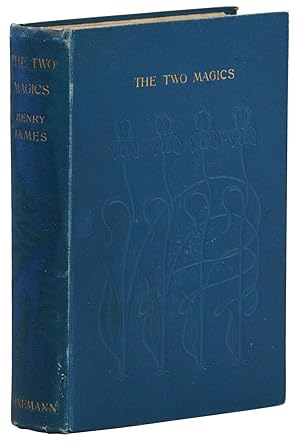
The Two Magics: The Turn of the Screw [and] Covering End
James, Henry
Published by William Heinemann, London, 1898
Used
From
Burnside Rare Books, ABAA, Portland, OR, U.S.A.
Seller rating 5 out of 5 stars

AbeBooks Seller since 3 September 2014
This specific copy is no longer available. Here are our closest matches for The Two Magics: The Turn of the Screw [and] Covering End by James, Henry.
About this Item
Description:
First edition, first printing. The entire printing consisted of 1,500 copies including those intended for export to the Colonies; this copy is one of the rare ones intended for the domestic market with the title page printed in red and black. In the earliest binding with the front cover decorated in blind with four irises. Near Fine with slight lean to binding, slight discoloration to spine cloth and light rubbing to cloth, though on the whole a much nicer example of this book than as normally found. Former owner bookplate to front paste down and foxing to endsheets. A collection of two stories by Henry James, one of which marks the first book appearance of "The Turn of the Screw.". Seller Inventory # 140944443
Bibliographic Details
Title: The Two Magics: The Turn of the Screw [and] ...
Publisher: William Heinemann, London
Publication Date: 1898
Condition: Near Fine
Edition: First Edition.
Top Search Results from the AbeBooks Marketplace

Stock Image
The Two Magics The Turn of the Screw Covering End
Print on DemandSeller: Majestic Books, Hounslow, United Kingdom
Seller rating 4 out of 5 stars

Condition: New. Print on Demand. Seller Inventory # 410418445
Buy New
£ 7.10
£ 6.50 shipping
Ships from United Kingdom to U.S.A.
Ships from United Kingdom to U.S.A.
Quantity: 4 available
Stock Image
The Two Magics The Turn of the Screw Covering End
Print on DemandSeller: Biblios, Frankfurt am main, HESSE, Germany
Seller rating 4 out of 5 stars
Condition: New. PRINT ON DEMAND. Seller Inventory # 18402768600
Stock Image
The Turn of the Screw : A 1898 horror novella by Henry James (The Two Magics: The Turn Of The Screw, Covering End)
Published by
Les prairies numériques, 2020
ISBN 10: 2382744081
ISBN 13: 9782382744086
Used
Softcover
Seller: Buchpark, Trebbin, Germany
Seller rating 5 out of 5 stars
Condition: Gut. Zustand: Gut | Sprache: Englisch | Produktart: Bücher | he Turn of the Screw is an 1898 horror novella by Henry James that first appeared in serial format in Collier's Weekly magazine (January 27 - April 16, 1898). In October 1898 it appeared in The Two Magics, a book published by Macmillan in New York City and Heinemann in London. Classified as both gothic fiction and a ghost story, the novella focuses on a governess who, caring for two children at a remote estate, becomes convinced that the grounds are haunted.In the century following its publication, The Turn of the Screw became a cornerstone text of academics who subscribed to New Criticism. The novella has had differing interpretations, often mutually exclusive. Many critics have tried to determine the exact nature of the evil hinted at by the story. However, others have argued that the brilliance of the novella results from its ability to create an intimate sense of confusion and suspense within the reader.The novella has been adapted numerous times in radio drama, film, stage, and television, including a 1950 Broadway play, and the 1961 film The Innocents. On Christmas Eve, an unnamed narrator listens to Douglas, a friend, read a manuscript written by a former governess whom Douglas claims to have known and who is now dead. The manuscript tells the story of how the young governess is hired by a man who has become responsible for his young nephew and niece after the deaths of their parents. He lives mainly in London but also has a country house, Bly. He is uninterested in raising the children.The boy, Miles, is attending a boarding school, while his younger sister, Flora, is living at a summer country house in Essex. She is currently being cared for by Mrs. Grose, the housekeeper. Miles and Flora's uncle, the governess' new employer, gives her full charge of the children and explicitly states that she is not to bother him with communications of any sort. The governess travels to her new employer's country house and begins her duties.Miles soon returns from school for the summer just after a letter arrives from the headmaster stating that he has been expelled. Miles never speaks of the matter, and the governess is hesitant to raise the issue. She fears there is some horrible secret behind the expulsion but is too charmed by the adorable young boy to want to press the issue. Soon thereafter, around the grounds of the estate, the governess begins to see the figures of a man and woman whom she does not recognise. These figures come and go at will without ever being seen or challenged by other members of the household, and they seem to the governess to be supernatural. She learns from Mrs. Grose that the governess' predecessor, Miss Jessel, and another employee, Peter Quint, had had a sexual relationship. Before their deaths, Jessel and Quint spent much of their time with Flora and Miles, and this fact has grim significance for the current governess when she becomes convinced that the two children are secretly aware of the ghosts' presence.Later, without permission, Flora leaves the house while Miles is playing music for the governess. The governess notices Flora's absence and goes with Mrs. Grose in search of her. They find her in a folly on the shore of the lake, and the governess is convinced that Flora has been talking to the ghost of Miss Jessel. When the governess finally confronts Flora, the girl denies seeing Miss Jessel and demands never to see the governess again. At the governess' suggestion, Mrs. Grose takes Flora away to her uncle, leaving the governess with Miles, who that night at last talks to her about his expulsion the ghost of Quint appears to the governess at the window. The governess shields Miles, who attempts to see the ghost. The governess tells Miles he is no longer controlled by the ghost and then finds that Miles has died in her arms, and the ghost has gone. Seller Inventory # 37021462/3
Stock Image
The Two Magics: The Turn of the Screw, Covering End
Seller: Revaluation Books, Exeter, United Kingdom
Seller rating 5 out of 5 stars
Paperback. Condition: Brand New. 137 pages. 10.00x8.00x0.31 inches. In Stock. Seller Inventory # zk1790649218
Buy New
£ 11.49
£ 12.50 shipping
Ships from United Kingdom to U.S.A.
Ships from United Kingdom to U.S.A.
Quantity: 1 available
Stock Image
The Turn of the Screw : A 1898 horror novella by Henry James (The Two Magics: The Turn Of The Screw, Covering End)
Published by
Les prairies numériques, 2020
ISBN 10: 2382744081
ISBN 13: 9782382744086
Used
Softcover
Seller: Buchpark, Trebbin, Germany
Seller rating 5 out of 5 stars
Condition: Sehr gut. Zustand: Sehr gut | Sprache: Englisch | Produktart: Bücher | he Turn of the Screw is an 1898 horror novella by Henry James that first appeared in serial format in Collier's Weekly magazine (January 27 - April 16, 1898). In October 1898 it appeared in The Two Magics, a book published by Macmillan in New York City and Heinemann in London. Classified as both gothic fiction and a ghost story, the novella focuses on a governess who, caring for two children at a remote estate, becomes convinced that the grounds are haunted.In the century following its publication, The Turn of the Screw became a cornerstone text of academics who subscribed to New Criticism. The novella has had differing interpretations, often mutually exclusive. Many critics have tried to determine the exact nature of the evil hinted at by the story. However, others have argued that the brilliance of the novella results from its ability to create an intimate sense of confusion and suspense within the reader.The novella has been adapted numerous times in radio drama, film, stage, and television, including a 1950 Broadway play, and the 1961 film The Innocents. On Christmas Eve, an unnamed narrator listens to Douglas, a friend, read a manuscript written by a former governess whom Douglas claims to have known and who is now dead. The manuscript tells the story of how the young governess is hired by a man who has become responsible for his young nephew and niece after the deaths of their parents. He lives mainly in London but also has a country house, Bly. He is uninterested in raising the children.The boy, Miles, is attending a boarding school, while his younger sister, Flora, is living at a summer country house in Essex. She is currently being cared for by Mrs. Grose, the housekeeper. Miles and Flora's uncle, the governess' new employer, gives her full charge of the children and explicitly states that she is not to bother him with communications of any sort. The governess travels to her new employer's country house and begins her duties.Miles soon returns from school for the summer just after a letter arrives from the headmaster stating that he has been expelled. Miles never speaks of the matter, and the governess is hesitant to raise the issue. She fears there is some horrible secret behind the expulsion but is too charmed by the adorable young boy to want to press the issue. Soon thereafter, around the grounds of the estate, the governess begins to see the figures of a man and woman whom she does not recognise. These figures come and go at will without ever being seen or challenged by other members of the household, and they seem to the governess to be supernatural. She learns from Mrs. Grose that the governess' predecessor, Miss Jessel, and another employee, Peter Quint, had had a sexual relationship. Before their deaths, Jessel and Quint spent much of their time with Flora and Miles, and this fact has grim significance for the current governess when she becomes convinced that the two children are secretly aware of the ghosts' presence.Later, without permission, Flora leaves the house while Miles is playing music for the governess. The governess notices Flora's absence and goes with Mrs. Grose in search of her. They find her in a folly on the shore of the lake, and the governess is convinced that Flora has been talking to the ghost of Miss Jessel. When the governess finally confronts Flora, the girl denies seeing Miss Jessel and demands never to see the governess again. At the governess' suggestion, Mrs. Grose takes Flora away to her uncle, leaving the governess with Miles, who that night at last talks to her about his expulsion the ghost of Quint appears to the governess at the window. The governess shields Miles, who attempts to see the ghost. The governess tells Miles he is no longer controlled by the ghost and then finds that Miles has died in her arms, and the ghost has gone. Seller Inventory # 37021462/2
Stock Image
The Turn of the Screw : A 1898 horror novella by Henry James (The Two Magics: The Turn Of The Screw, Covering End)
Published by
Les prairies numériques, 2020
ISBN 10: 2382744081
ISBN 13: 9782382744086
Used
Softcover
Seller: Buchpark, Trebbin, Germany
Seller rating 5 out of 5 stars
Condition: Hervorragend. Zustand: Hervorragend | Sprache: Englisch | Produktart: Bücher | he Turn of the Screw is an 1898 horror novella by Henry James that first appeared in serial format in Collier's Weekly magazine (January 27 - April 16, 1898). In October 1898 it appeared in The Two Magics, a book published by Macmillan in New York City and Heinemann in London. Classified as both gothic fiction and a ghost story, the novella focuses on a governess who, caring for two children at a remote estate, becomes convinced that the grounds are haunted.In the century following its publication, The Turn of the Screw became a cornerstone text of academics who subscribed to New Criticism. The novella has had differing interpretations, often mutually exclusive. Many critics have tried to determine the exact nature of the evil hinted at by the story. However, others have argued that the brilliance of the novella results from its ability to create an intimate sense of confusion and suspense within the reader.The novella has been adapted numerous times in radio drama, film, stage, and television, including a 1950 Broadway play, and the 1961 film The Innocents. On Christmas Eve, an unnamed narrator listens to Douglas, a friend, read a manuscript written by a former governess whom Douglas claims to have known and who is now dead. The manuscript tells the story of how the young governess is hired by a man who has become responsible for his young nephew and niece after the deaths of their parents. He lives mainly in London but also has a country house, Bly. He is uninterested in raising the children.The boy, Miles, is attending a boarding school, while his younger sister, Flora, is living at a summer country house in Essex. She is currently being cared for by Mrs. Grose, the housekeeper. Miles and Flora's uncle, the governess' new employer, gives her full charge of the children and explicitly states that she is not to bother him with communications of any sort. The governess travels to her new employer's country house and begins her duties.Miles soon returns from school for the summer just after a letter arrives from the headmaster stating that he has been expelled. Miles never speaks of the matter, and the governess is hesitant to raise the issue. She fears there is some horrible secret behind the expulsion but is too charmed by the adorable young boy to want to press the issue. Soon thereafter, around the grounds of the estate, the governess begins to see the figures of a man and woman whom she does not recognise. These figures come and go at will without ever being seen or challenged by other members of the household, and they seem to the governess to be supernatural. She learns from Mrs. Grose that the governess' predecessor, Miss Jessel, and another employee, Peter Quint, had had a sexual relationship. Before their deaths, Jessel and Quint spent much of their time with Flora and Miles, and this fact has grim significance for the current governess when she becomes convinced that the two children are secretly aware of the ghosts' presence.Later, without permission, Flora leaves the house while Miles is playing music for the governess. The governess notices Flora's absence and goes with Mrs. Grose in search of her. They find her in a folly on the shore of the lake, and the governess is convinced that Flora has been talking to the ghost of Miss Jessel. When the governess finally confronts Flora, the girl denies seeing Miss Jessel and demands never to see the governess again. At the governess' suggestion, Mrs. Grose takes Flora away to her uncle, leaving the governess with Miles, who that night at last talks to her about his expulsion the ghost of Quint appears to the governess at the window. The governess shields Miles, who attempts to see the ghost. The governess tells Miles he is no longer controlled by the ghost and then finds that Miles has died in her arms, and the ghost has gone. Seller Inventory # 37021462/1
Stock Image
The Turn of the Screw: A 1898 horror novella by Henry James (The Two Magics: The Turn Of The Screw, Covering End)
Published by
Les prairies numeriques 2020-11, 2020
ISBN 10: 2382744081
ISBN 13: 9782382744086
New
PF
Seller: Chiron Media, Wallingford, United Kingdom
Seller rating 5 out of 5 stars
PF. Condition: New. Seller Inventory # 6666-IUK-9782382744086
Buy New
£ 12.76
£ 15.49 shipping
Ships from United Kingdom to U.S.A.
Ships from United Kingdom to U.S.A.
Quantity: 10 available
Stock Image
The Two Magics: The Turn of The Screw & Covering End
Published by
Createspace Independent Publishing Platform, 2016
ISBN 10: 1539039625
ISBN 13: 9781539039624
New
Paperback / softback
Seller: THE SAINT BOOKSTORE, Southport, United Kingdom
Seller rating 5 out of 5 stars
Paperback / softback. Condition: New. This item is printed on demand. New copy - Usually dispatched within 5-9 working days. Seller Inventory # C9781539039624
Buy New
£ 13.17
£ 13.24 shipping
Ships from United Kingdom to U.S.A.
Ships from United Kingdom to U.S.A.
Quantity: Over 20 available
Stock Image
The Two Magics: The Turn of the Screw Covering End
Published by
CreateSpace Independent Publishing Platform, 2017
ISBN 10: 1981532161
ISBN 13: 9781981532162
New
Paperback
Seller: Revaluation Books, Exeter, United Kingdom
Seller rating 5 out of 5 stars
Paperback. Condition: Brand New. 148 pages. 9.00x6.00x0.34 inches. In Stock. This item is printed on demand. Seller Inventory # 1981532161
Buy New
£ 13.75
£ 10 shipping
Ships from United Kingdom to U.S.A.
Ships from United Kingdom to U.S.A.
Quantity: 1 available
Stock Image
The Turn of the Screw: A 1898 horror novella by Henry James (The Two Magics: The Turn Of The Screw, Covering End)
Seller: Ria Christie Collections, Uxbridge, United Kingdom
Seller rating 5 out of 5 stars
Condition: New. In. Seller Inventory # ria9782382744086_new
Buy New
£ 15.55
£ 11.98 shipping
Ships from United Kingdom to U.S.A.
Ships from United Kingdom to U.S.A.
Quantity: Over 20 available