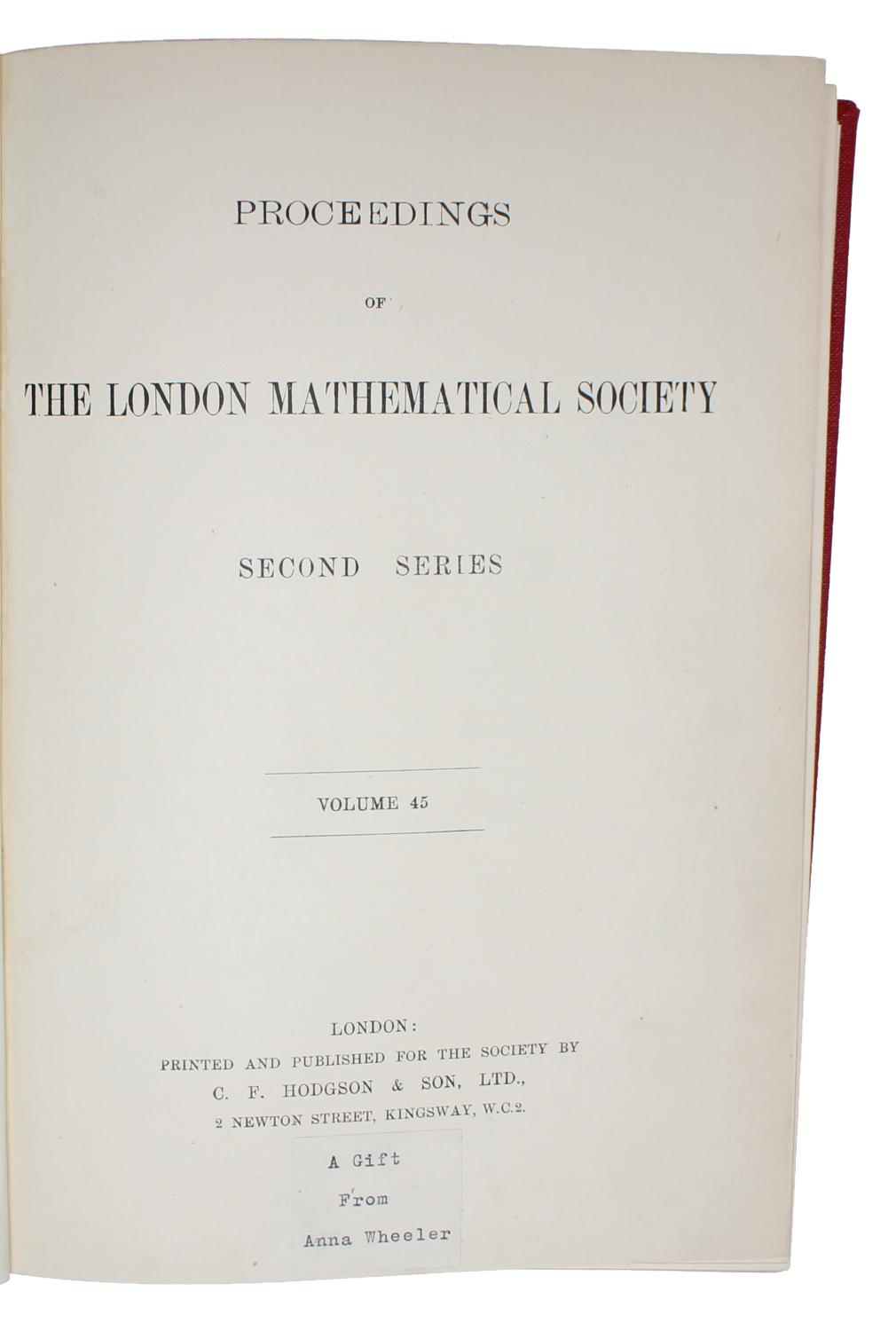

Systems of Logic based on Ordinals. [Received 31 May, 1938. - Read 16 June, 1938.]. [In: Proceedings of the London Mathematical Society. Second Series. Volume 45]. - [TURING'S PH.D.-THESIS]
"TURING, A.M.
Used
Soft cover
From
Herman H. J. Lynge & Søn ILAB-ABF, Copenhagen, Denmark
Seller rating 4 out of 5 stars

Heritage Bookseller
AbeBooks member since 1996
This book is no longer available. AbeBooks has millions of books. Please enter search terms below to find similar copies.
About this Item
Description:
London, Hodgson & Son, 1939. Royal8vo. In a recent nice red full cloth binding with gilt lettering to spine. Entire volume 45 of "Proceedings of the London Mathematical Society. Second Series". Small white square paper label pasted on to lower part of spine, covering year of publication stating: "A Gift / From /Anna Wheeler". A very nice and clean copy without any institutional stamps. Pp. 161-240. [Entire volume: (4), 475 pp.]. The rare first printing of Turing's Ph.D.-thesis, which "opened new fields of investigation in mathematical logic". This seminal work constitutes the first systematic attempt to deal with the Gödelian incompleteness theorem as well as the introduction to the notion of relative computing. After having studied at King's College at Cambridge from 1931 to 1934 and having been elected a fellow here in 1935, Turing, in 1936 wrote a work that was to change the future of mathematics, namely his seminal "On Computable Numbers", in which he answered the famous "Entscheidungsproblem", came up with his "Universal Machine" and inaugurated mechanical and electronic methods in computing. This most famous theoretical paper in the history of computing caught the attention of Church, who was teaching at Princeton, and in fact he gave to the famous "Turing Machine" its name. It was during Church's work with Turing's paper that the "Church-Turing Thesis" was born. After this breakthrough work, Newman, under whom Turing had studied at Cambridge, urged him to spend a year studying with Church, and in September 1936 he went to Princeton. It is here at Princeton, under the guidance of Church, that Turing in 1938 finishes his thesis [the present paper] and later the same year is granted the Ph.D. on the basis of it. The thesis was published in "Proceedings of the London Mathematical Society" in 1939, and after the publication of it, Turing did no more on the topic, leaving the actual breakthroughs to other generations. In his extraordinary Ph.D.-thesis Turing provides an ingenious method of proof, in which a union of systems prove their own consistency, disproving, albeit shifting the problem to even more complicated matters, Gödel's incompleteness theorem. It would be many years before the ingenious arguments and striking partial completeness result that Turing obtained in the present paper would be thoroughly investigated and his line of research continued. The present thesis also presents other highly important proofs and hypotheses that came to influence several branches of mathematics. Most noteworthy of these is the idea that was later to change the face of the general theory of computation, namely the attempt to produce an arithmetical problem that is not number-theoretical (in his sense). Turing's result is his seminal "o-machines"" he here introduces the notion of relative computing and augments the "Turing Machines" with so-called oracles ("o"), which allowed for the study of problems that could not be solved by the Turing machine. Turing, however, made no further use of his seminal o-machine, but it is that which Emil Post used as the basis for his theory of "Degrees of Unsolvability", crediting Turing with the result that for any set of natural numbers there is another of higher degree of unsolvability. This transformed the notion of computability from an absolute notion into a relative one, which led to entirely new developments and in turn to vastly generalized forms of recursion theory. "In 1939 Turing published "Systems of Logic Based on Ordinals,". This paper had a far-reaching influence" in 1942 E.L. Post drew upon it for one of his theories for classifying unsolvable problems, while in 1958 G. Kreisel suggested the use of ordinal logics in characterizing informal methods of proof. In the latter year S. Feferman also adapted Turing's ideas to use ordinal logics in predicative mathematics." (D.S.B. XIII:498). A part from these groundbreaking points, which Turing never returned to himself, he here also consider. Seller Inventory # 54748
Bibliographic Details
Title: Systems of Logic based on Ordinals. [...
Binding: Soft cover
Edition: 1st Edition
AbeBooks offers millions of new, used, rare and out-of-print books, as well as cheap textbooks from thousands of booksellers around the world. Shopping on AbeBooks is easy, safe and 100% secure - search for your book, purchase a copy via our secure checkout and the bookseller ships it straight to you.
Search thousands of booksellers selling millions of new & used books
New & Used Books

New and used copies of new releases, best sellers and award winners. Save money with our huge selection.
Rare & Out of Print Books

From scarce first editions to sought-after signatures, find an array of rare, valuable and highly collectible books.