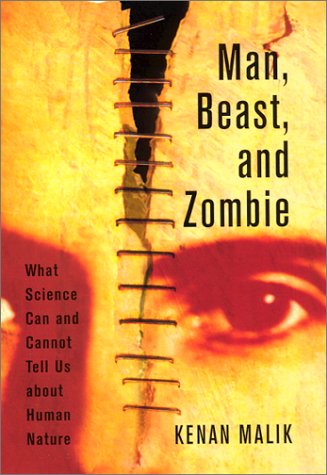
Are humans unique? Can animals think as we do? Will machines ever be conscious? What is will? For centuries, attempts to answer these questions have been the stuff of theological and philosophical dispute, as well as bar-room debate. Now scientists claim they can solve these riddles of human existence, once and for all. Man, Beast and Zombie is a thrillingly original and accessible book. Huge in its reach and powerful in its grasp, it draws on cutting-edge sciences such as evolutionary biology, cognitive psychology and Artificial Intelligence to ess what, precisely, they can and cannot explain about human nature. Kenan Malik explains the histories of these sciences and the philosophies that underpin them and yses the complex relation between human beings, animals and machines to explore what really makes us human.
Writer and neuroscientist Kenan Malik follows his highly acclaimed
The Meaning of Race with the weighty and ambitious
Man, Beast and Zombie: What Science Can and Cannot Tell Us About Human Nature. The book, Malik tells us, is "in part an exploration of the scientific arguments about human nature; in part it is a study of cultural history, about the impact of intellectual and cultural changes on scientific conceptions of the human; and in part it is an attempt to understand the philosophical framework within which the contemporary science of Man works". At the heart of the book are well-informed and often discriminating critical discussions of evolutionary psychology and cognitive science. For instance, Malik denies that the claims of sociobiologists or evolutionary psychologists are merely political claims masquerading as scientific ones or that the claims of EP are inherently racist. He treats both sociobiology and EP as serious--albeit seriously flawed--contributions to the debate about human nature.
Malik wants to recover the humanist vision epitomised by Jacob Bronowski's wonderful series of 30 years ago, The Ascent of Man, and to counter the prevailing pessimistic, sceptical, ironic, self-regarding spirit of the age: a view which allows us to think of Man as "weak, wretched, barbarous, savage, inhuman, as maniacs and murderers, tramps, mobs, rabble, flotsam, vermin. But never again, it seems, as dignified and noble, or as the measure of all things".
The shame of it is that Malik's humanist vision is never really fleshed out and so the detailed criticisms of evolutionary psychologists and cognitive scientists swing free of the question of whether or not those particular individuals and their work actually do exacerbate the bleakly pessimistic view of Man Malik describes.
More generally Man, Beast and Zombie falls short of the broad synthesis of philosophy, cultural history and science it purports to be because the various parts do not make a satisfying, persuasive whole. Nevertheless it is still a well-written, detailed and informative book for those interested in the Darwin Wars and the intra/inter-disciplinary squabbles which characterise it. --Larry Brown