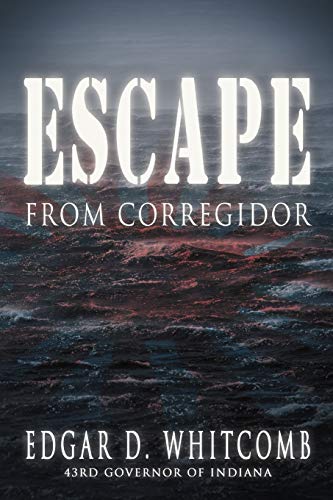
At a crucial moment, Ed Whitcomb, a B-17 navigator, made a split-second decision and thereby set off a hair-raising, spine-tingling sequence of narrow escapes, captures, unexpected breaks and bitter betrayals that culminated in his final extrication from enemy territory. Whitcomb reached Clark Field just before its demolition by the Japanese. He then evaded capture at the fall of Bataan by fleeing in a row boat to the bastion of Corregidor, where he was caught. Escaping under cover of darkness, he swam for eight hours to get to the mainland. After weeks of struggle in a snake-infested jungle, he sailed by moonlight down the heavily patrolled coast, only to fall, once again, into the clutches of the enemy. Facing captors, Ed Whitcomb took a desperate chance for freedom. Clenching his fists, he said: "My name is Robert Fred Johnson, mining employee". This is the story of a man who vowed never to give up. He assumed the identity of a civilian and lived another man's life for almost two years. Neither hunger, nor beatings, nor the long gray hopelessness of prison life could shake Ed Whitcomb's determination to escape the enemy and return home to Indiana. Ed Whitcomb is the epitome of the American fighting man. He has the courage and fortitude needed to defy all odds in order to bring honor and respect to his state and country. Escape from Corregidor is the story, told with simplicity and fearlessness, of his dedication to the principles of devotion to his fellow man and his country.
Escape from CORREGIDOR
By Edgar D. WhitcombAuthorHouse
Copyright © 2012 Edgar D. Whitcomb
All right reserved.ISBN: 978-1-4772-6304-4Contents
Introduction...................................xi1. Takeoff.....................................12. Surprise attack.............................103. Sweating it out.............................264. Surrender...................................435. Getaway.....................................606. Invasion....................................717. Ordeal by water.............................828. Jungle interlude............................959. Salvador Savaras............................10810. Split up...................................12011. New companions.............................13012. Santiago prison............................13613. Lead-pipe questioning......................14614. Santo Tomas................................16315. Transfer...................................17316. Shanghai...................................18117. Malaria—and hope.....................19518. "Hello, Mom"...............................20719. Full circle................................215Epilogue.......................................233
Chapter One
TAKEOFF
The four engines of our B-17 wind up with a thundering roar as we lumber down the runway on Hamilton Field, California. Pencils, books, maps, and everything loose slide to the back of the table, and the force of the acceleration takes hold of my body as the plane lunges forward. Runway lights flash past faster and faster, until at last I feel light and breathing becomes easier. We are off the ground; and through the plastic nose of the plane, I can see the lights of the bay, the boats and the bridges of San Francisco. I press my face to the cold window to drink up these last precious glimpses of the U.S.A. It is October 16, 1941, and we are on our way to a two-year tour with the Air Corps in the Philippine Islands. It will be a long time before we see this again. We may never see it again.
Little do I know that I am starting on a strange trip around the world, perhaps unlike that experienced by any other person ... that I will be captured by the enemy ... that I will escape and be captured again ... that I will be accused of being a deserter and returned to the U.S.A. with a name not even my own ... or that I will have to fly from San Francisco again before I can take an active part in the war.
Seconds after the anti-aircraft searchlights salute us high above the long string of lights which I recognize as the Golden Gate Bridge, we plunge into a wall of total blackness. With the darkness comes torrential rain and turbulence; the aircraft begins to pitch and toss, and loose gear falls to the floor.
I feel a little weak in the stomach as I realize that it is my responsibility to navigate this giant bomber with its crew seven thousand miles across the Pacific. As I sit back and wait for the weather to clear so I can take a celestial observation to establish our position, I wonder what "Old Charlie" would think of me now.
It was Charles J. Lunn, chief navigator for Pan-American Airways at Miami, who had taught us what we knew about navigation less than a year ago. At night Charlie used to take us to the top of the San Sebastian Hotel and point out all the important stars in the heavens. He called out names for them that sounded like something out of Grandma's almanac; but after a few weeks, Arcturus and Betelgeuse became as common to us as Smith and Jones.
"Don't write that down," he would say. "You've got to get it up here in your head. Your notes and papers won't do you any good when you're out over the ocean some night. You've got to know this stuff."
When we were more advanced in our navigation training, Charlie used to take us on flights down to Havana or out over the Bahamas in the Pan-American flying boats which had been converted into classrooms, with individual tables and equipment for each cadet.
When we were graduated, we gave Charlie a two-hundred-dollar watch to show our feelings of appreciation for what he had done for us; and with big tears in his eyes he sent fifty of us off to the Army like a proud father sending his sons into the world to make their way. "You guys are going to be captains and majors in the Army Air Corps some day, and some day you'll have the responsibility of navigating bombers across the Atlantic and Pacific."
Charlie's prediction had come true, and on this night of October 16, 1941, twenty-six of Charlie's boys, including Seamon, Jones, Horowitz, Oliver, Berkowitz, Warner, McAuliff , Schreiber and me, were individually navigating the first flight of B-17's from the United States to Clark Field in the Philippine Islands. It was the 19th Bombardment Group under the command of Colonel Eugene Eubank.
The blackness of the night as we departed from San Francisco Bay turned out to be just one of many thunderstorms we flew through as our plane made its way to Hawaii, Midway Island, Wake Island, Port Moresby in New Guinea, and Port Darwin in Australia.
In Australia we were met by a Captain Colin Kelly who had flown down from the Philippine Islands to brief us on the long flight from Port Darwin to Clark Field.
Though the flight from Australia to Luzon had been by individual navigation, by prearranged plan our squadron rendezvoused near Batangas on the south shore of Luzon, and we flew in formation at a low altitude across the island of Corregidor, the mouth of Manila Bay, Bataan Peninsula, and on across the plains to Clark Field. From the nose of the B-17 I looked with eager eyes at the scenery below as it flashed past, for this was a new and interesting land. Clark Field lay in the western portion of a vast plain, stretching from Lingayen Gulf at the north to the swamps of Manila Bay on the south, and bordered on the eastern and western sides by mountain ranges. Directly to the east of the field, a volcano-shaped mountain marked the approximate center of the great plain as it rose abruptly out of the flat country that lay all around it. As we circled for landing we could see the golf course spread out west of the field, a swimming pool, and a number of large frame houses just to the west of the field. We were eager to get on the ground and to learn what our new home in the Orient had to offer. From the air everything looked clean, fresh, and green, and we were certain that Clark Field in Pampanga Province, Luzon Island, would be a wonderful place to spend the next few months.
On the ground, we were unimpressed with the fact that we had just completed the greatest mass flight in aviation history. We were more interested in getting settled in our new oriental home. Clark Field was a pleasant place and fairly well suited to our purposes, as it had been an air base for many years, although it became immediately apparent that it was too small to accommodate our bombardment group and the other squadrons which were stationed there before we arrived.
Within a few days about seventeen of our bombers were flown to Del Monte, about five hundred miles to the south on the island of Mindanão. We were quartered in old Fort Stotsenburg to the west of the field, where we occupied quarters which had previously been used by service families before they had been sent back to the United States. By setting up our cots on the porch and in the living room we found that fifteen or twenty of us could live comfortably in a big old wooden frame house previously occupied by only one family.
In spite of our somewhat crowded conditions, we soon learned to appreciate the luxury of military service in the Orient. It took us no time at all to find that life was impossible without a battery of servants to wash our clothes, make our bunks, keep our shoes polished, and fetch tall cool drinks at our beck and call. All these services were available to us for a few cents a day. We could swim, play golf, or hike to the various little villages near the field. On these walks we observed beautiful groups of multi-colored birds. There were parakeets, canaries, and parrots, all very much at home in the heavy tropical vegetation to the west side of Fort Stotsenburg. There were tall palm trees, banana trees with their wide green leaves, and all kinds of crisp green vegetation.
The villagers were a friendly sort of people with nothing more important to do than to visit with us and to be of service to us in any way possible. For the most part they worked as servants, cooks, and waiters at Clark Field and Fort Stotsenburg.
Back at the field, we learned that we would have a few days of leave to go to Manila and rest up from the long flight we had just taken. There was much excitement around the old house after news came of our leave. A fellow by the name of Warner Croxton and I decided to make the trip together.
"They say there's a place in Manila where you can store your winter stuff. Think I'll take a few things in," Croxton said as we prepared for our trip.
"That's not a bad idea. Crowded as things are here, it would be a good idea to put some of these things in storage," I answered.
After packing our bags and getting shaved and showered, we made our way to the train station at the south side of Fort Stotsenburg. The train was crowded with American and Filipino soldiers and a large number of Filipino civilians. As we bumped along from Stotsenburg to Angeles and San Fernando, Croxton nudged me and asked, "Do you see what I see?"
I turned slowly. Across the aisle, a young mother was breast-feeding a very small baby which she held in her arms. The child—she was hardly more than that—was clad only in a dress which barely reached to her waist.
"They say that's common here in the tropics. Out in the Boondocks a lot of the kids don't wear anything at all," I answered.
Croxton grinned. "No, I mean the cigarette."
I looked across the aisle again. While the mother fed the baby she was also smoking a long brown cigarette with the fire end in her mouth.
"That's a hell of a way to smoke a cigarette," I said. "Think I'd rather chew betel nut."
"Me too," answered Croxton.
We continued to watch the young mother as our train made its way along toward Manila. She did not puff on the cigarette very often; but from time to time she would take it from her lips and flip the ashes on the floor.
Croxton raised his eyebrows. "Watch her. Pretty soon she will throw that baby on the floor and go screaming for a bucket of water." But nothing happened; she continued to smoke the cigarette, and the baby slept until we were almost to Manila.
"Bet we'll find out about a lot of new customs here that we never heard of before," Croxton observed. "Last night I was reading a book by Florence Horn called Orphans of the Pacific, which tells a lot about the customs here in the islands. There's this one tribe of natives up in the northern part of the island who feed a starved dog on uncooked rice; then after a few hours, when the rice is partly digested, they cut the dog open and eat the rice themselves."
"Sounds like a dirty trick to pull on a starved dog," I answered. "But I'll bet that's not as good as a baloot."
"What's that?"
"They tell me they take an egg and bury it for several months. Then, when they dig it up, it's a baloot and very delicious."
"No, thanks," he replied. "Think I'll just stick to steak and potatoes for mine. But I guess these people don't care too much for that kind of food. One of the fellows was telling me that although they have steaks and pork chops in the refrigerator all the time, their houseboys are continually asking for money to get fish heads and rice for themselves."
The little train came to a jolting halt, and we found we were in the Manila station. It seemed that everyone in Manila was a taxi driver, for taxis were everywhere, and little brown men were everywhere to meet the hundreds of people who flooded of the train.
"Taxi, Joe. Taxi, Joe. Take your bags for you, sir?" they shouted, waving and pointing to their cabs. The taxis ranged in size from tiny little autos to stately, ancient touring cars. We chose one of the latter; and the instant our choice was indicated, we found ourselves seated and our bags loaded, and ourselves off with a jerk. The driver's rubber air horn honked wildly as we plowed recklessly into the crowded street ahead of us.
There were more horse-drawn carriages (called carromatas) than autos on the crowded, dirty streets, and the thousands of undersized taxis seemed literally to pump themselves along with their horns. The horn seemed to be by far the most important part of the vehicle as the taxi driver pushed madly across town, honk! honk! honking his way along. Whenever the traffic caused him to stop, he would continue to honk his horn and make nasty remarks to the nearest driver of a horse-drawn rig.
The city was dirty and ugly; and it smelled bad. The streets were crowded with little people scurrying in all directions, some barefooted and dressed in sleeveless sport shirts and shorts, while others wore white suits and expensive-looking dresses.
"Where's the Manila Hotel?" I shouted to the driver when he stopped at an intersection.
"On over," he answered, still honking his horn and waiting for the "go" sign.
After a while we came to a river with a sign on the bridge which told us it was the Pasig River. On the other side we drove out onto a wide boulevard lined with huge, stately trees. In the distance we could see many beautiful buildings. It was apparent that we had left the old part of the city and that now we were in the new, modern section of Manila. To our right we saw a green golf course, and beyond it a long wall which we later learned was the Walled City. Inside the wall was the ancient city of Manila, built around the old Spanish fort of Santiago. In a very few minutes we pulled up to the magnificent Manila Hotel. Our driver unloaded us, and we paid him the two pesos which he asked. Later we learned that the reasonable rate for that distance was twenty-five centavos. We had paid the equivalent of one dollar in American money for a ride that should have cost us about twelve and one-half cents; but we had learned our first lesson in Filipino—the first in a long list of lessons which finally cost us everything but our very lives. Our first look at Manila had been worth a dollar, but our lesson was worth far more than that.
After we were checked in at the hotel we learned that we were situated on the eastern end of Manila Bay. From high in the hotel we looked out across the bay to see the reflection of a red sun sinking into the distant horizon. In the foreground were ships of all descriptions lying at anchor with their flags waving high in the evening breeze and their many lights blinking signals to the shore. Rising out of the water far in the west were black mounds which were the island of Corregidor and the peninsula of Bataan.
As we drank in the splendor of the approaching twilight, Croxton said, "Sometime when we get more settled, we ought to go out and look over the island of Corregidor."
"Yes, it seemed like an interesting place from the quick look I had at it as we flew over. Like to see it myself," I replied. "Any idea on where we might go tonight?"
"Well, I have the address of a fellow here I used to know back at the Point. Name's Bud Watkins. He's in subs here."
"A West Pointer in submarines? How did that happen?"
"No, he was at Annapolis when I was at the Point." Croxton rummaged through his luggage until he came out with a little notebook. "Here it is. St. Louis Apartments. That shouldn't be too hard to find."
"All right, let's get a cab and go there. Maybe he can tell us where this place is where we can store our clothes."
In a few moments we were down on the street and hailing a cab for the St. Louis Apartments; but we didn't climb in until we had firmly established the fare as being twenty-five centavos.
At the apartment house we found the name on the mailbox and rapped on the door with the appropriate number. In response to our knock a big, husky fellow swung open the door and greeted his old friend Croxton with the usual, "Well, you old son-of-a-gun. What the hell are you doing here?"
Croxton told of our flight and introduced me to Watkins.
"Honey, come here," Watkins shouted into the other room. "Come see who's here. My old friend Croxton."
A very glamorous girl, the likes of whom we hadn't seen since we left the United States, appeared from the next room. "Ellie, these are Lieutenants Croxton and Whitcomb...."
The four of us visited for a while until it became apparent that Bud and Ellie had a previous engagement for dinner at the Army-Navy Club. Croxton accepted the invitation to join them but me being curious to have a good look at Manila, headed out alone to see the bright lights of the city.
Manila was a great and wondrous city on that Saturday night in early November, 1941, as I strolled along the Escolta and up Rizal. I was exploring the place, for it would be home during the next two years while we were stationed in the Philippines. Parts of the city were dirty, and parts of it smelled bad. On the other hand, there were modern theaters, hotels, and night clubs, and I found one fine spot where it would be nice to bring a party later on—a night club with good food and a good orchestra on top of the Avenue Hotel, six or seven stories above the heart of Manila.
Along the dark streets carromata drivers were more anxious to take a lone passenger on a joy ride than to take him sight-seeing. "You want a very beautiful girl, Joe?" they would ask over and over. "She is very beautiful and very clean. Only two pesos." But the girls were neither beautiful nor clean. The houses of prostitution were nothing more than Filipino homes with mother, father, and all the rest of the relatives sitting around the living room where the bargain was made for girls as young as fourteen or fifteen years of age. Then there was a younger member of the family peddling his wares.
(Continues...)
Excerpted from Escape from CORREGIDORby Edgar D. Whitcomb Copyright © 2012 by Edgar D. Whitcomb. Excerpted by permission of AuthorHouse. All rights reserved. No part of this excerpt may be reproduced or reprinted without permission in writing from the publisher.
Excerpts are provided by Dial-A-Book Inc. solely for the personal use of visitors to this web site.