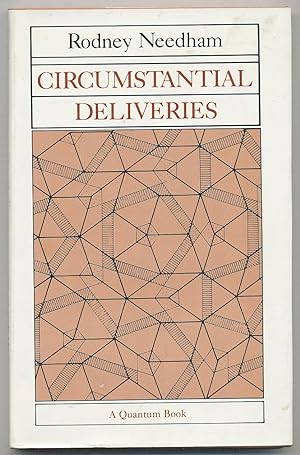
. 1981, with dustjacket, bright clean copy, light shelfwear, no markings, Professional booksellers since 1981
Circumstantial Deliveries
By Rodney NeedhamUniversity of California Press
Copyright © 1982 Rodney Needham
All right reserved.ISBN: 0520043898 Rehearsal Capital truths are to be narrowly eyed, collateral lapses and circumstantial deliveries not to be too strictly sifted. And if the substantial subject be well forged out, we need not examine the sparks which irregularly fly from it.
Sir Thomas Browne
I The essays that follow have a common character in that they all implicate what I take to be central notions in the comparative interpretation of human experience. It is not by way of collateral lapses that these matters recur in one essay after another. Their intrinsic importance, rather, is displayed by the very fact that disquisitions on various topics should converge, as the examination probes deeper, on a common set of concerns.
The general premise is that social facts may be revealingly analyzed by reference to characteristic features in polythetic combination. Underlying such features, it is contended, are certain primary factors of experience which form the elementary constituents of culture. Among these relatively steady agents are synthetic complexes recognizable as archetypes. In addition, there are in any form of civilization, as in the life of any individual, more idiosyncratic affective representations which here I call paradigmatic or exemplary scenes.
Some of the terms just adduced, critical as they are, may call for some explanation.
The notion of "characteristic features" is taken from Wittgenstein, who uses it to refer to likenesses that are more or less connected with certain things in question; the features may occur sporadically and in different combinations, or they may even disappear from the constitution of a thing of a given kind; their incidence is literally incidental, not essential. Thus there are characteristic features among the class of events described as wishing; and in the sphere of more patently social facts there are characteristic features of marriage or of a descent group, though none of them is essential to the recognition of either institution. By contrast, when Wittgenstein looks for what is usually taken to be definitive, in the sense of an attribute common to all members of a given class, he writes instead of a "specific" feature. In the classification of social facts, anthropologists have usually employed specific features in their definitions of institutions, and this procedure has entailed grave disadvantages in the framing of comparative propositions. The effect can be brought out by the explication of another analytical contrast.
The distinction between characteristic and specific features is solidary with that between "polythetic" and "monothetic" classification. Much has been written on this topic, and I have elsewhere drawn out its implications for the study of social facts, but the crux of the matter can be stated briefly. In the traditional definition of a class in western philosophy, and also in dictionary definitions, the members of a class share at least one feature in common; it is by virtue of this point of resemblance that the individuals belong to, or constitute, the class. This procedure has been termed monothetic classification. The conception has clear advantages in the exact sciences, so that the class of photons for example can be unambiguously defined; also, the princi-
ple of substitution comes into play, so that what is asserted about one photon can be taken to hold for any other photon. But in the comparative study of social forms, typically, the features in question are semantic discriminations, and these do not possess the autonomous character of natural facts. Characteristically, the members of a class of social facts may share no feature in common; things are classed together by having each a preponderance of the defining features, but there is no single essential feature that is common to all, and any missing feature can be different for each member of the class. This is true of the classificatory concepts of other civilizations, as represented in their lexical discriminations, as well as of those which are more or less deliberately devised by anthropologists. This mode of classification has been termed polythetic, and its recognition has had trenchant consequences, both descriptive and theoretical, for comparativism. Further implications are traced in the chapters that follow.
The "primary factors" which are described as forming the elementary constituents of culture correspond to aspects of thought and imagination, as exhibited in cultural traditions, which appear to have a universal distribution in world ethnography. These factors of experience are heterogeneous; they include sensory perceptions such as texture or color, and abstractions such as number or binary opposition. Also, they vary greatly in the meanings that they are made to carry; and there are no necessary connections among them such as would compose them into systems. In regarding these factors as primary, the idea is that they may play in forms of consciousness a part similar to that of ultimate predicates in epistemology. Nevertheless, they are not strictly primary, in the sense of being absolutely elementary, for as semantic vehicles they are more or less synthetic products of other phenomena, both cerebral and traditional.
Hence they are not ultimate particulars of the kind that a thorough-going reductionism might seek, and their isolation constitutes a transitional or provisional phase in comparative analysis. They will be found further treated in my Primordial Characters and especially in Chapter 1, below.
As for "archetypes," these have been extensively resorted to throughout ancient philosophy, medieval mysticism, and modern depth psychology. Rather than open the way to some of the usual objections and qualifications, I do not offer a prior definition but shall leave the present acceptation of this idea to emerge from the uses that it serves in the investigations that follow.
Illustrations of what are introduced here as "paradigmatic scenes" will be found in Chapter 4.
This array of ideas goes far, to the extent that the cogency of each is admitted, toward the formulation of a comparative method which, in a sere but accurate description, will integrate global characteristics of collective representations with innate vectors of individual cerebration. In combination, they subtend remarkable similarities of ideation, imagination, and organization among what are otherwise very divergent and idiocratic forms of social life.
II A few more particular comments on the individual essays may help the reader to approach them in a suitable frame of expectation and forbearance.
"Essential Perplexities" was an inaugural lecture at Oxford. It is reproduced here slightly altered and after the deletion of the local allusions that were called for by the occasion. It is a schematic statement of certain consequences of the view that a critical task of social anthropology is to chart the limits of human understanding. Some of the points of
research or method adumbrated in it are developed in the succeeding essays.
"Physiological Symbols" takes up the topic of symbolic elements and examines the possibility of accounting for certain of them by reference to the physiology of the human body. The positive suggestions made the substance of an address delivered extempore to the 23rd annual meeting of the Kroeber Anthropological Society at Berkeley, California. The subsequent critical observations and the overall form of the argument were worked out later, so that the investigation records both the persuasions of a line of explanation and the counterarguments emerging from a deeper consideration. The refutations are decidedly the more in accord with the methodological stance which the present collection is meant to demonstrate.
"Inner States as Universals" pursues the suggestion that the psyche is not so complex as many psychological vocabularies, beginning with that of English, seem to assert. The background to it was provided by my monograph on belief and the language of experience; and it was designed as a precursor in a deliberate expansion of academic interest in indigenous psychologies.
The circumstances of "Characteristics of Religion" were less typical of my theoretical impulsions, and not so methodical. I was asked to deliver a lecture in the context of a symposium on interpretations of religion and culture, and in reflecting on the presuppositions of that undertaking I found myself committed to an inspection of the characteristic features of what is commonly taken to constitute religion. Although this is not the kind of enterprise that I should normally embark on, or at any rate not with much hope of saying anything new, I hope that in the outcome it will be found to have transcended the usual involutions of a concern with mere definition.
"Existential Quandaries," finally, is an exercise of yet another kind. I was invited to deliver a public lecture on some topic that might have a general appeal, so I settled on some of the standing worries in the everyday explication of human life. This is indeed much the kind of employment that I think social anthropology should have in people's assessment of their nature and their place in the world, though not perhaps so directly or in this form. It is one thing to impart a new edge and force to questions about life, so that others may if they are persuaded reformulate the terms in which they speculate on their condition. It is quite another matter to isolate specific questions from among existential concerns, and then even to propose answers to them. No doubt a comparativist has no special authority to draw such conclusions, but then I should not concede that a student of mankind was disqualified either.
III Toward the end of Anna Karenina , Levin knows himself to be happy with his family and the fullness of his practical life, and yet he is overwhelmed by the uncertainty and the seeming pointlessness of existence. Nevertheless, he goes on living, not knowing and not seeing any chance of knowing what he is and for what purpose he has been placed in the world. He is tormented by this ignorance to the extent of fearing suicide; this happy father and contented husband hides ropes lest he hang himself, and he will not go out with a gun in case he obliterate the quandaries of life by shooting himself.
Others, however, have taken comfort from what they have seen as evidences of design in the world, and this character has given them the confidence that they themselves had their parts, and their lives a real justification, in some
overriding purpose behind existence. In the year that Tolstoy published his tragedy, a pioneer anthropologist, L.H. Morgan, presented in his Ancient Society a scheme of stages in the advance of man toward civilization, and he represented this evolution as discovering "the plan of the Supreme Intelligence." Now, more than a century later, comparativism can discern in the forms of human life many more numerous, and more evidential, regularities and concomitancies. These are as remarkable as the natural facts which have conducted to the idea that the world reflects a divine design, and in certainty and detail they far exceed the plan of progress inferred by Morgan. But to the extent that we can account for the design-like features which frame human lives, none of them can plausibly be ascribed a purposive character; nor can they well be interpreted as keys to a general significance imbuing the variety of institutions which frame human existence. The cosmological argument from design did not carry much conviction; a sociological argument from design, by resort to the global comparison of social facts, remained to be made. In this sphere the supposed evidences are as plain as they are in cosmology; and so, I think, are the conclusions.
Ideally, I assume, it is a mark of a humane discipline that under one aspect or another, whether directly or by implication, it shall have some bearing on the perplexities that are inseparable from reflection on human experience. The essays that follow, taken together, are minor and occasional exercises in a semantic comparativism toward that end. Because these deliveries are circumstantial, they are indeed not to be too strictly sifted; they are meant to be received as they were delivered. If the substantial subjects are not yet fully forged out, in their immanent forms they may nonetheless prefigure capital truths.
Continues...Excerpted from Circumstantial Deliveriesby Rodney Needham Copyright © 1982 by Rodney Needham. Excerpted by permission.
All rights reserved. No part of this excerpt may be reproduced or reprinted without permission in writing from the publisher.
Excerpts are provided by Dial-A-Book Inc. solely for the personal use of visitors to this web site.