

Order Total (1 Item Items):
Shipping Destination:

Time Division Multiplex Systems Bell by Bennett (3 results)
Skip to main search results
Search filters
Product Type
- All Product Types
- Books (3)
- Magazines & Periodicals (No further results match this refinement)
- Comics (No further results match this refinement)
- Sheet Music (No further results match this refinement)
- Art, Prints & Posters (No further results match this refinement)
- Photographs (No further results match this refinement)
- Maps (No further results match this refinement)
- Manuscripts & Paper Collectibles (No further results match this refinement)
Condition Learn more
- New (No further results match this refinement)
- As New, Fine or Near Fine (1)
- Very Good or Good (No further results match this refinement)
- Fair or Poor (No further results match this refinement)
- As Described (2)
Binding
- All Bindings
- Hardcover (1)
- Softcover (No further results match this refinement)
Collectible Attributes
- First Edition (2)
- Signed (No further results match this refinement)
- Dust Jacket (No further results match this refinement)
- Seller-Supplied Images (2)
- Not Print on Demand (3)
Language (1)
Price
- Any Price
- Under £ 20 (No further results match this refinement)
- £ 20 to £ 35 (No further results match this refinement)
- Over £ 35
Free Shipping
- Free Shipping to U.S.A. (No further results match this refinement)
Seller Location
Seller Rating
-
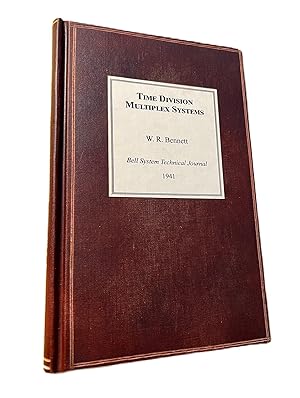
"Time Division Multiplex Systems", in "The Bell System Technical Journal".
Published by American Telephone and Telegraph Co, New York, 1941
Seller: JF Ptak Science Books, Hendersonville, NC, U.S.A.
Seller rating 5 out of 5 stars

Hardcover. Condition: As New. BENNETT, W.R. "Time Division Multiplex Systems", in "The Bell System Technical Journal", American Telephone and Telegraph Co, New York, 1941. ( Volume: 20, Issue: 2, April 1941) 199-221 in the issue of pp131-234. The issue is newly bound in cloth, with a paper label on the front cover and gilt-stamped on the spine. As new condition. VF $400 [++] "THE idea of transmitting and receiving independent signals over a common line by means of synchronized switches at the terminals is quite old and has been used in multiplex telegraphy for many years. In general if N signal channels are to be provided over one line, the switching cycle includes N equal time intervals, one of which is allotted to each channel. Each channel is connected to the line throughout a part of its particular time interval and is disconnected throughout the remainder of the cycle. Absence of interference between the channels depends upon the fact that the channels are connected to the line throughout mutually exclusive time intervals. It is thus possible to avoid the use of channel band filters such as are necessary in carrier systems employing frequency as the basis of separation." Abstract, via IEEE Explore.
-
![Seller image for Time Division Multiplex Systems in Bell System Technical Journal 20, 1941, pp. 199-221 [FULL VOLUME] for sale by Atticus Rare Books](https://pictures.abebooks.com/inventory/md/md30295641652.jpg)
Time Division Multiplex Systems in Bell System Technical Journal 20, 1941, pp. 199-221 [FULL VOLUME]
Published by American Telephone and Telegraph Co, New York, 1941
First Edition
1st Edition. FIRST EDITION (full volume) OF A PAPER CITED BY CLAUDE SHANNON "AS ONE OF HIS SOURCES OF THE SAMPLING THEOREM" (Butzera, Multiplex signal transmission and the development of sampling techniques" Applicable Analysis, January 2008, 1437). One year after publication of his seminal 1948 paper - a proof of his sampling theorem -- Shannon wrote that Bennett [in the paper offered here] had established "a result similar to Theorem 1 [his own sampling theorem]" (C.E. Shannon, Proc. IRE 37, 1949, pp. 10-21). Notably, Shannon's paper - by any measure seminal - only cited ten other papers, two of them his own. Bennett's paper, in other words, was one of only eight included. Note that we also offer this item in its original paper wrappers. "In the field of digital signal processing, the sampling theorem is a fundamental bridge between continuous-time signals and discrete-time signals. It establishes a sufficient condition for a sample rate that permits a discrete sequence of samples to capture all the information from a continuous-time signal of finite bandwidth" (Wikipedia). "Computer and information systems are prone to data loss. [Shannon's] key insight was that data transmission is possible despite noise and errors if the data is encoded in some redundant way" (Arora, Protecting Against Information Loss: coding Theory, Princeton F13). Claude Shannon was not the first scientist to propose or prove the sampling theorem (History of Physics: The Wenner Collection). In 1939, and while studying in Berlin, Herbert Raabe received his doctorate with a dissertation entitled â??Investigation of Time Multiplex Transmission' - a work whose thesis turned out to be a milestone in the development of sampling. Raabe had "independently proved the sampling theorem for multiplexed telephone transmission" (Wenner). It is surprising that in 1941, only two years after Raabe's dissertation and during the turbulence of WWII, Bennett, working not in Germany but in America at Bell Labs, was already aware enough of Raabe's dissertation to cite it in the paper offered here, his own work on time-division multiplex systems. Just as Bennett cited Raabe, eight years later and in his seminal sampling theorem paper, Shannon would cite Bennett. Bennett "applied the sampling theorem to multiplexed telephony systems, building on the work of Raabe" (ibid). Raabe and Bennett's work differed only slightly. Both investigated crosstalk between adjacent channels, but Bennett carried this to a greater generality, using switching functions to suppress crosstalk and minimize bandwidth. "All in all, Bennett's approach is more general but in the same spirit as that of Raabe. Both use Fourier series and periodic inputs and both compare switching with amplitude modulation. Bennett considers a general "switching operation" in which the signal is multiplied by a periodic function, represented by a Fourier series. Raabe speci cally considers a square wave and its Fourier series expansion, but goes on to consider band-pass inputs as well" (Butzer, 35). Finally, and in 1948 " Shannon published his famous paper â??Communication in the Presence of Noise' - "a proof of both the sampling theorem and the interpolation formula as one part of his broader development of information theory" (Wenner). In it, Shannon cites Bennett's 1941 multiplex systems paper, this paper, as one of his sources of the sampling theorem. ALSO INCLUDED: Fry, Thorton B."Industrial mathematics," pp. 255-292. A significant paper on military work in mathematics. Dodge, H. F., and Romig, H. G., "Single Sampling and Double Sampling Inspection Tables," pp. 1-60. CONDITION & DETAILS: New York: American Telephone and Telegraph Co. 4to. Full volume, handsomely rebound in half calf with gilt-tooled raised bands and letting on the spine. Bright and very clean inside and out. Fine.
-

Time Division Multiplex Systems in Bell System Technical Journal 20, 1941, pp. 199-221 [ORIGINAL PAPER WRAPPERS]
Published by American Telephone and Telegraph Co, New York, 1941
First Edition
1st Edition. IN ORIGINAL PAPER WRAPS, the FIRST EDITION OF A PAPER CITED BY CLAUDE SHANNON "AS ONE OF HIS SOURCES OF THE SAMPLING THEOREM" (Butzera, Multiplex signal transmission and the development of sampling techniques" Applicable Analysis, January 2008, 1437). One year after publication of his seminal 1948 paper - a proof of his sampling theorem -- Shannon wrote that Bennett [in the paper offered here] had established "a result similar to Theorem 1 [his own sampling theorem]" (C.E. Shannon, Proc. IRE 37, 1949, pp. 10-21). Notably, Shannon's paper - by any measure seminal - only cited ten other papers, two of them his own. Bennett's paper, in other words, was one of only eight to make the cut. Note that we also offer this paper in its bound form. "In the field of digital signal processing, the sampling theorem is a fundamental bridge between continuous-time signals and discrete-time signals. It establishes a sufficient condition for a sample rate that permits a discrete sequence of samples to capture all the information from a continuous-time signal of finite bandwidth" (Wikipedia). "Computer and information systems are prone to data loss. [Shannon's] key insight was that data transmission is possible despite noise and errors if the data is encoded in some redundant way" (Arora, Protecting Against Information Loss: coding Theory, Princeton F13). Claude Shannon was not the first scientist to propose or prove the sampling theorem (History of Physics: The Wenner Collection). In 1939, and while studying in Berlin, Herbert Raabe received his doctorate with a dissertation entitled â??Investigation of Time Multiplex Transmission' - a work whose thesis turned out to be a milestone in the development of sampling. Raabe had "independently proved the sampling theorem for multiplexed telephone transmission" (Wenner). It is surprising that in 1941, only two years after Raabe's dissertation and during the turbulence of WWII, Bennett, working not in Germany but in America at Bell Labs, was already aware enough of Raabe's dissertation to cite it in the paper offered here, his own work on time-division multiplex systems. Just as Bennett cited Raabe, eight years later and in his seminal sampling theorem paper, Shannon would cite Bennett. Bennet "applied the sampling theorem to multiplexed telephony systems, building on the work of Raabe" (ibid). Raabe and Bennett's work differed only slightly. Both investigated crosstalk between adjacent channels, but Bennett carried this to a greater generality, using switching functions to suppress crosstalk and minimize bandwidth. "All in all, Bennett's approach is more general but in the same spirit as that of Raabe. Both use Fourier series and periodic inputs and both compare switching with amplitude modulation. Bennett considers a general "switching operation" in which the signal is multiplied by a periodic function, represented by a Fourier series. Raabe speci cally considers a square wave and its Fourier series expansion, but goes on to consider band-pass inputs as well" (Butzer, 35). Finally, and in 1948 " Shannon published his famous paper â??Communication in the Presence of Noise' - "a proof of both the sampling theorem and the interpolation formula as one part of his broader development of information theory" (Wenner). In it, Shannon cites Bennett's 1941 multiplex systems paper, this paper, as one of his sources of the sampling theorem. CONDITION & DETAILS: New York: American Telephone and Telegraph Co. 8vo. Complete in original wrappers. The wrappers remain bright and evidence only a few smudges. Bright and very clean inside. Near fine condition.

