

Order Total (1 Item Items):
Shipping Destination:

Statement Presbyter First by Hinman Samuel (1 results)
Skip to main search results
Search filters
Product Type
- All Product Types
- Books (1)
- Magazines & Periodicals (No further results match this refinement)
- Comics (No further results match this refinement)
- Sheet Music (No further results match this refinement)
- Art, Prints & Posters (No further results match this refinement)
- Photographs (No further results match this refinement)
- Maps (No further results match this refinement)
- Manuscripts & Paper Collectibles (No further results match this refinement)
Condition Learn more
- New (No further results match this refinement)
- As New, Fine or Near Fine (No further results match this refinement)
- Very Good or Good (1)
- Fair or Poor (No further results match this refinement)
- As Described (No further results match this refinement)
Binding
- All Bindings
- Hardcover (No further results match this refinement)
- Softcover (1)
Collectible Attributes
- First Edition (1)
- Signed (No further results match this refinement)
- Dust Jacket (No further results match this refinement)
- Seller-Supplied Images (1)
- Not Print on Demand (1)
Language (1)
Price
- Any Price
- Under £ 20 (No further results match this refinement)
- £ 20 to £ 35 (No further results match this refinement)
- Over £ 35
Free Shipping
- Free Shipping to U.S.A. (No further results match this refinement)
Seller Location
Seller Rating
-
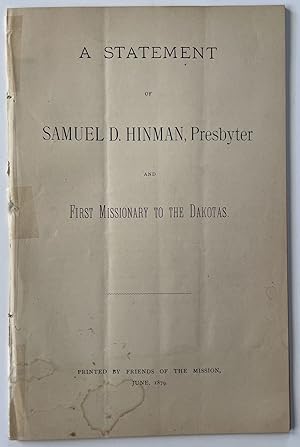
A Statement of Samuel D. Hinman, Presbyter and First Missionary to the Dakotas
Published by Friends of the Mission, 1879
Seller: Stellar Books & Ephemera, ABAA, Carlsborg, WA, U.S.A.
Seller rating 5 out of 5 stars

First Edition
Condition: Good. A Statement of Samuel D. Hinman, Presbyter and First Missionary to the Dakotas, Samuel D. Hinman, Friends of the Mission, N. P., 1879, 8.5 x 5.5 inches, 32 pp. Booklet with no wrappers, thread sewn binding with three pieces of tape; some spot staining to front; binding worn; interior pages clean; good condition. Samuel Dutton Hinman (1839-1890) was an American Episcopalian priest; he was the first Episcopalian missionary sent to the Dakota, or Sioux, people, initially establishing the Mission of St. John in Redwood County, Minnesota. His time there was short-lived, however, as the mission was destroyed in the Sioux uprising of 1862; Hinman survived by fleeing to nearby Fort Ridgely. Following the uprising, Hinman continued his missionary work among the Santee Sioux in Nebraska. There he led the meetings of white and Native clergy, catechists, and lay representatives that eventually formed the Niobrara Convocation, which was an annual meeting of Native and non-Native Episcopalians to discuss their mission work. According to Trask (2013), although the Niobrara convocation helped the Episcopal Church "advance its status in the Indian reform movement", Hinman's involvement may have hindered the autonomy of the Santee and Yankton Sioux. Because of his own goal to be elevated to Bishop of Niobrara, Hinman would have been quite determined to turn the dynamics of the meeting to his advantage rather than acting in the best interests of the Native people, and the concluding document from the meeting supports this (Trask, 2013). He also had a rivalry with neighboring Episcopalian missionary Hobart Hare, and Hinman suffered a humiliating setback when Hare was elected Bishop of Niobrara. Throughout Bishop Hare's time in the Dakota Territory, he was plagued by rumors of Hinman's dalliances with Native women; Hinman's wife fell ill and eventually died of syphilis, which she allegedly contracted from Hinman who got it from a Native woman; he denied this, but was subject to several clerical investigations. Bishop Hare "declined to reemploy Samuel Hinman from 1878 onward because his behavior was not a proper role model for Indians" (Trask, 2013). Hinman disputed this, and the conflict led to a libel trial filed by Hinman against Hare, which Hinman won, although Hare won an appeal trial in 1887 that banned Hinman from the Santee and Yankton Sioux reservations. This booklet contains the statement of Samuel D. Hinman, condemning and refuting the accusations brought against him in 1878 by Bishop Hare and members of the Santee Sioux tribe. The 2013 paper I have cited above, "Episcopal Missionaries on the Santee and Yankton Reservations Cross-Cultural Collaboration and President Grant's Peace Policy" by David S. Trask, provides excellent further reading on this subject for those interested. Two copies found in OCLC as of November 16, 2023.
