
Order Total (1 Item Items):
Shipping Destination:

Snakes Java Bali Surrounding Islands by Lang (2 results)
Skip to main search results
Search filters
Product Type
- All Product Types
- Books (2)
- Magazines & Periodicals (No further results match this refinement)
- Comics (No further results match this refinement)
- Sheet Music (No further results match this refinement)
- Art, Prints & Posters (No further results match this refinement)
- Photographs (No further results match this refinement)
- Maps (No further results match this refinement)
- Manuscripts & Paper Collectibles (No further results match this refinement)
Condition Learn more
- New (1)
- As New, Fine or Near Fine (No further results match this refinement)
- Very Good or Good (No further results match this refinement)
- Fair or Poor (No further results match this refinement)
- As Described (1)
Binding
- All Bindings
- Hardcover (2)
- Softcover (No further results match this refinement)
Collectible Attributes
- First Edition (No further results match this refinement)
- Signed (No further results match this refinement)
- Dust Jacket (No further results match this refinement)
- Seller-Supplied Images (2)
- Not Print on Demand (2)
Language (2)
Price
- Any Price
- Under £ 20 (No further results match this refinement)
- £ 20 to £ 35 (No further results match this refinement)
- Over £ 35
Free Shipping
- Free Shipping to U.S.A. (No further results match this refinement)
Seller Location
Seller Rating
-
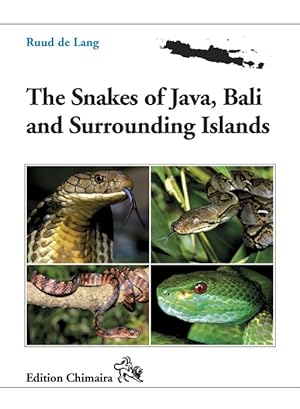
The Snakes of Java, Bali and Surrounding Islands
Language: English
Published by Edition Chimaira, Frankfurt, 2017
ISBN 10: 3899735250 ISBN 13: 9783899735253
Seller: PEMBERLEY NATURAL HISTORY BOOKS BA, ABA, Iver, United Kingdom
Association Member: ABA ILAB PBFA
Seller rating 5 out of 5 stars

Condition: New. 435, 288 col + 21 b/w photos, 2 col maps. . HB. NEW. . Text English. Alfred Russel Wallace described Java in his book The Malay Archipelago (1869) as ".the finest and most interesting tropical island in the world". Large tropical islands tend to have a diverse, and species-rich snake fauna. The snake fauna of Java contains 91 species in 13 families. The most recently described snakes from Java include the pipe snake Cylindrophis subocularis (2016), two species of Dendrelaphis (2008), the pit viper Trimeresurus insularis (1977), and the minute fossorial snake Calamaria lovii wermuthi (1965). This is surprisingonly five taxa of snakes described in the last half century from the 13th largest island on the planet. Of course there are several reasons for this. Relatively few people study Indonesian snakes, but more alarming is the fact that Java has a human population of more than 141 million or about 1026 humans/km . Looking at the list of Javan snakes today one can only wonder how many species of snakes were present when Wallace wrote that statement in 1869. I have little doubt environmental modifications by humans over the last century have reduced the snake diversity. At the same time many snakes may have either adapted to human modified environments or have successfully evaded the damaged environments and still survive somewhere on the islandwaiting to be discovered by science. This book is a first step in discovering new species of Javan snakes. Using this book the herpetologist or naturalist can readily identify all of the species known to occur on the island. Thus, snake enthusiasts will hopefully recognize species that are unknown when they are found. Ruud de Lang has compiled species accounts for all of the known snake taxa, provided details for identification and for the exploration of the background of the snake fauna as well. [9783899735253].
-
Large tropical islands tend to have a diverse, and species-rich snake fauna. The snake fauna of Java contains 91 species in 13 families. The most recently described snakes from Java include the pipe snake Cylindrophis subocularis (2016), two species of Dendrelaphis (2008), the pit viper Trimeresurus insularis (1977), and the minute fossorial snake Calamaria lovii wermuthi (1965). This is surprising only five taxa of snakes described in the last half century from the 13th largest island on the planet. Of course there are several reasons for this. Relatively few people study Indonesian snakes, but more alarming is the fact that Java has a human population of more than 141 million or about 1026 humans/km . Looking at the list of Javan snakes today one can only wonder how many species of snakes were present when Wallace wrote that statement in 1869. There is little doubt environmental modifications by humans over the last century have reduced the snake diversity. At the same time many snakes may have either adapted to human modified environments or have successfully evaded the damaged environments and still survive somewhere on the island waiting to be discovered by science. The Snakes of Java, Bali and Surrounding Islands is a first step in discovering new species of Javan snakes. Using this book the herpetologist or naturalist can readily identify all of the species known to occur on the island. Thus, snake enthusiasts will hopefully recognize species that are unknown when they are found. Ruud de Lang has compiled species accounts for all of the known snake taxa, provided details for identification and for the exploration of the background of the snake fauna as well. Frankfurt a. M. Edition Chimaira. 435 pp., 288 color & 21 b/w illustrations, 2 b/w distribution maps, 18 tables, hardcover gr. 8 [15 x 21.5 cm].


