

Order Total (1 Item Items):
Shipping Destination:

Secular Variation Moons Motion by Adams (5 results)
Skip to main search results
Search filters
Product Type
- All Product Types
- Books (5)
- Magazines & Periodicals (No further results match this refinement)
- Comics (No further results match this refinement)
- Sheet Music (No further results match this refinement)
- Art, Prints & Posters (No further results match this refinement)
- Photographs (No further results match this refinement)
- Maps (No further results match this refinement)
- Manuscripts & Paper Collectibles (No further results match this refinement)
Condition Learn more
- New (1)
- As New, Fine or Near Fine (No further results match this refinement)
- Very Good or Good (1)
- Fair or Poor (No further results match this refinement)
- As Described (3)
Binding
Collectible Attributes
- First Edition (2)
- Signed (No further results match this refinement)
- Dust Jacket (No further results match this refinement)
- Seller-Supplied Images (3)
- Not Print on Demand (4)
Language (1)
Free Shipping
Seller Location
Seller Rating
-

"On the Secular Variation of the Moon's Mean Motion" (Philosophical Transactions of the Royal Society of London, Vol. 143 for the Year 1853 Part I & II, pp. 397-406)
Published by Royal Society of London, London, 1853
First Edition
Hardcover. Condition: Very Good. First Edition. iv, [1]-566, [1]-15 pp. 4to. Library binding, tan leather spine with gold embossed titling. Interiors clean, ex-library stamp on title page, and occurring sporadically within. Numerous folding plates that illustrate articles. Pages were trimmed slightly when rebound. Adams corrects Pierre-Simon Laplace's (1749-1827) earlier equations for the moon's motion. Also contains William Thomson's "On the Thermal Effects of Fluids in Motion" (Volume 143 pp. 357-365, 1853) and George Gabriel Stokes' "On the Change of Refrangibility of Light.- No. II" (pp.385-386).
-
![Seller image for On the Secular Variation of the Moon's Mean Motion Volume 143 1853 [LeatherBound] for sale by True World of Books](https://pictures.abebooks.com/inventory/md/md31532967626.jpg)
On the Secular Variation of the Moon's Mean Motion Volume 143 1853 [LeatherBound]
Publication Date: 2025
LeatherBound. Condition: New. BOOKS ARE EXEMPT FROM IMPORT DUTIES AND TARIFFS; NO EXTRA CHARGES APPLY. Leather Binding on Spine and Corners with Golden leaf printing on spine. Bound in genuine leather with Satin ribbon page markers and Spine with raised gilt bands. A perfect gift for your loved ones. Reprinted from 1853 edition. NO changes have been made to the original text. This is NOT a retyped or an ocr'd reprint. Illustrations, Index, if any, are included in black and white. Each page is checked manually before printing. As this print on demand book is reprinted from a very old book, there could be some missing or flawed pages, but we always try to make the book as complete as possible. Fold-outs, if any, are not part of the book. If the original book was published in multiple volumes then this reprint is of only one volume, not the whole set and contains approximately 11 pages. IF YOU WISH TO ORDER PARTICULAR VOLUME OR ALL THE VOLUMES YOU CAN CONTACT US. Resized as per current standards. Sewing binding for longer life, where the book block is actually sewn (smythe sewn/section sewn) with thread before binding which results in a more durable type of binding. Language: English.
-
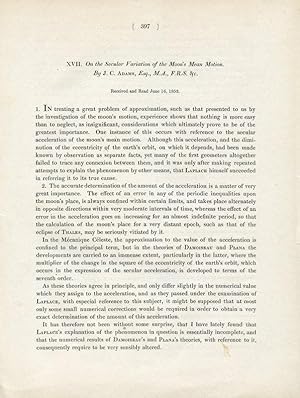
On the Secular Variation of the Moon's Mean Motion extracted from Philosophical Transactions of the Royal Society, Vol. 143, Part III, 1853, pp. 397-406
Published by Taylor and Francis, London, 1853
First Edition
1st Edition. FIRST EDITION of an important and consequential paper in which John Couch Adams announces new mathematical methods in dealing with the pertubations of the Moon, and in so doing corrects Laplace's famed 1788 memoir. Laplace studied the Moon's mean rate of motion relative to the stars; his work provided an explanation in terms of changes in the eccentricity of the Earth's orbit considering only the radial gravitational forces on the Moon from the Sun and Earth and had obtained close agreement with historical observational records. "Adams showed that Laplace's solution was incorrect. In particular, Laplace had ignored a variation in solar eccentricity that introduces into the differential equations for the moon's motion a series of additional terms" (DSB I, p. 54b). In other works, Adams paper showed that while tangential terms vanish in the first-order theory of Laplace, they became substantial when quadratic terms are admitted. Small terms integrated in time come to have large effects and Adams concluded that Plana had overestimated the secular acceleration by approximately 1.66 inches per century" (Wikipedia). Adams "paper caused a sharp scientific controversy, marked by angry chauvinism on the part of several French astronomers. Their attack stimulated a number of independent investigations of the subject, all of which confirmed Adams' results. The matter was definitely settles in his favor by 1861, but not without hard feelings" (DSB 54b). CONDITION & DETAILS: London: Richard Taylor and William Francis. Quarto. (11 x 8.5 inches; 275 x 213mm). pp. 397-406. No wrappers as extracted from Philosophical Transactions. Clean and bright; near fine condition.
-

On the Secular Variation of the Moon's Mean Motion. Received and Read June 16, 1853.
Seller: Herman H. J. Lynge & Søn ILAB-ABF, Copenhagen, Denmark
Seller rating 4 out of 5 stars

(London, Richard Taylor and William Francis, 1853) 4to. No wrappers as extracted from "Philosophical Transactions" 1853, Vol. 143. Pp. 397-406. First appearance of this importent paper by Adams, - famous for his co-discovery with Le Verrier, of Neptune in 1846 - in which he introduces new mathematical methods in dealing with the pertubations of the Moon, raising a sharp scientific controversy, and correcting Laplace's great memoir of 1788."He (Adams) was elected a fellow of Pembroke College in 1853, and shortly afterward he presented to the Royal Society a remarkable paper on the secular acceleration of the moon?s mean motion. This quantity was thought to have been definitively investigated by Pierre Simon de Laplace in 1788, but Adams showed that Laplace?s solution was incorrect. In particular, Laplace had ignored a variation in solar eccentricity that introduces into the differential equations for the moon?s motion a series of additional terms. Adams calculated the second term of the series, on which the secular acceleration depends, as 3771/64m4 the value computed from Laplace?s work was 2187/128 m4. The effect of the correction was to reduce the figure for the moon?s secular acceleration by about half, from 10?.58 to 5?.70.This paper caused a sharp scientific controversy, marked by angry chauvinism on the part of several French astronomers. Their attacks stimulated a number of independent investigations of the subject, all of which confirmed Adams? result. The matter was definitely settled in his favor by 1861, but not without hard feelings."(DSB).
-
On the Secular Variation of the Moon's Mean Motion. Received and Read June 16, 1853.
Seller: Herman H. J. Lynge & Søn ILAB-ABF, Copenhagen, Denmark
Seller rating 4 out of 5 stars
(London, Richard Taylor and William Francis, 1853) 4to. No wrappers as extracted from "Philosophical Transactions" 1853, Vol. 143 - Part III. Pp. 397-406. Clean and fine. First appearance of this importent paper by Adams, - famous for his co-discovery with Le Verrier, of Neptune in 1846 - in which he introduces new mathematical methods in dealing with the pertubations of the Moon, raising a sharp scientific controversy, and correcting Laplace's great memoir of 1788."He (Adams) was elected fellow of Pembroke College in 1853, and shortly afterwards he presented to the Royal Society a remarkable paper (the paper offered) on the secular accleration of the moon's mean motion. This quantity was thought to have been definitively investigated by Pierre Simon de Laplace in 1788, but Adams showed that Laplace's solution was incorrect. In particular, Laplace had ignored a variation in solar eccentricity that introduces into the diffrential equations for the moon's motion a series of additional terms. Adams calculated the second term of series, on which the secular acceleartion depends.This paper caused a sharp scientific controversy, marked by angry chauvinism on the part of several French astronomers. Their attack stimulated a number of independent investigations of the subject, all of which confirmed Adams' results. The matter was definitely settles in his favor by 1861, but not without hard feelings."(DSB I, p. 54b).


