

Order Total (1 Item Items):
Shipping Destination:

Recent Advances Robot Learning (14 results)
Skip to main search results
Search filters
Product Type
- All Product Types
- Books (14)
- Magazines & Periodicals (No further results match this refinement)
- Comics (No further results match this refinement)
- Sheet Music (No further results match this refinement)
- Art, Prints & Posters (No further results match this refinement)
- Photographs (No further results match this refinement)
- Maps (No further results match this refinement)
- Manuscripts & Paper Collectibles (No further results match this refinement)
Condition Learn more
- New (13)
- As New, Fine or Near Fine (1)
- Very Good or Good (No further results match this refinement)
- Fair or Poor (No further results match this refinement)
- As Described (No further results match this refinement)
Binding
Collectible Attributes
- First Edition (No further results match this refinement)
- Signed (No further results match this refinement)
- Dust Jacket (No further results match this refinement)
- Seller-Supplied Images (7)
- Not Print on Demand (10)
Language (1)
Price
- Any Price
- Under £ 20 (No further results match this refinement)
- £ 20 to £ 40 (No further results match this refinement)
- Over £ 40
Free Shipping
- Free Shipping to U.S.A. (No further results match this refinement)
Seller Location
Seller Rating
-
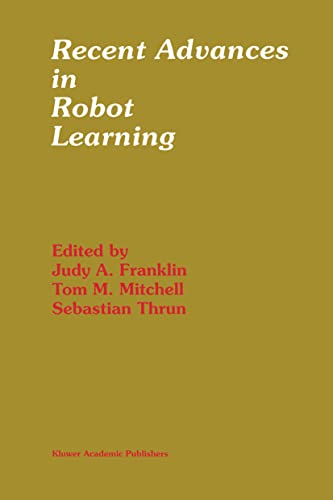
Recent Advances in Robot Learning: Machine Learning (The Springer International Series in Engineering and Computer Science, 368)
Seller: Ria Christie Collections, Uxbridge, United Kingdom
Seller rating 5 out of 5 stars

£ 134.30
£ 11.98 shipping
Ships from United Kingdom to U.S.A.Quantity: Over 20 available
Add to basketCondition: New. In.
-

Recent Advances in Robot Learning: Machine Learning (The Springer International Series in Engineering and Computer Science)
Seller: Ria Christie Collections, Uxbridge, United Kingdom
Seller rating 5 out of 5 stars
£ 134.30
£ 11.98 shipping
Ships from United Kingdom to U.S.A.Quantity: Over 20 available
Add to basketCondition: New. In.
-
Taschenbuch. Condition: Neu. Recent Advances in Robot Learning | Machine Learning | Judy A. Franklin (u. a.) | Taschenbuch | iv | Englisch | 2011 | Springer | EAN 9781461380641 | Verantwortliche Person für die EU: Springer Verlag GmbH, Tiergartenstr. 17, 69121 Heidelberg, juergen[dot]hartmann[at]springer[dot]com | Anbieter: preigu.
-
Condition: New. pp. iv + 218.
-

Gebunden. Condition: New. Recent Advances in Robot Learning contains seven papers on robot learning written by leading researchers in the field. As the selection of papers illustrates, the field of robot learning is both active and diverse. A variety of machine learning .
-
Condition: New. pp. iv + 218.
-

Taschenbuch. Condition: Neu. Druck auf Anfrage Neuware - Printed after ordering - Recent Advances in Robot Learning contains seven papers on robot learning written by leading researchers in the field. As the selection of papers illustrates, the field of robot learning is both active and diverse. A variety of machine learning methods, ranging from inductive logic programming to reinforcement learning, is being applied to many subproblems in robot perception and control, often with objectives as diverse as parameter calibration and concept formulation. While no unified robot learning framework has yet emerged to cover the variety of problems and approaches described in these papers and other publications, a clear set of shared issues underlies many robot learning problems. Machine learning, when applied to robotics, is situated: it is embedded into a real-world system that tightly integrates perception, decision making and execution. Since robot learning involves decision making, there is an inherent active learning issue. Robotic domains are usually complex, yet the expense of using actual robotic hardware often prohibits the collection of large amounts of training data. Most robotic systems are real-time systems. Decisions must be made within critical or practical time constraints. These characteristics present challenges and constraints to the learning system. Since these characteristics are shared by other important real-world application domains, robotics is a highly attractive area for research on machine learning. On the other hand, machine learning is also highly attractive to robotics. There is a great variety of open problems in robotics that defy a static, hand-coded solution. Recent Advances in Robot Learning is an edited volume of peer-reviewed original research comprising seven invited contributions by leading researchers. This research work has also been published as a special issue of Machine Learning (Volume 23, Numbers 2 and 3).
-
Paperback. Condition: Brand New. reprint edition. 224 pages. 9.13x6.10x0.59 inches. In Stock.
-
Paperback. Condition: Like New. LIKE NEW. SHIPS FROM MULTIPLE LOCATIONS. book.
-

Recent Advances in Robot Learning : Machine Learning
Language: English
Published by Springer Us Jun 1996, 1996
ISBN 10: 0792397452 ISBN 13: 9780792397458
Buch. Condition: Neu. Neuware - Recent Advances in Robot Learning contains seven papers on robot learning written by leading researchers in the field. As the selection of papers illustrates, the field of robot learning is both active and diverse. A variety of machine learning methods, ranging from inductive logic programming to reinforcement learning, is being applied to many subproblems in robot perception and control, often with objectives as diverse as parameter calibration and concept formulation. While no unified robot learning framework has yet emerged to cover the variety of problems and approaches described in these papers and other publications, a clear set of shared issues underlies many robot learning problems. Machine learning, when applied to robotics, is situated: it is embedded into a real-world system that tightly integrates perception, decision making and execution. Since robot learning involves decision making, there is an inherent active learning issue. Robotic domains are usually complex, yet the expense of using actual robotic hardware often prohibits the collection of large amounts of training data. Most robotic systems are real-time systems. Decisions must be made within critical or practical time constraints. These characteristics present challenges and constraints to the learning system. Since these characteristics are shared by other important real-world application domains, robotics is a highly attractive area for research on machine learning. On the other hand, machine learning is also highly attractive to robotics. There is a great variety of open problems in robotics that defy a static, hand-coded solution. Recent Advances in Robot Learning is an edited volume of peer-reviewed original research comprising seven invited contributions by leading researchers. This research work has also been published as a special issue of Machine Learning (Volume 23, Numbers 2 and 3).
-
Condition: new. Questo è un articolo print on demand.
-

Condition: New. Dieser Artikel ist ein Print on Demand Artikel und wird nach Ihrer Bestellung fuer Sie gedruckt. Recent Advances in Robot Learning contains seven papers on robot learning written by leading researchers in the field. As the selection of papers illustrates, the field of robot learning is both active and diverse. A variety of machine learning .
-

Recent Advances in Robot Learning
Language: English
Published by Springer US Sep 2011, 2011
ISBN 10: 1461380642 ISBN 13: 9781461380641
Seller: BuchWeltWeit Ludwig Meier e.K., Bergisch Gladbach, Germany
Seller rating 5 out of 5 stars
Taschenbuch. Condition: Neu. This item is printed on demand - it takes 3-4 days longer - Neuware -Recent Advances in Robot Learning contains seven papers on robot learning written by leading researchers in the field. As the selection of papers illustrates, the field of robot learning is both active and diverse. A variety of machine learning methods, ranging from inductive logic programming to reinforcement learning, is being applied to many subproblems in robot perception and control, often with objectives as diverse as parameter calibration and concept formulation. While no unified robot learning framework has yet emerged to cover the variety of problems and approaches described in these papers and other publications, a clear set of shared issues underlies many robot learning problems. Machine learning, when applied to robotics, is situated: it is embedded into a real-world system that tightly integrates perception, decision making and execution. Since robot learning involves decision making, there is an inherent active learning issue. Robotic domains are usually complex, yet the expense of using actual robotic hardware often prohibits the collection of large amounts of training data. Most robotic systems are real-time systems. Decisions must be made within critical or practical time constraints. These characteristics present challenges and constraints to the learning system. Since these characteristics are shared by other important real-world application domains, robotics is a highly attractive area for research on machine learning. On the other hand, machine learning is also highly attractive to robotics. There is a great variety of open problems in robotics that defy a static, hand-coded solution. Recent Advances in Robot Learning is an edited volume of peer-reviewed original research comprising seven invited contributions by leading researchers. This research work has also been published as a special issue of Machine Learning (Volume 23, Numbers 2 and 3). 228 pp. Englisch.
-

Recent Advances in Robot Learning
Language: English
Published by Springer US, Springer New York Sep 2011, 2011
ISBN 10: 1461380642 ISBN 13: 9781461380641
Seller: buchversandmimpf2000, Emtmannsberg, BAYE, Germany
Seller rating 5 out of 5 stars
Taschenbuch. Condition: Neu. This item is printed on demand - Print on Demand Titel. Neuware -Recent Advances in Robot Learning contains seven papers on robot learning written by leading researchers in the field. As the selection of papers illustrates, the field of robot learning is both active and diverse. A variety of machine learning methods, ranging from inductive logic programming to reinforcement learning, is being applied to many subproblems in robot perception and control, often with objectives as diverse as parameter calibration and concept formulation. While no unified robot learning framework has yet emerged to cover the variety of problems and approaches described in these papers and other publications, a clear set of shared issues underlies many robot learning problems. Machine learning, when applied to robotics, is situated: it is embedded into a real-world system that tightly integrates perception, decision making and execution. Since robot learning involves decision making, there is an inherent active learning issue. Robotic domains are usually complex, yet the expense of using actual robotic hardware often prohibits the collection of large amounts of training data. Most robotic systems are real-time systems. Decisions must be made within critical or practical time constraints. These characteristics present challenges and constraints to the learning system. Since these characteristics are shared by other important real-world application domains, robotics is a highly attractive area for research on machine learning. On the other hand, machine learning is also highly attractive to robotics. There is a great variety of open problems in robotics that defy a static, hand-coded solution. Recent Advances in Robot Learning is an edited volume of peer-reviewed original research comprising seven invited contributions by leading researchers. This research work has also been published as a special issue of Machine Learning (Volume 23, Numbers 2 and 3).Springer Verlag GmbH, Tiergartenstr. 17, 69121 Heidelberg 228 pp. Englisch.


