

Order Total (1 Item Items):
Shipping Destination:

Origin Instincts by Darwin Charles (2 results)
Skip to main search results
Search filters
Product Type
- All Product Types
- Books (2)
- Magazines & Periodicals (No further results match this refinement)
- Comics (No further results match this refinement)
- Sheet Music (No further results match this refinement)
- Art, Prints & Posters (No further results match this refinement)
- Photographs (No further results match this refinement)
- Maps (No further results match this refinement)
- Manuscripts & Paper Collectibles (No further results match this refinement)
Condition Learn more
- New (No further results match this refinement)
- As New, Fine or Near Fine (No further results match this refinement)
- Very Good or Good (No further results match this refinement)
- Fair or Poor (No further results match this refinement)
- As Described (2)
Binding
- All Bindings
- Hardcover (No further results match this refinement)
- Softcover (2)
Collectible Attributes
- First Edition (1)
- Signed (No further results match this refinement)
- Dust Jacket (No further results match this refinement)
- Seller-Supplied Images (2)
- Not Print on Demand (2)
Language (1)
Price
- Any Price
- Under £ 20 (No further results match this refinement)
- £ 20 to £ 35 (No further results match this refinement)
- Over £ 35
Free Shipping
Seller Location
Seller Rating
-

Origin of certain instincts. In Nature, vol. 7, no. 179
Publication Date: 1873
Seller: Jeremy Norman's historyofscience, Novato, CA, U.S.A.
Seller rating 4 out of 5 stars

First Edition
Darwin, Charles (1809-82). Origin of certain instincts. In Nature 7 (1873): 417-418. Whole number. [cix] - cxii, 417-436, cxiii - cxvi pp. 269 x 183 mm. Without wrappers. First and last leaves (conjugate) detached, but very good otherwise. First Edition, of one of Darwin's lesser-known discoveries. Darwin was the first to postulate, in this paper, the existence of an inertially-based navigational system in animals; his suggestion was confirmed by studies done in the 20th century. This type of navigational system, now known as path integration, uses input from the vestibular organs and other sensors in the body to enable an animal, such as a migrating bird, to estimate its position with relation to its home. Freeman, The Works of Charles Darwin, 1760. .
-
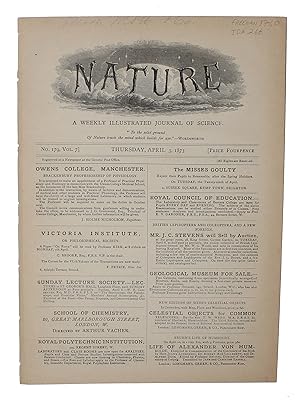
Origin of certain instincts.
Seller: Herman H. J. Lynge & Søn ILAB-ABF, Copenhagen, Denmark
Seller rating 4 out of 5 stars
London, 1873. Small folio. Extracted, with traces from the sewn cords, in the original printed wrappers. In "Nature", No. 179, Vol. 7, April 13. Entire issue offered. Front wrapper detached, otherwise fine and clean. Housed in a portfolio with white paper title-label to front board. Darwin's notice: Pp. 417-18. [Entire issue: Pp. (1), cx-cxvi, 417-436]. First appearance of Darwin's comment to an article in NATURE of March 20, 1873, containing his view on the origin of certain instincts. "THE writer of the interesting article in NATURE of March 20 doubts whether my belief ?that many of the most wonderful instincts have been acquired, independently of habit, through the preservation of useful variations of pre existing instincts,? means more than ?that in a great many instances we cannot conceive how the instincts originated.? This in one sense is perfectly true, but what I wished to bring prominently forward was simply that in certain cases instincts had not been acquired through the experience of their utility, with continued practice during successive generations. I had in my mind the case of neuter insects, which never leave offspring to inherit the teachings of experience, and which are themselves the offspring of parents which possess quite different instincts. The Hive-bee is the best known instance, as neither the queen nor the drones construct cells, secrete wax, collect honey, &c." (From the present paper). Freeman 1760.
