Order Total (1 Item Items):
Shipping Destination:

Mechanical Performance Logical Inference by Jevons Stanley (5 results)
Skip to main search results
Search filters
Product Type
- All Product Types
- Books (5)
- Magazines & Periodicals (No further results match this refinement)
- Comics (No further results match this refinement)
- Sheet Music (No further results match this refinement)
- Art, Prints & Posters (No further results match this refinement)
- Photographs (No further results match this refinement)
- Maps (No further results match this refinement)
- Manuscripts & Paper Collectibles (No further results match this refinement)
Condition Learn more
- New (No further results match this refinement)
- As New, Fine or Near Fine (2)
- Very Good or Good (No further results match this refinement)
- Fair or Poor (No further results match this refinement)
- As Described (3)
Binding
Collectible Attributes
- First Edition (4)
- Signed (No further results match this refinement)
- Dust Jacket (No further results match this refinement)
- Seller-Supplied Images (5)
- Not Print on Demand (5)
Language (1)
Price
- Any Price
- Under £ 20 (No further results match this refinement)
- £ 20 to £ 35 (No further results match this refinement)
- Over £ 35
Free Shipping
- Free Shipping to U.S.A. (No further results match this refinement)
Seller Location
Seller Rating
-
On the Mechanical Performance of Logical Inference [The Logical Piano]
Published by Taylor & Francis, London, 1870
Seller: Manhattan Rare Book Company, ABAA, ILAB, New York, NY, U.S.A.
Seller rating 5 out of 5 stars

First Edition
Original wrappers. Condition: Fine. First edition. A LANDMARK IN COMPUTER SCIENCE: FIRST EDITION OF JEVONS'S PRESENTATION AND EXPLANATION OF HIS "LOGICAL PIANO", THE FIRST MACHINE TO SOLVE A MATHEMATICAL PROBLEM AT SUPERHUMAN SPEED. Jevons invented a "logical piano" (so named because it resembled a small upright piano) that could perform, through a sequence of switches, various types of logical calculations. In doing so, he became "the first person to construct a machine with sufficient power to solve a complicated problem faster than the problem could be solved without the machine's aid" (Goldstine, The Computer from Pascal to von Neumann ). "From his thinking on the processes of logical inference, [Jevons] developed the idea that these might be performed mechanically. As early as 1865 he was trying to build a 'reasoning machine, or logical abacus' (Papers, 4.69), which evolved through several stages into a 'logical piano' or logical machine which he demonstrated before the Royal Society in January 1870. He thought it 'quite as likely to be laughed at as admired' (Letters and Journal, 250), but it was later to be recognized as one of the forerunners of twentieth-century computers, and is preserved in the History of Science Museum at Oxford." (R.D. Collison Black, Dictionary of National Biography). "Jevons's logical piano could handle up to four terms and their negations (one per key) and provide all the possible combinations. Its operating principle was one of the most basic modes of thought, the law of duality. Given one to four terms, the machine, using this law, would expand, eliminate, those with contradictions, and churn out the conclusion. In this way, 'the actual process of logical deduction is thus reduced to a purely mechanical form, and we arrive at a machine embodying [Boole's] Laws of Thought." (Margaret Schabas, A World Ruled by Number: William Stanley Jevons and the Rise of Mathematical Economics). "On the Mechanical Performance of Logical Inference," a paper Jevons read before the Royal Society on January 20, 1870, is his most detailed description of this early prototype of the modern computer. In: Philosophical Transactions of the Royal Society of London for the year 1870, pp. 497-518, Vol. 160, Part II (the complete volume). London: Taylor and Francis, 1870. Quarto (9x12 inches), original wrappers, largely unopened; custom box. Complete with 26 plates (3 for Jevons). A FINE COPY.
-

On the Mechanical Performance of Logical Inference
Published by London: Taylor and Francis, 1870, 1870
First Edition
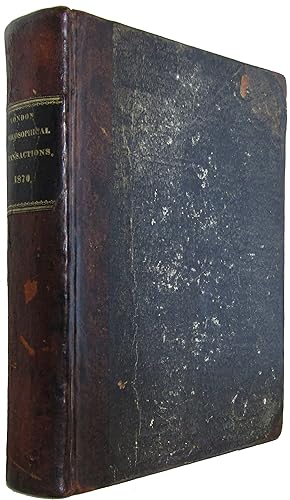
Hardcover. Condition: Fine. No Jacket. 1st Edition. FIRST EDITION of Jevons's explanation of his "logical piano"; a landmark in computer science. Jevons invented a "logical piano" (so named because it resembled a small upright piano) that could perform, through a sequence of switches, various types of logical calculations. In doing so, he became "the first person to construct a machine with sufficient power to solve a complicated problem faster than the problem could be solved without the machine's aid" (Goldstine). "On the Mechanical Performance of Logical Inference," a paper Jevons read before the Royal Society on January 20, 1870, is his most detailed description of this early prototype of the modern computer. The logical piano now stands in the Museum of the History of Science in Oxford. In: Philosophical Transactions of the Royal Society of London for the year 1870, pp. 497-518, Vol. 160, Part II (the complete volume). London: Taylor and Francis, 1870. Quarto, modern half-calf over marbled boards, with the original wrappers bound-in. A fine copy.
-
On the Mechanical Performance of Logical Inference
Published by Taylor and Francis, London, 1870
Seller: James Cummins Bookseller, ABAA, New York, NY, U.S.A.
Seller rating 5 out of 5 stars
First Edition
First edition. First edition. Extract from Philosophical Transactions, Vol. 160, part II, pp.497-518, with the general title for that number, 3 lithographed plates, book label "R. S." to verso of title and 2 plates. 4to. The first edition of Jevons' landmark paper presenting his "logical piano" (so called due to its appearance), the first machine capable of solving problems at superhuman speed and a key precursor of the modern computer. Origins of Cyberspace 330; Tomash & Williams J15; Lee, Computer Pioneers, 400; Randell, The Origins of Digital Computers, 479 Extract from Philosophical Transactions, Vol. 160, part II, pp.497-518, with the general title for that number, 3 lithographed plates, book label "R. S." to verso of title and 2 plates. 4to.
-
On the Mechanical Performance of Logical Inference.
Published by Taylor and Francis, London, 1870
Seller: Athena Rare Books ABAA, Fairfield, CT, U.S.A.
Seller rating 3 out of 5 stars

First Edition
FIRST EDITION. [pp. 497-518 along with 3 lithographic plates in Philosophical Transactions of the Royal Society of London, for the year MDCCCLXX, Vol. 160]. TP + [iii]-iv = Advertisement + 3 unnumbered sheets inserted with recto and verso lists of institutions and individuals receiving Philosophical Transactions + [iii]-v = Contents + [vii] = List of Illustrations + [1]-174 + 2 large folded inserts + 175-608 + 52 Lithographic Plates, Quarto, First Edition (Hook & Norman, Origins of Cyberspace 330; Tomash & Williams, J15).A Landmark of Computer Science - Jevon's Original Announcement of His "Logical Piano"The First Working Analog ComputerThis paper, delivered to the Royal Society on January 20, 1970, preceded Jevon's more familiar presentation of the "logical piano" in Principles of Science by four years. Jevons' talk was accompanied by the exhibition and demonstration of an actual "logical piano" - and that machine can be seen today at the Museum of the History of Science in Oxford.The machine was built according to Jevons' specification by a young Salfor clockmaker and has been described as "the first such machine with sufficient power to solve a complicated problem faster than the problem could be solved without the machine's aid" [Gardner, Logic Machines and Diagrams, p. 91]."From his thinking on the processes of logical inference, [Jevons] developed the idea that these might be performed mechanically. As early as 1865 he was trying to build a 'reasoning machine, or logical abacus' (Papers, 4.69), which evolved through several stages into a 'logical piano' or logical machine which he demonstrated before the Royal Society in January 1870. He thought it 'quite as likely to be laughed at as admired' (Letters and Journal, 250), but it was later to be recognized as one of the forerunners of twentieth-century computers" [R.D. Collison Black, Dictionary of National Biography].[Jevons'] logic owes something to De Morgan and a good deal more to Boole. It represents in the main an attempt to simplify Boole's system by eliminating the more complex and uninterpretable of its mathematical operations and by reducing its procedures of calculation to a mechanical routine Jevons's most interesting adaptation of Boole is to be seen in his method of indirect inference-the principle underlying his "logical piano" and other mechanical aids to calculation-whereby premises are used to eliminate inconsistent combinations of terms from a matrix listing all the possibilities under which a given set of terms and their negatives can be associated. The machine itself, exhibited at the Royal Society in 1870 and described in the Philosophical Transactions for the same year, anticipates in its design a number of the features of modern logical computers[The Encyclopedia of Philosophy, Vol. 4, p. 260] Contemporary ¾ leather with marbled boards which show a bit of wear overall along with a spine label with title gilt on a black field. There is a blacked-out former library stamp on the verso of the title page which has lightly bled through to the other side along with the stamped notification "Zum Verkauf freigegeben" (Released for Sale). Overall, this is a lovely copy of this famous presentation of the earliest analog computer ever built. ADDITIONAL PHOTOS AVAILABLE UPON REQUEST.
-
![Seller image for On the Mechanical Performance of Logical Inference in Philosophical Transactions of the Royal Society of London 160, 1870, pp. 497-518 [FIRST PUBLISHED DESCRIPTION OF JEVONS' LOGIC MACHINE OR LOGICAL PIANO] for sale by Atticus Rare Books](https://pictures.abebooks.com/inventory/md/md22290536278.jpg)
HANDSOMELY BOUND, FULL VOLUME FIRST EDITION & "FIRST PUBLISHED DESCRIPTION" OF [JEVONS'] LOGIC MACHINE, often called a â??logical piano' because of its resemblance to that instrument" (The Origins of Cyberspace, 137). Jevons' machine was the first logic machine with enough power to solve complicated problems with superhuman speed" - in other words, faster than could a human being. In 1866, William Stanley Jevons, an English economist and logician, was appointed Professor of Logic and Mental and Moral Philosophy at Owens College, Manchester. As did many other logicians of the 19th century, Jevons wanted to elucidate clear links between mathematics and logic. He was particularly drawn toward developing the ways in which logical problems could be resolved by just repeatedly applying simple, mechanical rules. It was during this time that a principle of reasoning dawned on him that he expressed as follows: "Whatever is true of a thing is true of its like" (Jevons, Elementary Lessons on Logic). The realization galvanized Jevons into action. Inspired by Boole's established formal rules of logic and Babbage's mechanical calculating machine, Jevons was able, in 1870, to take "the last steps towards mechanization of logic deduction" with the machine he devised (Amblard, A Finite State Description of the Earliest Logical Computer, 1). Jevons began with the hope of constructing "a logical abacus as a device capable of performing logical inference in the way similar to that as the arithmetic abacus is used for calculations" (Stankovic, From Boolean Logic, 74). Basically, he wanted to build a mechanical device that would implement automated deduction - a "labor-saving device that required only the addition of keys, levers, and pulleys to become a logic machine. "In appearance the machine resembles a miniature upright piano. On the face of the piano are openings through which one can see letters representing the 16 possible combinations of four logical terms and their negatives. The keys at the bottom are used to introduce the terms of a logical equation. This action automatically eliminates from the face of the machine all combinations of terms which are inconsistent with the proposition just fed to the machine. After all premises have been fed to the device, its face is then examined to determine what conclusions can be drawn" (Lee, Computer Pioneers, 401). The original plans for Jevons' machine have been lost to history, but this paper is his first description of the construction and is very detailed; it is also accompanied by three copperplate engravings mapping the interior of the machine's construction. Jevons' original machine can still be seen today at the Museum of the History of Science, Oxford. It should be noted that "Jevons' fame as the inventor of the logic machine has tended to obscure the important role he played in the history of both deductive and inductive logic. He was one of the pioneers of modern symbolic logic) (Lee, 400). CONDITION & DETAILS: Philosophical Transactions of the Royal Society of London for the Year 1860, 160, 1861. London: Taylor and Francis, Printers to the Royal Society (11.5 x 9.25 inches; 288 x 231mm). [12], 12, [1], 608, [5]. 52 copperplate engravings. Full volume, complete. Small ex-libris blindstamp and penciled notation on the title page; closed tears at the edges of some pages. Handsomely rebound in aged calf. 5 raised bands at the spine, each gilt-ruled; gilt-tooled fleur de lis at the spine. Red and black, gilt-lettered morocco spine labels. Tightly and solidly bound. New endpapers. Occasional toning and foxing. Very good condition.
![Seller image for On the Mechanical Performance of Logical Inference [The Logical Piano] for sale by Manhattan Rare Book Company, ABAA, ILAB](https://pictures.abebooks.com/inventory/md/md30457016622.jpg)