
Order Total (1 Item Items):
Shipping Destination:

Introduction Population Modeling (31 results)
Skip to main search results
Search filters
Product Type
- All Product Types
- Books (31)
- Magazines & Periodicals (No further results match this refinement)
- Comics (No further results match this refinement)
- Sheet Music (No further results match this refinement)
- Art, Prints & Posters (No further results match this refinement)
- Photographs (No further results match this refinement)
- Maps (No further results match this refinement)
- Manuscripts & Paper Collectibles (No further results match this refinement)
Condition Learn more
- New (23)
- As New, Fine or Near Fine (3)
- Very Good or Good (5)
- Fair or Poor (No further results match this refinement)
- As Described (No further results match this refinement)
Binding
Collectible Attributes
- First Edition (1)
- Signed (No further results match this refinement)
- Dust Jacket (No further results match this refinement)
- Seller-Supplied Images (12)
- Not Print on Demand (27)
Language (2)
Free Shipping
Seller Location
Seller Rating
-

paperback. Condition: Good. Connecting readers with great books since 1972! Used textbooks may not include companion materials such as access codes, etc. May have some wear or writing/highlighting. We ship orders daily and Customer Service is our top priority!
-
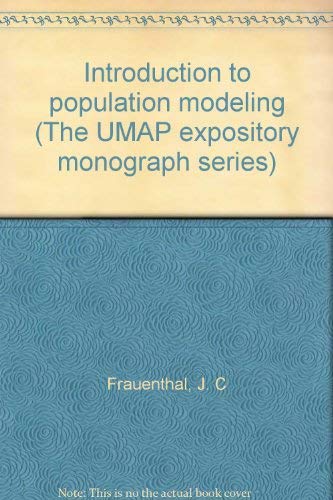
Introduction to Population Modeling
Language: English
Published by Birkhäuser Verlag AG, 1998
ISBN 10: 3764330155 ISBN 13: 9783764330156
Taschenbuch. Condition: Gut. 186 Seiten Sofort verfügbar Versand spätestens am nächsten Arbeitstag Rechnung mit ausgewiesener MwSt. liegt bei daily shipping worldwide with invoice ex library in good condition aus Bibliothek in guten Zustand Sprache: Englisch Gewicht in Gramm: 550.
-
Introduction to population modeling (The UMAP expository monograph series)
Published by Birkhauser
ISBN 10: 3764330155 ISBN 13: 9783764330156
Covers have rubbing, scratches and indentations. No names, underlining, notes or highlighting. d5.
-

Condition: New.
-
Introduction to Population Modeling (Paperback)
Language: English
Published by Birkhauser Boston Inc, Secaucus, 1979
ISBN 10: 0817630155 ISBN 13: 9780817630157
Paperback. Condition: new. Paperback. The text of this monograph represents the author's lecture notes from a course taught in the Department of Applied Mathematics and Statistics at the State University of New York at Stony Brook in the Spring of 1977. On account of its origin as lecture notes, some sections of the text are telegraphic in style while other portions are overly detailed. This stylistic foible has not been modified as it does not appear to detract seriously from the readability and it does help to indicate which topics were stressed. The audience for the course at Stony Brook was composed almost entirely of fourth year undergraduates majoring in the mathematical sciences. All of these students had studied at least four semesters of calculus and one of probability; few had any prior experience with either differential equations or ecology. It seems prudent to point out that the author's background is in engineering and applied mathematics and not in the biological sciences. It is hoped that this is not painfully obvious. -vii- The focus of the monograph is on the formulation and solution of mathematical models; it makes no pretense of being a text in ecology. The idea of a population is employed mainly as a pedagogic tool, providing unity and intuitive appeal to the varied mathematical ideas introduced. If the biological setting is stripped away, what remains can be interpreted as topics on the qualitative behavior of differential and difference equations. The text of this monograph represents the author's lecture notes from a course taught in the Department of Applied Mathematics and Statistics at the State University of New York at Stony Brook in the Spring of 1977. Shipping may be from multiple locations in the US or from the UK, depending on stock availability.
-
-

Condition: As New. Unread book in perfect condition.
-
Introduction to Population Modeling (Modules and Monographs in Undergraduate Mathematics and Its Applications)
Seller: Ria Christie Collections, Uxbridge, United Kingdom
Seller rating 5 out of 5 stars

£ 49.62
£ 11.98 shipping
Ships from United Kingdom to U.S.A.Quantity: Over 20 available
Add to basketCondition: New. In.
-
PF. Condition: New.
-
Introduction to Population Modeling
Seller: Kennys Bookshop and Art Galleries Ltd., Galway, GY, Ireland
Seller rating 5 out of 5 stars
Condition: New. 1979. Paperback. . . . . .
-
Paperback. Condition: Brand New. 1st edition. 186 pages. 8.50x5.51x0.47 inches. In Stock.
-
Condition: New. 1979. Paperback. . . . . . Books ship from the US and Ireland.
-
-

-
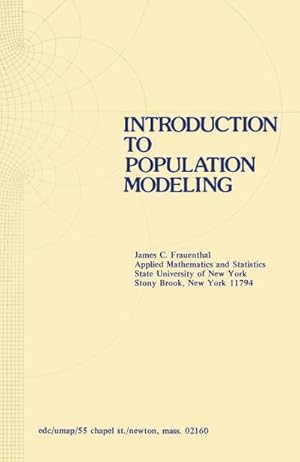
Taschenbuch. Condition: Neu. Druck auf Anfrage Neuware - Printed after ordering - The text of this monograph represents the author's lecture notes from a course taught in the Department of Applied Mathematics and Statistics at the State University of New York at Stony Brook in the Spring of 1977. On account of its origin as lecture notes, some sections of the text are telegraphic in style while other portions are overly detailed. This stylistic foible has not been modified as it does not appear to detract seriously from the readability and it does help to indicate which topics were stressed. The audience for the course at Stony Brook was composed almost entirely of fourth year undergraduates majoring in the mathematical sciences. All of these students had studied at least four semesters of calculus and one of probability; few had any prior experience with either differential equations or ecology. It seems prudent to point out that the author's background is in engineering and applied mathematics and not in the biological sciences. It is hoped that this is not painfully obvious. -vii- The focus of the monograph is on the formulation and solution of mathematical models; it makes no pretense of being a text in ecology. The idea of a population is employed mainly as a pedagogic tool, providing unity and intuitive appeal to the varied mathematical ideas introduced. If the biological setting is stripped away, what remains can be interpreted as topics on the qualitative behavior of differential and difference equations.
-

Condition: As New. Unread book in perfect condition.
-
Paperback. Condition: Very Good. Very Good. book.
-
Introduction to Population Modeling (Paperback)
Language: English
Published by Birkhauser Boston Inc, Secaucus, 1979
ISBN 10: 0817630155 ISBN 13: 9780817630157
Paperback. Condition: new. Paperback. The text of this monograph represents the author's lecture notes from a course taught in the Department of Applied Mathematics and Statistics at the State University of New York at Stony Brook in the Spring of 1977. On account of its origin as lecture notes, some sections of the text are telegraphic in style while other portions are overly detailed. This stylistic foible has not been modified as it does not appear to detract seriously from the readability and it does help to indicate which topics were stressed. The audience for the course at Stony Brook was composed almost entirely of fourth year undergraduates majoring in the mathematical sciences. All of these students had studied at least four semesters of calculus and one of probability; few had any prior experience with either differential equations or ecology. It seems prudent to point out that the author's background is in engineering and applied mathematics and not in the biological sciences. It is hoped that this is not painfully obvious. -vii- The focus of the monograph is on the formulation and solution of mathematical models; it makes no pretense of being a text in ecology. The idea of a population is employed mainly as a pedagogic tool, providing unity and intuitive appeal to the varied mathematical ideas introduced. If the biological setting is stripped away, what remains can be interpreted as topics on the qualitative behavior of differential and difference equations. The text of this monograph represents the author's lecture notes from a course taught in the Department of Applied Mathematics and Statistics at the State University of New York at Stony Brook in the Spring of 1977. Shipping may be from our Sydney, NSW warehouse or from our UK or US warehouse, depending on stock availability.
-

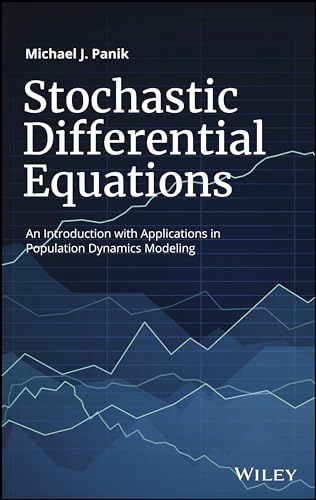
Stochastic Differential Equations : An Introduction With Applications in Population Dynamics Modeling
Seller: GreatBookPricesUK, Woodford Green, United Kingdom
Seller rating 5 out of 5 stars
Condition: As New. Unread book in perfect condition.
-

Stochastic Differential Equations : An Introduction With Applications in Population Dynamics Modeling
Seller: GreatBookPricesUK, Woodford Green, United Kingdom
Seller rating 5 out of 5 stars
Condition: New.
-
Condition: New. Brand new! Please provide a physical shipping address.
-
Stochastic Differential Equations: An Introduction with Applications in Population Dynamics Modeling
Language: English
Published by John Wiley and Sons Ltd, 2017
ISBN 10: 1119377382 ISBN 13: 9781119377382
Seller: THE SAINT BOOKSTORE, Southport, United Kingdom
Seller rating 5 out of 5 stars
Hardback. Condition: New. New copy - Usually dispatched within 4 working days.
-
Stochastic Differential Equations: An Introduction with Applications in Population Dynamics Modeling
Language: English
Published by John Wiley and Sons Ltd, 2017
ISBN 10: 1119377382 ISBN 13: 9781119377382
Seller: Kennys Bookshop and Art Galleries Ltd., Galway, GY, Ireland
Seller rating 5 out of 5 stars
First Edition
Condition: New. A beginner s guide to stochastic growth modeling The chief advantage of stochastic growth models over deterministic models is that they combine both deterministic and stochastic elements of dynamic behaviors, such as weather, natural disasters, market fluctuations, and epidemics. Num Pages: 336 pages. BIC Classification: PBT; PBWL. Category: (P) Professional & Vocational. Weight in Grams: 666. . 2017. 1st Edition. Hardcover. . . . .
-
Stochastic Differential Equations An Introduction with Applications in Population Dynamics Modeling
Language: English
Published by John Wiley & Sons Inc, 2017
ISBN 10: 1119377382 ISBN 13: 9781119377382
Hardcover. Condition: Brand New. 352 pages. 9.50x6.50x0.75 inches. In Stock.
-
Stochastic Differential Equations: An Introduction with Applications in Population Dynamics Modeling
Language: English
Published by John Wiley and Sons Ltd, 2017
ISBN 10: 1119377382 ISBN 13: 9781119377382
Condition: New. A beginner s guide to stochastic growth modeling The chief advantage of stochastic growth models over deterministic models is that they combine both deterministic and stochastic elements of dynamic behaviors, such as weather, natural disasters, market fluctuations, and epidemics. Num Pages: 336 pages. BIC Classification: PBT; PBWL. Category: (P) Professional & Vocational. Weight in Grams: 666. . 2017. 1st Edition. Hardcover. . . . . Books ship from the US and Ireland.
-
Hardcover. Condition: New. NEW. SHIPS FROM MULTIPLE LOCATIONS. book.
-
Introduction to Population Modeling
Published by Birkhäuser Verlag GmbH, 1998
ISBN 10: 3764330155 ISBN 13: 9783764330156
paperback. Condition: Befriedigend. 186 Seiten; 9783764330156.4 Gewicht in Gramm: 500.
-
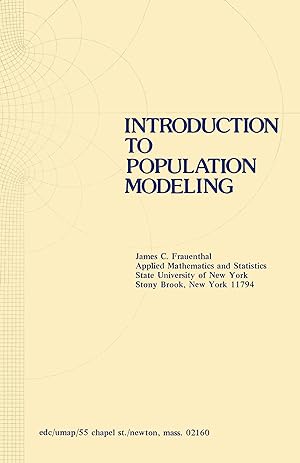
Condition: New. Dieser Artikel ist ein Print on Demand Artikel und wird nach Ihrer Bestellung fuer Sie gedruckt. The text of this monograph represents the author s lecture notes from a course taught in the Department of Applied Mathematics and Statistics at the State University of New York at Stony Brook in the Spring of 1977. On account of its origin as lecture notes.
-
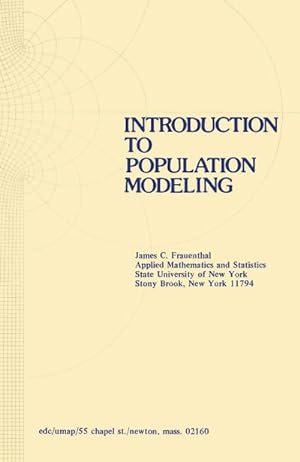
Introduction to Population Modeling
Language: English
Published by Birkhäuser Boston Jan 1979, 1979
ISBN 10: 0817630155 ISBN 13: 9780817630157
Seller: BuchWeltWeit Ludwig Meier e.K., Bergisch Gladbach, Germany
Seller rating 5 out of 5 stars
Taschenbuch. Condition: Neu. This item is printed on demand - it takes 3-4 days longer - Neuware -The text of this monograph represents the author's lecture notes from a course taught in the Department of Applied Mathematics and Statistics at the State University of New York at Stony Brook in the Spring of 1977. On account of its origin as lecture notes, some sections of the text are telegraphic in style while other portions are overly detailed. This stylistic foible has not been modified as it does not appear to detract seriously from the readability and it does help to indicate which topics were stressed. The audience for the course at Stony Brook was composed almost entirely of fourth year undergraduates majoring in the mathematical sciences. All of these students had studied at least four semesters of calculus and one of probability; few had any prior experience with either differential equations or ecology. It seems prudent to point out that the author's background is in engineering and applied mathematics and not in the biological sciences. It is hoped that this is not painfully obvious. -vii- The focus of the monograph is on the formulation and solution of mathematical models; it makes no pretense of being a text in ecology. The idea of a population is employed mainly as a pedagogic tool, providing unity and intuitive appeal to the varied mathematical ideas introduced. If the biological setting is stripped away, what remains can be interpreted as topics on the qualitative behavior of differential and difference equations. 208 pp. Englisch.
-

Introduction to Population Modeling
Language: English
Published by Birkhäuser Boston, Birkhäuser Boston Jan 1979, 1979
ISBN 10: 0817630155 ISBN 13: 9780817630157
Seller: buchversandmimpf2000, Emtmannsberg, BAYE, Germany
Seller rating 5 out of 5 stars
Taschenbuch. Condition: Neu. This item is printed on demand - Print on Demand Titel. Neuware -The text of this monograph represents the author's lecture notes from a course taught in the Department of Applied Mathematics and Statistics at the State University of New York at Stony Brook in the Spring of 1977. On account of its origin as lecture notes, some sections of the text are telegraphic in style while other portions are overly detailed. This stylistic foible has not been modified as it does not appear to detract seriously from the readability and it does help to indicate which topics were stressed. The audience for the course at Stony Brook was composed almost entirely of fourth year undergraduates majoring in the mathematical sciences. All of these students had studied at least four semesters of calculus and one of probability; few had any prior experience with either differential equations or ecology. It seems prudent to point out that the author's background is in engineering and applied mathematics and not in the biological sciences. It is hoped that this is not painfully obvious. -vii- The focus of the monograph is on the formulation and solution of mathematical models; it makes no pretense of being a text in ecology. The idea of a population is employed mainly as a pedagogic tool, providing unity and intuitive appeal to the varied mathematical ideas introduced. If the biological setting is stripped away, what remains can be interpreted as topics on the qualitative behavior of differential and difference equations.Springer Basel AG in Springer Science + Business Media, Heidelberger Platz 3, 14197 Berlin 208 pp. Englisch.


