

Order Total (1 Item Items):
Shipping Destination:

Height Vector Rods Three Dimensional Patterson by Crick (1 results)
Skip to main search results
Search filters
Product Type
- All Product Types
- Books (1)
- Magazines & Periodicals (No further results match this refinement)
- Comics (No further results match this refinement)
- Sheet Music (No further results match this refinement)
- Art, Prints & Posters (No further results match this refinement)
- Photographs (No further results match this refinement)
- Maps (No further results match this refinement)
- Manuscripts & Paper Collectibles (No further results match this refinement)
Condition Learn more
- New (No further results match this refinement)
- As New, Fine or Near Fine (No further results match this refinement)
- Very Good or Good (No further results match this refinement)
- Fair or Poor (No further results match this refinement)
- As Described (1)
Binding
- All Bindings
- Hardcover (No further results match this refinement)
- Softcover (No further results match this refinement)
Collectible Attributes
- First Edition (1)
- Signed (No further results match this refinement)
- Dust Jacket (No further results match this refinement)
- Seller-Supplied Images (1)
- Not Print on Demand (1)
Language (1)
Price
- Any Price
- Under £ 20 (No further results match this refinement)
- £ 20 to £ 35 (No further results match this refinement)
- Over £ 35
Free Shipping
- Free Shipping to U.S.A. (No further results match this refinement)
Seller Location
Seller Rating
-
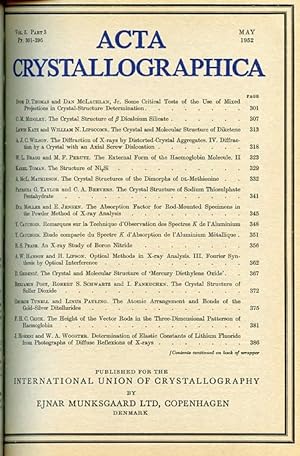
The height of the vector rods in the three-dimensional Patterson of haemoglobin in Acta Crystallographica, Volume 5, Part 3, May 1952, pp. 381-386
Published by Ejnar Munksgaard Ltd, Copenhagen, 1952
First Edition
1st Edition. FIRST EDITION IN ORIGINAL WRAPS OF THE PAPER IN WHICH FRANCIS CRICK DEMONSTRATES THAT THE THEN ACCEPTED PERUTZ MODEL OF HEMOGLOBIN OF LONG PARALLEL CHAINS CANNOT BE CORRECT. "Max Perutz was one of the first crystallographers to attempt the deciphering of macrostructures. Perutz used the Patterson method for investigating the structure of haemoglobin. Perutz reasoned that if "the [haemo]globin molecule consisted of a complex interlocking system of coiled polypeptide chains where interatomic vectors occur with equal frequency in all possible directions, the Patterson synthesis would be unlikely to provide a clue to the structure" (Schindler, Model, Theory and Evidence in the Discovery of the DNA Structure, 11). H. Perutz original interpretation of a molecule made up of alpha chains which run parallel to the X-axis was clearly much too simple. "Quantitative considerations led Crick [in this paper] to the conclusion that chains running parallel to X make up only part of the molecule. The actual folding of the chain now revealed is so complex that it could never have been solved on the basis of the three-dimensional Patterson" (Perutz, Unravelling the Atomic Mechanism of Haemoglobin, 220). In the paper, "A method is described for calculating the average height of the vector rods in the three-dimensional Patterson of haemoglobin. The calculations have been carried out for the-helix. They show that the simple models previously considered for haemoglobin give peaks which are too high, and that to obtain even rough agreement either less than about half the protein must be put into chains parallel to theXaxis or considerable irregularity must be introduced. The evidence suggests that the folded polypeptide chain does not run in one direction for more than 20Å at a stretch" (Crick, The Height of the Vector Rods, Abstract, 5, 3, 1952, p.381). CONDITION & DETAILS: Copenhagen: Ejnar Munksgaard Ltd. First edition in original wraps. 4to. 10.25 by 7.5 inches (256 x 188mm). pp. 301-396. Meticulously re-backed at the spine with the original spine label. Pristine condition inside and out. Fine.
