
Order Total (1 Item Items):
Shipping Destination:

Event Based Programming Taking Events by Faison Ted (38 results)
Skip to main search results
Search filters
Product Type
- All Product Types
- Books (38)
- Magazines & Periodicals (No further results match this refinement)
- Comics (No further results match this refinement)
- Sheet Music (No further results match this refinement)
- Art, Prints & Posters (No further results match this refinement)
- Photographs (No further results match this refinement)
- Maps (No further results match this refinement)
- Manuscripts & Paper Collectibles (No further results match this refinement)
Condition Learn more
- New (24)
- As New, Fine or Near Fine (4)
- Very Good or Good (8)
- Fair or Poor (2)
- As Described (No further results match this refinement)
Binding
Collectible Attributes
- First Edition (1)
- Signed (No further results match this refinement)
- Dust Jacket (No further results match this refinement)
- Seller-Supplied Images (16)
- Not Print on Demand (32)
Language (1)
Free Shipping
Seller Location
Seller Rating
-

Hardcover. Condition: Good. Connecting readers with great books since 1972! Used textbooks may not include companion materials such as access codes, etc. May have some wear or writing/highlighting. We ship orders daily and Customer Service is our top priority!
-
Hardcover. Condition: Very Good. No Jacket. May have limited writing in cover pages. Pages are unmarked. ~ ThriftBooks: Read More, Spend Less.
-

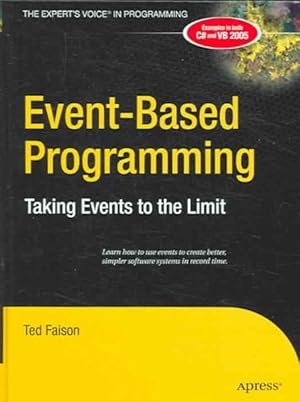
Event-Based Programming: Taking Events to the Limit
Seller: Bay State Book Company, North Smithfield, RI, U.S.A.
Seller rating 5 out of 5 stars

Condition: very_good.
-

Event-Based Programming: Taking Events to the Limit
Seller: Goodwill of Greater Milwaukee and Chicago, Racine, WI, U.S.A.
Seller rating 5 out of 5 stars
Condition: good. Book is considered to be in good or better condition. The actual cover image may not match the stock photo. Hard cover books may show signs of wear on the spine, cover or dust jacket. Paperback book may show signs of wear on spine or cover as well as having a slight bend, curve or creasing to it. Book should have minimal to no writing inside and no highlighting. Pages should be free of tears or creasing. Stickers should not be present on cover or elsewhere, and any CD or DVD expected with the book is included. Book is not a former library copy.
-

Event-Based Programming: Taking Events to the Limit
Seller: Goodwill of Silicon Valley, SAN JOSE, CA, U.S.A.
Seller rating 4 out of 5 stars

Condition: acceptable. Supports Goodwill of Silicon Valley job training programs. The cover and pages are in Acceptable condition! Any other included accessories are also in Acceptable condition showing use. Use can include some highlighting and writing, page and cover creases as well as other types visible wear such as cover tears discoloration, staining, marks, scuffs, etc. All pages intact.
-
Condition: new.
-

Event-Based Programming: Taking Events to the Limit
First Edition
paperback. Condition: Good. 1st ed. Ships in a BOX from Central Missouri! May not include working access code. Will not include dust jacket. Has used sticker(s) and some writing or highlighting. UPS shipping for most packages, (Priority Mail for AK/HI/APO/PO Boxes).
-

Condition: good. May show signs of wear, highlighting, writing, and previous use. This item may be a former library book with typical markings. No guarantee on products that contain supplements Your satisfaction is 100% guaranteed. Twenty-five year bookseller with shipments to over fifty million happy customers.
-
Condition: New.
-
Condition: New.
-
Condition: Brand New. New. US edition. Expediting shipping for all USA and Europe orders excluding PO Box. Excellent Customer Service.
-
Condition: New. This is a Brand-new US Edition. This Item may be shipped from US or any other country as we have multiple locations worldwide.
-

Condition: As New. Unread book in perfect condition.
-
Condition: New.
-
Brand new book. Fast ship. Please provide full street address as we are not able to ship to P O box address.
-
Condition: Fair. This is an ex-library book and may have the usual library/used-book markings inside.This book has soft covers. In fair condition, suitable as a study copy. Please note the Image in this listing is a stock photo and may not match the covers of the actual item,1350grams, ISBN:9781430243267.
-
hardcover. Condition: New. In shrink wrap. Looks like an interesting title!
-
Event-Based Programming: Taking Events to the Limit
Seller: Ria Christie Collections, Uxbridge, United Kingdom
Seller rating 5 out of 5 stars
£ 54.30
£ 11.98 shipping
Ships from United Kingdom to U.S.A.Quantity: Over 20 available
Add to basketCondition: New. In.
-
Event-Based Programming: Taking Events to the Limit
Seller: Ria Christie Collections, Uxbridge, United Kingdom
Seller rating 5 out of 5 stars
£ 54.30
£ 11.98 shipping
Ships from United Kingdom to U.S.A.Quantity: Over 20 available
Add to basketCondition: New. In.
-
Paperback. Condition: New.
-

Event-Based Programming : Taking Events to the Limit
Seller: GreatBookPricesUK, Woodford Green, United Kingdom
Seller rating 5 out of 5 stars
Condition: New.
-

Event-Based Programming : Taking Events to the Limit
Seller: GreatBookPricesUK, Woodford Green, United Kingdom
Seller rating 5 out of 5 stars
Condition: As New. Unread book in perfect condition.
-

Condition: New.
-
Event-Based Programming: Taking Events to the Limit
Seller: Ria Christie Collections, Uxbridge, United Kingdom
Seller rating 5 out of 5 stars
£ 75.17
£ 11.98 shipping
Ships from United Kingdom to U.S.A.Quantity: Over 20 available
Add to basketCondition: New. In.
-
£ 75.24
£ 15.49 shipping
Ships from United Kingdom to U.S.A.Quantity: Over 20 available
Add to basketPaperback. Condition: New.
-

Condition: New. Shows how to use an event-based paradigm to reduce or completely eliminate coupling between classes and componentsDescribes component, including coordinators, workers, builders, binders and routersContains three complete case studies, showi.
-

Event-Based Programming : Taking Events to the Limit
Seller: GreatBookPricesUK, Woodford Green, United Kingdom
Seller rating 5 out of 5 stars
Condition: good. May show signs of wear, highlighting, writing, and previous use. This item may be a former library book with typical markings. No guarantee on products that contain supplements Your satisfaction is 100% guaranteed. Twenty-five year bookseller with shipments to over fifty million happy customers.
-
Paperback. Condition: Like New. Like New. book.
-
Condition: very good. Gut/Very good: Buch bzw. Schutzumschlag mit wenigen Gebrauchsspuren an Einband, Schutzumschlag oder Seiten. / Describes a book or dust jacket that does show some signs of wear on either the binding, dust jacket or pages.
-
Paperback. Condition: Brand New. 670 pages. 9.33x7.60x1.65 inches. In Stock.

