

Order Total (1 Item Items):
Shipping Destination:

Dutch Silver Embossed Ecclesiastical Secular by Frederiks (3 results)
Skip to main search results
Search filters
Product Type
- All Product Types
- Books (3)
- Magazines & Periodicals (No further results match this refinement)
- Comics (No further results match this refinement)
- Sheet Music (No further results match this refinement)
- Art, Prints & Posters (No further results match this refinement)
- Photographs (No further results match this refinement)
- Maps (No further results match this refinement)
- Manuscripts & Paper Collectibles (No further results match this refinement)
Condition Learn more
- New (No further results match this refinement)
- As New, Fine or Near Fine (No further results match this refinement)
- Very Good or Good (3)
- Fair or Poor (No further results match this refinement)
- As Described (No further results match this refinement)
Binding
- All Bindings
- Hardcover (3)
- Softcover (No further results match this refinement)
Collectible Attributes
- First Edition (2)
- Signed (No further results match this refinement)
- Dust Jacket (1)
- Seller-Supplied Images (2)
- Not Print on Demand (3)
Language (1)
Price
- Any Price
- Under £ 20 (No further results match this refinement)
- £ 20 to £ 35 (No further results match this refinement)
- Over £ 35
Free Shipping
- Free Shipping to U.S.A. (No further results match this refinement)
Seller Location
Seller Rating
-
Dutch Silver (Vol. IV): Embossed Ecclesiastical and Secular Plate from the Renaissance Until the End of the Eighteenth Century
Published by Martinus Nijhoff, The Hague, 1961
Hardcover. Condition: Very Good. No Jacket. Exlibrary, usual marks; no DJ; Volume IV of Dutch Silver series; blue cloth covers with embossed design on front and decorative gilt titles on spine; light scratches and fading to covers; spine very faded; covers slightly warped; very good internally.
-
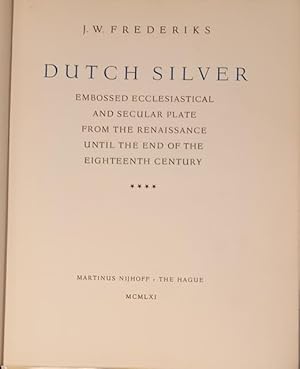
DUTCH SILVER. Vol.IV: Embossed Ecclesiastical and Secular Plate from the Renaissance until the End of the Eighteenth Century.
Published by Martinus NIjhoff, The Hague, 1961
Seller: studio bibliografico pera s.a.s., LUCCA, LU, Italy
Seller rating 4 out of 5 stars

First Edition
Copertina rigida. Condition: buone. Prima edizione. Prima edizione. Disponibile solo il quarto dei quattro volumi che compongono l'opera. Cm.3\,8x24,6. Pg.XXXVI, 336. Legatura in tela editoriale con impressioni a rilievo. Numerose illustrazione. Allegata lettera di invio, dattiloscritta dall'autore, a Hugh Honour. 3600 gr.
-

Dutch Silver: Volume I: Embossed Plaquettes Tazze and Dishes from the Renaissance Until the End of the 18th Century; Volume II: Wrought Plate of North and South-Holland from the Renaissance Until the End of the 18th Century; Volume III: Wrought Plate of the Central, Northern and Southern Provinces from the Renaissance Until the End of the 18th Century; Volume IV: Embossed Ecclesiastical and Secular Plate from the Renaissance Until the End of the 18th Century
Published by Martinus Nijhoff, SS, 1952
First Edition
Hardcover. Condition: Very Good. Dust Jacket Condition: Good. First Edition; First Printing. Hardcover. 4to. Martinus Nijhoff, The Hague, Netherlands. 1952-1961 4 volumes. Xvi, 538 pgs, xxxiv, 211 pgs, xii, 157 pgs, xxxvi, 179 pgs text. Illustrated with with 476 ills + 979 plates. DJ has shelf-wear present to the DJ extremities (crown of the DJ is chipped on 3 volumes; Volume 4 is missing the DJ). Bound in cloth with titles present to the spine. Boards lightly rubbed and worn. No ownership marks present. Text is clean and free of marks, binding tight and solid. Prosperity generally brings with it a desire for luxury, which finds its expression in man's endeavour to surround himself with objects of beauty. Artists of all kinds are always being attracted to the centres of wealth, which thus develop into centres of art. We observe this through the whole of history; in antiquity, in the Middle Ages and, above all, during the Renaissance in Italy, where the many States and cities vied with each other in fostering cultural life, where palaces, castles and churches were built and decorated by the greatest artists as a result of the liberality of the art-loving princes, whose example was followed by the nobility and the rich merchants. North of the Alps, it was mainly France that came into the foreground in this field. The Duc de Berry was one of the greatest patrons of art of all times. His brother Philip, Duke of Burgundy, and his successors made of their court, which frequently resided in the Southern Netherlands, a centre of culture. Under the Hapsburgs the tradition was con tinued. The Northern Netherlands, which also gradually came to be part of the Burgundian realm (Holland since 1433) , at first lagged behind as far as cultural life was concerned, but little by little they caught up with their southern contemporaries. An important factor in the development of the Netherlands was their geographical po sition, which predestined them to become a great commercial centre." eSS; ; Folio 13" - 23" tall.


