Order Total (1 Item Items):
Shipping Destination:

Dow Theory Explanation Development Attempt by Rhea Robert (12 results)
Skip to main search results
Search filters
Product Type
- All Product Types
- Books (12)
- Magazines & Periodicals (No further results match this refinement)
- Comics (No further results match this refinement)
- Sheet Music (No further results match this refinement)
- Art, Prints & Posters (No further results match this refinement)
- Photographs (No further results match this refinement)
- Maps (No further results match this refinement)
- Manuscripts & Paper Collectibles (No further results match this refinement)
Condition Learn more
- New (No further results match this refinement)
- As New, Fine or Near Fine (No further results match this refinement)
- Very Good or Good (6)
- Fair or Poor (2)
- As Described (4)
Binding
Collectible Attributes
- First Edition (4)
- Signed (1)
- Dust Jacket (No further results match this refinement)
- Seller-Supplied Images (8)
- Not Print on Demand (12)
Language (2)
Free Shipping
Seller Location
Seller Rating
-

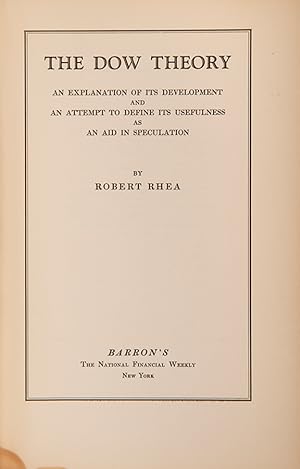
The Dow Theory-An Explanation Of Its Development And An Attempt To Define Its Usefulness As An Aid In Speculation
Published by Barron's (January 1, 1932), 1932
Hardcover. Condition: Fair. Dust Jacket Condition: No Dustjacket. Later Edition. ISBN . B0006ALVF2 Hardback. No dustjacket. 12th printing of the original 1932 edition. Tight sound copy with average wear overall, but pretty much a tight sound reading copy only due to being an Ex library copy with the usual faults, Ink stamps, spine label, card pocket, etc. A nice tight sound reading copy only. No Signature.
-
Hardcover. Condition: Good. No Jacket. Eleventh printing. Light scuffing and rubbing to the boards. Sound binding. Clean interior pages. This could have light cosmetic flaws, but remains in good condition. No dust jacket included with this book. Secure packaging for safe delivery.
-
Hardcover. Condition: Fair. No Jacket. Dust jacket missing. Third printing. Cover and binding are worn but intact. A reading copy in fair condition. Scuffing to cover boards. Markings on pages. Moderate loosening to binding. Secure packaging for safe delivery.
-
The Dow Theory-An Explanation of its Development and an Attempt to Define its Usefulness as an Aid in Speculation
Language: English
Published by Barron's, 1932
hardcover. Condition: Very Good. 1932. Barrons Stated Thirteenth Printing. Pages are all clean tight and bright, no marks. Blue cloth hardcover is clean and strong, light rub at corners and spine ends.
-

Hardcover. Condition: Good. No Jacket. Eighth printing. Shelf and handling wear to cover and binding, with general signs of previous use. Boards betray fading and nicks and other signs of wear and imperfection commensurate with age. Binding is tight and structurally sound. Erstwhile owner's bookplate on front pastedown; interior pages unmarked. Sealed in plastic for shipping. Secure packaging for safe delivery.
-

Dow Theory an Explanation of its Development and an Attempt to Define its Usefulness as an Aid in Speculation
Published by BARRON'S, BOSTON, MA, 1932
Seller: Princeton Antiques Bookshop / Ruffolo Enterprises, Atlantic City, NJ, U.S.A.
Seller rating 5 out of 5 stars

HARD BACK GREEN. Condition: GOOD. THIRD PRINTING. about 1/4 of title page at bottom missing, covers rubbed, corners and spine bumped DATE PUBLISHED: 1932 EDITION: THIRD PRINTING 252.
-

The Dow Theory-An Explanation of its Development and an Attempt to Define its Usefulness as an Aid in Speculation
Language: English
Published by Barrons', 1932
Seller: Ed's Editions LLC, ABAA, West Columbia, SC, U.S.A.
Seller rating 5 out of 5 stars
First Edition
hardcover. Condition: Good. First Edition. First Edition stated, First Printing. Black cloth boards have rubbing along the edges, rubbed through at the corners and other various spots. Red spine lettering. Has a good binding, no marks or notations. [xi], 252 pp.
-
DOW THEORY AN EXPLANATION OF ITS DEVELOPMENT AND AN ATTEMPT TO DEFINE ITS USEFULNESS AS AN AID IN SPECULATION
Published by BARRON'S, NY, 1932
Hardcover. Condition: Very Good. Dust Jacket Condition: NoNE. N/A (illustrator). 8TH PRINTING. A RARE TITLE SOLID CLEAN AND BRIGHT BOUND IN NAVY BLUE WITH FULL GOLD LETTERING VERY SMALL SCRATCH ON COVER BRIGHT TEXTBLOCK UNMARKED BOOK MAY HAVE PRICELESS ADVICE !
-
The Dow Theory An Explanation of Its Development and an Attempt to Define Its Usefulness as an Aid in Speculation
Published by Ny
Seller: Bluestocking Books, Bangor, PA, U.S.A.
Association Member: IOBA
Seller rating 5 out of 5 stars
Ny. Good with no dust jacket; Cloth; Barron's The National Financial Weekly; . 1932; 3rd Printing. Dark blue cloth , good, edges rubbed, tear to bottom of spine cloth, spine rubbed, 252 pages with appendix and several charts. ; 8vo - over 7¾" - 9¾" tall . Good with no dust jacket; Cloth; Barron's The National Financial Weekly; 1932; 3rd Printing.
-
The Dow Theory. An explanation of its development and an attempt to define its usefulness as an aid in speculation.
Published by New York Barron's, 1932
Seller: Shapero Rare Books, London, United Kingdom
Association Member: ABA ILAB PBFA
Seller rating 4 out of 5 stars

First Edition
First edition; 8vo (23.5 x 16 cm); publisher's ad. to half-title verso, tables, appendix of the editorials of William Peter Hamilton in the Wall Street Journal; later black cloth, spine lettered in red, minor damp-staining to margins of front few ff., occasional pencil annotations; x, [2], 252pp. stock23 The first edition of Robert Rhea's contribution to the development of Dow Theory, named for the eccentric founder of The Wall Street Journal, Charles Dow (1851-1902), whose trend-following trading strategy laid the groundwork for modern technical analysis and market forecasting. While confined to bed with illness for ten years, Rhea studied the Dow's action thoroughly, eventually becoming convinced that it provided the only accurate method for forecasting stock movement. This clear and precise work is the result. By 1938 Rhea was selling his mimeographed 'Dow Theory Comments' opinions to five thousand clients at forty dollars a year. Soon he had twenty-five assistants, and his bedroom became a statistical storehouse. Dennistoun 405; Zerden p.10; Hess Collection.
-

The Dow Theory: An Explanation of Its Development and an Attempt to Define Its Usefulness As An Aid In Speculation.
Published by Barron's, New York, 1932
First Edition Signed
First edition of this classic work by one of the pioneering figures in the history of Dow Theory. Octavo, original cloth. Presentation copy, inscribed by the author on the front free endpaper, "To Katherine Hubert from the compiler of these notes Robert Rhea June 22, 1933." Laid into this volume is a pamphlet by Rhea, entitled the "Dow Theory Comment." Books inscribed by Rhea are rare. Originally published serially by Barron's, it is an explanation of Dow Theory development and an attempt to define its usefulness as an aid to speculation. Rhea carefully studied 252 editorials of Charles H. Dow and William Peter Hamilton in order to present Dow Theory in terms that would be useful for the individual investor.
-
The Dow Theory. An Explanation of its Development and an Attempt to Define its Usefulness as an Aid in Speculation.
Publication Date: 1932
Seller: Maggs Bros. Ltd ABA, ILAB, PBFA, London, United Kingdom
Association Member: ABA ILAB PBFA
Seller rating 5 out of 5 stars
First Edition
First edition. 8vo. x, [2], 252 pp. Original black cloth, spine lettered and ruled in red, front cover with single blind fillet border (some light spotting to edges of text block, otherwise internally clean; tips of spine and joints rubbed, otherwise a very good copy indeed). New York, Barron's. Despite being perhaps the single most recognisable name in investment history, Charles H. Dow never published his own work on the theory of the price movement in bookform. Instead, it was left to others to popularise the Dow system of technical analysis such as William Peter Hamilton and Robert Rhea. 'While confined to bed with illness for ten years, Rhea studied the Dow?s action thoroughly, eventually becoming convinced that it provided the only accurate method for forecasting stock movement. Idolizing Dow and William P. Hamilton, Rhea formulated a complete history of Dow Theory and, in conjunction with students of the theory from across the U. S., defined its terminology. This clear and precise work is the result.' 'By 1938 Rhea was selling his mimeographed Dow Theory Comments opinions to five thousand clients at forty dollars a year. Soon he had twenty five assistants, and his bedroom became a statistical storehouse. He did not want to be a tipster; however he reputedly averaged $436 gain as against every $100 he lost' (Dennistoun). With an 8 page oblong octavo pamphlet loosely inserted advertising subscriptions to Rhea's 'Dow Theory Comment'. Dennistoun, Bubbles, Booms and Busts, 405; Zerden, Best Books on the Stock Mark: A Bibliography, p. 10.