
Diffraction Cathode Rays Thin Films by Thomson George Paget (3 results)

Published by Macmillan & Co., London, 1927
- Softcover
Seller: JF Ptak Science Books, Hendersonville, NC, U.S.A.JF Ptak Science Books
Contact seller5-star sellerCondition: Used - Very good
£ 268.40
£ 4.47 shippingShips within U.S.A.Quantity: 1 available
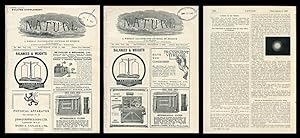
Add to basketSoft cover. Condition: Very Good. Thomson, George Paget. "The Diffraction of Cathode Rays by Thin Films of Platinum." in Nature, Vol. 120, No. 3031, December 3, 1927, p. 802 ("Letters to the Editor") in the issue of pp 793-828. Offered in the original wrappers. VG, solid copy. ".idea of a wave theory of the electron based on de…Broglie's theory was discussed, and Thomson, already deeply interested in de Broglie's work himself, saw how his work with positive rays might be adapted to test the idea. Reasoning that the effect should be easier to analyze with a solid than with a gaseous target, and that some of the positive ray apparatus at Aberdeen could be readily adapted for such an experiment, he asked Alexander Reid to look at the scattering of electrons through thin celluloid films (3.10−6 cms) onto photographic plates. The result was clear pictures of "halos" much as one would expect from a diffraction effect, and in a joint paper with Reid, published in May 1927, Thomson wrote of celluloid as a "diffracting system" and of the electrons as having "wavelengths" given by de Broglie's theory. Since the structure of celluloid was unknown, the experiment was not conclusive. So Thomson next turned to metallic films of the same thickness, for which the crystal structure was known, and repeated the experiment for scattering from aluminum, gold, and platinum. He found that the dimensions of the observed diffraction patterns agreed in all cases, to within 5 percent, with those predicted by de Broglie's wave theory of matter. These results were published in brief in December 1927 [the paper offered here] and in detail two months later." [++] Sir George Paget Thomson was awarded the Nobel Prize in Physics in 1937 with Clinton Davisson, "for their experimental discovery of the diffraction of electrons by crystals." This December paper is certainly part of Thomson's Nobel Prize effort. [And btw J.J. And George Paget Thomson are one of two pairs of father/son Nobelists along with William and Lawrence Bragg; the only mother/daughter pair was Marie and Irene Joliot-Curie.].
Published by Macmillan, London, 1927
- First Edition
Seller: Atticus Rare Books, West Branch, IA, U.S.A.Atticus Rare Books
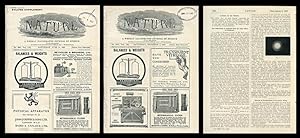
Contact seller5-star seller1st Edition. FIRST EDITION IN ORIGINAL WRAPS OF THOMSON & REID'S NOBEL PRIZE WINNING PAPERS "for the experimental discovery of the diffraction of electrons by crystals" (Nobel Prize Portal). The experiments conducted here "beautifully confirmed the [de Broglie's] wave theory" (Lindau Nobel Laureate Portal). Sir George Paget Thom…son was born in 1892, the son of the physicist Sir J. J. Thomson. Paget Thomson studied at Cambridge's Trinity College, later working for a year studying atomic structure with his father; this was followed by work at Cavendish Laboratory until WWI. Following a post at Cambridge, Paget Thomson became Professor of Natural Philosophy at the University of Aberdeen. It is at Aberdeen that Paget Thomson began to carry out experiments revealing the phenomena of electron diffraction with thin metal foils and high-voltage electrons. In 1924, the de Broglie hypothesis argued that a wave must be associated with the motion of any material corpuscle. "Reasoning that the effect would be easier to analyze with a solid than with a gaseous target, Thomson asked one of his students, Alexander Reid, to modify an existing apparatus and investigate the scattering of a beam of electrons with energy in the keV range through this celluloid films at normal incidence" (Lindau). In the first paper offered here (June 1927), Reid and Paget Thomson describe "the rings formed when a beam of cathode rays was sent at normal incidence through a thin film of celluloid and struck a photograph plate placed some distance behind the film. These were attributed to a diffraction of the cathode rays by the film, the cathode rays behaving as waves of wave-length h/mv according to de Broglie's theory of wave mechanics, and regularities in the structure of the film, or in the size of the molecules, making it behave as a kind of diffraction grating" (Abstract). In the paper of 1927 December, Paget Thomson (working alone) confirmed and extended his experimentation "to films of gold, aluminium, and of an unknown (probably organic) substance. In particular, the relation that the size of the rings is in all cases inversely as the momentum of the cathode rays is fully confirmed, and the number and size of the rings correspond remarkably with what is to be expected from the known crystalline structure of gold and aluminium, using de Broglie's expression for the wave- length of the cathode rays" (Abstract). "Whereas his father had seen the electron as a particle (and won his Nobel Prize in the process), Paget Thomson demonstrated that it could be diffracted like a wave, a discovery proving the principle of wave-particle duality which had first been posited by de Broglie in the 1920s as what is often dubbed the de Broglie hypothesis" (Strickland, Creators of Quantum Physics, 180). CONDITION & DETAILS: Two issues in original wraps. London: Macmillan. 4to. (10.5 x 7.5 inches; 262 x 188mm). Ex-libris with stamps on front wraps; professionally rebacked at the spine (see scan). Slight wear; bright and clean throughout. Both very good condition.
Published by Macmillan, London, 1927
- First Edition
Seller: Atticus Rare Books, West Branch, IA, U.S.A.Atticus Rare Books
Contact seller5-star seller1st Edition. FIRST EDITION IN ORIGINAL WRAPS OF THOMSON & REID'S NOBEL PRIZE WINNING PAPERS "for the experimental discovery of the diffraction of electrons by crystals" (Nobel Prize Portal). The experiments conducted here "beautifully confirmed the [de Broglie's] wave theory" (Lindau Nobel Laureate Portal). Sir George Paget Thom…son was born in 1892, the son of the physicist Sir J. J. Thomson. Paget Thomson studied at Cambridge's Trinity College, later working for a year studying atomic structure with his father; this was followed by work at Cavendish Laboratory until WWI. Following a post at Cambridge, Paget Thomson became Professor of Natural Philosophy at the University of Aberdeen. It is at Aberdeen that Paget Thomson began to carry out experiments revealing the phenomena of electron diffraction with thin metal foils and high-voltage electrons. In 1924, the de Broglie hypothesis argued that a wave must be associated with the motion of any material corpuscle. "Reasoning that the effect would be easier to analyze with a solid than with a gaseous target, Thomson asked one of his students, Alexander Reid, to modify an existing apparatus and investigate the scattering of a beam of electrons with energy in the keV range through this celluloid films at normal incidence" (Lindau). In the first paper offered here (June 1927), Reid and Paget Thomson describe "the rings formed when a beam of cathode rays was sent at normal incidence through a thin film of celluloid and struck a photograph plate placed some distance behind the film. These were attributed to a diffraction of the cathode rays by the film, the cathode rays behaving as waves of wave-length h/mv according to de Broglie's theory of wave mechanics, and regularities in the structure of the film, or in the size of the molecules, making it behave as a kind of diffraction grating" (Abstract). In the paper of 1927 December, Paget Thomson (working alone) confirmed and extended his experimentation "to films of gold, aluminium, and of an unknown (probably organic) substance. In particular, the relation that the size of the rings is in all cases inversely as the momentum of the cathode rays is fully confirmed, and the number and size of the rings correspond remarkably with what is to be expected from the known crystalline structure of gold and aluminium, using de Broglie's expression for the wave- length of the cathode rays" (Abstract). "Whereas his father had seen the electron as a particle (and won his Nobel Prize in the process), Paget Thomson demonstrated that it could be diffracted like a wave, a discovery proving the principle of wave-particle duality which had first been posited by de Broglie in the 1920s as what is often dubbed the de Broglie hypothesis" (Strickland, Creators of Quantum Physics, 180). CONDITION & DETAILS: Two issues in original wraps. London: Macmillan. 4to. (10.5 x 7.5 inches; 262 x 188mm). Ex-libris with stamps on front wraps; professionally rebacked at the spine (see scan). Slight wear; bright and clean throughout. Both very good condition.


