

Order Total (1 Item Items):
Shipping Destination:

9783642066689 - Simulating Continuous Fuzzy Systems: 188 Studies in Fuzziness and Soft Computing, 188 by Buckley, James J ; Jowers, Leonard J (12 results)
Skip to main search results
Search filters
Product Type
- All Product Types
- Books (12)
- Magazines & Periodicals (No further results match this refinement)
- Comics (No further results match this refinement)
- Sheet Music (No further results match this refinement)
- Art, Prints & Posters (No further results match this refinement)
- Photographs (No further results match this refinement)
- Maps (No further results match this refinement)
- Manuscripts & Paper Collectibles (No further results match this refinement)
Condition Learn more
- New (11)
- As New, Fine or Near Fine (1)
- Very Good or Good (No further results match this refinement)
- Fair or Poor (No further results match this refinement)
- As Described (No further results match this refinement)
Binding
- All Bindings
- Hardcover (No further results match this refinement)
- Softcover (12)
Collectible Attributes
- First Edition (No further results match this refinement)
- Signed (No further results match this refinement)
- Dust Jacket (No further results match this refinement)
- Seller-Supplied Images (5)
- Not Print on Demand (6)
Language (1)
Price
- Any Price
- Under £ 20 (No further results match this refinement)
- £ 20 to £ 35 (No further results match this refinement)
- Over £ 35
Free Shipping
- Free Shipping to U.S.A. (No further results match this refinement)
Seller Location
Seller Rating
-

Simulating Continuous Fuzzy Systems (Studies in Fuzziness and Soft Computing, 188)
Seller: Ria Christie Collections, Uxbridge, United Kingdom
Seller rating 5 out of 5 stars

£ 116.47
£ 11.98 shipping
Ships from United Kingdom to U.S.A.Quantity: Over 20 available
Add to basketCondition: New. In.
-
Condition: New. pp. 216.
-

Taschenbuch. Condition: Neu. Simulating Continuous Fuzzy Systems | James J. Buckley (u. a.) | Taschenbuch | Studies in Fuzziness and Soft Computing | xii | Englisch | 2010 | Springer | EAN 9783642066689 | Verantwortliche Person für die EU: Springer Verlag GmbH, Tiergartenstr. 17, 69121 Heidelberg, juergen[dot]hartmann[at]springer[dot]com | Anbieter: preigu.
-

Simulating Continuous Fuzzy Systems
Language: English
Published by Springer Berlin Heidelberg, Springer Berlin Heidelberg, 2010
ISBN 10: 3642066682 ISBN 13: 9783642066689
Taschenbuch. Condition: Neu. Druck auf Anfrage Neuware - Printed after ordering - 1. 1 Introduction This book is written in two major parts. The rst part includes the int- ductory chapters consisting of Chapters 1 through 6. In part two, Chapters 7-26, we present the applications. This book continues our research into simulating fuzzy systems. We started with investigating simulating discrete event fuzzy systems ([7],[13],[14]). These systems can usually be described as queuing networks. Items (transactions) arrive at various points in the s- tem and go into a queue waiting for service. The service stations, preceded by a queue, are connected forming a network of queues and service, until the transaction nally exits the system. Examples considered included - chine shops, emergency rooms, project networks, bus routes, etc. Analysis of all of these systems depends on parameters like arrival rates and service rates. These parameters are usually estimated from historical data. These estimators are generally point estimators. The point estimators are put into the model to compute system descriptors like mean time an item spends in the system, or the expected number of transactions leaving the system per unit time. We argued that these point estimators contain uncertainty not shown in the calculations. Our estimators of these parameters become fuzzy numbers, constructed by placing a set of con dence intervals one on top of another. Using fuzzy number parameters in the model makes it into a fuzzy system. The system descriptors we want (time in system, number leaving per unit time) will be fuzzy numbers.
-
Paperback. Condition: Brand New. 214 pages. 9.25x6.10x0.49 inches. In Stock.
-
Paperback. Condition: Like New. Like New. book.
-
Condition: new. Questo è un articolo print on demand.
-

Simulating Continuous Fuzzy Systems
Language: English
Published by Springer Berlin Heidelberg Feb 2010, 2010
ISBN 10: 3642066682 ISBN 13: 9783642066689
Seller: BuchWeltWeit Ludwig Meier e.K., Bergisch Gladbach, Germany
Seller rating 5 out of 5 stars
Taschenbuch. Condition: Neu. This item is printed on demand - it takes 3-4 days longer - Neuware -1. 1 Introduction This book is written in two major parts. The rst part includes the int- ductory chapters consisting of Chapters 1 through 6. In part two, Chapters 7-26, we present the applications. This book continues our research into simulating fuzzy systems. We started with investigating simulating discrete event fuzzy systems ([7],[13],[14]). These systems can usually be described as queuing networks. Items (transactions) arrive at various points in the s- tem and go into a queue waiting for service. The service stations, preceded by a queue, are connected forming a network of queues and service, until the transaction nally exits the system. Examples considered included - chine shops, emergency rooms, project networks, bus routes, etc. Analysis of all of these systems depends on parameters like arrival rates and service rates. These parameters are usually estimated from historical data. These estimators are generally point estimators. The point estimators are put into the model to compute system descriptors like mean time an item spends in the system, or the expected number of transactions leaving the system per unit time. We argued that these point estimators contain uncertainty not shown in the calculations. Our estimators of these parameters become fuzzy numbers, constructed by placing a set of con dence intervals one on top of another. Using fuzzy number parameters in the model makes it into a fuzzy system. The system descriptors we want (time in system, number leaving per unit time) will be fuzzy numbers. 216 pp. Englisch.
-
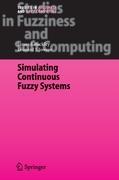
Simulating Continuous Fuzzy Systems
Language: English
Published by Springer Berlin Heidelberg, 2010
ISBN 10: 3642066682 ISBN 13: 9783642066689
Condition: New. Dieser Artikel ist ein Print on Demand Artikel und wird nach Ihrer Bestellung fuer Sie gedruckt. Studies continuous dynamical systems using crisp continuous simulationVariety of applications of fuzzy dynamical systems ranging from Bungee jumping to the AIDS epidemic to dynamical models in economicsCompanion text to Simula.
-

Simulating Continuous Fuzzy Systems
Language: English
Published by Springer, Springer Feb 2010, 2010
ISBN 10: 3642066682 ISBN 13: 9783642066689
Seller: buchversandmimpf2000, Emtmannsberg, BAYE, Germany
Seller rating 5 out of 5 stars
Taschenbuch. Condition: Neu. This item is printed on demand - Print on Demand Titel. Neuware -1. 1 Introduction This book is written in two major parts. The rst part includes the int- ductory chapters consisting of Chapters 1 through 6. In part two, Chapters 7-26, we present the applications. This book continues our research into simulating fuzzy systems. We started with investigating simulating discrete event fuzzy systems ([7],[13],[14]). These systems can usually be described as queuing networks. Items (transactions) arrive at various points in the s- tem and go into a queue waiting for service. The service stations, preceded by a queue, are connected forming a network of queues and service, until the transaction nally exits the system. Examples considered included - chine shops, emergency rooms, project networks, bus routes, etc. Analysis of all of these systems depends on parameters like arrival rates and service rates. These parameters are usually estimated from historical data. These estimators are generally point estimators. The point estimators are put into the model to compute system descriptors like mean time an item spends in the system, or the expected number of transactions leaving the system per unit time. We argued that these point estimators contain uncertainty not shown in the calculations. Our estimators of these parameters become fuzzy numbers, constructed by placing a set of con dence intervals one on top of another. Using fuzzy number parameters in the model makes it into a fuzzy system. The system descriptors we want (time in system, number leaving per unit time) will be fuzzy numbers.Springer-Verlag KG, Sachsenplatz 4-6, 1201 Wien 216 pp. Englisch.
-
Condition: New. Print on Demand pp. 216 100 Illus.
-
Condition: New. PRINT ON DEMAND pp. 216.

