

Order Total (1 Item Items):
Shipping Destination:

9783642024078 - Theory and Practice of Model Transformations: Second International Conference, Icmt 2009, Zürich, Switzerland, June 29-30, 2009, Proceedings: 5563 Lecture Notes in ... (14 results)
Skip to main search results
Search filters
Product Type
- All Product Types
- Books (14)
- Magazines & Periodicals (No further results match this refinement)
- Comics (No further results match this refinement)
- Sheet Music (No further results match this refinement)
- Art, Prints & Posters (No further results match this refinement)
- Photographs (No further results match this refinement)
- Maps (No further results match this refinement)
- Manuscripts & Paper Collectibles (No further results match this refinement)
Condition Learn more
- New (12)
- As New, Fine or Near Fine (2)
- Very Good or Good (No further results match this refinement)
- Fair or Poor (No further results match this refinement)
- As Described (No further results match this refinement)
Binding
- All Bindings
- Hardcover (No further results match this refinement)
- Softcover (14)
Collectible Attributes
- First Edition (No further results match this refinement)
- Signed (No further results match this refinement)
- Dust Jacket (No further results match this refinement)
- Seller-Supplied Images (7)
- Not Print on Demand (9)
Language (1)
Price
- Any Price
- Under £ 20 (No further results match this refinement)
- £ 20 to £ 35 (No further results match this refinement)
- Over £ 35
Free Shipping
- Free Shipping to U.S.A. (No further results match this refinement)
Seller Location
Seller Rating
-

Condition: As New. Unread book in perfect condition.
-

-

Condition: New. pp. 296.
-
Paperback. Condition: Brand New. 2009 edition. 295 pages. 9.13x6.14x0.71 inches. In Stock.
-
Theory and Practice of Model Transformations: Second International Conference, ICMT 2009, Zürich, Switzerland, June 29-30, 2009, Proceedings (Lecture Notes in Computer Science, 5563)
Seller: Ria Christie Collections, Uxbridge, United Kingdom
Seller rating 5 out of 5 stars

£ 68.72
£ 11.98 shipping
Ships from United Kingdom to U.S.A.Quantity: Over 20 available
Add to basketCondition: New. In.
-
Theory and Practice of Model Transformations: Second International Conference, ICMT 2009, Zurich, Switzerland, June 29-30, 2009, Proceedings (Lecture Notes in Computer Science)
Language: English
Published by Springer Berlin Heidelberg 2010-06-02, 2010
ISBN 10: 3642024076 ISBN 13: 9783642024078
Paperback. Condition: New.
-

Theory and Practice of Model Transformations : Second International Conference, ICMT 2009, Zürich, Switzerland, June 29-30, 2009, Proceedings
Language: English
Published by Springer, Springer Spektrum, 2009
ISBN 10: 3642024076 ISBN 13: 9783642024078
Taschenbuch. Condition: Neu. Druck auf Anfrage Neuware - Printed after ordering - Models have become essential for supporting the development, analysis and e- lution of large-scale and complex IT systems. Models allow di erent views, p- spectives and elements of a system to be captured rigorously and precisely, thus allowing automated tools to manipulate and manage the models. In a full- edged model-driven engineering (MDE) process, the transformations developed and - pressed between models are also key. Model transformations allow the de nition and implementation of the operations on models, and also provide a chain that enables the automated development of a system from its corresponding m- els. Model transformations are already an integral part of any model-driven approach, and there are a number of available model transformation languages, tools, and supporting environments; some of these approaches are now approa- ing maturity. Nevertheless, much work remains: the research community and industry need to better understand the foundations and implications of model transformations, such as the key concepts and operators supporting transfor- tion languages, their semantics, and their structuring mechanisms and properties (e. g. , modularity, composability and parametrization). The e ect of using model transformations on organizations and development processes - particularly when applied to ultra-large scale systems, or in distributed enterprises - is still not clear. These issues, and others related to the speci cation, design, implemen- tion, analysis and experimentation with model transformation, are the focus of these proceedings. The Second International Conference on Model Transformation (ICMT 2009) was held in late June 2009 in Zurich, Switzerland.
-
Taschenbuch. Condition: Neu. Theory and Practice of Model Transformations | Second International Conference, ICMT 2009, Zürich, Switzerland, June 29-30, 2009, Proceedings | Richard F. Paige | Taschenbuch | x | Englisch | 2009 | Springer | EAN 9783642024078 | Verantwortliche Person für die EU: Springer Verlag GmbH, Tiergartenstr. 17, 69121 Heidelberg, juergen[dot]hartmann[at]springer[dot]com | Anbieter: preigu.
-
Condition: Sehr gut. Zustand: Sehr gut | Seiten: 296 | Sprache: Englisch | Produktart: Bücher | Models have become essential for supporting the development, analysis and e- lution of large-scale and complex IT systems. Models allow di?erent views, p- spectives and elements of a system to be captured rigorously and precisely, thus allowing automated tools to manipulate and manage the models. In a full-?edged model-driven engineering (MDE) process, the transformations developed and - pressed between models are also key. Model transformations allow the de?nition and implementation of the operations on models, and also provide a chain that enables the automated development of a system from its corresponding m- els. Model transformations are already an integral part of any model-driven approach, and there are a number of available model transformation languages, tools, and supporting environments; some of these approaches are now approa- ing maturity. Nevertheless, much work remains: the research community and industry need to better understand the foundations and implications of model transformations, such as the key concepts and operators supporting transfor- tion languages, their semantics, and their structuring mechanisms and properties (e. g. , modularity, composability and parametrization). The e?ect of using model transformations on organizations and development processes ¿ particularly when applied to ultra-large scale systems, or in distributed enterprises ¿ is still not clear. These issues, and others related to the speci?cation, design, implemen- tion, analysis and experimentation with model transformation, are the focus of these proceedings. The Second International Conference on Model Transformation (ICMT 2009) was held in late June 2009 in Zurich, Switzerland.
-
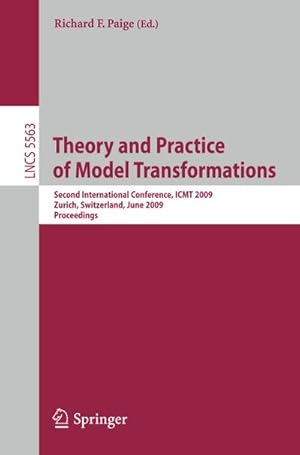
Theory and Practice of Model Transformations
Language: English
Published by Springer Berlin Heidelberg Jun 2009, 2009
ISBN 10: 3642024076 ISBN 13: 9783642024078
Seller: BuchWeltWeit Ludwig Meier e.K., Bergisch Gladbach, Germany
Seller rating 5 out of 5 stars
Taschenbuch. Condition: Neu. This item is printed on demand - it takes 3-4 days longer - Neuware -Models have become essential for supporting the development, analysis and e- lution of large-scale and complex IT systems. Models allow di erent views, p- spectives and elements of a system to be captured rigorously and precisely, thus allowing automated tools to manipulate and manage the models. In a full- edged model-driven engineering (MDE) process, the transformations developed and - pressed between models are also key. Model transformations allow the de nition and implementation of the operations on models, and also provide a chain that enables the automated development of a system from its corresponding m- els. Model transformations are already an integral part of any model-driven approach, and there are a number of available model transformation languages, tools, and supporting environments; some of these approaches are now approa- ing maturity. Nevertheless, much work remains: the research community and industry need to better understand the foundations and implications of model transformations, such as the key concepts and operators supporting transfor- tion languages, their semantics, and their structuring mechanisms and properties (e. g. , modularity, composability and parametrization). The e ect of using model transformations on organizations and development processes - particularly when applied to ultra-large scale systems, or in distributed enterprises - is still not clear. These issues, and others related to the speci cation, design, implemen- tion, analysis and experimentation with model transformation, are the focus of these proceedings. The Second International Conference on Model Transformation (ICMT 2009) was held in late June 2009 in Zurich, Switzerland. 296 pp. Englisch.
-
Condition: New. Print on Demand pp. 296 Illus.
-
Condition: New. PRINT ON DEMAND pp. 296.
-

Theory and Practice of Model Transformations
Language: English
Published by Springer Berlin Heidelberg, 2009
ISBN 10: 3642024076 ISBN 13: 9783642024078
Condition: New. Dieser Artikel ist ein Print on Demand Artikel und wird nach Ihrer Bestellung fuer Sie gedruckt. Models have become essential for supporting the development, analysis and e- lution of large-scale and complex IT systems. Models allow di?erent views, p- spectives and elements of a system to be captured rigorously and precisely, thus allowing automated to.
-

Theory and Practice of Model Transformations
Language: English
Published by Springer, Springer Jun 2009, 2009
ISBN 10: 3642024076 ISBN 13: 9783642024078
Seller: buchversandmimpf2000, Emtmannsberg, BAYE, Germany
Seller rating 5 out of 5 stars
Taschenbuch. Condition: Neu. This item is printed on demand - Print on Demand Titel. Neuware -Models have become essential for supporting the development, analysis and e- lution of large-scale and complex IT systems. Models allow di erent views, p- spectives and elements of a system to be captured rigorously and precisely, thus allowing automated tools to manipulate and manage the models. In a full- edged model-driven engineering (MDE) process, the transformations developed and - pressed between models are also key. Model transformations allow the de nition and implementation of the operations on models, and also provide a chain that enables the automated development of a system from its corresponding m- els. Model transformations are already an integral part of any model-driven approach, and there are a number of available model transformation languages, tools, and supporting environments; some of these approaches are now approa- ing maturity. Nevertheless, much work remains: the research community and industry need to better understand the foundations and implications of model transformations, such as the key concepts and operators supporting transfor- tion languages, their semantics, and their structuring mechanisms and properties (e. g. , modularity, composability and parametrization). The e ect of using model transformations on organizations and development processes ¿ particularly when applied to ultra-large scale systems, or in distributed enterprises ¿ is still not clear. These issues, and others related to the speci cation, design, implemen- tion, analysis and experimentation with model transformation, are the focus of these proceedings. The Second International Conference on Model Transformation (ICMT 2009) was held in late June 2009 in Zurich, Switzerland.Springer-Verlag KG, Sachsenplatz 4-6, 1201 Wien 296 pp. Englisch.


