

Order Total (1 Item Items):
Shipping Destination:

Slothouber Jan (13 results)
Skip to main search results
Search filters
Product Type
- All Product Types
- Books (13)
- Magazines & Periodicals (No further results match this refinement)
- Comics (No further results match this refinement)
- Sheet Music (No further results match this refinement)
- Art, Prints & Posters (No further results match this refinement)
- Photographs (No further results match this refinement)
- Maps (No further results match this refinement)
- Manuscripts & Paper Collectibles (No further results match this refinement)
Condition Learn more
- New (No further results match this refinement)
- As New, Fine or Near Fine (No further results match this refinement)
- Very Good or Good (4)
- Fair or Poor (No further results match this refinement)
- As Described (9)
Binding
- All Bindings
- Hardcover (No further results match this refinement)
- Softcover (9)
Collectible Attributes
- First Edition (2)
- Signed (No further results match this refinement)
- Dust Jacket (No further results match this refinement)
- Seller-Supplied Images (8)
- Not Print on Demand (13)
Language (2)
Free Shipping
- Free Shipping to U.S.A. (No further results match this refinement)
Seller Location
Seller Rating
-

Vier Kanten: van het werk van Graatsma en Slothouber voor de Staatsmijnen (Stedelijk Museum Catalog # 374)
Published by Stedelijk Museum Amsterdam, 1964
Softcover, 40 pages; in Dutch; good condition; ex-college library copy with partially removed stickers on front cover at upper left corner; and library bookplate on inside front cover; no internal marks.
-
Sq. 8vo, soft cover, illustrations, 20 p. In very good condition. K1.
-
Cubics. Cubic constructions compedium.
Language: English
Published by Heerlen, Cubic Constructions Centre,, 1970
Seller: Buch & Cafe Antiquarius, Bonn, NRW, Germany
Association Member: GIAQ
Seller rating 5 out of 5 stars

First Edition
small-8°, original softcover. 1. ed. With numerous illustrations on plates, 428 p. Rare copy with impressive plates. Cover a bit brownish, binding loosened, otherwise very fine copy. Sprache: Englisch Gewicht in Gramm: 0.
-

Kleur en kubus: werk van Jan Slothouber en William Graatsma voor de staatsmijnen (D.S.M.)
Published by Hilversum : Steendrukkerij de Jong & Co., 1966
Condition: Good. Oorspronkelijk geniet omslag, softcover, enkele illustraties in z/w en kleur, tekst in het Nederlands, Engels, Frans en Duits, ongepagineerd, vierkant (circa 12x12cm). Met adressering en frankering. Tentoonstelling 66: 26 februari tot 6 april 1966 kantine Steendrukkerij de Jong & Co.
-

Kleur en kubus: werk van Jan Slothouber en William Graatsma voor de staatsmijnen (D.S.M.)
Published by Hilversum : Steendrukkerij de Jong & Co., 1966
Condition: Good. Oorspronkelijk geniet omslag, softcover, enkele illustraties in z/w en kleur, tekst in het Nederlands, Engels, Frans en Duits, ongepagineerd, vierkant (circa 12x12cm). Met adressering en frankering. Tentoonstelling 66: 26 februari tot 6 april 1966 kantine Steendrukkerij de Jong & Co.
-
katalogus 374: vier kanten van het werk van graatsma en slothouber voor de staatsmijnen. 12.2. - 15.3.65.
Published by tedelijk Museum, Amsterdam, 1965
Seller: terrahe.oswald, Gangkofen, Germany
Seller rating 5 out of 5 stars
Kl.-8°. 38,(2) S., mit zahlreichen Abbildungen. Orig.-Kartonage. Mit einer Einleitung von Pieter Brattinga. - Einband berieben und etwas angestaubt; Vorderdeckel zu einem Drittel lose; Ecken und Kanten gering bestoßen.
-
4to, oblong, stiff lineoleum cover, oblong, illustrated throughout, second edition, limited to 100 signed and numbered copies (nr. 52) In good condition. K13.
-

Cubics. A cubic constructions compendium. Een compendium over cubische constructies. This edition has been realised, also in consequence of the xxxv-th biennale in venice, throught the collaboration of: the cubic constructions centre (ccc), heerlen, the netherlands: jan slothouber, william graatsma. The editors of the "octopus foundation", deventer, the netherlands: paul brand, wim crouwel, hein van haaren. The dutch committe for the biennale 1970, venice, italy: r w d oxenaar, commissary, mrs g j a ten holte, secretary, h van haare, member of the committee, d welling, member of the committee. deventer, june 1970. deze uitgave kwam, mede naar anleiding van de xxxv-ste biennale in venetie, tot stand door samenwerking van: het centrum voo
Published by Heerlen (Niederlande). Cubic Constructions Centre. 1970, 1970
Seller: Antiquariat Querido - Frank Hermann, Düsseldorf, NRW, Germany
Seller rating 5 out of 5 stars
Erste Auflage. 17,5 x 17,5 cm. 428 S. Illustrierter, flexibler OKarton. Einband gering lichtschattig, Bindung wie meist labil. Sonst gutes Exemplar. Durchgehend mit schwarz-weißen und wenigen Abbildungen versehen. Jan Slothouber, der 1918 geborene und 2007 verstorbene Architekt und ehemalige Professor an der Technischen Universität Eindhoven entwickelte von 1950 bis 1970 zusammen mit William Graatsma (1925 - 2017) ein "Würfel"-Designsystem für die Staatsmijnen (später DSM; Koninklijke DSM N.V. mit Sitz in Heerlen in den Niederlanden). Nach seinem Tod erwarb das Van Abbemuseum wichtige Teile seines Werkes, Archivs und seiner Bibliothek. Sprache: Englisch und Niederländisch.
-
Cubics. A cubic constructions compendium. Een compendium over cubische constructies. This edition has been realised, also in consequence of the xxxv-th biennale in venice, throught the collaboration of: the cubic constructions centre (ccc), heerlen, the netherlands: jan slothouber, william graatsma. The editors of the "octopus foundation", deventer, the netherlands: paul brand, wim crouwel, hein van haaren. the dutch committe for the biennale 1970, venice, italy: r w d oxenaar, commissary, mrs g j a ten holte, secretary, h van haare, member of the committee, d welling, member of the committee. deventer, june 1970. deze uitgave kwam, mede naar anleiding van de xxxv-ste biennale in venetie, tot stand door samenwerking van: het centrum voo .
Published by Cubic constructions centre, Heerlen, 1970
Seller: Antiquariat am St. Vith, Mönchengladbach, Germany
Seller rating 5 out of 5 stars
Broschiert. Kl.-Oktav. 428 S. Broschur. Sprache: Englisch, Mit zahlr., teils farb. Abb. gebräunt, Rücken mit Knickfalten, Titelblatt lose und mit kl.Sammlerstempel, Bindung sehr labil.
-

Vouwblad ter gelegenheid van de tentoonstelling Cubische Constructies 1965-1970
Published by Nuth, Rosbeek
Seller: Antiquariaat Looijestijn, Rotterdam, Netherlands
Seller rating 5 out of 5 stars
2004, vouwblad, oplage 1000 exemplaren, perfect exemplaar, zeldzaam.
-
Cubische cel-grafieken = Cubic cell graphics (Rosbeek goodwill series #3).
Published by Rosbeek, Nuth, 1970
Seller: Antiquariaat Digitalis, Amsterdam, Netherlands
Seller rating 5 out of 5 stars
First Edition
Soft cover. Condition: Very Good. 1st Edition. Stapled stiff wrappers (softcover), [10]p, chiefly illustrations, 20x20 cm. Good/very good, wrappers discolored. Text in English and Dutch.
-
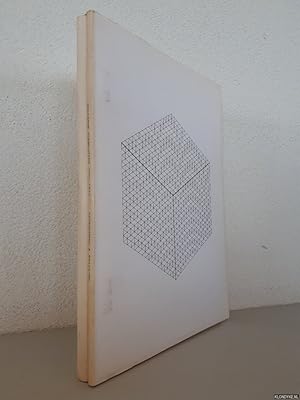
Cubische vormgeving 1955-1970 = Formes cubiques 1955-1970 = Kubische Gestaltung 1955-1970 = Cubic design 1955-1970
Published by Centrum voor Cubische Constructies, 1976
Condition: Good. Dubbel portfolio, met voorin bladzijden vastgezet met splitpennen: illustraties en figuren in kleur en z/w, 453-553 pagina's + 17 bijlagen (zie hieronder) achterin, gedrukt in 1000 genummerde exemplaren (dit is nummer 0088), 4to. Bijlagen: 1) Cubische vormgeving Affiche - 1968; 2) Bulletin 2 / Centrum voor Cubische Constructies - 1968; 3) Kubische Konstruktionen auf der ihm Niederländische Notizen Nr. 30 - 1969; 4) Tentoonstellingscatalogus Centrum voor Cubische Constructies Galerie De Mangelgang - 1969; 5) Cubisch gewelfde blokken - 1970; 6) Centrum voor Cubische Constructies, Plus-nieuws. . . 1970; 7) Kinderpostzegels Loketschild. . . 1970; 8) Informatieblad Kinderpostzegels - 1970; 9) Katalogus 1 Collectie XXXV-ste Bià nnale Venetià - 1971; 10] Katalogus Centrum voor Cubische Constructies, De Hallen - 1971; 11) Informatieblad Cubics - 1971; 12) Cubic cell graphics, Galerie De Mangelgang. . . 1971; 13) Cubisch gewelfd alfabet, Steendrukkerij De Jong & Co. -1972; 14) Cubische verdubbeling en halvering, grafiek Kalender, Zeefdrukkerij Wijtmans - 1972; 15) Cubic cosmic city, Publikatie 9, Drukkerij Rosbeek - 1973; 16) Kubisch gewolbte Konstruktionen Katalogus, Neue Galerie Aachen - 1973; 17) Katalogus "Rietveld in Limburg", Bonnefantenmuseum - 1976.
-
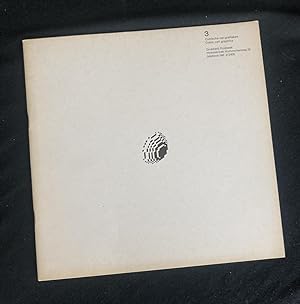
[DESIGN AS MATHEMATICAL CALCULATION ? POST-DIGITAL DESIGN] Group of six characteristic publications and multiples by the Dutch architects and designers Jan Slothouber and William Graatsma, including six double-sided printed cardboard parts for assembling a cubic calendar, six model plates in different colors and four square catalogs or folders, among others with eight screen prints
Seller: Penka Rare Books and Archives, ILAB, Berlin, Germany
Seller rating 5 out of 5 stars
Heerlen, Amsterdam and Loenersloot: Cubic Construction Center, Stedelijk Museum and others, 1965?1971. Octavos (17.5 ? 17.5 cm.) and calendar boards measuring 35 ? 17.8 cm. Calendar boards somewhat toned, else good or better. William Graatsma and Gerrit Jan Slothouber had a formative influence on Dutch design in the post-war period. They first became known as designers for the Dutch chemical company DSM, for which they designed packaging, advertisements, and fonts, for example. Even then, they experimented with limiting themselves to the cube as a variable basic form. This concept aroused such interest that the Stedelijk Museum Amsterdam organized an exhibition of their work in 1965 (the catalog is available here). Soon afterwards, they founded the "Cubic Construction Center" (CCC for short) in order to deepen their concept not only practically but also theoretically. For example, they studied Le Corbusier and the ideal basic dimension of 70 cm in order to develop variations of the basic module using preferably pure primary and secondary colors as well as transparent materials. The guiding principle for this project of strict limitation to the cube was the idea of using the economically simple and universally applicable cube to create an art form appropriate to the social requirements of a democratically organized industrial society. (Cf. Uta R?mer, AKL LIX, 2008, p. 481.) The group contains the following objects: (a) Cubic calendar 1970, [1969]. With the months of the year screen-printed on 6 thick cardboard sheets in black and silver. To be mounted as a cube with folding lines. (b) Original paper sleeve with 6 colored cardboard plates for model construction. No year. (c) Vier kanten van het werk van Graatsma en Slothouber voor de staatsmijnen [Four sides of Graatsma and Slothouber's work for state mines: Exhibition catalog]. Amsterdam: Stedelijk Museum, 1965. Original printed self-wrappers; 38, [4] pp. with numerous illustrations and a color graphic. (d) Cubisch waarneembaar hexagon [Cubic observable hexagon]. Loenersloot: Galerie Mickery, 1969. Original pictorial folder; 8 silkscreens in black, white and gray as well as a printed glassine sheet. (e) Staatsmijnen DSM/Voorlichtingsdienst: Kubiese konstrukties + Strukturen 67 / DSM Design [State Mines DSM / Information Service: Cubic Constructions + Structures 67 / DSM Design.] Heerlen: DSM, 1967. Original pictorial folder; [24] pp. as unbound folded sections with numerous reproductions of showcase designs and other cubic constructions. (f) Centrum voor Cubische Constructies: Catalogus nr 1 [Center for Cubic Constructions: Catalog No.]. Heerlen: Cubic Construction Center, 1971. [16] pp. and in each case a printed glassine sheet at the beginning and at the end. With numerous illustrations. As of January 2025, KVK and OCLC show only two copies of (d) worldwide outside North America, only one copy of (e) worldwide outside North America and no copy of (f) in North America.


![Seller image for [DESIGN AS MATHEMATICAL CALCULATION ? POST-DIGITAL DESIGN] Group of six characteristic publications and multiples by the Dutch architects and designers Jan Slothouber and William Graatsma, including six double-sided printed cardboard parts for assembling a cubic calendar, six model plates in different colors and four square catalogs or folders, among others with eight screen prints for sale by Penka Rare Books and Archives, ILAB](https://pictures.abebooks.com/inventory/md/md32158689971.jpg)