
Rumford Count Founding Paper Oceanography (1 results)
 More images
RUMFORD, Count (Benjamin THOMPSON). "Sur la manière dont la chaleur se propage dans les fluides; sur une loi remarquable qui s'observe dans la condensationde l'eau par le froid, lorque ce liquide approche du terme de la congelation avec des conjectures sur la cause finale de la salure de l'Ocean" in "Bibliotheque Britannique."
RUMFORD, Count (Benjamin THOMPSON). **Founding Paper in Oceanography and on Ocean Circulation**
Published by Bibliotheque Britannique, Geneva, 1797
- Hardcover
Seller: JF Ptak Science Books, Hendersonville, NC, U.S.A.JF Ptak Science Books
Contact seller5-star sellerCondition: Used - Very good
£ 310.26
£ 4.52 shippingShips within U.S.A.Quantity: 1 available
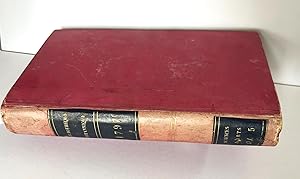
Hardcover. Condition: Very Good. RUMFORD, Count (Benjamin THOMPSON). "Sur la manière dont la chaleur se propage dans les fluides; sur une loi remarquable qui s'observe dans la condensationde l'eau par le froid, lorque ce liquide approche du terme de la congelation.avec des conjectures sur la cause finale de la salure de l'Ocean"…and other papers in pp 97-198, with one folding plate in "Bibliotheque Britannique, ou Recuell extrait des Ouvrages Anglais periodiques et autres." Geneva, Imp. De la Bibliotheque Britannique, 1797, volume 5, 392pp and three folding plates and tables; in the Science et Arts series. Paper-covered boards and spine. There is a little wear and rubbing to the boards, though overall the binding is quite nice. VERY GOOD. The text is very crisp and bright. [++] The "Bibliotheque Britannique" provided translations of significant and important papers (mostly extracts, or reviews, though with some complete article translations) that were written primarily in English and then translated into French to reach a wider audience in Europe many of these translations were the first exposure to the papers on the Continent. Many of the leading lights were published here including Jenner, Davy, Thomson, Wollaston, Waterhouse, Gay-Lussac, Pictet, and many others. The journal was active 1796-1815 after which it changed direction somewhat and renamed "Bibliotheque Universelle". For more on the significance on the BB, see: "The Transmission of Culture in Western Europe, 1750-1850: Papers Celebrating the Bicentenary of the Foundation of the 'Bibliothèque britannique' (1796-1815) in Geneva" by David Bickerton and Judith Proud.[++] On RUMFORD: "Benjamin Thompson (Count Rumford, 1753-1814, American) describes experiments leading to his discovery of convection currents in the essay "On the propagation of heat in fluids." He proceeds to examine the possible role of convection in the world ocean, concluding from his own theoretical work and from the 1751 deep water temperature measurements of Henry Ellis that the existence of cold water at depth in the tropics implies a meridional circulation transporting deep water from the polar regions toward the equator. Water cooled at the surface in high latitudes gets denser and hence descends. This cold, dense water spreads along the sea floor toward the equator, forcing a countercurrent from equator to pole at the surface. Thompson furthermore supplements this large-scale model of ocean circulation with an explanation of how in high latitudes a smaller scale vertical circulation can take place which results in significant heat transfer to the atmosphere: cold winds cool surface waters, which consequently descend, initiating a vertical circulation that brings to the surface warmer waters which in turn transfer heat to the atmosphere, cool, and descend, continuing the vertical circulation pattern."--Claire Parkinson, Breakthroughs, 1797. [++] Also in this volume is a review/observation of James HUTTON's great classic "Theory of the Earth, etc. Theorie de la Terre, avec les preuves et des eclairisemens, en quartre parties."(published in 1796) on pp 53-73 and 262-273. [++] Rumford makes a second appearance in the volume in "Count Rumford's Experimental Essays, etc. Essais politiques, economiaues et physiques du Comte Rumford. Vie essai, sur la conduite de Feu et l'economie du Combustion" pp 201-244, pp 297-355.
