

Order Total (1 Item Items):
Shipping Destination:

Powell Jefferson Lange David (16 results)
Skip to main search results
Search filters
Product Type
- All Product Types
- Books (16)
- Magazines & Periodicals (No further results match this refinement)
- Comics (No further results match this refinement)
- Sheet Music (No further results match this refinement)
- Art, Prints & Posters (No further results match this refinement)
- Photographs (No further results match this refinement)
- Maps (No further results match this refinement)
- Manuscripts & Paper Collectibles (No further results match this refinement)
Condition Learn more
- New (10)
- As New, Fine or Near Fine (3)
- Very Good or Good (2)
- Fair or Poor (No further results match this refinement)
- As Described (1)
Binding
Collectible Attributes
- First Edition (No further results match this refinement)
- Signed (No further results match this refinement)
- Dust Jacket (No further results match this refinement)
- Seller-Supplied Images (9)
- Not Print on Demand (15)
Language (1)
Free Shipping
Seller Location
Seller Rating
-
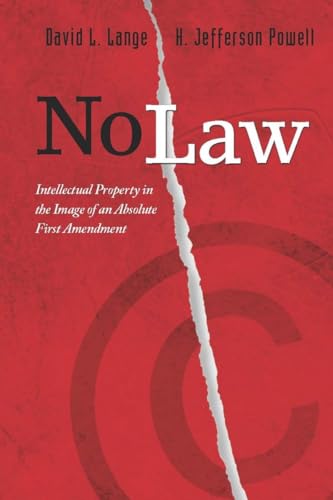
Paperback. Condition: As New. No Jacket. Pages are clean and are not marred by notes or folds of any kind. ~ ThriftBooks: Read More, Spend Less.
-
No Law: Intellectual Property in the Image of an Absolute First Amendment
Seller: Midtown Scholar Bookstore, Harrisburg, PA, U.S.A.
Seller rating 5 out of 5 stars

Paperback. Condition: Very Good. crisp clean w/remainder mark Standard-sized.
-
No Law: Intellectual Property in the Image of an Absolute First Amendment
Language: English
Published by Stanford Law Books, Stanford, 2009
ISBN 10: 0804745781 ISBN 13: 9780804745789
Hardcover. Condition: Ex-Library. "Lange and Powell argue that the First Amendment imposes absolute limits upon claims of exclusivity in intellectual property and expression, and strips Congress of the power to restrict personal thought and free expression in the name of intellectual property rights." [from publisher] Includes bibliographical references and index. Ex-library with usual markings, not affecting text, lacking a dustjacket.
-

No Law : Intellectual Property in the Image of an Absolute First Amendment
Language: English
Published by Stanford University Press, 2008
ISBN 10: 080474579X ISBN 13: 9780804745796
Condition: As New. Unread book in perfect condition.
-

No Law : Intellectual Property in the Image of an Absolute First Amendment
Language: English
Published by Stanford University Press, 2008
ISBN 10: 080474579X ISBN 13: 9780804745796
Condition: New.
-

No Law
Language: English
Published by Stanford University Press, US, 2008
ISBN 10: 080474579X ISBN 13: 9780804745796
Seller: Rarewaves.com USA, London, LONDO, United Kingdom
Seller rating 5 out of 5 stars
Paperback. Condition: New. The original text of the Constitution grants Congress the power to create a regime of intellectual property protection. The first amendment, however, prohibits Congress from enacting any law that abridges the freedoms of speech and of the press. While many have long noted the tension between these provisions, recent legal and cultural developments have transformed mere tension into conflict. No Law offers a new way to approach these debates. In eloquent and passionate style, Lange and Powell argue that the First Amendment imposes absolute limits upon claims of exclusivity in intellectual property and expression, and strips Congress of the power to restrict personal thought and free expression in the name of intellectual property rights. Though the First Amendment does not repeal the Constitutional intellectual property clause in its entirety, copyright, patent, and trademark law cannot constitutionally license the private commodification of the public domain. The authors claim that while the exclusive rights currently reflected in intellectual property are not in truth needed to encourage intellectual productivity, they develop a compelling solution for how Congress, even within the limits imposed by an absolute First Amendment, can still regulate incentives for intellectual creations. Those interested in the impact copyright doctrines have on freedom of expression in the U.S. and the theoretical and practical aspects of intellectual property law will want to take a closer look at this bracing, resonant work.
-

No Law
Language: English
Published by Stanford University Press, US, 2008
ISBN 10: 080474579X ISBN 13: 9780804745796
Paperback. Condition: New. The original text of the Constitution grants Congress the power to create a regime of intellectual property protection. The first amendment, however, prohibits Congress from enacting any law that abridges the freedoms of speech and of the press. While many have long noted the tension between these provisions, recent legal and cultural developments have transformed mere tension into conflict. No Law offers a new way to approach these debates. In eloquent and passionate style, Lange and Powell argue that the First Amendment imposes absolute limits upon claims of exclusivity in intellectual property and expression, and strips Congress of the power to restrict personal thought and free expression in the name of intellectual property rights. Though the First Amendment does not repeal the Constitutional intellectual property clause in its entirety, copyright, patent, and trademark law cannot constitutionally license the private commodification of the public domain. The authors claim that while the exclusive rights currently reflected in intellectual property are not in truth needed to encourage intellectual productivity, they develop a compelling solution for how Congress, even within the limits imposed by an absolute First Amendment, can still regulate incentives for intellectual creations. Those interested in the impact copyright doctrines have on freedom of expression in the U.S. and the theoretical and practical aspects of intellectual property law will want to take a closer look at this bracing, resonant work.
-

No Law : Intellectual Property in the Image of an Absolute First Amendment
Language: English
Published by Stanford University Press, 2008
ISBN 10: 080474579X ISBN 13: 9780804745796
Seller: GreatBookPricesUK, Woodford Green, United Kingdom
Seller rating 5 out of 5 stars
Condition: As New. Unread book in perfect condition.
-

No Law : Intellectual Property in the Image of an Absolute First Amendment
Language: English
Published by Stanford University Press, 2008
ISBN 10: 080474579X ISBN 13: 9780804745796
Seller: GreatBookPricesUK, Woodford Green, United Kingdom
Seller rating 5 out of 5 stars
Condition: New.
-
No Law: Intellectual Property in the Image of an Absolute First Amendment
Seller: Midtown Scholar Bookstore, Harrisburg, PA, U.S.A.
Seller rating 5 out of 5 stars
Hardcover. Condition: Very Good. Very Good - Crisp, clean, unread book with some shelfwear/edgewear, may have a remainder mark - NICE Standard-sized.
-
No Law: Intellectual Property in the Image of an Absolute First Amendment
Language: English
Published by Stanford Law Books 2008-12-15, 2008
ISBN 10: 080474579X ISBN 13: 9780804745796
Paperback. Condition: New.
-
No Law Intellectual Property in the Image of an Absolute First Amendment
Language: English
Published by Stanford Law & Politics, 2008
ISBN 10: 080474579X ISBN 13: 9780804745796
Paperback. Condition: Brand New. 1st edition. 456 pages. 8.75x6.00x1.00 inches. In Stock.
-

Condition: New. No Law embraces an absolutist first amendment position to challenge the conventional idea that Congress may make laws abridging the freedom of expression to protect intellectual propertyÜber den AutorDavid Lange is Melvin G. Shi.
-

No Law
Language: English
Published by Stanford University Press, US, 2008
ISBN 10: 080474579X ISBN 13: 9780804745796
Paperback. Condition: New. The original text of the Constitution grants Congress the power to create a regime of intellectual property protection. The first amendment, however, prohibits Congress from enacting any law that abridges the freedoms of speech and of the press. While many have long noted the tension between these provisions, recent legal and cultural developments have transformed mere tension into conflict. No Law offers a new way to approach these debates. In eloquent and passionate style, Lange and Powell argue that the First Amendment imposes absolute limits upon claims of exclusivity in intellectual property and expression, and strips Congress of the power to restrict personal thought and free expression in the name of intellectual property rights. Though the First Amendment does not repeal the Constitutional intellectual property clause in its entirety, copyright, patent, and trademark law cannot constitutionally license the private commodification of the public domain. The authors claim that while the exclusive rights currently reflected in intellectual property are not in truth needed to encourage intellectual productivity, they develop a compelling solution for how Congress, even within the limits imposed by an absolute First Amendment, can still regulate incentives for intellectual creations. Those interested in the impact copyright doctrines have on freedom of expression in the U.S. and the theoretical and practical aspects of intellectual property law will want to take a closer look at this bracing, resonant work.
-

No Law
Language: English
Published by Stanford University Press, US, 2008
ISBN 10: 080474579X ISBN 13: 9780804745796
Paperback. Condition: New. The original text of the Constitution grants Congress the power to create a regime of intellectual property protection. The first amendment, however, prohibits Congress from enacting any law that abridges the freedoms of speech and of the press. While many have long noted the tension between these provisions, recent legal and cultural developments have transformed mere tension into conflict. No Law offers a new way to approach these debates. In eloquent and passionate style, Lange and Powell argue that the First Amendment imposes absolute limits upon claims of exclusivity in intellectual property and expression, and strips Congress of the power to restrict personal thought and free expression in the name of intellectual property rights. Though the First Amendment does not repeal the Constitutional intellectual property clause in its entirety, copyright, patent, and trademark law cannot constitutionally license the private commodification of the public domain. The authors claim that while the exclusive rights currently reflected in intellectual property are not in truth needed to encourage intellectual productivity, they develop a compelling solution for how Congress, even within the limits imposed by an absolute First Amendment, can still regulate incentives for intellectual creations. Those interested in the impact copyright doctrines have on freedom of expression in the U.S. and the theoretical and practical aspects of intellectual property law will want to take a closer look at this bracing, resonant work.
-
No Law Intellectual Property in the Image of an Absolute First Amendment
Language: English
Published by Stanford Law & Politics, 2008
ISBN 10: 080474579X ISBN 13: 9780804745796
Paperback. Condition: Brand New. 1st edition. 456 pages. 8.75x6.00x1.00 inches. In Stock. This item is printed on demand.

