Order Total (1 Item Items):
Shipping Destination:

Perrissin Jean (14 results)
Skip to main search results
Search filters
Product Type
- All Product Types
- Books (11)
- Magazines & Periodicals (No further results match this refinement)
- Comics (No further results match this refinement)
- Sheet Music (No further results match this refinement)
- Art, Prints & Posters (3)
- Photographs (No further results match this refinement)
- Maps (No further results match this refinement)
- Manuscripts & Paper Collectibles (No further results match this refinement)
Condition Learn more
- New (1)
- As New, Fine or Near Fine (5)
- Very Good or Good (2)
- Fair or Poor (No further results match this refinement)
- As Described (6)
Binding
Collectible Attributes
- First Edition (2)
- Signed (3)
- Dust Jacket (No further results match this refinement)
- Seller-Supplied Images (6)
- Not Print on Demand (14)
Language (2)
Free Shipping
Seller Location
Seller Rating
-

Condition: Neuf.
-
ANNECY - 1758, (1758/)1758, (1759/)1763 - ENSEMBLE de 3 actes notariés, en un double feuillet chacun [27x17,5 cm], 4 pages manuscrites sur papier vergé filigrané, empreinte noire timbre 'Gabelle Générale' 'deux sols', avec le double écu couronné aux armes de Sardaigne et de Savoie . L'ENSEMBLE des 3 actes notariés [bon état pour les 2 premiers actes, taches et manques de papier pour le 3e]. Pliures horizontales. VENTE, réparations, frais funéraires / n° 3 - Acquis pour . Claude François Magnin fait de Noble Antoine Greyfier. Du 20e fevrier 1758. Bessons not(air)e. Somme 3900 £. - [signé] Jacquet, Marchand.'Facture' pour Menuiserie, Maçonnerie, Charpenterie, rue de l'Halle / n° 4 - Quittance pour . Claude François Magnin, avocat au Senat, Bourgeois de Annecy, passée par les Consorts Girel, Duc, et Rachel maîtres menuisiers, maçon, et charpentier. Du 29 juin 1758. Brunet no(tair)e. So(mm)e £ 772: 10. [signé] Marchand. [.] du vingt huit juillet suivant, quoique par autre fait ecrit. [signé] Brunet no(tai)re. *****___*****___***** VENTE / n° 5 - Extrait d'acquis fait par . Claude F(rançoi)s Magnien de Nobles Joseph Portier de Belair, du 31 janvier 1759 - n° 5 - [signé] Jacquet, Marchand / [.] L'extrait sus ecrit est conforme a son original [.] ce jourd'hui dix septieme Mars mil sept cent soixante trois. [signé] P. Bessons not(aire). Français Acte notarié.
-

Condition: Comme neuf. Merci, votre achat aide à financer des programmes de lutte contre l'illettrisme.
-

Condition: Bon. Attention: Ancien support de bibliothèque, plastifié, étiquettes. Merci, votre achat aide à financer des programmes de lutte contre l'illettrisme.
-

Condition: Bon. Merci, votre achat aide à financer des programmes de lutte contre l'illettrisme.
-
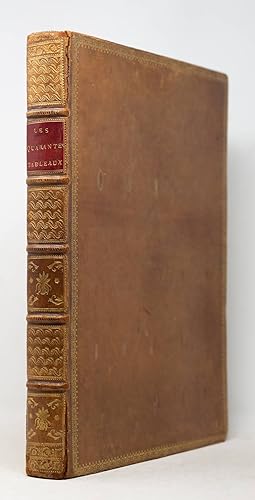
Le Premier volume, contenant quarante tableaux ou Histoires diverses qui sont mémorables touchant les Guerres, Massacres, & Troubles advenus en France en ces dernieres annees. Le tout recueilli selon le tesmoignage de ceux qui y ont esté en personne, & qui les on veus, lesquels sont pourtrais à la verité
Published by Castellin, Laon & Le Vignon, Geneva, 1570
First Edition
Hardcover. Condition: Very good. First. THE RARE COMPLETE SUITE ILLUSTRATING THE WARS OF RELIGION. THE SAUVAGEOT -- ODIOT -- HOFER -- de GANAY COPY [Geneva: Nicolas Castellin & Pierre Le Vignon, 1570]. First volume only (all published). Folio (15 1/4" x 11 3/16", 388mm x 284mm). With an engraved-and-letterpress title-page, a manuscript preface, 39 double-page engraved plates and 3pp. manuscript table of contents. Collated complete, with the title-page as plate 1. Bound in early-XIXc calf with a gilt roll border. On the spine, five raised bands. Title (LES QUARANTES TABLEAUX) gilt to red morocco in the second panel. All edges of the text-block gilt. Gilt inside dentelle. Marbled end-papers. Green silk marking-ribbon. Boards starting, with the head-piece perished. Some abrasions to the boards, and scuffing, bumping and wear to the extremities. All plates backed onto celadon-tinted paper, with some marginal chips and splits filled. Scattered manuscript markings (e.g., to the title-page, to the caption of the first plate (no. 2). With the bookplates of Odiot, Hofer and Sauvageot to the front paste-down. With a partly-obliterated bookplate (personification of Time at a lectern) and the bookplate of Hubert de Ganay on the recto of the front paste-down. In all, a remarkably rare survival intact, (re-)bound in the XIXc and with a distinguished provenance. In 1569, Nicolas Castellin and Pierre Le Vignon commissioned a revolutionary book: one that sought to tell recent history pictorially. It was not the first to do so, but it was the first to be done not at the behest of a monarch or a party, not to glorify -- but to inform the public. The story to be told was the origins of the French Wars of Religion, starting with the unexpected death of Henry II in 1559 (a splinter from a lance during a joust) and the power-vacuum that brought to a head the long-simmering tension between French Catholics and Protestants (Huguenots, Calvinists) and ending (by some reckonings) with the Edict of Nantes (1598), granting in name if not in fact religious equality of a kind. Such was the centrality of France that this conflict swirled out to include the monarchs and prelates of most of Europe: England and Scotland, Spain and Portugal, the Papal States. Thus this series was a crucial means of dissemination of the relevant turning-points and events in the wars. Demand provoked various runs of the illustrations in copper and in wood at various scales; the present copy, as often (when complete examples can be found) is mixed. Whole sets of the tableaux are one of the traditional prizes of book-collectors, and the present copy has passed through distinguished hands. The binding owner, likely, was Charles Sauvageot (1787-1860), a polymathic collector. He was a violinist, co-founder of the département des arts decoratifs at the Louvre (now its own museum), historian and antiquary. His sale catalogue (from 3 December 1860, the present item lot 747) notes that the volume was "d'ailleurs très-bien conservé." He was also likely the cause -- if not the scribe -- of the fine manuscript "avertissement" and table of plates. Its next recorded owner was Ernest Odiot (1828-1890), a collector principally of decorative objects. Philip Hofer (1898-1984) is one of the great figures of American book-collecting. After being graduated from Harvard, Hofer established and directed the department of printing and graphic arts at the Houghton; from 1933, he collected seriously in the field of illustrated books. In 1934 became the first assistant director of the Morgan Library. The book must have passed out of his collection, as the book was acquired from the sale of Hubert, comte de Ganay (1888-1974; Christie's Paris 26 November 2019, lot 115). He was a similarly omnivorous collector from a long-descended Nivernais family. Benedict, Graphic History: The Wars, Massacres and Troubles of Tortorel and Perrissin; Brunet V.892-895; Mortimer-Hofer-Jackson, Harvard XVIc French Books II.421; Robert-Dumesnil VI.46-69.
-
La mort du roy Henry deuxieme aux tournelles a Paris, le x iuillet 1559
Published by J. de Laon, Geneva, 1570
Seller: Jeremy Norman's historyofscience, Novato, CA, U.S.A.
Seller rating 5 out of 5 stars

La mort du roy Henry deuxieme aux tournelles a Paris, le x iuillet 1559. Woodcut. [Geneva: J. de Laon, ca. 1570.] Print measures 399 x 521 mm.; in archival frame measuring 543 x 678 mm. A few small marginal repairs, light soiling, vertical crease, but very good. This large and rare print, the fourth image in Perrissin and Tortorel's Premier volume, contenant quarante tableaux ou histoires diverses qui sont mémorables (1569-70), is the only 16th-century image depicting the two greatest medical figures of that centuryAndreas Vesalius and Ambroise Parétogether in the same scene. The two men are shown standing side by side at a table at the foot of the king's bed; Vesalius is on the left. An assortment of medical and surgical instruments can be seen on the table. The woodcut depicts the deathbed of Henri II of France, who suffered a lance blow in his right eye in a tournament with the Count of Montgomery on June 30, 1559. In spite of the presence of many medical men in Paris, including Paré, the French court immediately sent a messenger to Flanders for Vesalius, who left for Paris on July 2. By the time Vesalius was able to examine Henri II, on July 3, the king's condition had deteriorated to the point where Vesalius judged he could not recover. The king died one week later, on July 10. As noted above, this famous image forms the fourth in a series of 40 prints issued by Perrissin and Tortorel in their Première volume, only the first volume of which was published. The prints were apparently also issued separately. The series of prints is an important landmark in the history of pictorial journalism, in that "it is the first extended print series offering a pictorial account of recent events where the images do not simply illustrate a written history but carry the burden of telling the story themselves, and that was intended not to glorify a ruler's deeds but to show a broad general public the events of their time" (Benedict, Graphic History: The Wars, Massacres and Troubles of Tortorel and Perrissin [2007], p. 4). The previous print in the series (no. 3; not present here) shows the king at the tournament where he received his fatal wound. The prints were widely distributed, and exhibit captions in French, German, Italian or Latin. .
-
A collection of 11 engravings from: Quarante tableaux ou histoires diverses qui sont mémorables touchant les guerres, massacres et troubles advenus en France en ces dernières années, Le tout recueilli selon le tesmoignage de ceux qui y ont esté en personne. First edition of the engravings and woodcuts
Published by Geneva: Nicolas Castellin & Pierre Le Vignon-1570, 1569
Seller: Wittenborn Art Books, San Francisco, CA, U.S.A.
Seller rating 5 out of 5 stars
Art / Print / Poster
Condition: Good. Eleven of the engravings and woodcuts from the series of 40; most 32 x 50 cm. and matted. Most with parts missing, sometimes with ink drawings of the missing parts.Between 1569 and 1570 French painter, engraver and architect Jean Perrissin , French printmaker Jacques Tortorel , and French printmaker Jacques Le Challeux ? all Protestants (Huguenots) who had fled to Geneva to escape religious persecution in France? undertook a more elaborate project, publishing from Geneva an album of prints entitled Premier volume. Contentant quarante tableaux ou histoire diverse qui son memorables touchant les guerres, massacres & troubles advenus en France en ces dernieres annees. Le tout receuilli selon le tesmoignage de ceux qui y on esté en personne, & qui les on veus, lesquels son pourtrais à la verité. (First Volume, Containing Forty Tableaux or Diverse Memorable Histories Concerning the Wars, Massacres and Troubles that have Occurred in France in These Last Years. All Gathered from the Testimony of Those Who Were There in Person and Saw Them, and Truly Portrayed.) The images, of which some were copperplate engravings and some of which were woodcuts, consisted of the elaborate engraved title page and thirty-nine images, each measuring roughly 32 x 50 cm, depicting significant "wars, massacres, and troubles" in the French Wars of Religion between 1559 and 1570. The images had large subject headings in their upper margins, and alphabetical keys to extensive captions explaining what happened in each image. Perhaps because this series of prints was issued as a portfolio, presumably for a higher price than would have been charged for single news prints, these prints have had a higher survival rate than many ephemeral news prints of the time.References: Brunet V: 892-95; Fairfax Murray German 415; Harvard/Mortimer 421; Robert Dumesil, Le peintre graveur VI:47-69.Met Museum Accession Number: 51.580.4; Philip Benedict, Le Regard saisit l'Histoire: Les Guerres, Massacres et Troubles de Tortorel et Perissin: Geneve: Croz, 2012Un un recueil collectif, publié en 1569-1570, de planches gravées sur bois ou sur cuivre, qui représentent des épisodes importants des premières guerres de religion, qui ont opposé les catholiques et les protestants en France au XVIe siècle. Les principaux auteurs des planches sont Jean Perrissin et Jacques Tortorel ; le recueil est de ce fait souvent désigné sous la forme Tortorel et Perrissin.Le recueil débute avec une représentation de la séance du parlement de Paris où Anne du Bourg, conseiller au parlement, s'adresse, en juin 1559, au roi Henri II et lui reproche sa politique de répression à l'égard des protestants. Les planches suivantes se réfèrent à des épisodes qui ont précédé les guerres de religion proprement dites, comme la conjuration d'Amboise, puis à des événements qui appartiennent aux trois premières guerres de religion jusqu'en mars 1570. Un nombre important de planches représentent des batailles (15 planches), des escarmouches, des sièges ou des massacres.
-

Le Duc de Guise est blessé à mort, le 18. de Feurier. 1563.
Published by Artist: Tortorel/ Perrissin Jacques/ Jean; ca:, 1560
Seller: Antique Sommer& Sapunaru KG, München, Germany
Seller rating 3 out of 5 stars

Technic: Woodcut, colorit: colored, condition: Mounted and margins cut, size (in cm): 37 x 48, The wood cut depicts the attack on Francis de Lorraine II, Prince of Joinville, Duke of Guise, Duke of Aumale( 1519 ? 1563). In the back ground the city of Orleans. The Duke of Guise was a French soldier and politician. By religion, he practised Catholicism, at a time when France was being polarized between the Catholics and Huguenots. In the fourth encounter, Guise was about to take Orléans from the Huguenot supporters of Condé when he was wounded on 18 February 1563 by the Huguenot assassin, Jean de Poltrot de Méré, and died six days later, bled to death by his surgeons, at Château Corney.
-
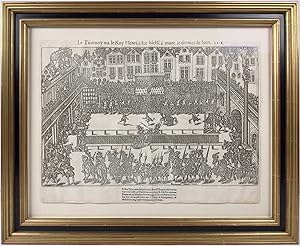
Le Tournoy ou le Roy Henri 2 fut blessé á mort le dernier de Iuin. 1559
Published by Nicolas Castellin & Pierre Le Vignon, Geneva, 1570
Art / Print / Poster First Edition Signed
No binding. Condition: Near fine. First. THE GOURARY COPY. Plate 3 from Jean Tortorel and Jacques Perrissin. Le Premier volume, contenant quarante tableaux ou Histoires diverses qui sont mémorables touchant les Guerres, Massacres, & Troubles advenus en France en ces dernieres annees. Le tout recueilli selon le tesmoignage de ceux qui y ont esté en personne, & qui les on veus, lesquels sont pourtrais à la verité. [Geneva: Nicolas Castellin & Pierre Le Vignon, 1570]. Single-sheet wood-engraving (sheet: 14 7/8" x 19 3/8", 367mm x 491mm; frame: 20 1/2" x 20 5/8"), signed "I PERRISSIM FECIT 1570" at the lower edge of the plate. Letterpress title and caption outside the plate-mark. Float-mounted and framed with Museum Glass. Central fold (from publication) along with some creases (especially at lower-right) and nicks to the edges. Upper edge shaved, touching the capitals of the title. A good impression. In 1569, Nicolas Castellin and Pierre Le Vignon commissioned a revolutionary book: one that sought to tell recent history pictorially. It was not the first to do so, but it was the first to be done not at the behest of a monarch or a party, not to glorify -- but to inform the public. The story to be told was the origins of the French Wars of Religion and the power-vacuum that brought to a head the long-simmering tension between French Catholics and Protestants (Huguenots, Calvinists) and ending (by some reckonings) with the Edict of Nantes (1598), granting in name if not in fact religious equality. This peace obtained for most of the XVIIc, ending with Louis XIV's Edict of Fontainebleau (1685). The present plate illustrates the starting-gun of the Wars of Religion: Henri II's wounding -- quite by accident -- in the eye, which led to his death. The wound was sustained from the shattered lance of Gabriel de Lorges, Comte de Montgomery during a joust at the Place des Vosges in celebration of two marriages: the king's daughter to the King of Spain and the king's sister to the Duke of Savoy. Henri was reportedly wearing the colors of his mistress, Diane de Poitiers; could Perrissin be mocking him with the inscription at right ("HEN.II.GRA.DEI./REX.GALL.INVICTISS", Henri II by the Grace of God the Unconquered King of the French)? This ophthalmic trauma was compounded by the trajectory of one of the splinters upward causing a subdural hemorrhage, a bleed between the brain and skull. Henri was rushed to his chambers, and while his surgeons cleared the accessible splinters and bled him (12 ounces!), the great medical men of Europe -- including Andreas Vesalius and Ambroise Paré -- were summoned to attend the king. His medical team experimented with lances into the eye sockets of recently decapitated men, in the hopes of understanding the precise type of trauma. Neither Vesalius nor Paré nor any other doctor was able to save the king, and he died 10 July 1559. The text below can be rendered: "King Henry, having made peace with the King of Spain, celebrating the weddings of his daughter whom he had given him in marriage, and of his sister Madame Marguerite, whom he had also given in marriage to the Duke of Savoy, and wishing to have a joust with the Count of Montgomery, was mortally wounded, and greatly lamented by his subjects." Our engraving was part of the great collection of "fête books," as they are known, amassed by Paul and Marianne Gourary. After Paul's death in 2007, the collection -- "Splendid Ceremonies" -- was sold by Christie's New York (12 June 2009), in which the present item was lot 341. Wellcome 42593i. Quarante Tableaux: Benedict, Graphic History: The Wars, Massacres and Troubles of Tortorel and Perrissin; Brunet V.892-895; Mortimer-Hofer-Jackson, Harvard XVIc French Books II.421; Robert-Dumesnil VI.46-69.
-

L'execution d'amboise, faite le 15. Mars. 1560.
Published by Geneva: Nicholas Castellin, 1569-1570, 1570
Seller: Arader Galleries - AraderNYC, New York, NY, U.S.A.
Seller rating 5 out of 5 stars
Single sheet (14 x 19 4/8 inches). Fine woodcut with Perrissin's monogramme "IP" lower left, within the platemark, woodcut title above and legend below the neat line. THE EXECUTIONS AT AMBOISE Number 7 of 40 plates (including the illustrated title-page) in the celebrated series published with titles and legends in French (as here), German, Italian and Latin, as "Premier volume contenant quarante tableaux ou histoires diverses qui sont memorables touchant les guerres, massacres et troubles advenus en France en ces dernieres annees. Le tout recueilli selon le tesmoignage de ceux qui y ont este en personne" - "First Volume, containing forty tableaus or divers memorable histories concerning the wars, massacres and troubles that have occurred in France in these last years. All gathered from the testimony of those who were there in person and saw them, and truly portrayed". "THE FIRST EXTENDED PRINT SERIES OFFERING A PICTORIAL ACCOUNT OF RECENT EVENTS where the images do not simply illustrate a written history but carry the burden of telling the story themselves, and that was intended not to glorify aruler's deeds but to show a broad general public the events of their time" (Benedict, page 4) Issued as a woodcut only. Immediately following the scene of the Conspiracy of Amboise, in which La Renaudie and Pardaillon are killed, many of the conspirators intent on kidnapping the young King Francis II, were rounded up and immediately hanged and left swinging from the battlements over the castle gate, others followed and many were also beheaded, or had their sentence commuted to rowing in the galleys for life. This print depicts these punishments in all their violent detail, and shows La Renaudie hanging from his own gibbet, awaiting quartering. "The scene at the focal point of the image is that of the conspirator who dipped his hands in the blood of his previously beheaded associates and lifted them as high as his bound arms allowed, cried out as he did so, "Lord, here is the blood of your children, avenge it." (Benedict 7) The publishing history of the "Quarante Tableaux" is extremely complex, and explained in great detail by Philip Benedict in his excellent "The Graphic History: the Wars, Massacres and Troubles of Tortorel and Perrissin" 2007. However the events depicted begin with the "special meeting of the Parlement of Paris in June 1559 at which Anne Du Bourg spoke out before king Henry II against the harsh repression of Protestantism through [to] a minor skirmish between Hugenot and Catholic forces along the Rhone in March 1570. The first dozen or so plates show the events that led up to the outbreak of open civil war in spring 1562. The remainder of the series is comped of events from the first three French Wars of Religion (1562-1563, 1567-1568, and 1568-1570). Above all it is a compendium of battles (15 pictures), sieges (5 pictures), raids (4 pictures) and massacres (3 pictures - 5 if the massacres from prior to the outbreak of the First civil war are included)" (Benedict, page 6).
-
Lentreprinse d'Amboise descouverte les 13. 14. & 15. de Mars. 1560.
Published by Geneva: Nicholas Castellin, 1569-1570, 1570
Seller: Arader Galleries - AraderNYC, New York, NY, U.S.A.
Seller rating 5 out of 5 stars
Signed
PERRISSIN, Jean (before 1546-1617) and Jacques TORTOREL (fl: 1568-1575). Lentreprinse d'Amboise descouverte les 13. 14. & 15. de Mars. 1560. Geneva: Nicholas Castellin, 1569-1570 Single sheet (15 6/8 x 20 2/8 inches). Fine woodcut signed "I. Tor Torel. Fecit" within the platemark, woodcut title above and legend below the neat line. THE CONSPIRACY OF AMBOISE Number 6 of 40 plates (including the illustrated title-page) in the celebrated series published with titles and legends in French (as here), German, Italian and Latin, as "Premier volume contenant quarante tableaux ou histoires diverses qui sont memorables touchant les guerres, massacres et troubles advenus en France en ces dernieres annees. Le tout recueilli selon le tesmoignage de ceux qui y ont este en personne" - "First Volume, containing forty tableaus or divers memorable histories concerning the wars, massacres and troubles that have occurred in France in these last years. All gathered from the testimony of those who were there in person and saw them, and truly portrayed". "THE FIRST EXTENDED PRINT SERIES OFFERING A PICTORIAL ACCOUNT OF RECENT EVENTS where the images do not simply illustrate a written history but carry the burden of telling the story themselves, and that was intended not to glorify aruler's deeds but to show a broad general public the events of their time" (Benedict, page 4) The Conspiracy of Amboise, depicted in this superb woodcut, was an abortive plot by the young French Huguenot aristocrats of 1560 against the Catholic House of Guise. "On the accession of the 14-year-old Francis II to the French throne in 1559, the Guise family gained ascendancy in the government, creating enmity among the smaller nobility. A conspiracy to overturn their government was formed at Nantes, with a needy Périgord nobleman named La Renaudie as its nominal head, though the agitation had in the first instance been fostered by the agents of Louis I de Bourbon, prince de Condé. The Guises were warned of the conspiracy while the court was at Blois, and for greater security they removed the King to Amboise. La Renaudie, however, merely postponed his plans, and the conspirators assembled in small parties in the woods around Amboise. They had, however, been again betrayed, and many of them were surrounded and captured before the coup could be delivered; on March 19, 1560, La Renaudie and the rest of the conspirators openly attacked the château of Amboise. They were repelled, La Renaudie was killed, and a large number were taken prisoners" (Encyclopedia Britannica online). This magnificent scene shows James Savoy, Duke of Nemours receiving his orders from the Royal Guard at Amboise, where the Guise family have taken the young king Francis II, then hiding in the surrounding woods, waiting in ambush for Renaudie, the leader of the conspirators, and his men. Renaudie is then shown attacking Pardillian, part of the King's guard, and then in turn Renaudie is shot by one of Pardillian's pages. Also published as an engraving, this slightly later woodcut contains information in the legend not included on the engraved version: Pardaillon's pistol failed to fire, giving La Renaudie the opportunity to kill him with his sword, and before dying from a gunshot fired by one of Pardaillan's pages, La Renaudie was able to kill the page. The publishing history of the "Quarante Tableaux" is extremely complex, and explained in great detail by Philip Benedict in his excellent "The Graphic History: the Wars, Massacres and Troubles of Tortorel and Perrissin" 2007. However the events depicted begin with the "special meeting of the Parlement of Paris in June 1559 at which Anne Du Bourg spoke out before king Henry II against the harsh repression of Protestantism through [to] a minor skirmish between Hugenot and Catholic forces along the Rhone in March 1570. The first dozen or so plates show the events that led up to the outbreak of open civil war in spring 1562. The remainder of the series is comped o.
-
Le massacre fait a Tours par la populace au mois de Iuillet. 1562.
Published by Geneva: Nicholas Castellin, 1569-1570, 1570
Seller: Arader Galleries - AraderNYC, New York, NY, U.S.A.
Seller rating 5 out of 5 stars
PERISSIN, Jean (before 1546-1617) and Jacques TORTOREL (fl: 1568-1575). Le massacre fait a Tours par la populace au mois de Iuillet. 1562. Geneva: Nicholas Castellin, 1569-1570 Single sheet (16 x 20 2/8 inches). Fine woodcut with Perissin's monogram lower left after a copper engraving by Franz Hogenberg, woodcut title above and legend below the neat line. THE MASSACRE OF THE HUGUENOTS AT TOURS IN 1562 Number 14 of 40 plates (including the illustrated title-page) in the celebrated series published with titles and legends in French (as here), German, Italian and Latin, as "Premier volume contenant quarante tableaux ou histoires diverses qui sont memorables touchant les guerres, massacres et troubles advenus en France en ces dernieres annees. Le tout recueilli selon le tesmoignage de ceux qui y ont este en personne" - "First Volume, containing forty tableaus or divers memorable histories concerning the wars, massacres and troubles that have occurred in France in these last years. All gathered from the testimony of those who were there in person and saw them, and truly portrayed". "THE FIRST EXTENDED PRINT SERIES OFFERING A PICTORIAL ACCOUNT OF RECENT EVENTS where the images do not simply illustrate a written history but carry the burden of telling the story themselves, and that was intended not to glorify a ruler's deeds but to show a broad general public the events of their time" (Benedict, page 4) An extraordinary scene showing the complete massacre of the Huguenots by the people of Tours on July 11th, 1562, also issued as an etching, and sometimes with an account of the massacre rather than a legend beneath. The massacre was in reprisal for the Huguenots having taken the city of Tours on April 2nd and looting its churches. As a result the Catholics with the help of the Royal army threw men, women and children from the bridge into the teaming Loire below. They were then shot, hacked and clubbed to death from the shore and in boats. a prominent judge, alleged to have swallowed his gold, is shown hanged from a tree with his entrails drawn out, as the soldiers look for the gold hidden there. The bodies are seen left floating in the Loire to become carrion for flocks of crows and even wild dogs. 200 prisoners were taken and housed in the church of Notre-Dame-la-Riche, outside the city walls, and left there for 3 days without food before being massacred. Other specific and very graphic examples of cruelty are incorporated into this extraordinary print. Amid the killing a terrified Huguenot woman is shown giving birth, only to have the child snatched away and thrown into the Loire; and a soldier holds up another Huguenot baby and offers one of his companions money if he can shoot it. Tours was one of the first cities where the Huguenots secured political domination in the wake of the massacre of Vassy. In July, the combined royal and Catholic forces retook it after a brief siege directed by the marshal de St. Andre. The Huguenots negotiated surrender terms according to which they were promised safe passage from the city, but the agreement was not respected and many of the Protestants were killed" (Benedict 14). The publishing history of the "Quarante Tableaux" is extremely complex, and explained in great detail by Philip Benedict in his excellent "The Graphic History: the Wars, Massacres and Troubles of Tortorel and Perrissin" 2007. However the events depicted begin with the "special meeting of the Parlement of Paris in June 1559 at which Anne Du Bourg spoke out before king Henry II against the harsh repression of Protestantism through [to] a minor skirmish between Hugenot and Catholic forces along the Rhone in March 1570. The first dozen or so plates show the events that led up to the outbreak of open civil war in spring 1562. The remainder of the series is comped of events from the first three French Wars of Religion (1562-1563, 1567-1568, and 1568-1570). Above all it is a compendium of battles (15 pictures), sieges (5 pictures), r.
-
"Le Tournoy ou le Roy Henri 2 sur blessé à mort le dernier le Juin 1559".
Published by [Geneva: Nicholas Castellin], 1570 (but 1569)., 1570
Seller: Arader Galleries - AraderNYC, New York, NY, U.S.A.
Seller rating 5 out of 5 stars
Art / Print / Poster Signed
No Binding. Condition: Near Fine. Sheet size (14 4/8 x 19 2/8 inches), matted. Fine etching signed "Perrissim. Fecit. 1570" within the platemark, woodcut title above and legend beneath. Provenance: The Paul and Marianne Gourary Collection of Illustrated Fete Books "Splendid Ceremonies". The third plate in the celebrated series "Premier volume contenant quarante tableaux ou histoires diverses qui sont memorables touchant les guerres, massacres et troubles advenus en France en ces dernieres annees. Le tout recueilli selon le tesmoignage de ceux qui y ont este en personne" first published in Geneva in 1569 - 1570. The publisher's preferred etched issue found in the earliest editions of 30 plates. This fine and dramatic scene depicts the tragic moment at the tournament of June 1559 when Henri II (1519-1559), King of France was ousted from his horse by Gabriel de Lorges, Count of Montgomery (1530-1574) when a lance splintered, went into his eye and shot upwards into his brain, causing a subdural hemorrhage. In spite of this horrific injury,."the king managed to get to his chambers, where all of his physicians gathered in the hope of curing him. Initially, his surgeons cleaned the splinters out his eye, purged him with rhubarb and other purgatives, and bled him - as was the practice of the day - of 12 ounces (34 centilitres) of blood. The king's injuries were so serious that many famous physicians were sent for, including Andreas Vesalius. While the courtiers waited for Vesalius to arrive, the physicians who were at the king's bedside made several experiments, including thrusting the lance through the eye sockets of four decapitated criminals in the hope of discovering the extent of the king's injuries. When Vesalius arrived five days later, he used the brain of a cadaver to view the same type of injury. Ambroise Paré, the famous French surgeon, was also consulted on the king's condition. Despite the presence of the most famous surgeons in Europe, and their best efforts to save him, the king died nine days after receiving his injury" Wellcome Library online. The publishing history of the "Quarante Tableaux" is extremely complex, and explained in great detail by Philip Benedict in his excellent "The Graphic History: the Wars, Massacres and Troubles of Tortorel and Perrissin" 2007. Signed by Author(s).

![Seller image for Actes notariés - Ensemble de 3 actes [n° 3 - Acquis pour . Claude François Magnin fait de Noble Antoine Greyfier. Du 20e fevrier 1758] /// [n° 4 - Quittance pour . Claude François Magnin, avocat au Senat, Bourgeois de Annecy, passée par les Consorts Girel, Duc, et Rachel maîtres menuisiers, maçon, et charpentier. Du 29 juin 1758] /// [n° 5 - Extrait d'acquis fait par . Claude F(rançoi)s Magnien de Noble Joseph Portier de Belair, du 31 janvier 1759]. for sale by Jean-Paul TIVILLIER](https://pictures.abebooks.com/inventory/md/md30971097001.jpg)