
Panic 1837 (3 results)
 More images
Published by Claremont 1838
- First Edition
- Manuscript
Seller: Auger Down Books, ABAA/ILAB, Marlboro, VT, U.S.A.Auger Down Books, ABAA/ILAB
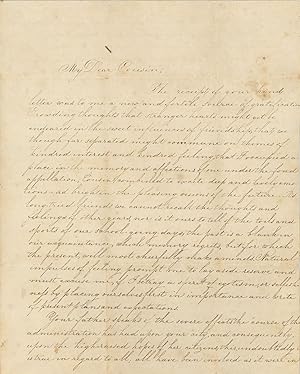
Contact seller5-star sellerCondition: Fine. An entertaining letter written by Marion Richards of Claremont, New Hampshire, defending the northern way of life and describing the relative calm in New Hampshire during the Panic of 1837, which apparently had been the subject of previous correspondence between the two. She makes an interesting reference to "fe…male rights," which she says she does not support, perhaps also in reference to an earlier conversation. She writes, "Your father speaks of the severe effects the course of the administration has had upon your city, and consequently upon the high-raised hopes of her citizens; this, undoubtedly is true in regard to all; all have been involved as it were in one general ruin and all have suffered. We, as individuals, it is true, felt the change and with others echoed the cry, 'hard times', but still in comparison with many, suffered little. Embarked in no dangerous enterprise, we retrenched our expenses, adopting this plain sentiment, 'to want no more than may suffice and make that little do'. Politics, however, interest me only as it affects my father's purse and deprives me of pleasure. Not very patriotic, I confess, but being neither an advocate of female rights, and having a proper sense of the small amount of my influence, I leave such like, to father and Congress. " The next section contains a detailed defense of the yankee character:"And now allow me to follow somewhat in your train of thought and speak a good word for the Yankees. With that characteristic trait of a 'thorough-going-Yankee-Down-Easter' I have guessed that you, Cousin, suppose us to be an antisocial class of people, & in order to lead you to a different conclusion, I will attempt a slight delineation of sectional character. That we are cautious in the choice of friends, is true; & that this caution may be carried so far as to give the impression that we are cold and retiring in our feelings, is perhaps equally so; but may not this, in the end, result to mutual benefit? if a friendship is longer in maturing, will it not stand a longer & severer test? and are not the pleasures arising from a friendship founded on a knowledge of character greater, than those based upon supposed merit, liable to be broken by any trivial occurrence? A cold climate has not exerted its influences over the generous sympathies of our hearts & the social feelings, though concealed by a cold exterior, can be aroused and glow with as much warmth as in a softer clime. 'Nestled among the mountains', we have imbibed a free, independent spirit both in thought & action." She also discusses the prospect of visiting Newark, and writes that it is perhaps more appealing in her imagination than in reality. Overall an interesting rumination on the culture of New England and a woman's perception of life further south during the period. $300 Full transcription follows: My Dear Cousin, The receipt of your kind letter was to me a new and fertile source of gratification. Crowding thoughts that stranger hearts might yet be endeared in the sweet influences of friendship, that we though far separated might commune on themes of kindred interest and kindred feeling, that I occupied a place in the memory and affections of one under the fond appellation, Cousin, combined to excite deep and lively emotions and brighten the pleasing visions of the future. As long-tried friends, we cannot recall the thoughts and sports of our school-going days; the past is a blank in our acquaintance, which memory regrets, but for which the present, will most cheerfully make amends. Natural impulses of feeling prompt me to lay aside reserve and must excuse me, if I betray a spirit of egotism, or selfishness by placing ourselves first in importance and write of present plans and expectations. Your father speaks of the severe effects the course of the administration has had upon your city, and consequently upon the high-raised hopes of her citizens; this, undoubtedly is true in regard to all; all have been involved as it w.
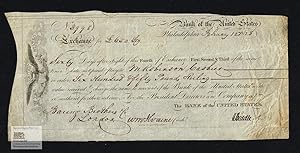
Bank of the United States. Bill of Exchange for 650 Pounds Sterling to Baring Brothers in London, Philadelphia 1828, signed by Nicholas Biddle
Bank of the United States; Nicholas Biddle (1786-1844), important US-american banker and statesman, third and last presedent of the second Bank of the United States of America, he and his bank became target of US president Andrew Jackson's "bank war", failed in the financial panic 1837
Published by Philadelphia: Bank of the United States of America 1928
- First Edition
- Signed
Seller: historicArt Antiquariat & Kunsthandlung, Wiesbaden-Breckenheim, , GermanyhistoricArt Antiquariat & Kunsthandlung
Contact seller5-star sellerCondition: Used
£ 400.12
£ 10.36 shippingShips from Germany to U.S.A.Quantity: 1 available
1. original bill of exchange on thin handmade paper with decorative steel engraving of the famous Bank of the United States of America and an American eagle, paper size ca. 11 x 25 cm, signed by Nicholas Biddle, in the lower right corner stained, otherwise in very good condition, extremely rare 2100 gr.
 More images
Seller: The Lawbook Exchange, Ltd., ABAA ILAB, Clark, NJ, U.S.A.The Lawbook Exchange, Ltd., ABAA ILAB
Contact seller5-star sellerMobile: Printed by Cooper & Leavens, 1837. Rare Printing of an Act to Protect the Bank of Alabama During the Panic of 1837 [Alabama]. [Panic of 1837]. An Act to Extend the Time of Indebtedness to the Bank of the State of Alabama and Its Branches, And Legalizing the Suspension of Specie Payments; And for Other Purposes. Passed at… the Called Session of the Legislature June 12, 1837. Mobile: Printed by Cooper & Leavens, 1837. 14 pp. Octavo (7-3/4" x 5"). Disbound stab-stitched pamphlet. Light rubbing to spine ends, moderate browning and dampspotting. Early owner signature, "J.C. Merritt Esq" to head of title page, "to 1840" in same hand next to publication date. $1,500. * Only edition. The Panic of 1837 was a major economic depression that lasted into the 1840s. This 1837 act of the Alabama legislature was designed to minimize its effects on the state's bank. It specified terms for loan repayment, with a payment calendar and rates of interest. It also specified how the bank should issue loans and bonds and the amount of specie each bank branch should hold. One provision (No. 21) states that slaves, along with real estate, can be used as security against a loan. The Act was a success; the Bank of Alabama was one of the few banks in the United States to survive the Panic. It was fatally weakened, however, and its banking charter was revoked in 1842. J.C. Merritt Esq., may well be the banking magnate Joseph Cornelius Merritt (1839-1922) of Chanute, Kansas. He was President of the First National Bank in Chanute, as well as the city's mayor. OCLC locates 1 copy, at Birmingham-Southern College. This record is obsolete; the college closed in May 2024 and this pamphlet was sold in the auction of its library special collections in August 2024. Not in Cohen. Mobile: Printed by Cooper & Leavens, 1837. (illustrator).


