

Order Total (1 Item Items):
Shipping Destination:

Ochsenfeld Robert (1 results)
Skip to main search results
Search filters
Product Type
- All Product Types
- Books (1)
- Magazines & Periodicals (No further results match this refinement)
- Comics (No further results match this refinement)
- Sheet Music (No further results match this refinement)
- Art, Prints & Posters (No further results match this refinement)
- Photographs (No further results match this refinement)
- Maps (No further results match this refinement)
- Manuscripts & Paper Collectibles (No further results match this refinement)
Condition Learn more
- New (No further results match this refinement)
- As New, Fine or Near Fine (No further results match this refinement)
- Very Good or Good (No further results match this refinement)
- Fair or Poor (No further results match this refinement)
- As Described (1)
Binding
- All Bindings
- Hardcover (No further results match this refinement)
- Softcover (No further results match this refinement)
Collectible Attributes
- First Edition (1)
- Signed (No further results match this refinement)
- Dust Jacket (No further results match this refinement)
- Seller-Supplied Images (1)
- Not Print on Demand (1)
Language (1)
Price
- Any Price
- Under £ 20 (No further results match this refinement)
- £ 20 to £ 40 (No further results match this refinement)
- Over £ 40
Free Shipping
- Free Shipping to U.S.A. (No further results match this refinement)
Seller Location
Seller Rating
-
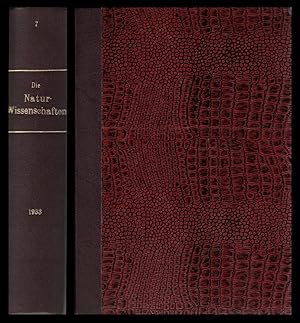
Ein neuer Effekt bei Eintritt der Supraleitfähigkeit in Die Naturwissenschaften, Vol. 21, pp. 787-788, 1933
Published by Julius Springer, Berlin, 1933
First Edition
1st Edition. FIRST EDITION, FULL VOLUME, OF MEISSNER & OCHSENFELD'S CONSEQUENTIAL 1933 DISCOVERY OF THE MEISSNER EFFECT: "SUPERCONDUCTORS EXPEL MAGNETIC FIELDS" (Brandt, Harvest of the Century, 362). "Superconductivity [is] one of the most spectacular phenomena of physics, [arising] when a superconducting material is cooled to a low critical temperature. Suddenly, an electric current can flow with no resistance whatsoever" (Nobel Prize Press Release]. Simultaneously, the Meissner effect occurs. Meissner and Ochsenfeld's â??unexpected' discovery that superconductors exclude magnetic fields from their interior "had important experimental and theoretical consequences" (Brandt). While superconductivity was first observed by Onnes in 1911, M & O's observation took the first step toward explaining it; their work led as well to the pioneering theories of Fritz and Heinz London who were able to provide a theoretical description of the electrodynamics of superconductivity not only consistent with the Meissner effect but that could also be used with Maxwell's electrodynamical equations to predict how magnetic field and surface current varies with distance from the surface of a superconductor. The Meissner effect is a phenomenon in which a superconductor negates all magnetic fields inside of the superconducting material. It does this by creating small currents along the surface of the superconductor that then cancel out all magnetic fields that would come in contact with the material. When "superconducting materials within a magnetic field become cold enough to become superconductors, the superconducting materials expel the magnetic field and are no longer magnetic. The phenomenon of a magnet levitating above a superconductor is a spectacular demonstration of the Meissner effect (Stiles, UAnews, Dec. 17, 2008). While studying the resistance of metals at low temperatures, the Dutch physicist Onnes was the first to observe the phenomenon of superconductivity, the absence of electrical resistance. "Onnes and his team discovered that the electrical resistance of mercury goes to zero below 4.2" -- meaning, electrical resistance disappears in certain materials at very low temperatures. "Of all the discoveries in condensed matter physics during the 20th century, some might call superconductivity the "â??crown jewel'" (CERN; PW 24, April 2011, 18). M & O's work went further, showing that "when materials were cooled below their critical temperatures and became superconductors, they excluded magnetic [and ]became diamagnetic. They found that this happened both when the substances were cooled to below their critical temperatures in the presence of a magnetic field, and when the magnetic field was applied after they were cooled" (Eisberg, Quantum Physics, 525). The Meissner effect demonstrates that "magnetic fields cannot penetrate into the interiors of superconductors but instead remain confined in a thin surface layer" (History of Physics: The Wenner Collection). The phenomenon is the result of electric currents "circulating at the surface of the superconductor, [there generating] magnetic fields that are exactly equal and opposite to the applied field" (Watson, The Quantum Quark, 309). When operating within the effect, the "superconductor creates a mirror image of the magnetic field that repels the magnetic field. The cancellation of [that] field creates currents that persist indefinitely without resistance" (Wenner). CONDITION & DETAILS: Complete 4to. 904 pp. Very small institutional stamp on the title and front flyleaf; no other markings. Handsomely bound in faux alligator over brown cloth, spine is gilt lettered. Slight rubbing at edge tips, bright and clean throughout. Near fine.
