
Order Total (1 Item Items):
Shipping Destination:

Nicholas Shackleton (4 results)
Skip to main search results
Search filters
Product Type
- All Product Types
- Books (4)
- Magazines & Periodicals (No further results match this refinement)
- Comics (No further results match this refinement)
- Sheet Music (No further results match this refinement)
- Art, Prints & Posters (No further results match this refinement)
- Photographs (No further results match this refinement)
- Maps (No further results match this refinement)
- Manuscripts & Paper Collectibles (No further results match this refinement)
Condition Learn more
- New (No further results match this refinement)
- As New, Fine or Near Fine (No further results match this refinement)
- Very Good or Good (1)
- Fair or Poor (No further results match this refinement)
- As Described (3)
Binding
Collectible Attributes
- First Edition (2)
- Signed (1)
- Dust Jacket (No further results match this refinement)
- Seller-Supplied Images (4)
- Not Print on Demand (4)
Language (2)
Free Shipping
Seller Location
Seller Rating
-
OXYGEN ISOTOPE ANALYSIS AND SEASONALITY DETERMINATIONS: LIMITS AND POTENTIAL OF A NEW TECHNIQUE.
Language: English
Published by Society for American Archaeology, Washington, D.C.
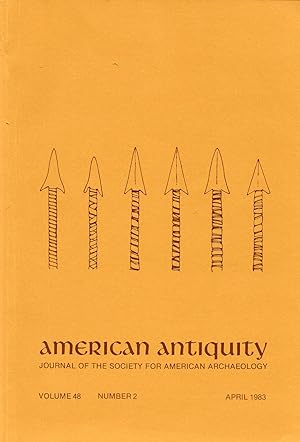
Soft cover. Condition: Very Good. pp390-398, illustrated. Removed from AMERICAN ANTIQUITY. JOURNAL OF THE SOCIETY FOR AMERICAN ARCHAEOLOGY, Volume 48, Number 2, April, 1983. VG. In report covers. May include a first or last copied page. Synopsis: "This paper presents a critical assessment of Killingley's approach (1981) to the determination of month of collection of marine molluscs by prehistoric people. The basis of the method is careful oxygen isotope measurements made in successive growth increments in the shells. The authors have analyzed specimens of Monodonta and Patella collected live on the coast of northern Spain, in conjunction with seasonality studies on molluscs from prehistoric sites in the neighborhood. These studies confirm the necessity of making careful analyses of each species under consideration. Given the significance both of interspecies differences and of climatic variability on timescales from a year upwards (particularly important in Killingley's area), they conclude that his apparent accuracy of (plus or minus) a month is illusory." Also includes: SEASONALITY DETERMINATION BY OXYGEN ISOTOPIC PROFILE: A REPLY TO BAILEY ET AL, by John S. Killingley, pp399-403, tables. This is the author's response to Bailey et al. Synopsis: "Profiles were measured on two species of intertidal mollusks (Tegula funebralis and Collisella limatula) to provide further evidence for the applicability of the technique to seasonality studies.".
-
Hard cover. Condition: Good in good dust jacket. 320 p. Audience: General/trade.
-
Large Scale Density Inhomogeneities in the Universe in Nature 215 No. 5102 p. 719, August 12, 1967 (Wilkinson) [1st MEASUREMENT OF CMB ANISOTROPY] WITH Oxygen isotope analysis and Pleistocene temperature re-assessed (Shackleton) pp. 15-17 [OXYGEN ISOTOPE RATIOS]
Published by Macmillan & Sons, London, 1967
First Edition
1st Edition. BOUND FIRST EDITION, full volume, of the first tentative measurement of a CMB anisotropy, a slightly elevated temperature in the direction of a known quasar cluster. Wilkinson & Partridge's paper presents results "which appear to set rather stringent limits on the magnitude of possible density inhomogeneities in the universe" (Wilkinson and Partridge, 1967, 719). ALSO included is Nicholas Shackleton's reassessment of Emiliani's conclusions from his 1966 analysis of the oxygen isotope ratios in Caribbean cores as an indicator of variations in total volume of glacier ice sheets. WILKINSON: "The CMB radiation is a direct relic of the early universe. It is a unique and deep probe of both the thermal history of the early universe and the primordial perturbations in the matter distribution" (Tuluie, "Cosmic Microwave Background" AJ, 1996, 15). Following "the discovery of the CMB, early work focused on putting constraints on the isotropy of the radiation field: that would be an important part of establishing its cosmological origin and would put constraints on the peculiar motion of the galaxy relative to the Local Group and the Virgo Supercluster" (ibid). Small "anistropies" (inhomogeneities in directional measurements) of temperature and polarization of the Cosmic Microwave Background radiation (CMB) allow scientists to test cosmological and astronomical theories, including cosmic inflation, the geometry of the visible universe, and the distribution of galaxy clusters. Wilkinson and Partridge's paper, again, presents the first attempt to put experimental limits on the level of anistropy. SHACKLETON: Shackleton "concludes that glacial/interglacial variations in foraminiferal oxygen isotope records were primarily influenced by changes in the oxygen isotopic composition of seawater, rather than temperature" (Ravelo, The Use of Oxygen and Carbon Isotopes, 735). CONDITION & DETAILS: London: Macmillian & Sons. Ex-libris with very minimal interior markings and ghosting from the removal of a spine label. Complete volume bound in bright red cloth with red buckram at the spine. Tightly bound and very clean. The interior is bright and exceptionally clean throughout.
-
Variations in the Earth's Orbit: Pacemaker of the Ice Ages. Pre-publication typescript headed 'Manuscript accepted for publication in Science (as submitted Oct. 12, 1976)'
Published by American Association for the Advancement of Science, [Washington, D.C., 1976
Seller: SOPHIA RARE BOOKS, Koebenhavn V, Denmark
Seller rating 5 out of 5 stars

First Edition Signed
First edition. A LANDMARK PAPER IN CLIMATE SCIENCE . Extremely rare pre-publication typescript of one of the most important papers in climate science, the definitive proof of Milankovi?'s theory of ice ages, that they result from variations in the precession, eccentricity, and obliquity of the Earth's orbit around the Sun. This copy is heavily annotated on the title page by the celebrated American palaeontologist, evolutionary biologist, and science writer Steven Jay Gould. Milankovi? calculated the effects of the variation in the Earth's orbit on the incoming solar radiation in the Northern Hemisphere. He concluded that Earth's orbit changes in three cycles of different lengths and theorized that there were variations of more than twenty percent in the amount of sunshine reaching the northern latitudes. In his 1941 account, Canon of Insolation and the Ice Age Problem, he suggested that this caused the waxing and waning of the great continental ice sheets. Using ocean sediment cores, Shackleton, Hays and Imbrie demonstrated in the present paper that oscillations in climate over the past few million years could be correlated with variations in the orbital and positional relationship between the Earth and the Sun, as predicted by Milankovi? "Shackleton's work contributed to the first global compilation of climate data, CLIMAP1, in 1976 He [of Cambridge University], John Imbrie of Brown University and Jim Hays of the Lamont Doherty Geophysics Observatory, showed that there was a strong signal in the ocean oxygen isotope record from the volume changes associated with ice ages. There were cyclic changes in the signals that took place over familiar periods of 23000 and 41000 years, timescales familiar from theoretical work in the 1930s by the Serbian climatologist Milutin Milankovitch. These and the 100,000-year cycle were identified with ice ages by Milankovitch, on the basis of on solar insolation theory, changes in the radiation reaching Earth from the Sun as a result of regular changes in the precession, obliquity and eccentricity of the Earth's orbit. Shackleton, Imbrie and Hays's confirmation of the Milankovitch cycles in the ice age record was a key finding: changes in our climate are induced by processes outside the Earth itself. It implied that these orbital cycles could be found in a range of palaeoclimate data. How and why the Earth's orbital changes affect the climate remained and remain difficult questions, but the very existence of such cycles in the recent rock record sparked new interest. When researchers looked for these periodicities, in tree ring records or annual sediment layers in glacial lakes, they found them. Palaeoclimatology was born" ('Ice Ages,' Geoscientist 17, 1 January 2007). This article was subsequently published inScience, Vol. 194, No. 4270, 10 December 1976, pp. 1121-1132. No other copy of this pre-publication document located. Provenance: Stephen Jay Gould (1941-2002), American palaeontologist, evolutionary biologist, and science writer. Not signed by him but bearing his filing mark (which matches his usage elsewhere) in addition to his extensive annotations to the first page, under the strident heading 'My approach', and with four numbered sections, concluding 'Funny / what looks good in direction, / a major problem / in magnitude / (my point).' Gould's interest stems from his attempt to develop a comprehensive theory of evolution over shorter 'ecological' time periods, 'normal geological time', and in periods of mass extinction (this is Gould's 'three tier' system; see his classic 'The paradox of the first tier', 1985). Although he had previously acknowledged the role of Milankovi? Cycles in climate change, the evidence of his later work and also his annotations here is that he was unconvinced that the right level of precision had been reached, especially in measuring absolute temperatures. Gould apparently never published his response, so the annotations here are a unique record of his thinking. Earth's history has been characterized by periods, called Ice Ages (with capital letters), when the climate was markedly colder than at other times. The most well known are the Pre-Cambrian, the late-Ordovician, the Permo-Carboniferous and the Pleistocene Ice Ages the last of these, which began around 2-3 million years ago, is the one we are currently living through. Ice Ages are characterized by multiple switches of the global climate between cold periods (called 'glacials' and sometimes ice ages in lower case) when extensive ice sheets are present, and warm periods ('interglacials') when there is less ice over the Earth or when the climate is more or less similar to or warmer than today. In the second half of the 19th century several scientists, notably Joseph Alphonse Adhémar (1797-1862) and James Croll (1821-90), suggested that the origin and recurrence of these glaciations may be linked to changes in the Earth's orbit. The most important features of the orbit as far as the effect on climate are concerned are its eccentricity (the degree to which the elliptical orbit differs from a circle); the tilt (or obliquity) of the Earth's axis of rotation with respect to the plane of its orbit; the precession of the Earth's axis of rotation (like the wobble of a spinning top); and the precession of the orbit (a slow rotation of the orbit itself around the Sun). Each of these quantities varies periodically, typically with periods of tens of thousands of years, due to the gravitational effects of other planets and the fact that the Earth is not a perfect sphere. And each can affect the amount and distribution of the solar radiation reaching the Earth's surface. "By 1890, because of uncertainties in the timing of ice ages and deficiencies in the stratigraphic record, the astronomical theory was largely disregarded for at least three decades. Geologists and climatologists were trying to find the cause of the ice ages in Earth's autonomous system (atmosphereoceanice) as well.


![Seller image for Large Scale Density Inhomogeneities in the Universe in Nature 215 No. 5102 p. 719, August 12, 1967 (Wilkinson) [1st MEASUREMENT OF CMB ANISOTROPY] WITH Oxygen isotope analysis and Pleistocene temperature re-assessed (Shackleton) pp. 15-17 [OXYGEN ISOTOPE RATIOS] for sale by Atticus Rare Books](https://pictures.abebooks.com/inventory/md/md30446197706.jpg)
