

Order Total (1 Item Items):
Shipping Destination:

Monger S (11 results)
Author:
monger s
Refine with Advanced Search
Skip to main search results
Search filters
Product Type
- All Product Types
- Books (11)
- Magazines & Periodicals (No further results match this refinement)
- Comics (No further results match this refinement)
- Sheet Music (No further results match this refinement)
- Art, Prints & Posters (No further results match this refinement)
- Photographs (No further results match this refinement)
- Maps (No further results match this refinement)
- Manuscripts & Paper Collectibles (No further results match this refinement)
Condition Learn more
- New (5)
- As New, Fine or Near Fine (1)
- Very Good or Good (5)
- Fair or Poor (No further results match this refinement)
- As Described (No further results match this refinement)
Binding
- All Bindings
- Hardcover (No further results match this refinement)
- Softcover (10)
Collectible Attributes
- First Edition (No further results match this refinement)
- Signed (No further results match this refinement)
- Dust Jacket (No further results match this refinement)
- Seller-Supplied Images (7)
- Not Print on Demand (11)
Language (2)
Free Shipping
Seller Location
Seller Rating
-

Using Cutters on Cakes
Language: English
Published by Search Press, Limited, 2014
ISBN 10: 1782210334 ISBN 13: 9781782210337
Condition: Good. Former library copy. Pages intact with minimal writing/highlighting. The binding may be loose and creased. Dust jackets/supplements are not included. Includes library markings. Stock photo provided. Product includes identifying sticker. Better World Books: Buy Books. Do Good.
-
Using Cutters on Cakes
Language: English
Published by Search Press, Limited, 2014
ISBN 10: 1782210334 ISBN 13: 9781782210337
Seller: Better World Books Ltd, Dunfermline, United Kingdom
Seller rating 5 out of 5 stars

Condition: Good. Former library copy. Pages intact with minimal writing/highlighting. The binding may be loose and creased. Dust jackets/supplements are not included. Includes library markings. Stock photo provided. Product includes identifying sticker. Better World Books: Buy Books. Do Good.
-
Using Cutters on Cakes
Language: English
Published by Search Press, Limited, 2014
ISBN 10: 1782210334 ISBN 13: 9781782210337
Seller: Better World Books Ltd, Dunfermline, United Kingdom
Seller rating 5 out of 5 stars
Condition: Very Good. Former library copy. Pages intact with possible writing/highlighting. Binding strong with minor wear. Dust jackets/supplements may not be included. Includes library markings. Stock photo provided. Product includes identifying sticker. Better World Books: Buy Books. Do Good.
-

Contributions to Canadian Paleontology (Five Papers)
Language: English
Published by Geological Survey of Canada, Ottawa, ON, Canada, 1978
Seller: Post Horizon Booksellers, Nokomis, SK, Canada
Association Member: ABAC ILAB IOBA
Seller rating 5 out of 5 stars
Soft cover. Condition: Very Good. Geological Survey Bulletin 267. 75pp. Green card wrapper clean and without wear. Stapled binding sound. Papers: New species of brachiopods and trilobites from the Middle Ordovician (Whiterock) of southeastern British Columbia (Norford, Ross); Some Late Middle Devonian (Polygnathus varcus Zone) conodonts from central Mackenzie Valley, District of Mackenzie (Uyeno); Middle Carboniferous and Early Permian fusulinaceans from the Monkman Pass area, northeastern British Columbia ( Ross, Bamber); Carboniferous and Permian fusulinaceans from the Ominica Mountains, British Columbia (Ross, Monger); Permian fusulinaceans from the St. Elias Mountains, Yukon Territory (Ross).
-

Urban Documents
Language: English
Published by The Architecture Centre, 2006
ISBN 10: 0955360900 ISBN 13: 9780955360909
Soft cover. Condition: Fine. 2006, 24 page stapled booklet in card cover | this copy is very lightly read or unread - clean and neat, and free of name, notes etc | dispatched within two working days by Royal Mail - with tracking for international orders.
-

Centennial Continent / Ocean Transect # 7: B-2 Juan De Fuca Plate to Alberta Plains
Published by The Geological Soceity of America, 1985
Condition: very good. from the introduction, "This pamphlet supplements the display sheets of Transect B2. It provides (1) descriptions of terranes on the line of Transect B2, (2) comments on gravity, magnetic and heat flow data and seismicity by R. P. Riddihough, (3) description of the seismic cross-section by R. M. Clowes, (4) bases for the compilation of Cross-section II and (5) references." DT3. pictorial envelope, dup written in marker on cover, text 20 pages stapled, Two large folded maps, scale 1:500,000.
-

Metallogenesis and Tectonics of the Russian Far East, Alaska, and the Canadian Cordillera Professional Paper 1697
Published by USGS, 2005
ISBN 10: 0607984074 ISBN 13: 9780607984071
Condition: new. "The Proterozoic and Phanerozoic metallogenic and tectonic evolution of the Russian Far East, Alaska, and the Canadian Cordillera is recorded in the cratons, craton margins, and orogenic collages of the Circum-North Pacific mountain belts that separate the North Pacific from the eastern North Asian and western North American Cratons. The collages consist of tectonostratigraphic terranes and contained metallogenic belts, which are composed of fragments of igneous arcs, accretionary-wedge and subduction-zone complexes, passive continental margins, and cratons. The terranes are overlapped by continental-margin-arc and sedimentary-basin assemblages and contained metallogenic belts. The metallogenic and geologic history of terranes, overlap assemblages, cratons, and craton margins has been complicated by postaccretion dismemberment and translation during strike-slip faulting that occurred subparallel to continental margins. Seven processes overlapping in time were responsible for most of metallogenic and geologic complexities of the region (1) In the Early and Middle Proterozoic, marine sedimentary basins developed on major cratons and were the loci for ironstone (Superior Fe) deposits and sediment-hosted Cu deposits that occur along both the North Asia Craton and North American Craton Margin. (2) In the Late Proterozoic, Late Devonian, and Early Carboniferous, major periods of rifting occurred along the ancestral margins of present-day Northeast Asia and northwestern North America. The rifting resulted in fragmentation of each continent, and formation of cratonal and passive continental-margin terranes that eventually migrated and accreted to other sites along the evolving margins of the original or adjacent continents. The rifting also resulted in formation of various massive-sulfide metallogenic belts. (3) From about the late Paleozoic through the mid-Cretaceous, a succession of island arcs and contained igneous-arc-related metallogenic belts and tectonically paired subduction zones formed near continental margins. (4) From about mainly the mid-Cretaceous through the present, a succession of continental-margin igneous arcs (some extending offshore into island arcs) and contained metallogenic belts, and tectonically paired subduction zones formed along the continental margins. (5) From about the Jurassic to the present, oblique convergence and rotations caused orogen-parallel sinistral, and then dextral displacements within the plate margins of the Northeast Asian and North American Cratons. The oblique convergences and rotations resulted in the fragmentation, displacement, and duplication of formerly more continuous arcs, subduction zones, passive continental margins, and contained metallogenic belts. These fragments were subsequently accreted along the margins of the expanding continental margins. (6) From the Early Jurassic through Tertiary, movement of the upper continental plates toward subduction zones resulted in strong plate coupling and accretion of the former island arcs, subduction zones, and contained metallogenic belts to continental margins. In this region, the multiple arc accretions were accompanied and followed by crustal thickening, anatexis, metamorphism, formation of collision-related metallogenic belts, and uplift; this resulted in the substantial growth of the North Asian and North American continents. (7) In the middle and late Cenozoic, oblique to orthogonal convergence of the Pacific Plate with present-day Alaska and Northeast Asia resulted in formation of the present ring of volcanoes and contained metallogenic belts around the Circum-North Pacific. Oblique convergence between the Pacific Plate and Alaska also resulted in major dextral-slip faulting in interior and southern Alaska and along the western part of the Aleutian- Wrangell arc. Associated with dextral-slip faulting was crustal extrusion of terranes from western Alaska into the Bering Sea. " DV2. softcover, wrapped in shrink wrap, tight, crisp, 429 pages.
-

Metallogenesis and Tectonics of the Russian Far East, Alaska, and the Canadian Cordillera Professional Paper 1697
Published by USGS, 2005
ISBN 10: 0607984074 ISBN 13: 9780607984071
Condition: new. "The Proterozoic and Phanerozoic metallogenic and tectonic evolution of the Russian Far East, Alaska, and the Canadian Cordillera is recorded in the cratons, craton margins, and orogenic collages of the Circum-North Pacific mountain belts that separate the North Pacific from the eastern North Asian and western North American Cratons. The collages consist of tectonostratigraphic terranes and contained metallogenic belts, which are composed of fragments of igneous arcs, accretionary-wedge and subduction-zone complexes, passive continental margins, and cratons. The terranes are overlapped by continental-margin-arc and sedimentary-basin assemblages and contained metallogenic belts. The metallogenic and geologic history of terranes, overlap assemblages, cratons, and craton margins has been complicated by postaccretion dismemberment and translation during strike-slip faulting that occurred subparallel to continental margins. Seven processes overlapping in time were responsible for most of metallogenic and geologic complexities of the region (1) In the Early and Middle Proterozoic, marine sedimentary basins developed on major cratons and were the loci for ironstone (Superior Fe) deposits and sediment-hosted Cu deposits that occur along both the North Asia Craton and North American Craton Margin. (2) In the Late Proterozoic, Late Devonian, and Early Carboniferous, major periods of rifting occurred along the ancestral margins of present-day Northeast Asia and northwestern North America. The rifting resulted in fragmentation of each continent, and formation of cratonal and passive continental-margin terranes that eventually migrated and accreted to other sites along the evolving margins of the original or adjacent continents. The rifting also resulted in formation of various massive-sulfide metallogenic belts. (3) From about the late Paleozoic through the mid-Cretaceous, a succession of island arcs and contained igneous-arc-related metallogenic belts and tectonically paired subduction zones formed near continental margins. (4) From about mainly the mid-Cretaceous through the present, a succession of continental-margin igneous arcs (some extending offshore into island arcs) and contained metallogenic belts, and tectonically paired subduction zones formed along the continental margins. (5) From about the Jurassic to the present, oblique convergence and rotations caused orogen-parallel sinistral, and then dextral displacements within the plate margins of the Northeast Asian and North American Cratons. The oblique convergences and rotations resulted in the fragmentation, displacement, and duplication of formerly more continuous arcs, subduction zones, passive continental margins, and contained metallogenic belts. These fragments were subsequently accreted along the margins of the expanding continental margins. (6) From the Early Jurassic through Tertiary, movement of the upper continental plates toward subduction zones resulted in strong plate coupling and accretion of the former island arcs, subduction zones, and contained metallogenic belts to continental margins. In this region, the multiple arc accretions were accompanied and followed by crustal thickening, anatexis, metamorphism, formation of collision-related metallogenic belts, and uplift; this resulted in the substantial growth of the North Asian and North American continents. (7) In the middle and late Cenozoic, oblique to orthogonal convergence of the Pacific Plate with present-day Alaska and Northeast Asia resulted in formation of the present ring of volcanoes and contained metallogenic belts around the Circum-North Pacific. Oblique convergence between the Pacific Plate and Alaska also resulted in major dextral-slip faulting in interior and southern Alaska and along the western part of the Aleutian- Wrangell arc. Associated with dextral-slip faulting was crustal extrusion of terranes from western Alaska into the Bering Sea. " DV1. softcover, wrapped in shrink wrap, tight, crisp, 429 pages.
-

Metallogenesis and Tectonics of the Russian Far East, Alaska, and the Canadian Cordillera Professional Paper 1697
Published by USGS, 2005
ISBN 10: 0607984074 ISBN 13: 9780607984071
Condition: new. "The Proterozoic and Phanerozoic metallogenic and tectonic evolution of the Russian Far East, Alaska, and the Canadian Cordillera is recorded in the cratons, craton margins, and orogenic collages of the Circum-North Pacific mountain belts that separate the North Pacific from the eastern North Asian and western North American Cratons. The collages consist of tectonostratigraphic terranes and contained metallogenic belts, which are composed of fragments of igneous arcs, accretionary-wedge and subduction-zone complexes, passive continental margins, and cratons. The terranes are overlapped by continental-margin-arc and sedimentary-basin assemblages and contained metallogenic belts. The metallogenic and geologic history of terranes, overlap assemblages, cratons, and craton margins has been complicated by postaccretion dismemberment and translation during strike-slip faulting that occurred subparallel to continental margins. Seven processes overlapping in time were responsible for most of metallogenic and geologic complexities of the region (1) In the Early and Middle Proterozoic, marine sedimentary basins developed on major cratons and were the loci for ironstone (Superior Fe) deposits and sediment-hosted Cu deposits that occur along both the North Asia Craton and North American Craton Margin. (2) In the Late Proterozoic, Late Devonian, and Early Carboniferous, major periods of rifting occurred along the ancestral margins of present-day Northeast Asia and northwestern North America. The rifting resulted in fragmentation of each continent, and formation of cratonal and passive continental-margin terranes that eventually migrated and accreted to other sites along the evolving margins of the original or adjacent continents. The rifting also resulted in formation of various massive-sulfide metallogenic belts. (3) From about the late Paleozoic through the mid-Cretaceous, a succession of island arcs and contained igneous-arc-related metallogenic belts and tectonically paired subduction zones formed near continental margins. (4) From about mainly the mid-Cretaceous through the present, a succession of continental-margin igneous arcs (some extending offshore into island arcs) and contained metallogenic belts, and tectonically paired subduction zones formed along the continental margins. (5) From about the Jurassic to the present, oblique convergence and rotations caused orogen-parallel sinistral, and then dextral displacements within the plate margins of the Northeast Asian and North American Cratons. The oblique convergences and rotations resulted in the fragmentation, displacement, and duplication of formerly more continuous arcs, subduction zones, passive continental margins, and contained metallogenic belts. These fragments were subsequently accreted along the margins of the expanding continental margins. (6) From the Early Jurassic through Tertiary, movement of the upper continental plates toward subduction zones resulted in strong plate coupling and accretion of the former island arcs, subduction zones, and contained metallogenic belts to continental margins. In this region, the multiple arc accretions were accompanied and followed by crustal thickening, anatexis, metamorphism, formation of collision-related metallogenic belts, and uplift; this resulted in the substantial growth of the North Asian and North American continents. (7) In the middle and late Cenozoic, oblique to orthogonal convergence of the Pacific Plate with present-day Alaska and Northeast Asia resulted in formation of the present ring of volcanoes and contained metallogenic belts around the Circum-North Pacific. Oblique convergence between the Pacific Plate and Alaska also resulted in major dextral-slip faulting in interior and southern Alaska and along the western part of the Aleutian- Wrangell arc. Associated with dextral-slip faulting was crustal extrusion of terranes from western Alaska into the Bering Sea." DV4. softcover, wrapped in shrink wrap, tight, crisp, 429 pages.
-

Metallogenesis and Tectonics of the Russian Far East, Alaska, and the Canadian Cordillera Professional Paper 1697
Published by USGS, 2005
ISBN 10: 0607984074 ISBN 13: 9780607984071
Condition: new. The Proterozoic and Phanerozoic metallogenic and tectonic evolution of the Russian Far East, Alaska, and the Canadian Cordillera is recorded in the cratons, craton margins, and orogenic collages of the Circum-North Pacific mountain belts that separate the North Pacific from the eastern North Asian and western North American Cratons. The collages consist of tectonostratigraphic terranes and contained metallogenic belts, which are composed of fragments of igneous arcs, accretionary-wedge and subduction-zone complexes, passive continental margins, and cratons. The terranes are overlapped by continental-margin-arc and sedimentary-basin assemblages and contained metallogenic belts. The metallogenic and geologic history of terranes, overlap assemblages, cratons, and craton margins has been complicated by postaccretion dismemberment and translation during strike-slip faulting that occurred subparallel to continental margins. Seven processes overlapping in time were responsible for most of metallogenic and geologic complexities of the region (1) In the Early and Middle Proterozoic, marine sedimentary basins developed on major cratons and were the loci for ironstone (Superior Fe) deposits and sediment-hosted Cu deposits that occur along both the North Asia Craton and North American Craton Margin. (2) In the Late Proterozoic, Late Devonian, and Early Carboniferous, major periods of rifting occurred along the ancestral margins of present-day Northeast Asia and northwestern North America. The rifting resulted in fragmentation of each continent, and formation of cratonal and passive continental-margin terranes that eventually migrated and accreted to other sites along the evolving margins of the original or adjacent continents. The rifting also resulted in formation of various massive-sulfide metallogenic belts. (3) From about the late Paleozoic through the mid-Cretaceous, a succession of island arcs and contained igneous-arc-related metallogenic belts and tectonically paired subduction zones formed near continental margins. (4) From about mainly the mid-Cretaceous through the present, a succession of continental-margin igneous arcs (some extending offshore into island arcs) and contained metallogenic belts, and tectonically paired subduction zones formed along the continental margins. (5) From about the Jurassic to the present, oblique convergence and rotations caused orogen-parallel sinistral, and then dextral displacements within the plate margins of the Northeast Asian and North American Cratons. The oblique convergences and rotations resulted in the fragmentation, displacement, and duplication of formerly more continuous arcs, subduction zones, passive continental margins, and contained metallogenic belts. These fragments were subsequently accreted along the margins of the expanding continental margins. (6) From the Early Jurassic through Tertiary, movement of the upper continental plates toward subduction zones resulted in strong plate coupling and accretion of the former island arcs, subduction zones, and contained metallogenic belts to continental margins. In this region, the multiple arc accretions were accompanied and followed by crustal thickening, anatexis, metamorphism, formation of collision-related metallogenic belts, and uplift; this resulted in the substantial growth of the North Asian and North American continents. (7) In the middle and late Cenozoic, oblique to orthogonal convergence of the Pacific Plate with present-day Alaska and Northeast Asia resulted in formation of the present ring of volcanoes and contained metallogenic belts around the Circum-North Pacific. Oblique convergence between the Pacific Plate and Alaska also resulted in major dextral-slip faulting in interior and southern Alaska and along the western part of the Aleutian- Wrangell arc. Associated with dextral-slip faulting was crustal extrusion of terranes from western Alaska into the Bering Sea. DX1. softcover, wrapped in shrink wrap, tight, crisp, 429 pages.
-
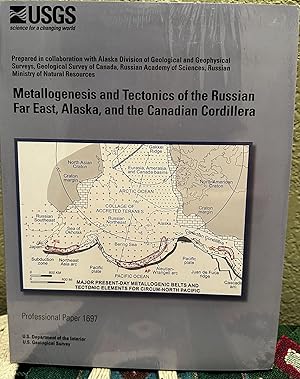
Metallogenesis and Tectonics of the Russian Far East, Alaska, and the Canadian Cordillera Professional Paper 1697
Published by USGS, 2005
ISBN 10: 0607984074 ISBN 13: 9780607984071
Condition: new. The Proterozoic and Phanerozoic metallogenic and tectonic evolution of the Russian Far East, Alaska, and the Canadian Cordillera is recorded in the cratons, craton margins, and orogenic collages of the Circum-North Pacific mountain belts that separate the North Pacific from the eastern North Asian and western North American Cratons. The collages consist of tectonostratigraphic terranes and contained metallogenic belts, which are composed of fragments of igneous arcs, accretionary-wedge and subduction-zone complexes, passive continental margins, and cratons. The terranes are overlapped by continental-margin-arc and sedimentary-basin assemblages and contained metallogenic belts. The metallogenic and geologic history of terranes, overlap assemblages, cratons, and craton margins has been complicated by postaccretion dismemberment and translation during strike-slip faulting that occurred subparallel to continental margins. Seven processes overlapping in time were responsible for most of metallogenic and geologic complexities of the region (1) In the Early and Middle Proterozoic, marine sedimentary basins developed on major cratons and were the loci for ironstone (Superior Fe) deposits and sediment-hosted Cu deposits that occur along both the North Asia Craton and North American Craton Margin. (2) In the Late Proterozoic, Late Devonian, and Early Carboniferous, major periods of rifting occurred along the ancestral margins of present-day Northeast Asia and northwestern North America. The rifting resulted in fragmentation of each continent, and formation of cratonal and passive continental-margin terranes that eventually migrated and accreted to other sites along the evolving margins of the original or adjacent continents. The rifting also resulted in formation of various massive-sulfide metallogenic belts. (3) From about the late Paleozoic through the mid-Cretaceous, a succession of island arcs and contained igneous-arc-related metallogenic belts and tectonically paired subduction zones formed near continental margins. (4) From about mainly the mid-Cretaceous through the present, a succession of continental-margin igneous arcs (some extending offshore into island arcs) and contained metallogenic belts, and tectonically paired subduction zones formed along the continental margins. (5) From about the Jurassic to the present, oblique convergence and rotations caused orogen-parallel sinistral, and then dextral displacements within the plate margins of the Northeast Asian and North American Cratons. The oblique convergences and rotations resulted in the fragmentation, displacement, and duplication of formerly more continuous arcs, subduction zones, passive continental margins, and contained metallogenic belts. These fragments were subsequently accreted along the margins of the expanding continental margins. (6) From the Early Jurassic through Tertiary, movement of the upper continental plates toward subduction zones resulted in strong plate coupling and accretion of the former island arcs, subduction zones, and contained metallogenic belts to continental margins. In this region, the multiple arc accretions were accompanied and followed by crustal thickening, anatexis, metamorphism, formation of collision-related metallogenic belts, and uplift; this resulted in the substantial growth of the North Asian and North American continents. (7) In the middle and late Cenozoic, oblique to orthogonal convergence of the Pacific Plate with present-day Alaska and Northeast Asia resulted in formation of the present ring of volcanoes and contained metallogenic belts around the Circum-North Pacific. Oblique convergence between the Pacific Plate and Alaska also resulted in major dextral-slip faulting in interior and southern Alaska and along the western part of the Aleutian- Wrangell arc. Associated with dextral-slip faulting was crustal extrusion of terranes from western Alaska into the Bering Sea. softcover, wrapped in shrink wrap, tight, crisp, 429 pages.

