Order Total (1 Item Items):
Shipping Destination:

Miranda Mitrano (4 results)
Skip to main search results
Search filters
Product Type
- All Product Types
- Books (4)
- Magazines & Periodicals (No further results match this refinement)
- Comics (No further results match this refinement)
- Sheet Music (No further results match this refinement)
- Art, Prints & Posters (No further results match this refinement)
- Photographs (No further results match this refinement)
- Maps (No further results match this refinement)
- Manuscripts & Paper Collectibles (No further results match this refinement)
Condition Learn more
- New (No further results match this refinement)
- As New, Fine or Near Fine (No further results match this refinement)
- Very Good or Good (No further results match this refinement)
- Fair or Poor (No further results match this refinement)
- As Described (4)
Binding
Collectible Attributes
- First Edition (2)
- Signed (No further results match this refinement)
- Dust Jacket (No further results match this refinement)
- Seller-Supplied Images (4)
- Not Print on Demand (4)
Language (1)
Free Shipping
- Free Shipping to U.S.A. (No further results match this refinement)
Seller Location
Seller Rating
-
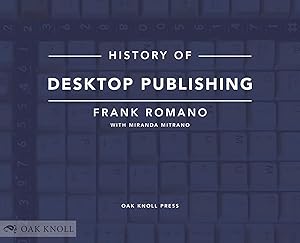
HISTORY OF DESKTOP PUBLISHING
Published by Oak Knoll Press, New Castle, Delaware, 2019
Seller: Oak Knoll Books, ABAA, ILAB, NEW CASTLE, DE, U.S.A.
Seller rating 5 out of 5 stars

softcover. 10.5 x 8.5 inches. softcover. 400 pages. Awarded Honourable Mention by the Jury of the 18th ILAB Breslauer Prize for Bibliography "Frank Romano's History of Desktop Publishing is an essential book for anyone studying the field and for many just generally interested in the history of printing and typesetting. You will find information in this book on and around desktop publishing that you are unlikely to find anywhere else -- certainly not all collected in one place." - David Walden, TUGboat Volume 41, No. 1 "There were so many players, so many companies. So much to know and to understand. But Frank Romano has the unique background, skills and resources to take this on. He has produced an amazingly comprehensive, rich, and detailed history. All presented in an easy, personal, accessible fashion that draws you in and keeps you turning the pages. It is truly a Tour de Force!" - Jonathan Seybold "There's just so much in this book. Its a bit like surfing the Internet in the early days -- you're never quite sure what you'll bump into. If you're anything like me, you won't read this book from front to back. Instead, you'll sample it, dip in, and enjoy. all while finding answers, obscurities, and some truly amazing personalities." - Jim Hamilton, What They Th!nk History of Desktop Publishing is a personal and encyclopedic story of how the personal computer, unique applications, and many colorful people changed the creative and print communities. Author Frank Romano has documented the histories of hot metal and phototypesetting and continues the tale of document production in this book. This installment ends as the Internet becomes a primary focus. It is hard to imagine someone more involved with the universe of desktop publishing from its beginnings than Romano, who takes us on a personal journey from the end of the typewriter era to the age of the Internet, examining the development of personal computers, pagemaking and graphic design programs, postscript, digital fonts, data storage, inkjet printing, GUIs, and the rise of the digital era. For those who grew up during--or built their careers on--these advances, this book provides entertaining perspective and insight on an important period of their lives. For younger readers, it is a fascinating narrative of modern ancient history: how we got from the typewriter to DTP. Fully illustrated, with a Foreword by Gene Gable and a detailed Chronology by Richard Romano. Frank Romano has spent over 60 years in the printing and publishing industries. He was publisher and editor of TypeWorld and Electronic Publishing magazine, and he is the author of many articles and books on printing, publishing, and graphic design, including books on QuarkXPress, Adobe InDesign, PDF workflow, and digital printing. He has lectured extensively and has taught at RIT (where he is Professor Emeritus) and other universities. He is the President of the Museum of Printing in Haverhill, MA.
-
HISTORY OF THE LUDLOW TYPOGRAPH
Published by Museum of Printing, Haverhill, MA, 2022
Seller: Oak Knoll Books, ABAA, ILAB, NEW CASTLE, DE, U.S.A.
Seller rating 5 out of 5 stars
First Edition
softcover. Ludlow Typograph (illustrator). square 8vo. softcover. xvi, 509 pages. First edition. Co-published with Pear Tree Publishing. This is the story of an iconic device for hot metal typesetting. Author Frank Romano has dug deep to discover more than has ever been published about the people, the company, and the machine that established typographic tastes. From the Museum of Printing: Frank Romano's latest book is now available! It is called History of the Ludlow Typograph and covers the remarkable tale of a device that is still in use by letterpress printers around the world today. Romano writes about the people, the company, the machine, and the type library that established typographic tastes. Born at the beginning of the 20th century, the active production lifespan of the Ludlow Typograph lasted just over 80 years, but its impact has continued. In the last decade of the 20th century as typography evolved from metal to film to digital, many of the fonts in use were based on hot metal libraries. One of the major trendsetters for typographers was the Ludlow Typograph. At 535 pages and with over 400 illustrations, this book digs deeper into the history of the Ludlow Typograph than any previous book.
-
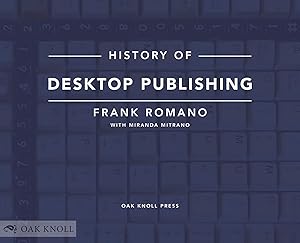
HISTORY OF DESKTOP PUBLISHING
Published by Oak Knoll Press, New Castle, Delaware, 2019
Seller: Oak Knoll Books, ABAA, ILAB, NEW CASTLE, DE, U.S.A.
Seller rating 5 out of 5 stars
printed paper-covered boards. 10.5 x 8.5 inches. printed paper-covered boards. 400 pages. Awarded Honourable Mention by the Jury of the 18th ILAB Breslauer Prize for Bibliography "Frank Romano's History of Desktop Publishing is an essential book for anyone studying the field and for many just generally interested in the history of printing and typesetting. You will find information in this book on and around desktop publishing that you are unlikely to find anywhere else -- certainly not all collected in one place." - David Walden, TUGboat Volume 41, No. 1 "There were so many players, so many companies. So much to know and to understand. But Frank Romano has the unique background, skills and resources to take this on. He has produced an amazingly comprehensive, rich, and detailed history. All presented in an easy, personal, accessible fashion that draws you in and keeps you turning the pages. It is truly a Tour de Force!" - Jonathan Seybold "There's just so much in this book. Its a bit like surfing the Internet in the early days -- you're never quite sure what you'll bump into. If you're anything like me, you won't read this book from front to back. Instead, you'll sample it, dip in, and enjoy. all while finding answers, obscurities, and some truly amazing personalities." - Jim Hamilton, What They Th!nk History of Desktop Publishing is a personal and encyclopedic story of how the personal computer, unique applications, and many colorful people changed the creative and print communities. Author Frank Romano has documented the histories of hot metal and phototypesetting and continues the tale of document production in this book. This installment ends as the Internet becomes a primary focus. It is hard to imagine someone more involved with the universe of desktop publishing from its beginnings than Romano, who takes us on a personal journey from the end of the typewriter era to the age of the Internet, examining the development of personal computers, pagemaking and graphic design programs, postscript, digital fonts, data storage, inkjet printing, GUIs, and the rise of the digital era. For those who grew up during--or built their careers on--these advances, this book provides entertaining perspective and insight on an important period of their lives. For younger readers, it is a fascinating narrative of modern ancient history: how we got from the typewriter to DTP. Fully illustrated, with a Foreword by Gene Gable and a detailed Chronology by Richard Romano. Frank Romano has spent over 60 years in the printing and publishing industries. He was publisher and editor of TypeWorld and Electronic Publishing magazine, and he is the author of many articles and books on printing, publishing, and graphic design, including books on QuarkXPress, Adobe InDesign, PDF workflow, and digital printing. He has lectured extensively and has taught at RIT (where he is Professor Emeritus) and other universities. He is the President of the Museum of Printing in Haverhill, MA.
-
HISTORY OF THE LUDLOW TYPOGRAPH
Published by Museum of Printing, Haverhill, MA, 2022
Seller: Oak Knoll Books, ABAA, ILAB, NEW CASTLE, DE, U.S.A.
Seller rating 5 out of 5 stars
First Edition
pictorial paper covered boards. Ludlow Typograph (illustrator). square 8vo. pictorial paper covered boards. xvi, 509 pages. First edition. Co-published with Pear Tree Publishing. This is the story of an iconic device for hot metal typesetting. Author Frank Romano has dug deep to discover more than has ever been published about the people, the company, and the machine that established typographic tastes. From the Museum of Printing: Frank Romano's latest book is now available! It is called History of the Ludlow Typograph and covers the remarkable tale of a device that is still in use by letterpress printers around the world today. Romano writes about the people, the company, the machine, and the type library that established typographic tastes. Born at the beginning of the 20th century, the active production lifespan of the Ludlow Typograph lasted just over 80 years, but its impact has continued. In the last decade of the 20th century as typography evolved from metal to film to digital, many of the fonts in use were based on hot metal libraries. One of the major trendsetters for typographers was the Ludlow Typograph. At 535 pages and with over 400 illustrations, this book digs deeper into the history of the Ludlow Typograph than any previous book.