Order Total (1 Item Items):
Shipping Destination:

Marie Andre Jacob (8 results)
Skip to main search results
Search filters
Product Type
- All Product Types
- Books (8)
- Magazines & Periodicals (No further results match this refinement)
- Comics (No further results match this refinement)
- Sheet Music (No further results match this refinement)
- Art, Prints & Posters (No further results match this refinement)
- Photographs (No further results match this refinement)
- Maps (No further results match this refinement)
- Manuscripts & Paper Collectibles (No further results match this refinement)
Condition Learn more
- New (1)
- As New, Fine or Near Fine (2)
- Very Good or Good (No further results match this refinement)
- Fair or Poor (No further results match this refinement)
- As Described (5)
Binding
Collectible Attributes
Language (2)
Free Shipping
Seller Location
Seller Rating
-

Immortality and Resurrection:
Published by Herder and Herder, New York, New York, 1970
Seller: Andover Books and Antiquities, Andover, MA, U.S.A.
Seller rating 4 out of 5 stars

Hardcover. 160 pp. Concilium: Religion in the Seventies. Volume 060: Scripture. LCC: 71129759 Good condition; light foxing on top and side endpapers; a few spots of browning and one edge spot worn to board.
-
Le papier.
Published by Traverses, 27/28, mai 1983. Un fascicule in-8° carré, broché., 1983
BE. [19083].
-
Ecrimage , Deuxième ouvrage collectif du Groupe Corot , En frontispice une xylographie inédite de Valentin Le Campion Enrichi d'une estampe originale numérotée de Janine Jacob
Language: French
Published by Librairie José Corti, Ville d'Avray, 1993
First Edition Signed
Couverture souple. Condition: Comme neuf. Dust Jacket Condition: Comme neuf. Valentin le Campion , Dominique Aliadière , Fabienne Bara , Andrée Beauvais , Françoise Bizette , Claude Bureau , Dany Dang , Sylvie Heyart , Janine Jacob , Hélène Laffly , Anne Marie Leclaire , René Marchal , Claude Raimbourg , Jacqueline Rowe , André Wa (illustrator). Edition Originale. S.l., Groupe Corot - Les Nouvelles, 1993; in-4, 68 pp., broché, couverture muette, jaquette imprimée, état proche du neuf. Édition originale, un des 169 exemplaires numérotés enrichis d'une estampe originale, ici une gravure sur cuivre signée de Janine Jacob tirée à 14 exemplaires numérotés. Textes de Marcel Proust, Rainer-Maria Rilke, Andrée Beauvais, Charles Baudelaire, Pierre Vella, Dany Dang, Isabelle Normand, Léo Jean, Simone Landry, Victor Hugo, Claude Raimbourg, Blanche Rowe et Emmeline Wallet. Illustrations originales en hors texte de Dominique Aliadière, Fabienne Bara, Andrée Beauvais, Françoise Bizette, Claude Bureau, Dany Dang, Sylvie Heyart, Janine Jacob, Hélène Laffly, Anne-Marie Leclaire, René Marchal, Claude Raimbourg, Jacqueline Rowe et André Wallet. AB 26. Signé par l'illustrateur.
-
Published by Caractères, n° 30-31, c. 1983. Un volume in-8°, broché., 1983
[16773].
-

Histoire et Culture Dans l'Italie Byzantine
Language: French
Published by Ecole Francaise De Rome - 363, Rome, 2006
ISBN 10: 2728307415 ISBN 13: 9782728307418
First Edition
Couverture souple. Condition: nuovo. Dust Jacket Condition: nuovo. prima edizione. Histoire et culture dans l'Italie byzantine : acquis et nouvelles recherches André Jacob, Jean-Marie Martin, Ghislaine Noyé Description du livre: École française de Rome. Le XXe Congrès international des études byzantines a fourni l¿occasion de faire le point sur différents champs de recherche concernant l¿Italie byzantine : étude des manuscrits (transmission des textes et présentation), de la peinture byzantine ou d¿inspiration byzantine dans l¿Italie méridionale, histoire enfin. Dans ce dernier domaine, les objets sont multiples, des territoires dispersés de l¿Exarchat des VIe-VIIIe siècles aux thèmes sud-italiens des IXe-XIe, en passant par la Sicile. Les méthodes le sont aussi, qui associent l¿étude des textes littéraires (y compris l¿hagiographie), des actes de la pratique, des données de plus en plus nombreuses de l¿archéologie, de la sigillographie, de la numismatique et même de la toponymie. Ce recueil ne prétend pas constituer une synthèse (la multiplicité des objets de recherche l¿interdit). 674pp. N° de réf. du libraire 004322 Language : French Text Size: 240 x 170 mm.
-
EVENTAIL, dix gravures de Marie Laurencin accompagnées de poésies nouvelles de Louis CODET, Jean PELLERIN, Roger ALLARD, André BRETON, Francis CARCO, M. CHEVRIER, F. FLEURET, G. GABORY, Max JACOB, Valery LARBAUD et A. SALMON.
Published by Paris, 1922. Editions de la Nouvelle Revue Française., 1922
Seller: Librairie L'amour qui bouquine, ALISE SAINTE REINE, France
Seller rating 5 out of 5 stars

First Edition
Couverture souple. Condition: Comme neuf. Edition originale. Marie LAURENCIN (illustratrice). Louis CODET, Jean PELLERIN, Roger ALLARD, André BRETON, Francis CARCO, M. CHEVRIER, F. FLEURET, G. GABORY, Max JACOB, Valery LARBAUD et A. SALMON. EVENTAIL, dix gravures de Marie Laurencin accompagnées de poésies nouvelles de Louis CODET, Jean PELLERIN, Roger ALLARD, André BRETON, Francis CARCO, M. CHEVRIER, F. FLEURET, G. GABORY, Max JACOB, Valery LARBAUD et A. SALMON. Paris, 1922. Editions de la Nouvelle Revue Française. 1 volume petit in-8 (19,5 x 12 cm) broché de 61-(5) pages, avec 10 pointes sèches originales de Marie Laurencin tirées dans le texte au format carré 8,5 x 7,5 cm environ. Couverture rempliée imprimée en couleurs (bleu et rose) formant un éventail. Excellent état. Quelques décharges et ombres à la couverture sinon parfait exemplaire. Tirage unique à 335 exemplaires. Celui-ci, un des 27 exemplaires hors-commerce tirés sur Hollande vergé Van Gelder Zonen. Il a été tiré 300 exemplaires sur ce même papier et 8 exemplaires sur vergé bleuté du dix-huitième siècle avec une double suite des gravures, sur Japon impérial et sur vergé du dix-huitième siècle. Notre exemplaire contient en plus : - 1 état supplémentaire tiré à part de la couverture en couleurs avec l'éventail (sur vergé). - 1 état de l'éventail en couleurs tiré seul avant la lettre (sur vergé). - 1 suite complète des 10 pointes sèches tirées à part sur papier vergé Ingres. Le chiffre du tirage à part de cette suite n'est pas connu mais elle était sans aucun doute réservée aux exemplaires de tête et aux exemplaires de collaborateurs (soit une trentaine d'exemplaires en tout). Ce délicieux volume s'ouvre sur un "Petit concert sur l'absence de Marie Laurencin" par Maurice Chevrier (daté de septembre 1920). Viennent ensuite les poèmes de Roger Allard (L'Abbesse d'Aléa), d'André Breton (L'An suave, daté d'avril 1914), de Francis Carco (Le Miroir), de Louis Codet (La Nymphe d'Auteuil), de Fernand Fleuret (Prose pour Pallas Ambigüe, daté de 1911), de Georges Gabory (Qui n'entend qu'une cloche.), de Max Jacob (Olga, petit roman, daté de 1921), de Valery Larbaud (La Rue Soufflot), de Jean Pellerin (Fil de Rêve), enfin d'André Salmon (Elégie Fraternelle, daté de juillet 1921). La page de titre a été composée en calligramme par les élèves de l'Ecole Estienne. Le volume a été achevé d'imprimer le seize janvier 1922, le texte par Coulouma à Argenteuil, les gravures par Vernant et Dollé imprimeurs en taille-douce à Paris. Au début de l'année 1922, Marie Laurencin a 39 ans. Détails sur demande.
-
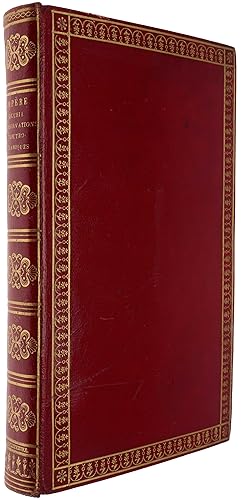
Recueil d'observations electro-dynamiques
Published by Crochard, Paris, 1823
Seller: SOPHIA RARE BOOKS, Koebenhavn V, Denmark
Seller rating 4 out of 5 stars
Signed
DOCUMENTING THE BIRTH OF ELECTRODYNAMICS. A beautiful copy bound in contemporary red morocco of the definitive version of this continually evolving collection of important memoirs on electrodynamics by Ampère (1775-1836) and others over the period 1820-1823, beginning with his 'Premier Mémoire', the "first great memoir on electrodynamics" (DSB). "Ampère had originally intended the collection to contain all the articles published on his theory of electrodynamics since 1820, but as he prepared copy new articles on the subject continued to appear, so that the fascicles, which apparently began publication in 1821, were in a constant state of revision, with at least five versions of the collection appearing between 1821 and 1823 under different titles" (Norman). Some of the 25 pieces in the collection are published here for the first time, others appeared earlier in journals such as Arago's Annales de Chimie et de Physique and the Journal de Physique. But even the articles that had appeared earlier are modified for the Receuil, or have additional notes by Ampère, to reflect his progress and changes in viewpoint in the intervening period. Many of the articles that are new to the present work concern Ampère's reaction to Faraday's first paper on electromagnetism, 'On some new electro-magnetical motions, and on the theory of magnetism', originally published in the 21 October 1821 issue of the Quarterly Journal of Science, which records the first conversion of electrical into mechanical energy and contains the first enunciation of the notion of a line of force. Faraday's work on electromagnetic rotations would lead him to become the principal opponent of Ampère's mathematically formulated explanation of electromagnetism as a manifestation of currents of electrical fluids surrounding 'electrodynamic' molecules. The Receuil contains the first French translation of Faraday's paper followed by extended notes by Ampère and his brilliant student Félix Savary (1797-1841). Ampère's reaction to Faraday's criticisms are the subject of several of the articles in the second half of the Receuil. The collection also includes Ampère's important response to a letter from the Dutch physicist Albert van Beek (1787-1856), in which "Ampère argued eloquently for his model, insisting that it could be used to explain not only magnetism but also chemical combination and elective affinity. In short, it was to be considered the foundation of a new theory of matter. This was one of the reasons why Ampère's theory of electrodynamics was not immediately and universally accepted. To accept it meant to accept as well a theory of the ultimate structure of matter itself" (DSB). The volume concludes with a résumé of a paper read by Savary to the Académie des Sciences on 3 February 1823, and a letter from Ampère to Faraday, dated 18 April 1823 (which does not appear in the Table of Contents), showing that this definitive version of the Receuil was in fact published in 1823. Only three other copies of this work listed by ABPC/RBH. Provenance: Marcel Gompel (1883-1944) (ex-libris on front paste-down - Répertoire général des ex-libris français: G1896). A Jewish professor at the Collège de France, Gompel worked in the Laboratoire d'Histoire naturelle des corps organisés from 1922 to 1940, under the direction of André Mayer. In World War II he became a hero of the French resistance and was finally tortured and executed on orders from Klaus Barbie, the chief of the Gestapo in Lyon. When Barbie came to trial, the prosecutors used Gompel's case as a particularly clear and egregious example of his guilt of crimes against humanity. His superb library was stolen by the Nazis. The collection opens with the 'Premier Mémoire' [1] (numbering as in the list of contents, below), first published in Arago's Annales at the end of 1820. This was Ampère's "first great memoir on electrodynamics" (DSB), representing his first response to the demonstration on 21 April 1820 by the Danish physicist Hans Christian Oersted (1777-1851) that electric currents create magnetic fields; this had been reported by François Arago (1786-1853) to an astonished Académie des Sciences on 4 September. In this memoir Ampère "demonstrated for the first time that two parallel conductors, carrying currents traveling in the same direction, attract each other; conversely, if the currents are traveling in opposite directions, they repel each other" (Sparrow, Milestones, p. 33). The first quantitative expression for the force between current carrying conductors appeared in Ampère's less well-known 'Note sur les expériences électro-magnétiques' [2], which originally appeared in the Annales des Mines. Ampère stated, without proof, that, if two infinitely small portions of electric current A and B, with intensities g and h, separated by a distance r, set at angles ? and ? to AB and in directions which created with AB two planes at an angle ? with each other, the action they exert on each other is gh (sin ? sin ? sin ? + k cos ? cos ?)/r2, where k is an unknown constant which he stated could 'conveniently' be taken to be zero. This last assumption was an error which significantly retarded his progress in the next two years before he stated correctly that k = ? 1/2 in his article [13], published for the first time in the Receuil. This article comprised 'notes' on a lecture [12] delivered to the Institut in April 1822 in which he surveyed experimental work carried out by himself and others since 1821 (he also published for the first time there the words 'electro-static' and 'electro-dynamic'). The full theoretical and experimental proof of the correct value of k appeared in two articles in Arago's Annales in 1822, [19] and [20], in an article by Savary [22], and in experiments with de la Rive [17] (see below). On 20 January 1821 Ampère performed an experiment together with César-Mansuète Despretz (1798-1863) intended to support his own theory of the interaction of electric currents again. Signed.
-
Rodez-en-Rouergue : Editions Subervie, directeur : Jean Digot. 10 plaquettes (un numéro double : 10/11) en feuilles sous couverture imprimée à rabats, (15-20) pages. Tous les exemplaires sont numérotés. La collection complète compte 12 numéros. Bon état. Avec des hors texte de Jean Segalat, Raymond Gid, Dropy,Jacqueline Cammas, Robert Delaunay (un portrait inédit), Jean Cocteau. Livres.