

Order Total (1 Item Items):
Shipping Destination:

Luskin Robert (9 results)
Did you mean
lufkin robert
Skip to main search results
Search filters
Product Type
- All Product Types
- Books (9)
- Magazines & Periodicals (No further results match this refinement)
- Comics (No further results match this refinement)
- Sheet Music (No further results match this refinement)
- Art, Prints & Posters (No further results match this refinement)
- Photographs (No further results match this refinement)
- Maps (No further results match this refinement)
- Manuscripts & Paper Collectibles (No further results match this refinement)
Condition Learn more
- New (No further results match this refinement)
- As New, Fine or Near Fine (2)
- Very Good or Good (7)
- Fair or Poor (No further results match this refinement)
- As Described (No further results match this refinement)
Binding
Collectible Attributes
- First Edition (2)
- Signed (No further results match this refinement)
- Dust Jacket (3)
- Seller-Supplied Images (No further results match this refinement)
- Not Print on Demand (9)
Language (2)
Free Shipping
Seller Location
Seller Rating
-
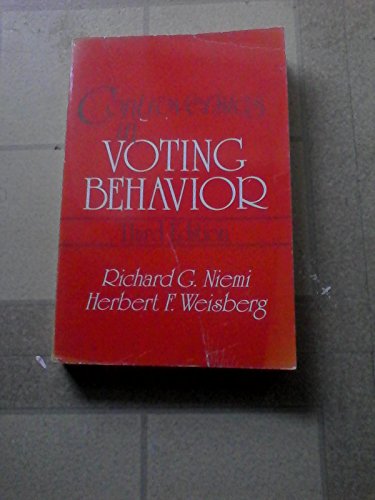
Controversies in Voting Behavior
Language: English
Published by CQ Press an imprint of SAGE, 1992
ISBN 10: 0871877066 ISBN 13: 9780871877062
Condition: Good. 3rd Edition. Pages intact with minimal writing/highlighting. The binding may be loose and creased. Dust jackets/supplements are not included. Stock photo provided. Product includes identifying sticker. Better World Books: Buy Books. Do Good.
-
Controversies in Voting Behavior, 3rd Edition
Seller: Wonder Book, Frederick, MD, U.S.A.
Seller rating 5 out of 5 stars

Condition: Good. Good condition. 3rd edition. A copy that has been read but remains intact. May contain markings such as bookplates, stamps, limited notes and highlighting, or a few light stains.
-

The Harvard Strike ( Illustrated with photographs.)
Published by Houghton Mifflin Company, 1970
Seller: GloryBe Books & Ephemera, LLC, Deforest, WI, U.S.A.
Seller rating 5 out of 5 stars
Hardcover. Condition: Good. Pages slightly tanned. Top corner of rear cover slightly worn otherwise Good. NOT A FORMER LIBRARY BOOK.
-
Hardcover. Condition: Good. No Jacket. Pages can have notes/highlighting. Spine may show signs of wear. ~ ThriftBooks: Read More, Spend Less.
-
The Harvard Strike
Language: English
Published by Houghton Mifflin Company, 1970
Seller: G.J. Askins Bookseller, New Lebanon, NY, U.S.A.
Association Member: SNEAB
Seller rating 5 out of 5 stars
Hardcover. Condition: Very Good. Dust Jacket Condition: Good. 398 page hardcover illustrated with photographs. The story of the 1969 student occupation of Harvard's University Hall. The authors were reporters for the student radio station WHRB. Dust jacket has light wear. Book is unmarked, tight and clean.
-
Hardcover. Condition: Very Good. Dust Jacket Condition: Very Good. 1st Edition. First edition/first printing. Black cloth-covered boards with red lettering and decoration (raised fist), 8 5/8 x 5 7/8 inches, 381 pp., index, b/w photo illustrations, map-illustrated endpapers. Book very good minus (modest spotting to front board; mild spine slant; pages clean and binding tight). Dustcover very good (moderate rubbing and edgewear). "It couldn't happen here, almost everyone said about the oldest and most renowned university in the country. Then on April 9, 1969, a band of students led by the radical wing of SDS seized University Hall." (1722RO081).
-
Hardcover. Condition: Near Fine. Dust Jacket Condition: NoNE. PHOTOS (illustrator). STATED FIRST PRINTNG. A RARE TITLE DOCUMENTING UNREST AT HARVARD IN 1969 STATED FIRST PRINTING SOLID CLEAN AND BRIGHT BOUND IN BLACK WITH BRIGHT RED LETTERING AND DESIGN SMALL PREVIOUS OWNERS SIGNATURE.
-

Soft cover. Condition: Fine.
-
The Harvard Strike
Published by Houghton Mifflin Company, Boston, MA, 1970
Seller: Ground Zero Books, Ltd., Silver Spring, MD, U.S.A.
Seller rating 4 out of 5 stars

First Edition
Hardcover. Condition: Very good. Dust Jacket Condition: Good. Daniel Alexander (Authors photograph) (illustrator). First Printing [Stated]. xvi, [2], 381, [1] pages. Illustrated endpapers. Footnotes. Illustrations. Appendix. Index. The DJ is in a plastic sleeve and has some wear and soiling. The surprise take over of a university building by the SDS brought to light the conflicts and differences between students, between students and faculty and the administration and the demands of the black students. On April 9, 1969, a band of students led by the SDS seized University Hall. The authors probe the inflamed and contradictory reports. They identify forces set in motion many months before the event, and follow the gradual hardening of attitudes on issues that divided students, faculty, and administration. The account of the seventeen-hour period during which students occupied University Hall produces striking vignettes--the orderly procedures of the insurgents for providing food and supplies, and the president of the university watching the police action through field glasses. The story follows the forging of new policies by each faction under the pressures of passionate concern, tight deadlines, and the glare of publicity. As part of the wider anti-war movement of the 1960s, student organizations such as the Harvard chapter of the Students for a Democratic Society (SDS) ran anti-war activities on campus. The Harvard Reserve Officer Training Corps (ROTC) programs drew particular attention. Although the faculty was willing to reduce the programs' privileges, the Harvard Corporation refused to terminate it. These developments, alongside the creation of a degree program in Afro-American studies, led to the events of April 1969. On the night of April 8 to 9, a group of about 300 students, led by the SDS, tacked a list of demands on the door of the home of Nathan Pusey, then President of Harvard. Not only did it call for the abolition of ROTC, but also for lower rent and student involvement in designing the curriculum for the Afro-American studies degree. The demands were later rejected by Pusey as baseless. At noon on April 9, a group of 30 to 70 students entered University Hall, ejecting administrative staff and faculty. While most left the building peacefully, some faculty like assistant dean Archie Epps were forcefully expelled. At 4:15 p.m. Harvard Yard was closed off by the administration, citing safety concerns. The occupiers were threatened with criminal prosecution and disciplinary action if they did not leave by 4:30. The Boston Globe estimated the number of students inside University Hall to now be about 500, with at least 3000 onlookers in the Yard. At 5 p.m., a meeting between moderate students and Dean Fred Glimp was convened at Lowell Lecture Hall, both agreeing on a peaceful resolution of the conflict. In the aftermath of the occupation, a series of reforms began. The ROTC lost the privileges not held by other extracurricular activities by a vote of the faculty later endorsed by the Harvard Corporation. Student representatives got a role in the appointment of faculty for Afro-American studies. A special "Committee of Fifteen" was formed to deal with the participants of the occupation. Unusual for a faculty board, it was not appointed, but elected by the Faculty of Arts and Sciences, consisting of ten of its members and augmented by five students, three from the College and one each of Radcliffe College and the Graduate School.


