Order Total (1 Item Items):
Shipping Destination:

Leaf Manuscript (71 results)
Skip to main search results
Search filters
Product Type
- All Product Types
- Books (64)
- Magazines & Periodicals (No further results match this refinement)
- Comics (No further results match this refinement)
- Sheet Music (No further results match this refinement)
- Art, Prints & Posters (No further results match this refinement)
- Photographs (No further results match this refinement)
- Maps (No further results match this refinement)
- Manuscripts & Paper Collectibles (7)
Condition Learn more
- New (No further results match this refinement)
- As New, Fine or Near Fine (1)
- Very Good or Good (7)
- Fair or Poor (No further results match this refinement)
- As Described (63)
Binding
- All Bindings
- Hardcover (5)
- Softcover (No further results match this refinement)
Collectible Attributes
- First Edition (7)
- Signed (1)
- Dust Jacket (No further results match this refinement)
- Seller-Supplied Images (67)
- Not Print on Demand (71)
Language (2)
Free Shipping
- Free Shipping to U.S.A. (No further results match this refinement)
Seller Location
Seller Rating
-
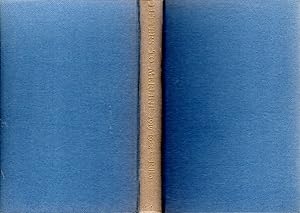
Letters to Merline, 1919-1922
Language: English
Published by Methuen & Co, London, 1951
Seller: Dorley House Books, Inc., Hagerstown, MD, U.S.A.
Seller rating 4 out of 5 stars

First Edition
Hardcover. Condition: Very Good. No Jacket. foldout facsimilie of a manuscript leaf with drawing in color. (illustrator). 1st. First Edition, First Englisg Printing; blue c w/gilt titles; , sunned psine; 149 clean, unmarked pages.
-
Tibetan Leaf Manuscript.
Published by [20th Century]., [Tibet].
Seller: Asia Bookroom ANZAAB/ILAB, Canberra, ACT, Australia
Association Member: ANZAAB ILAB
Seller rating 5 out of 5 stars

18 loose leaves from a Tibetan leaf manuscript, each 8.2 x 25cm, most with Tibetan script both sides, top edge of several leaves pierced, edgewear and browning, a few leaves wormed, in sound condition. An interesting assemblage from an unidentified Tibetan black ink leaf manuscript. Acquired in Tibet in the 1960s.
-
Illuminated Leaf on fine vellum.
Published by 15th Century?
Seller: Michael S. Kemp, Bookseller, Sheerness, KENT, United Kingdom
Association Member: PBFA
Seller rating 5 out of 5 stars
Single leaf, vellum, corner cut away, illuminated both sides in colour and gilt. 175 x 130 mm.
-
The Winning Of The West
Published by G.P. Putnam's Sons / The Knickerbocker Press, New York, 1900
Seller: The First Edition Rare Books, LLC, Cincinnati, OH, U.S.A.
Association Member: ABAA ILAB IOBA MWABA
Seller rating 5 out of 5 stars
Signed
Leather bound. Condition: Near fine. The Daniel Boone Edition of The Winning of the West by Theodore Roosevelt, with a manuscript leaf in Roosevelt's hand. (illustrator). Daniel Boone Edition. Octavo, [four volumes], [xxvii], [1], 352pp, [map]; [vii], [3], 427pp, [2pp maps]; [ix], [3], 339pp, [map]; [xi], 363pp, [2pp ads]. Publisher's half green levant morocco, marbled boards, raised bands, title stamped in gilt, "Daniel Boone Edition" in gilt on each spine. Marbled endpapers, top edge gilt, silk bookmark in each volume, detached but present in Volume III. Uncut. Solid text blocks, all appear unread. Free of restoration or archival repairs. Light sunning to the spines, as is typical with this edition. Touch of rubbing along margins of boards. From the library of Charles L. Gilcrest, with his bookplate on the second free endpaper of each volume. Frontispiece portrait with tissue cover in each volume, complete, with captioned tissue guards. Includes five fold-out maps, affixed to rear panel of each volume, printed on Japanese vellum. (Wheelock, 13) (Cole & Vail, A11.1) (Howes R433) From a limited edition of 200 sets, this being number 185, matching limitation in each volume. Includes a manuscript leaf in Roosevelt's hand from Volume IV, page 18, regarding the failed frontier campaigns of Gov. Arthur St. Clair and George Washington's decision to recall Gen. Anthony Wayne to command U.S. forces in the Northwest Indian War. The original manuscript leaf reads as follows: [The newly created Government of the United States]."was very reluctant to make formal war on the northwestern Indians. Not only were President Washington and the National Congress honorably desirous of peace, but they were hampered for funds, and dreaded any extra expense. Nevertheless they were forced into war. Throughout the years 1789 and 1790 an increasing volume of appeals for help came from the frontier countries. The governor of the Northwestern Territory, the brigadier-general of the troops on the Ohio, the members of the Kentucky Convention, and all the county lieutenants of Kentucky, the lieutenants of the frontier counties of Virginia proper, the representatives from the counties, the field officers of the different districts, the General Assembly of Virginia, all sent bitter complaints." [and long catalogues of injuries to the President, the Secretary of War, and the two Houses of Congress; complaints which were redoubled after Harmar's failure. With heavy hearts, the national authorities prepared for war.] This work was issued in full levant for $100 and half levant for $60. The full levant sold quickly, and the price was raised to $200 per set. The handwritten manuscript leaves all came from Volume III and IV, with the manuscript for Volume I now held at the New York Public Library. Signed.
-
[Mythological scenes on palm leaves].
Published by Lombok, 19th century.
Seller: Antiquariat INLIBRIS Gilhofer Nfg. GmbH, Vienna, A, Austria
Association Member: ILAB VDA VDAO
Seller rating 5 out of 5 stars
Manuscript / Paper Collectible
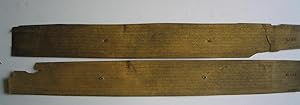
Oblong, 220 x 35 mm. 5 ff. Balinese on palm leaf. Balinese script in inscriped black ink. Illustrated with five hand-inscribed scenes. Wooden boards with delicately carved designs. Five mythological scenes hand-inscribed on the dried leaves of the lontar palm, each with a line on the reverse in Balinese script. Similar palm-leaf manuscripts from Lombok, today part of Indonesia, show scenes from Hindu or Muslim mythologies. These include the Ramayana, Adi Parva from the Mahabharata, the story of the Prophet Yusuf (Joseph), and Bharatayuddha. An illustrated copy of the latter, similar to the present manuscript, is held at the British Library (Or 13379, f. 6r). - The illustrations of this manuscript are clearly meant to be read together, similar to comic strips, with one scene following another to tell a short section of a story. To create this manuscript, a scene was first painstakingly inscribed by hand into the delicate palm leaf, and then ink was rubbed into the scored lines to finish the drawing. Unlike paper, palm leaves are ideal for hot, humid climates like that of Lombok, and have been used in Southeast Asia for thousands of years. - Faintly toned. In very good condition. - Cf. London, British Library, Or 13379, f. 6r.
-
[Finely Illuminated Vellum Manuscript Signature in Latin, perhaps France, ca. late 15th Century].
Published by ca. 15th Century]., [No location given:
Seller: Jeff Weber Rare Books, Neuchatel, NEUCH, Switzerland
Seller rating 4 out of 5 stars
22 x 21.75 cm. Double-columned, double-sided single signature, 32 lines. The leaf features 69 gilt initials with embellished pen-work, 2 of them larger with blue backgrounds and the rest smaller with beige or dark brown (matching text ink) backgrounds, with some additional red lettering and the heading "Psalms." 4 pp. Fine vellum; some initials faintly faded with gilt and colors otherwise bright and text clear. Fine. Although not fully translated, this signature was likely once part of a psalter. It features part of a litany from the Book of Hoursâ"Psalm 70 in its entirety, moving into a call-and-response from with red letters marking the call v. the response, beginning with "V: Salvos fac servos tuos" and cutting off at "R: aeternam dona eis. . ." Due to the structure of books, the page opposite the beginning of this litany is not the page that should numerically follow it were it still bound, and so it is broken early. The leaf also features almost all of Psalm 37," ending with "Qui retribuunt mala pro. . .".
-

Attractively written leaf from a Manuscript in Latin,
Publication Date: 1730
Seller: Sophie Dupre ABA ILAB PADA, Calne, United Kingdom
Seller rating 2 out of 5 stars

Manuscript / Paper Collectible
from a treatise on the Old Testament High Priest and Priesthood ('De Pontifice & Sacerdotibus'), here discussing the meaning of the Hebrew 'segen' which the writer takes to be a general word for 'deputy', quoting from the O.T. and from Lardner's 'Credibility of the Gospel History', Selden, Preland, and Maimonides, sides numbered 35 & 36, sections 104-112, English, no place, no date, circa.
-

Clementine.
Published by ca., 1480
Seller: Michael Steinbach Rare Books, Wien, Austria
Association Member: ILAB VDA VDAO
Seller rating 5 out of 5 stars
44 : 29 cm. One leaf with 11 lines handwritten. um 304 (?) 1 in Köln in Nordrhein-Westfalen. Altar mit vielen Reliquien in der "Goldenen Kammer" in der Ursula-Kirche in Köln. Clementine befand sich unter den Gefährtinnen der Ursula. Die Reliquien von Clementine und die von Gefährtinnen werden in Modena.
-
No Binding. Condition: Good. 1st Edition. This is what I believe to be a Buddhist or just ancient Palm leaf manuscript/bound; 2 leaves with the library or museum catalog number 41-1754 written in red ink; size: 19-3/8 x 2-1/2 in; the string is missing and I don't know the order of the leaves; It has in red written on it 41.1754; I don't know what the date is but on 2 leaves it says 1754 (but I don't if this is the actual date); chips to the edges, for the age I assume the leaves are in good condition. Please look at pixs carefully before purchasing it. Please remember I don't know anything about the item but of course ask questions if necessary.
-
A Prince and His Mistress.
Published by c.1710?, 1710
Seller: William Matthews/The Haunted Bookshop, Sidney, BC, Canada
Seller rating 5 out of 5 stars
Ink, watercolor, and gold, on paper. The image measures about 5 x 8 inches, in a frame with glass measuring 10.5 x 13.5 inches. Calligraphic writing at top and bottom, and on the reverse in 9 rectangular panels. This is a leaf from a manuscript. Finely executed, in very nice condition. (Not examined out of the frame). [This is an oversize item, and normal postage rates do not apply. Large framed artworks are sometimes available for pickup only.].
-
An Illuminated Manuscript Leaf from a Book of Hours.
Published by [Likely France, 1480-1500]., 1500
Seller: William Matthews/The Haunted Bookshop, Sidney, BC, Canada
Seller rating 5 out of 5 stars
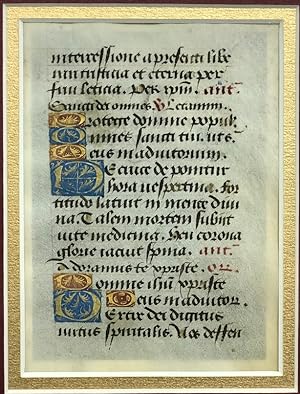
A single leaf from a French Book of Hours, produced ca.1480-1500. Executed on paper (we believe). Some wrinkling at the edges, fine condition . Leaf size is about 9 x 12 cm., in a frame measuring 22 x 26 cm. Attractively matted and framed in a reversible frame, so that both sides of the leaf are visible. Eighteen lines of Latin text in black & red, with seven illuminated capitals; the verso bears seven lines of text, one initial and a small illuminated panel. This leaf was the end of a section, the verso being only partly lettered. The text is from the Hours of the Cross at Vespers, including the hymn "De cruce deponitur". The Latin text of the hymn begins with the blue initial 'D': "De cruce deponitur hora vespertina. fortitudo latuit in mente divina. Talem mortem subiit vitæ medicina. heu corona gloriæ iacuit supina." An English translation is approximately: "At the hour of eventide Christ from his cross was taken. In whose soul his fortitude did covertly remain. Such a death vouchsafed to take of life the medicine sound. Glory's crown alas the while lay grovelling on the ground.".
-
TEXT IN LATIN
Published by 14th century, Germany
Seller: Phillip J. Pirages Rare Books (ABAA), McMinnville, OR, U.S.A.
Seller rating 3 out of 5 stars

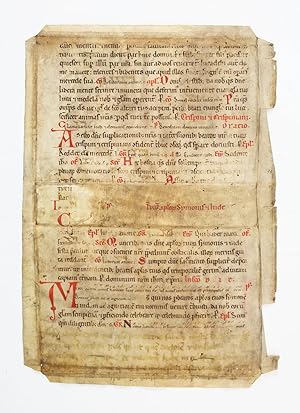
250 x 175 mm. (9 7/8 x 6 7/8"). Six extant lines of text and music in a gothic hand. Rubrics and staves in red, one large initial in red, and two large decorative initials in black and red. With the binding's original paper labels on spine, remnants of old paper lining on verso. Somewhat soiled and stained, but a good specimen overall. Recovered from a 17th century binding, this specimen presents an excellent opportunity to examine how Medieval manuscripts were used in the construction of later bindings. The two preserved spine labels tell us that the leaf previously covered a copy of Alphonso Stadlmayer's "Philosophia Tripartita," first published in 1650.
-
An Illuminated Manuscript Leaf from a Book of Hours.
Published by [Likely France, 1480-1500]., 1500
Seller: William Matthews/The Haunted Bookshop, Sidney, BC, Canada
Seller rating 5 out of 5 stars
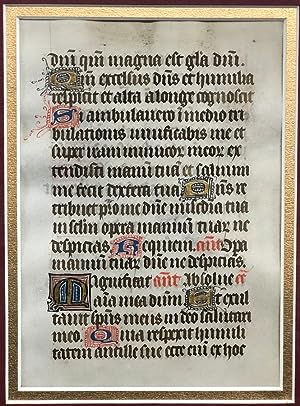
A single leaf from a French Book of Hours, produced ca.1480-1500. Executed on paper (we believe). Some wrinkling at the edges, fine condition . Leaf size is about 9 x 12 cm., in a frame measuring 22 x 26 cm. Attractively matted and framed in a reversible frame, so that both sides of the leaf are visible. Seventeen lines of Latin text in black & red, with eight illuminated capitals on the recto; seven illuminated capitals on the verso. The text on this leaf includes "Quia fecit in magna qui potens est" from the canticle Magnificat, or The Song of Mary, and was set to music by Bach in 1723, his "Magnificat". The Magnificat is usually sung or recited during the main evening prayer service, at Vespers in the Catholic and Lutheran churches, and Evening Prayer (Evensong) in the Anglican Church. In Eastern Christianity, the Magnificat is sung at Matins.
-

FROM A BOOK OF HOURS IN LATIN
Published by ca. 1440, Paris, 1440
Seller: Phillip J. Pirages Rare Books (ABAA), McMinnville, OR, U.S.A.
Seller rating 3 out of 5 stars
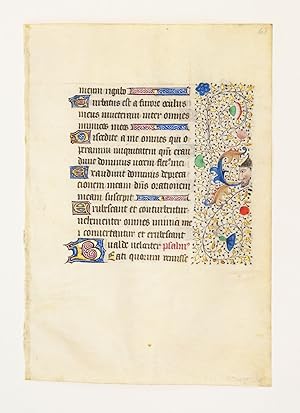
121 x 89 mm. (4 3/4 x 3 1/2"). Single column, 15 lines of text in a very fine gothic book hand. Rubrics in red, with multiple one-line initials and line fillers, all in blue, maroon, and burnished gold, and with two-line initials in the same colors and gold but also enclosing charming flowers on scrolling stems, with marginal extension in the form of gilt ivy leaves on sinuous stems, and WITH A FINE SWIRLING PANEL BORDER ON EACH SIDE featuring flowers, leaves, strawberries, and many burnished gold ivy leaves on hairline stems. IN FINE CONDITION, with the paint and gold bright, fresh, and entirely intact. This is a lovely little leaf from a fragment of a Book of Hours that obviously was produced for a client of considerable means by skilled craftsmen in a Parisian studio probably a little before the middle of the 15th century. This was clearly intended to be put into a book that could be carried easily on one's person, and part of what makes it so charming is this portable size.
-
TEXT IN LATIN
Published by 14th century, Germany
Seller: Phillip J. Pirages Rare Books (ABAA), McMinnville, OR, U.S.A.
Seller rating 3 out of 5 stars
132 x 164 mm. (5 1/4 x 6 3/8"). Double column, 12 extant lines in a gothic book hand. Rubrics and four-line staves in red, capitals touched in red, four large initials in red or blue. Spine with two old paper labels, one with ink titling. Vellum a bit soiled, a couple small holes, ink a little faded on verso, paper remnants on verso obscuring a few lines, but still a good specimen demonstrating use and reuse of Medieval manuscripts. From a noted Missal that had outlived its use, this manuscript leaf was later repurposed as a cover for a 17th century printed book. The spine label indicates it was a copy of Jacob Bidermann's "Herodiados libri tres," a lengthy Latin poem relating the story of John the Baptist and Herod, first published in 1622.
-
FROM A LARGE BOOK OF HOURS, WITH TEXT IN LATIN
Published by 3rd quarter of 15th century, France (probably Besançon)
Seller: Phillip J. Pirages Rare Books (ABAA), McMinnville, OR, U.S.A.
Seller rating 3 out of 5 stars
239 x 165 mm. (9 3/8 x 6 1/2"). Single column, 15 lines in an elegant gothic book hand. Rubrics in dark pink, line enders in pink and blue with white tracery and gold bezant, several one-line initials and one two-line initial in burnished gold on dark pink and blue ground with white tracery, each side with a panel border composed of hairline vines with gold ivy and bezants, a few colorful flowers, and EACH FEATURING THE FACE OF A MAN EMITTING ACANTHUS LEAVES FROM HIS MOUTH. ?A few tiny marginal spots, one of the faces slightly rubbed, otherwise IN BEAUTIFUL CONDITION. In addition to the floral decoration and vines often found in the borders of Books of Hours, this leaf features a duo of delightful inhabitants in the form of faces emitting colorful acanthus from their mouths. Each figure is individualized, the face on the recto with dark hair, flushed cheeks, and a prominent nose; on the verso is a face with a much paler complexion, a tonsured hairstyle, a large but very short nose, and fine, gray whiskers. This kind of imaginative work, together with luxurious touches such as the many gilt initials, several dozen gilt bezants and ivy leaves in each panel border, and the unusually wide margins, point to this manuscript having been a costly production. For additional leaves from this same manuscript at different price points, please check our website.
-
WITH TEXT IN LATIN FROM THE "SENTENTIAE" OF PETER LOMBARD
Published by late 12th or early 13th century, Germany(?)
Seller: Phillip J. Pirages Rare Books (ABAA), McMinnville, OR, U.S.A.
Seller rating 3 out of 5 stars
335 x 224 mm. (13 1/4 x 8 7/8"). Double column, 29 lines, in an elegant proto-gothic book hand. Rubrics in red, several two-line initials in red. Recovered from a binding and so the vellum a bit soiled, creased, and wavy, recto with a lighter patch (where a title label was once situated), light stains and glue and paper residue on the verso, but overall the leaf remarkably clean, entirely legible, and surprisingly well preserved. Once serving as a cover for a later book, this leaf comes from a nearly contemporaneous copy of Peter Lombard's "Sentences," considered the most important theological book of the 12th century. Written between 1155 and 1158 and arranged topically, Lombard's "Sententiae" summarize past learning about Christian doctrine by quoting authorities in an attempt to resolve textual disagreement by dialectical analysis. As a source collection that continued to spark discussion, Lombard's great work enjoyed sustained success as a theological textbook until the 17th century and inspired numerous commentaries, including those of Aquinas and Luther. This leaf comes from Book IV, "On the Doctrine of Signs," which is primarily concerned with the seven sacraments: Baptism, Confirmation, the Eucharist, Penance, Extreme Unction, Sacred Orders, and Matrimony. The script is an upright and very legible proto-gothic book hand with a few distinctive letter forms and abbreviations that may help determine a more definitive point of origin (these include a "g" with a downward cross on its tail, and a conjoined "qe" for "que"). It is unusual (and very lucky) that this leaf survives completely intact, as Medieval manuscripts used in later bindings were often cut down in size to make smaller covers or used as waste paper for pastedowns or other binding elements.
-
TEXT FROM THE HOURS OF THE CROSS
Published by late 15th century, France
Seller: Phillip J. Pirages Rare Books (ABAA), McMinnville, OR, U.S.A.
Seller rating 3 out of 5 stars
180 x 130 mm. (7 x 5 1/8"). Single column, verso with 20 lines in an attractive bâtarde hand. Rubrics in dark pink, four one-line initials in painted gold on blue or dark pink ground, two two-line initials, on in blue on dark pink ground and one in black on blue ground, both with painted gold embellishments, one three-line initial resembling unfurling scrolls, painted in gold on a blue ground with gold pointillation and filled with a large flower, A LARGE MINIATURE OF THE CRUCIFIXION in a plain red frame surrounded by a three-quarter border filled with blue flowers with long protruding pistils, with numerous hairline vines and gilt bezants, and triangular sections painted gold and filled with strawberries and white flowers. Faint foxing and soiling to margins, light chipping to red frame and one initial, minor fading to painted gold in border, negligible imperfections to miniature (one of Christ's arms slightly rubbed, a couple tiny scuffs), but with strong colors and well-preserved details. Opening the Hours of the Cross (a shorter text sometimes accompanying the Hours of the Virgin), this miniature of the Crucifixion is attractively painted and features a touching depiction of Christ's final moments at the same time that it provides exuberance in an elaborately botanic border. Besides the crucified Christ, there are only two other figures in this intimate and lonely--perhaps even bleak--miniature: the Virgin Mary stands at the left of the composition in a blue dress and long pink veil, while St. John stands at the right, dressed in pink and purple and holding a green book. Blood flows freely from Christ's wounds, including small rivulets from his hands that fall on the heads of the Virgin and St. John, as if to anoint them. Although St. John's attention is focused on Christ, the Virgin fixes her gaze not on her son, but at St. John. Perhaps she is taking in Christ's words as recorded in John 19:26-27: "When Jesus therefore had seen his mother and the disciple standing whom he loved, he saith to his mother: Woman, behold thy son. After that, he saith to the disciple: Behold thy mother." This miniature was probably executed in a provincial atelier, but the work is very competent, and it contains some quietly excellent details: the body of Christ looks natural and well-proportioned, the features of the Virgin and St. John are quite strong, and St. John's hand, raised in the sign of benediction, shows a high level of detail. Despite the somber content of the scene, the artist chose a surprisingly cheerful palette that favors pastel pink, lilac, and light blue. This type of Crucifixion image is quite common iconographically, but the coloring and spirited border give the content freshness that modulates the deep sorrow of the scene, lending it a sense of hope.
-
TEXT FROM THE 15 JOYS OF THE VIRGIN, IN FRENCH
Published by late 15th century, Northern France
Seller: Phillip J. Pirages Rare Books (ABAA), McMinnville, OR, U.S.A.
Seller rating 3 out of 5 stars
170 x 118 mm. (6 3/4 x 4 5/8"). Single column, verso with 15 lines in a gothic book hand. One four-line initial in blue with white embellishments, filled with pink and blue leaves, verso with three-quarter bar border of repeating orange and blue ivy on gold ground, and a panel border of acanthus and flowers on lobed shapes with gold ground or on bare vellum, recto with A HALF-PAGE ARCH-TOPPED MINIATURE depicting the Virgin and Child with a kneeling female patron holding a book, surrounded by a three-quarter gold and painted frame and a border of fruit, flowers, and acanthus on lobed or circular shapes filled with painted gold or on bare vellum. Rule at bottom of border just slightly grazed (margins otherwise quite ample), odd violet discoloration in vellum (a color transfer because of moisture?) on verso apparent (only) on the undecorated surface, with gilt and paint unaffected (the border at top and bottom on the side with the miniature with faint pinkish show-through), small mounting stains in five places in margins of verso, but the miniature itself nevertheless perfectly preserved, and the leaf sparkling with gold. This leaf is as joyful as the text it contains. The 15 Joys of the Virgin Mary is a prayer that was frequently added at the end of a Book of Hours, especially those produced in France in the 15th century. It celebrates the joyous moments in the Virgin's life (the Annunciation, Nativity, wedding feast at Cana, Pentecost, and so on), each beginning with the phrase "Doulce dame." The prayer was often paired with a miniature of the Virgin and Child Enthroned, as it is here, accompanied by the portrait of a female patron (also seen here). Despite the pinkish aura here, the present example is very pleasing, being replete with gold and full of detail skillfully realized by a talented artist. The molding of the faces is excellent, with subtle gray tones sculpting realistic features over porcelain skin. Although the Virgin is the largest figure in the composition (signifying her importance), the female patron is also a clearly announced presence. Beautifully dressed in golden robes and a black conical hennin draped with a delicate sheer veil, she kneels before a large codex, her hand resting gently on its open pages. Her finery clearly marks her as a member of the wealthy elite--a person who could afford such a costly accessory as a Book of Hours.
-
TEXT FROM THE HOURS OF THE HOLY SPIRIT
Published by ca. 1490, France, 1490
Seller: Phillip J. Pirages Rare Books (ABAA), McMinnville, OR, U.S.A.
Seller rating 3 out of 5 stars
144 x 99 mm. (5 5/8 x 3 3/4"). Single column, recto with 14 lines in a gothic book hand. Attractively matted and framed. Rubrics in red, two two-line initials, one painted pink on blue ground with flowers, the other painted blue and inhabited by a rampant lion on pink and gold ground, recto with a panel border featuring long-stemmed flowers and owls on a pink ground, verso WITH A HALF-PAGE ARCH-TOPPED MINIATURE DEPICTING PENTECOST, WITH A FULL BORDER featuring a plethora of different flowers, berries, greenery, songbirds, an owl, and a butterfly, all ON A RICHLY PAINTED GOLD GROUND. Trimmed close on one side (and just grazing a border on the opposite side), very minor chipping to faces, trivial signs of rubbing or wear, otherwise a fine leaf--colorful, bright, and very pleasing to the eye. This leaf contains the customary Pentecost miniature associated with the Hours of the Holy Spirit, but with several attributes that set it apart from other examples we have encountered. The miniature here depicts a densely crowded scene with the Virgin at the center surrounded by the apostles, each of whom wears a burnished gold halo. Packed tightly together, they gaze up at a white dove who emanates small red tongues of fire above their heads. According to biblical tradition, this visitation by the Holy Ghost in the form of a dove enabled Christ's disciples to start preaching, marking the beginning of the Christian Church. The artist favors an unusual pastel palette, choosing pale pink for the walls and eggshell blue for some of the floor tiles, as well as bright yellow, muted lilac, rose, and lime green for the robes of the apostles. Looking more closely at the figures, we see that each face is carefully individualized, each with its own features and expressions. Although most crane their necks to get a view of the miracle unfolding, one of the apostles looks directly out at the viewer, as if surprised by our presence. Moving outside the miniature, we note that the leaf features a particularly exuberant border with tangles of flowers, fruit, acanthus leaves, and several birds, including an owl in one corner. There is additional interest on the verso, with another bright border painted an intense pink and filled with more flowers and owls.
-
Illuminated Manuscript Leaf from and Antiphonal with Miniature of King David; Psalms 110, 111
Published by np, Italy, 1525
Seller: Manhattan Rare Book Company, ABAA, ILAB, New York, NY, U.S.A.
Seller rating 5 out of 5 stars
Manuscript / Paper Collectible First Edition
vellum; framed. Condition: Very Good. first edition. ILLUMINATED ANTIPHONAL LEAF WITH EXCEPTIONALLY LARGE HISTORIATED INITIAL OF KING DAVID AS PSALMIST. The recto features a stunning, large (6 1/4 x 7 in.) initial "T" featuring a miniature of David the Psalmist, captured mid-song with instrument in hand as an angel unfurls the opening of the Psalm 110 (Dixit Dominus)a classic image of divine inspiration rendered with rich pigments and a thickly burnished gold initial "T". The "T" frames and divides the image, with King David and the angel occupying the right half. The Psalm's beginning ("DIXIT DOMINUS") is displayed on the angel's banner, emphasizing the divine inspiration for the Psalm. David is pictured with elegant flowing blue robes and, while he's playing a stringed instrument, there is another harp lying beneath his feet. The left side of the "T" (for the opening "Tecum principium") depicts a finely painted landscape, with a winding road, a bridge, and a town in the distance. The verso continues Psalm 110, but then transitions with a large red-and-organge painted "R" into a section of Psalm 111 (Redemptionem misit Dominus populo suo). Leaf size: 13x19.25 inches; archival framed to an overall size of 19x26 in.) Likely Italian, c.1550-1550. Vellum. Some mild toning and creasing to vellum. Some lines of cracking to color on miniature from the creasing. Small closed tear at top margin. Overall, the color (particularly the gilt) is exceptionally bright. A magnificent leaf.
-
TEXT FROM THE VIGIL OF STS. PETER AND PAUL (28 JUNE) AND THE FEAST OF STS. PETER AND PAUL (29 JUNE)
Published by late 13th or early 14th century, Northern France, perhaps Beauvais or Amiens
Seller: Phillip J. Pirages Rare Books (ABAA), McMinnville, OR, U.S.A.
Seller rating 3 out of 5 stars
286 x 199 mm. (11 1/4 x 7 3/4"). Double column, containing a mixture of staves and text (approximately 21 lines) in an excellent formal gothic book hand. Attractively matted. Rubrics in red, chant text containing black penwork initials with red and yellow geometric elaboration, BEAUTIFULLY ILLUMINATED with five two-line initials painted blue or pink with white tracery on a ground in the contrasting color, two of the initials filled with grotesques and swirling vines (and two with the filler design traced out but never completed) each initial with blue and pink extensions terminating in orange leaves or spiky shapes; the verso featuring AN IMPRESSIVE SIX-LINE "N" (58 x 50 mm.) in the same style, filled with an intricate knotwork design and orange leaves, with long extensions, including a horizontal extension across the upper margin. Margins with light offsetting of the designs from the facing leaf; remnants of mounting tape on recto corners and bottom edge; verso apparently with a barely visible Medieval "14" in lower margin. An area measuring 5 mm. at edges just faintly yellowed (from mat burn?), but IN FINE CONDITION, the vellum otherwise quite bright, the paint rich, and the gold brightly glittering. This sumptuously decorated leaf--which is beautifully preserved and contains a particularly large and handsome initial--comes from the last volume of a three-volume Missal presented to Beauvais Cathedral by Canon Robert de Hangest (d. 1356). The Missal remained at the cathedral at least through the 17th century, when it is noted in an inventory, but was removed from the church at some point, likely in the aftermath of the French Revolution. The parent volume eventually entered the collection of Henri-Auguste Brölemann (1775-1854) of Lyon, who passed it to his grand-daughter Etienne Mallet, who then sold it at Sotheby's in 1926. It was then acquired for the collection of William Hearst, where it remained for the next 25 years. In 1941 it was again sold at auction, and subsequently dismembered. Though long thought to have been the work of famed biblioclast Otto Ege, recent scholarship suggests that it was actually Phillip Duschnes who was responsible for breaking up the book, keeping some leaves for himself and selling others on to his colleague Ege for inclusion in his portfolios of "Fifty Original Leaves from Medieval Manuscripts." The Beauvais Missal has been a subject of interest for many notable scholars (chief among them being Christopher de Hamel--see: "Otto Ege and the Beauvais Missal" in "Gilding the Lilly: A Hundred Medieval and Illuminated Manuscripts in the Lilly Library"), and it is currently the focus of a major effort to "reconstruct" the manuscript digitally--a project spearheaded by Lisa Fagin Davis. Other leaves from the parent volume are in the collections of the Morgan Library, the Metropolitan Museum of Art, the Cleveland Museum of Art, and the Houghton Library at Harvard, among many others. Although there is some dispute among art historians, the illumination has been tentatively attributed to the artist of the Hours of Yolande of Soissons, produced in Amiens ca. 1280 and now held by the Morgan Library (MS M.729). It is worth noting that the town of Hangest, home to the original owner, is only 10 miles from Amiens, and is a likely place of origin for the Missal. The present leaf contains a text for a major feast day, and thus contains a large and extravagantly decorated initial for its opening, "'Nunc scio vere." It is not too much to say that the decoration here is masterful, but, curiously--and of special interest to us from a modern perspective--the illuminators seem to have forgotten to put the finishing touches on the two smaller initials above, which still contain sketches of the preliminary design.
-
TEXT FROM THE HOURS OF THE HOLY SPIRIT
Published by ca. 1470-80, Netherlands, 1470
Seller: Phillip J. Pirages Rare Books (ABAA), McMinnville, OR, U.S.A.
Seller rating 3 out of 5 stars
164 x 123 mm. (6 1/2 x 4 7/8"). Single column, 17 lines, in a gothic hand. Capitals touched with red, rubrics in red, one-line initials in red or blue, one two-line initial in blue, A VERY LARGE HISTORIATED INITIAL (approximately 60 mm. square) DEPICTING PENTECOST, the initial painted blue with white tracery on a burnished gold ground, surrounded by A FULL BORDER decorated with colorful acanthus, large flowers, strawberries, insects (including a grasshopper, fly, moth, and mosquito(?)), all on a liquid gold ground. See: Marrow, et al., "The Golden Age of Dutch Manuscript Illumination," nos. 79-81. âMargins just faintly soiled, gold very slightly rubbed, but IN FINE CONDITION, the initial and border beautifully preserved. This is an extraordinarily handsome leaf, featuring an oversized historiated initial depicting Pentecost, attributed to the circle of the Master of the London Jason. Our artist has made remarkable use of space, fitting 13 clearly defined people within an initial opening measuring 45 x 32 mm. The Virgin sits enthroned directly in the center, encircled by the Apostles dressed in blue, violet, green, and orange robes. Our artist cleverly adds a notch at the top of initial--like a cupola inside a chapel--in order to fit an image of a dove inside the scene. The figures show an impressive degree of individualization and emotional response as they witness the descent of the Holy Spirit; a few gesture in surprise, two lower their gaze, and some look up in awe. The work is stylistically like that of the Master of the London Jason, named for his work on the "Historie van Jason" manuscript now housed at the British Library. As Marrow et al. note, the Master's style is characterized by "somewhat short, heavy figures [that] are well formed and have unusual, slightly broad yet expressive faces with deep sunken eyes." Our leaf's enclosing border is of very considerable interest, featuring as it does naturalistic flowers, strawberry plants, insects, and a small, brightly colored bird, all painted in colors that perfectly complement the main scene. A very fine production all around, this distinctive, energetic leaf would make a notable addition to any collection.
-

TEXT FROM THE FEAST OF STS. PETER AND PAUL
Published by 1441-48, Italy [Ferrara], 1441
Seller: Phillip J. Pirages Rare Books (ABAA), McMinnville, OR, U.S.A.
Seller rating 3 out of 5 stars
Visible leaf: 245 x 187 mm. (9 5/8 x 7 3/8"); Frame: 380 x 315 mm. (15 x 12 1/4"). Double column, 30 lines in a very fine rounded gothic hand (a few lines of text in the same hand, but smaller). Mounted and in a simple but pleasing gold frame. Visible side with rubrics in red, one-line initials in burnished gold or painted blue, one two-line initial in burnished gold on a pale pink ground with white tracery, a lovely illuminated bar between the columns, with a central plant knot AND SPROUTING IN UPPER AND LOWER MARGINS CLUSTERS OF FLOWERS AND LEAVES IN VARIOUS COLORS AS WELL AS GOLD BEZANTS, outer margin with swirling penwork studded with gilt bezants running the length of the column, each penwork swirl enclosing a painted and gilt flower, with ONE FIVE-LINE HISTORIATED INITIAL DEPICTING ST. PAUL HOLDING A SWORD AND BOOK, the initial painted pink with green leaves and a blue and green acanthus extension on a gilt ground. âNot examined outside of frame, but in very fine condition: vellum slightly wavy, text in the bottom margin just a bit faded, but, by all appearances, A VERY CLEAN, BRIGHT LEAF, SPARKLING WITH GILT. Executed with great skill and delicacy and in sensitive Italianate colors highlighted especially by spring green and pink, the present leaf is from a manuscript intended for a powerful aristocrat. It comes from the celebrated Breviary illuminated for the chapel of the Marquises of Este, rulers of Ferrara and Mantua, a manuscript commissioned by Leonello d'Este (duke of Ferrara from 1441-50). Because the d'Este family kept excellent records, we have confidence that this manuscript was done for Leonello by Giorgio d'Alemagna, Bartolomeo de Benincà, Guglielmo Giraldi, and Matteo de' Pasti (see Toniolo, "La Miniatura a Ferrara dal Tempo di Cosmè Tura all'eredità di Ercole de' Roberti" [1998], pp. 19-20 and 76-77). The leaves show subtle variations in the style of the illuminations, a result of work done by a team of artists doing variations on a theme. At one time in a Spanish library, the manuscript was brought to Britain during the Peninsular War and came to be owned by the Rolls family, later Lords Llangattock, of Monmouth in Wales, from whom it takes its name. By the time the work reached Britain, most of the miniatures had already been cut out. The Breviary sold at Christie's on 8 December 1958 (lot #190) to Goodspeed's of Boston, who broke it up. The intact first quire of 10 leaves was purchased by Philip Hofer and given to Harvard (cf. Wieck, "Late Medieval and Renaissance Illuminated Manuscripts," p. 130 and fig. 74), and individual leaves appeared in 1967 in the catalogues of Folio Fine Art ("the quality of the leaves is extremely high"), Maggs Brothers ("of a very high quality"), and Alan Thomas ("of exquisite quality"). The present example is especially desirable for the portrait of St. Paul, who is depicted holding a sword and book, and whose carefully molded features reflect the growing interest in realistic portraiture in Renaissance Italy.
-
TEXT FROM "O INTEMERATA."
Published by ca. 1475, Northern France, 1475
Seller: Phillip J. Pirages Rare Books (ABAA), McMinnville, OR, U.S.A.
Seller rating 3 out of 5 stars
155 x 110 mm. (6 x 4 1/4"). Single column, 16 lines in a gothic book hand. Rubrics in dark pink, ONE EXQUISITE FOUR-LINE INITIAL painted blue with white detailing, filled with red and blue vines and leaves, on a burnished gold ground, with a painted and gilt bar border on one side, each end capped with a flower, the text surrounded on three sides with a border of acanthus leaves, dense rinceaux, colorful flowers, gold ivy leaves, and bezants. A couple negligible imperfections, but IN VERY FINE CONDITION, One of the most popular optional prayers in the 15th century Book of Hours, "O Intemerata" ("Oh, immaculate virgin") is a brief supplication in which the Virgin is glorified for her purity as the "unspotted and forever blessed, singular and incomparable Virgin Mary, Mother of God." The present leaf is given special emphasis with the presence of a three-quarter rinceaux border surrounding the text, and the opening of the prayer is marked by an especially pretty and finely detailed initial that glitters with burnished gold. The leaf is unusually beautiful, precisely rendered, and in very fine condition.
-
WITH TEXT FROM THE END OF THE SANCTORAL AND BEGINNING OF THE COMMON OF SAINTS
Published by early 13th century, Germany
Seller: Phillip J. Pirages Rare Books (ABAA), McMinnville, OR, U.S.A.
Seller rating 3 out of 5 stars
273 x 193 mm. (10 3/4 x 7 1/2"). Single column, 31 lines, text in two sizes in a gothic hand. Rubrics in red, several one- and two-line initials in red, and two larger initials in red. A few lines with neumes, later notations in the margins (now quite faded). âVellum a bit soiled and creased as expected, fading to four or five lines where the spine was placed, several notches along one edge, other imperfections due to its reuse as binding scrap, but still an excellent specimen that is almost entirely legible. Written in a neat and attractive hand, this sizable leaf from a Missal remains mostly quite legible, with all its rubrication intact, despite having been used as part of a binding. A few lines also show musical notation from the earliest generation of neumes. They are described as "in campo aperto," which means literally "in an open field," because they and they alone occupy the space (or "field") above the text. They are also described as adiastematic because they appear in a straight line, whereas later diastematic neumes reflect changes in pitch by being placed in a higher or lower vertical position above the text. At the time the present leaf was written out, the neumes here simply served as an "aide memoire" to the singer, who had already learned the melody orally.
-
TEXT FROM COMPLINE, FROM THE HOURS OF THE PASSION
Published by third quarter of 15th century, Southern Netherlands (Bruges?)
Seller: Phillip J. Pirages Rare Books (ABAA), McMinnville, OR, U.S.A.
Seller rating 3 out of 5 stars
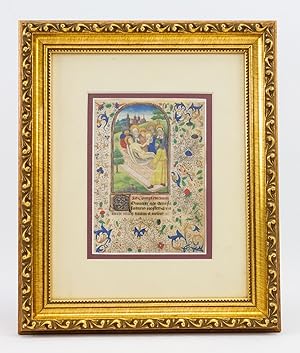
Matted leaf: 150 x 150 mm. (5 7/8 x 4 3/8"). Frame: 307 x 258 mm. (12 x 10 1/4"). Single column, with four lines below the miniature (and the obverse with 17 lines) in a batarde hand. Attractively matted and framed (the leaf slightly shifted in the mat, revealing top and side edges, but in no danger of damage). Rubrics in red, four one-line initials and three three-line initials all but one in burnished gold on blue and red ground with white tracery, the initial beneath the miniature painted pink on a burnished gold ground and filled with painted ivy vines, AN ARCH-TOPPED LARGE MINIATURE DEPICTING THE ENTOMBMENT, the body of Christ surrounded by seven other people, depicted in an outdoor setting with the turrets of a walled city in the background, the miniature in a double frame of gold and pink, surrounded by A FULL BORDER composed of hairline vines, acanthus, colorful flowers, and gilt bezants, and inhabited by a small bird. Minor soiling and a faint thumb print to borders, but IN VERY FINE CONDITION, THE MINIATURE BEAUTIFULLY PRESERVED. This is a beautifully rendered and deeply touching scene depicting the entombment of the crucified Christ and the pathos experienced by those at his side. Holding the sheet on which the body is lowered into the sarcophagus are (on the far left) the richly clothed Joseph of Arimathea and (on the far right) Nicodemus, who dons an especially lovely yellow garment with delicate embroidery. Between the two men in the foreground but behind the body are the Virgin Mary, who presses the hand of her deceased son to her lips; John the Evangelist, whose body is turned toward the Virgin in a gesture of support, but whose gaze is focused on the Savior; and Mary Magdalene, who holds a small ointment jar. Two other women with halos stand closely behind them, consoling one another. The artist has done a masterful job at creating a composition that captures the emotional gravity of the scene: Christ's body, gently cradled in a white sheet, is on full display, with blood still trickling from the wounds on his head and side. Despite there being seven people crowded around him, our attention is drawn to the action between Christ and the Virgin, who gently grasps his hand with motherly affection, and bids him a final farewell. Flickers of different emotions appear on the faces of his followers, including pity, sorrow, stoicism, and disbelief--echoing, perhaps, the viewer's own range of feelings upon viewing this image. The level of detail, excellence of composition, care seen in the molded bodies and faces, and the convincing setting suggest that the artist was quite practiced, and that the original manuscript from which the leaf comes was of very high quality.
-
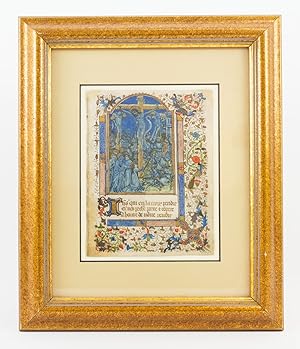
TEXT PRESUMABLY FROM THE HOURS OF THE CROSS
Published by ca. 1440, Metz, 1440
Seller: Phillip J. Pirages Rare Books (ABAA), McMinnville, OR, U.S.A.
Seller rating 3 out of 5 stars
Leaf: 162 x 124 mm. (6 3/8 x 4 7/8"). Frame: 308 x 258 mm. (12 1/8 x 10 1/8"). Single column, three lines of text under the miniature (obverse with 18 ruled lines, five of which contain text), in a gothic book hand. Attractively matted and framed. Recto with one three-line initial in gold on pink and blue ground, WITH A LARGE MINIATURE OF THE CRUCIFIXION WASHED IN BLUE, Christ on a painted gold cross, flanked by two thieves on painted gold crosses, surrounded by throngs of people including the Virgin, St. John, Mary Magdalene, and numerous soldiers, all in an arched gold frame inside a three-sided painted and gilt baguette and a FULL BORDER of colorful vine sprays and flowers inhabited by a peacock. See: "The Jeanne Miles Blacburn Collection of Manuscript Illuminations" nos. 29-38; Avril & Reynaud, pp. 182 & 190. Minor soiling/browning right at inner edge (away from border and image), otherwise IN VERY FINE CONDITION, THE MINIATURE REMARKABLY WELL PRESERVED, WITHOUT ANY LOSS OF PAINT. This stunning miniature with its memorable nocturnal scene comes from a very fine Book of Hours probably executed by Henri d'Orquevaulz (or d'Orquevaulx) or a member of his workshop. D'Oquevaulz was active during the second quarter of the 15th century in Metz, the cultural and commercial capital of Lorraine during the period, and the center of a growing book trade. According to the catalogue of the Jeanne Miles Blackburn Collection in the Cleveland Museum of Art, which owns 10 leaves from the original manuscript, the parent Book of Hours can be localized based on the Lorraine dialect found in the French text on some of the leaves (including the present example), and because the calendar singled out two bishop-saints of Metz (Clement and Arnoul). Although little is known about d'Orquevaulz, his dated signature in the colophon of a Livy manuscript that he illuminated for an alderman of Metz indicates that he was active in that city in 1440. Artistic affinities with northern European styles make it possible that d'Orquevaulz had emigrated from the Netherlands or Germany to Lorraine; another possibility, one that Avril and Renaud suggest, is that the master himself was from Metz, but that he had German associates, perhaps from the Rhineland area. According to these two scholars, the painter's use of large flat areas of colors is more typical of the Rhineland, the Netherlands, or Bohemia than of France; in any case, they praise his "exquisite color harmonies." The artist has outdone himself in the present miniature, rising to the height of pathos and making it one of the most extraordinary leaves we have ever offered for sale. In contrast to the bright colors used in Books of Hours even to depict the most serious scenes, the present leaf presents a remarkable visual nocturne, with the figures and buildings painted in the same shades of blue as the sky, suggesting that heaven itself is darkening at the death of Christ. Mary Magdalen kneels at the foot of the cross, while St. John supports the devastated Virgin as a soldier pierces the Savior's side with a lance. The miniature is crowded with figures (we see well-defined faces of no fewer than 18 persons and two horses), but the artist has not lost his dramatic focus, as Christ on his cross of brushed gold dominates the scene. In choosing to make this a darkened composition, the artist has risked obscuring detail, but his skill has been equal to his concept here, as he has used a diluted blue paint that allows for a very successful delineation in various shades, almost like grisaille (this technique, not incidentally, has prevented the cracking and erosion so commonly seen with the normal thick applications of typical cobalt blue). The result of the decision to show the world in eclipse at Christ's death is to heighten and universalize the drama here to such an extent that the scene leaves a powerful and lasting impression. The text on this leaf is entirely in French in rhyming verse. Roughly it transla.
-
TEXT FROM BOOK I, CHAPTERS XXIX-XXXII
Published by 12th century, Germany
Seller: Phillip J. Pirages Rare Books (ABAA), McMinnville, OR, U.S.A.
Seller rating 3 out of 5 stars
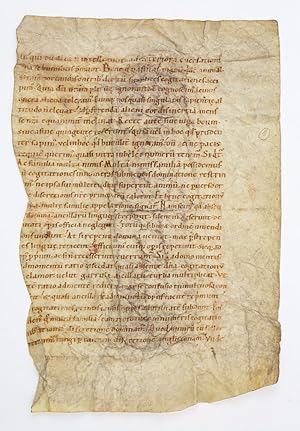
272 x 185 mm. (10 3/4 x 7 1/4"). Single column, 28 lines, in a late Caroline hand. ?Leaf trimmed irregularly along one side (about 18 lines lacking a letter or two), vellum a bit wrinkled and worn, text a little faded in places, but still very presentable, and the text almost entirely legible. Penned in a pleasing and very legible late Caroline hand, this leaf has sustained very little loss and is remarkably well preserved for having been previously reused as binding scrap. Although the text includes several abbreviations that are commonly found in proto-gothic scripts, the hand also shares a number of similarities with the Caroline minuscule that dominated Western Europe scribal hands in earlier periods, including a long "s" with the shaft on the line, and the use of the ampersand as a general abbreviation for the letters "et" occurring anywhere in a word. The text here comes from Pope Gregory the Great's "Moralia," conceived as a commentary on the book of Job and begun when Gregory was just a young papal envoy to Constantinople. It is a guide to the Christian life, written in simple, direct language which transforms the thought of Augustine into a practical manual of behavior.
-
TEXT FROM COMMENTARY ON I KINGS (LINES 185-248)
Published by ca. 1375, England, 1375
Seller: Phillip J. Pirages Rare Books (ABAA), McMinnville, OR, U.S.A.
Seller rating 3 out of 5 stars
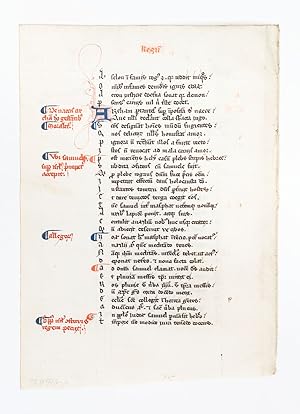
287 x 198 mm. (11 1/4 x 7 3/4). Single column, 32 lines in a small rounded English gothic hand, with rubrics in the margins. Rubrics in red, running title in red, paragraph marks in red or blue, two initials measuring two lines in height and colored blue with red penwork. See: P. E. Beichner, "Aurora, Petri Rigae Biblia Versificata, A Verse Commentary on the Bible." âRemnants of mounting tape in top margin of recto, but a really excellent specimen, the hand very clear, the ink especially rich, and the vellum extremely clean and quite bright. Written in a gothic hand heavily influenced by the English secretarial style, this leaf comes from a copy of the "Aurora," a commentary on the Bible in verse form written in the late 12th century by French poet Petrus Riga (1140-1209), a canon of Rheims cathedral. Although little is known about the author's life, Riga's text became immensely popular throughout Europe and was routinely studied in Medieval universities. According to Beichner, "for those who could read Latin, it supplied Scriptural lore in a popular form and it also served as a book of popular theology, devotional reading, moral instruction, and entertainment. Its influence was propagated by teachers, preachers, and lexicographers, by poets and other writers. It was studied, imitated, translated, and quoted. Not only was it widely read in monasteries and convents but it was also recommended reading for the sons of nobles." It is interesting to note that although Riga's work was copied numerous times in the 13th century, copies from the later Medieval period, such as the present work, are uncommonly rare. The parent manuscript containing our leaf was previously in the possession of the Dukes of Westminster, and was sold at Sotheby's on 11 July 1966 (lot 229), when it was advertised as having 267 leaves (missing the first gathering plus 13 other leaves). Bookseller Francis Edwards acquired the manuscript at that sale, removed three damaged leaves, and sold the remainder. It was thereafter broken up and dispersed. Several sister leaves are now in the collections of Marquette University, Lawrence University, and the University of South Carolina.


![Seller image for [Mythological scenes on palm leaves]. for sale by Antiquariat INLIBRIS Gilhofer Nfg. GmbH](https://pictures.abebooks.com/inventory/md/md32247953026.jpg)
![Seller image for [Finely Illuminated Vellum Manuscript Signature in Latin, perhaps France, ca. late 15th Century]. for sale by Jeff Weber Rare Books](https://pictures.abebooks.com/inventory/md/md30931089244.jpg)