Order Total (1 Item Items):
Shipping Destination:

Junianius (7 results)
Author:
junianius
Refine with Advanced Search
Skip to main search results
Search filters
Product Type
- All Product Types
- Books (7)
- Magazines & Periodicals (No further results match this refinement)
- Comics (No further results match this refinement)
- Sheet Music (No further results match this refinement)
- Art, Prints & Posters (No further results match this refinement)
- Photographs (No further results match this refinement)
- Maps (No further results match this refinement)
- Manuscripts & Paper Collectibles (No further results match this refinement)
Condition Learn more
- New (No further results match this refinement)
- As New, Fine or Near Fine (2)
- Very Good or Good (2)
- Fair or Poor (No further results match this refinement)
- As Described (3)
Binding
- All Bindings
- Hardcover (7)
- Softcover (No further results match this refinement)
Collectible Attributes
- First Edition (1)
- Signed (No further results match this refinement)
- Dust Jacket (No further results match this refinement)
- Seller-Supplied Images (5)
- Not Print on Demand (7)
Language (2)
Price
- Any Price
- Under £ 20 (No further results match this refinement)
- £ 20 to £ 40 (No further results match this refinement)
- Over £ 40
Free Shipping
- Free Shipping to U.S.A. (No further results match this refinement)
Seller Location
Seller Rating
-

Justini ex Trogi Pompei, Historiis Externis Libri XLIV [Historiae Philippicae]. Hic accessit ex Sexto Aurelio Victore - De Vita & Moribus Imperatorum Romanorum - Epitome.
Published by Ex Typographia Regia 1740 [MDCCXL], Augusta Taurinorum [Turin; Torino], 1740
RARE 1740 edition of the history of ancient world (from the foundation of Nineveh to 1st-century AD) by the Latin historian Justin (Marcus Junianus Justinus), an abridgement of the voluminous "Historiae Philippicae et Totius Mundi Origines et Terrae Situs" (Philippic Histories) written in the time of Augustus by Pompeius Trogus, whose work is lost. 170x110mm. 318 pages. Contemporary leather Hardcover. Decorated blue paper pasted on spine and part of cover. Cover and spine curved, wavy and worn. Cover corners bumped. Rear cover corners and spine edges partly peeling. Pasted decorated paper edges tattered. Spine and spine hinges rubbed. Spine edges peeling. Several small wormholes on front cover and spine hinges. Front inner cover upper corner peeled. Several small wormholes on front and rear inner covers. Binding visible on rear inner cover. Two small holes and several stains on title page edges - NO damage to text. Single small worm-mark on four last pages (315-318) upper edge and rear inner cover - NO damage to text. Last page (318) stained with slight damage to text, nevertheless readable. Pages yellowing, slightly age-stained and slightly wavy. [SUMMARY]: This extremely rare edition of ancient world history, used extensively in the Middle Ages and still of value to any serious student of ancient history, is in good condition for its age. The book is in : Latin.
-

Historiae Philippicae. Ad optimas editiones collatae, praemittitur notitia literaria, accedit index, studiis Soceietatis Bipontinae. Editio accurata.
Published by Ex Typographia Societatis, Zweibrücken (Biponti), 1784
Seller: AixLibris Antiquariat Klaus Schymiczek, Aachen, Germany
Association Member: BOEV
Seller rating 5 out of 5 stars

EA der Edition. 8°. Erste Auflage, XXVI, 423(1) S., 23 Bll. Etwas späterer Halblederband (um 1830) mit etwas Rückenvergoldung. Sprache: Latein, Mit gest. Titelvignette von Weis (Münzabbildung nach Carsten Niehburs Arabienbeschreibung). Einband leicht berieben; Bezugspapier der Deckel beschabt und hinterer Deckel auch mit kleiner Bezugspapierfehlstelle; Lederecken etwas bestoßen und mit winzigen Bezugsläsuren; Schmutztitel mit schwacher Knickspur; gering stockfleckig; hinterer Vorsatz und letzte Blätter in den Ecken etwas braunfleckig bzw. leimschattig; erste Blätter mit winzigem Wurmloch im weissen Rand.
-
Justini Historiarum ex Trogo Pompeio Libri XLIV
Published by Paris: Joseph Barbou, 1770
Seller: McConnell Fine Books ABA & ILAB, Deal, KENT, United Kingdom
Association Member: ABA ILAB PBFA
Seller rating 5 out of 5 stars
Hardcover. Condition: Fine. Full calf, 6 inches tall. A delightful 18th century calf binding with gilt bands, labels and floral gilt tooling to the panels. The mottled calf boards are framed by simple gilt rolls. All edges gilt. Frontispiece by Gravelot and woodcut ornaments. Finely printed latin text of this great history.
-
Iustini Historia ex Trogo Pompeio quattuor [et] triginta epithomatis collecta. -
Published by [Paris:] Francois Regnault [ca. 1513]., 1513
Seller: Antiquariat Tautenhahn, Lübeck, Germany
Association Member: GIAQ ILAB VDA
Seller rating 5 out of 5 stars
(2) Bll. (Titelei), (16) Bll. (Index), 140 (recte: 141) römisch numerierte Bll., (1) Bl. (vakat), moderner Lederband (Saffian), blindgeprägter Rücken und Vorderdeckel (Bourbonische Lilien), handumstochene Kapitalbändchen, 19 x 13,5 cm. Drei historische Schriften (ca. 1. bis 4. Jahrhundert n. Chr.) dreier römischer Geschichtsschreiber (d.s. Marcus Junianius Justinus, Lucius Annaeus Florus und Rufius Festus); Themen sind die Weltgeschichte, die Geschichte Makedoniens, die Geschichte Roms und die des Partherreichs (iranisches Hochland, Mesopotamien). - Der vollständige Titel lautet: "Iustini Historia ex Trogo Pompeio quattuor [et] triginta epithomatis collecta. Lucii Flori Epithomata quattuor q[uam] cultissima in dece[m] Titi Livi[i] decadas. Sexti Ruffi consularis viri ad Valentianum Augustum de Historia Romana opus dignissimum". - Eingehend kollationiert und vollständig; zum Vergleich diente das Digitalisat der Biblioteka Jagiellonska, Krakau. Sign. BJ Bien. G. I. 7 (a). Hier auch mit dem Paginierungsfehlern auf den Blättern CXXIXf. und CXXXIf. - Mit der gedruckten Widmung an den Humanisten und Verfasser der Gründungsgeschichte Venedigs ("Historiae rerum Venetiarum", 1487) Marcantonio Coccio Sabellico auf dem zweiten Blatt. - Das Titelblatt mit der seit 1513 verwendeten dritten Verlegermarke (Holzschnitt) Regnaults: Dargestellt ist ein Elephant mit zweitürmiger Burg auf dem Rücken, die Frontseite der Burg ziert ein schlichtes Wappenschild mit Regnaults Initialen ("FR"); am unteren Bildrand ein Spruchband mit Regnaults Vor- und Zunamen. - Renouard [1965], 363 ("Sa marque la plus ancienne est un triton, sa seconde marque figure un berger et une bergère, à partir de 1513 il emploie des marques à l'Éléphant"). - Mit vielen Schmuckinitialen im Text. - In lateinischer Sprache. - - - Enthält 1.: Die 44 durch Marcus Junianius Justinus (ca. 2./3. Jhr.) überlieferten Bücher des römischen Geschichtsschreibers Pompeius Trogus über die Weltgeschichte ("Historiae Philippicae"; Blätter I-XCIII). - Enthält 2.: Die von Lucius Annaeus Florus (ca. 1.-2. Jhr.) zusammengestellten Epithome der Geschichte Roms in vier (in anderer Zählung zwei) Bänden nach Titus Livius ("Zwei [bzw. vier] Bücher über die Kriege der Römer"; Blätter XCIIII-CXXXIII ). - Enthält 3.: Rufius Festus' (4. Jhr.) Kurzübersicht der Geschichte Roms zu seinem Hauptwerk "Breviarium rerum gestarum populi romani" (Blätter CXXXIIII-[CXLI]). - - - Provenienz: Bibliothek des Pädagogen und Bibliophilen Jürgen Engel (1933-2023; kleines typographisches Nachlassexlibris auf dem vorderen Spiegel). - Fachmännisch restauriert (Blätter gewaschen, einige wenige randlich angegossen). - Die Blätter insgesamt schwach wellig; dezente Stempelsignatur auf dem Titelblatt; ein Blatt mit kleiner randlicher Fehlstelle (ohne Textverlust); sonst und insgesamt gutes Exemplar et bien en vue.
-
![Seller image for Ivstinvs Ex M Zverii Boxhornii Recensione. [ Historiarum Philippicarum libri XLIV ] for sale by Eastleach Books](https://pictures.abebooks.com/inventory/md/md18564458458.jpg)
Ivstinvs Ex M Zverii Boxhornii Recensione. [ Historiarum Philippicarum libri XLIV ]
Language: Latin
Published by Apud Baba 1644, Venetiis [ Venice ], 1657
Condition: Very Good. reprint. Printers boards, VG. engraved title, [viii]+419+[7]pp, corner of the penultimate printed page torn away just below the text, edges un trimmed, text clean & bright with just the occasional yellowing to the paper. A nice copy, unbound & still in the printers boards. Justin's Historiae Philippicae with annotations & conjectures by the Dutch scholar from the University of Lieden, Marcus Zuerius Boxhorn [ 1612 - 1653 ] based upon his reading of a MS at Lieden. The text of the Historiarum is that of the French scholar & diplomat Jacques Bongars [ 1554 - 1612 ] which was first published in 1581. Ebert noted that Bongar's edition was a 'careful collation of 10 MSs & 3 editions'. Justin - Roman historian about whom little is know. His fame lies with this one work, an abridgement of the lost Historiae Philippicae et Totius Mundi Origines et Terrae Situs, written by Pompeius Trogus. Graesse III 513 & Ebert 11143 ( for the 1638 edition ). 175 grams.
-
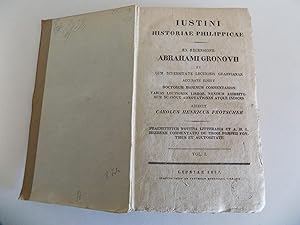
Iustini Historiae Philippicae. Ex recensione Abrahamii Gronovii et cum diversitate lectionis Graevianae accurate edidit, doctorum hominum commentarios varias lectiones librorum, nondum adhibitorum suasque adnotationes atque indices adiecit Carolus Henricus Frotscher. Praemittitur notitia litteraria et A. H. L. Heerenii commentatio de Trogi Pompeii fontibus et auctoritate. Vol. I-III in 3 Bänden.
Language: Latin
Published by Kühn 1827-1830, Leipzig, 1827
Seller: Antiquariat Rolf Bulang, Dautphetal, Germany
Seller rating 4 out of 5 stars

First Edition
Hardcover. Condition: Gut. Erste Ausgabe. CIV, 302 S., 1 Blatt; VIII, 592; 543 S. Einfache Pappbände der Zeit. Schweiger II/1, 494f. Der Buchblock von Band I nach S. 64 angebrochen und die Titelblätter jeweils mit kleinem altem Stempel, insgesamt handelt es sich jedoch um ein noch ordentliches, gut erhaltenes Exemplar mit nur leichten Gebrauchsspuren.
-
Justini historiarum Phillipicarum ex Trogo Pompeio. Libri XLIV (Abrégé de l'Histoire des Philippiques de Trogue Pompée)
Language: Latin
Published by Crapelet imprimeur, Paris, 1823
Plein veau. Condition: Bon. Justini historiarum Phillipicarum ex Trogo Pompeio. Libri XLIV. Un volume 14,5x21,7 cm de XXXII, 626 pages.Reliure romantique plein veau glacé (Vogel, non signé), tranches marbrées à la cuve, plats estampés à froid. Vignette Ex Libris du duc de Montebello (Louis Napoléon Lannes de Montebello, 1801-1874, deuxième du nom). Bon état du dos, petit manque 5 mm à la coiffe de tête, frottements sur les charnières, très légère fente 1 cm à la limite du premier plat en tête, petit manque 2 mm à la limite du second plat et du dos, bon état des plats, leger coup sur le premier plat, quatre petites décolorations de la peau sur le second plat, bon état des angles et des coupes. Très bonne tenue de la couture, parfait état intérieu;r parfait état des tranches. COMMENTAIRE DU LIBRAIRE. Luxueux exemplaire de ce volume de la Biblioteca classica latina édité par Nicolas-Eloi Lemaire d'après le texte établi par Johann Christian Friedrich Wetzel. L'appareil critique représente 176 pages du volume, dont 9 en français.



![Seller image for Iustini Historia ex Trogo Pompeio quattuor [et] triginta epithomatis collecta. - for sale by Antiquariat Tautenhahn](https://pictures.abebooks.com/inventory/md/md32010620851.jpg)