Order Total (1 Item Items):
Shipping Destination:

Herrera Maria Lidia (15 results)
Skip to main search results
Search filters
Product Type
- All Product Types
- Books (15)
- Magazines & Periodicals (No further results match this refinement)
- Comics (No further results match this refinement)
- Sheet Music (No further results match this refinement)
- Art, Prints & Posters (No further results match this refinement)
- Photographs (No further results match this refinement)
- Maps (No further results match this refinement)
- Manuscripts & Paper Collectibles (No further results match this refinement)
Condition Learn more
- New (14)
- As New, Fine or Near Fine (1)
- Very Good or Good (No further results match this refinement)
- Fair or Poor (No further results match this refinement)
- As Described (No further results match this refinement)
Binding
- All Bindings
- Hardcover (No further results match this refinement)
- Softcover (15)
Collectible Attributes
- First Edition (No further results match this refinement)
- Signed (No further results match this refinement)
- Dust Jacket (No further results match this refinement)
- Seller-Supplied Images (5)
- Not Print on Demand (10)
Language (3)
Free Shipping
- Free Shipping to U.S.A. (No further results match this refinement)
Seller Location
Seller Rating
-

Condition: New. UNA MIRADA HACIA EL NAVISMO.
-
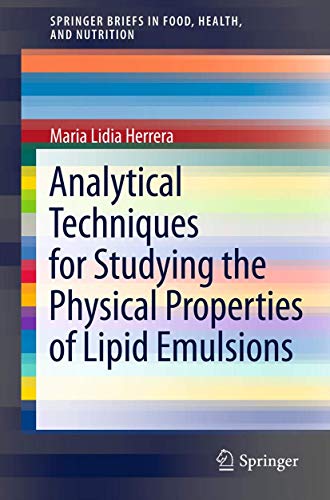
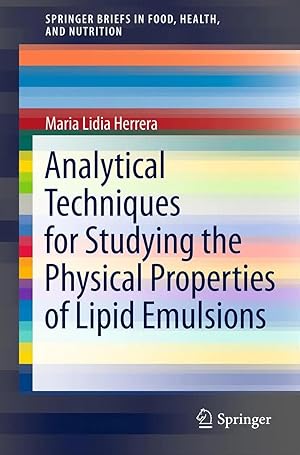
Analytical Techniques for Studying the Physical Properties of Lipid Emulsions (SpringerBriefs in Food, Health, and Nutrition)
Book 2 of 43: SpringerBriefs in Food, Health, and NutritionSeller: Ria Christie Collections, Uxbridge, United Kingdom
Seller rating 5 out of 5 stars

£ 48.98
£ 11.98 shipping
Ships from United Kingdom to U.S.A.Quantity: Over 20 available
Add to basketCondition: New. In.
-
-
-
Paperback. Condition: Brand New. 2012 edition. 72 pages. 9.25x6.10x0.16 inches. In Stock.
-

Analytical Techniques for Studying the Physical Properties of Lipid Emulsions
Book 2 of 43: SpringerBriefs in Food, Health, and NutritionLanguage: English
Published by Springer US, Springer US Mär 2012, 2012
ISBN 10: 1461432553 ISBN 13: 9781461432555
Seller: buchversandmimpf2000, Emtmannsberg, BAYE, Germany
Seller rating 5 out of 5 stars
Taschenbuch. Condition: Neu. Neuware -This book will review old and new methods to study emulsion stability and structure. Examples of emulsion-based foods include ice cream, yoghurt, and mayonnaise. The physicochemical properties of emulsions play an important role in food systems, as they directly contribute to the texture, sensory and nutritional properties of foods. One of the main properties is stability, which refers to the ability of an emulsion to resist physical changes over time. The development of an effective strategy to prevent undesirable changes in the properties of a particular food emulsion depends on the dominant physicochemical mechanism(s) responsible for the changes. In practice, two or more of these mechanisms may operate in concert. It is therefore important for food scientists to identify the relative importance of each mechanism, the relationship between them, and the factors that influence them, so that effective means of controlling the stability and physicochemical properties of emulsions can be established. Several techniques are used to study the physical behavior and structure of emulsions. Each technique has its advantages and disadvantages and provides different insights into the destabilization mechanisms. Among the oldest methods used to study emulsion stability is visual observation and small deformation rheometry. More recently, other techniques, such as ultrasound profiling, microscopy, droplet size distribution, and measurement of surface concentration to characterize adsorbed protein at the interface, have also been employed. Some of these techniques, such as droplet size distribution, involve some form of dilution. However, dilution disrupts some structures that play an important role in stability. The ability to study the stability of food emulsions in their undiluted form may reveal subtle nuances about their stability. Diffusing wave spectroscopy (DWS), laser scanning confocal microscopy (LSCM), nuclear magnetic resonance (NMR), and Turbiscan are among the more powerful, non-perturbing techniques used to characterized emulsions.Springer Verlag GmbH, Tiergartenstr. 17, 69121 Heidelberg 68 pp. Englisch.
-

Analytical Techniques for Studying the Physical Properties of Lipid Emulsions
Book 2 of 43: SpringerBriefs in Food, Health, and NutritionLanguage: English
Published by Springer US, Springer US, 2012
ISBN 10: 1461432553 ISBN 13: 9781461432555
Taschenbuch. Condition: Neu. Druck auf Anfrage Neuware - Printed after ordering - This book will review old and new methods to study emulsion stability and structure. Examples of emulsion-based foods include ice cream, yoghurt, and mayonnaise. The physicochemical properties of emulsions play an important role in food systems, as they directly contribute to the texture, sensory and nutritional properties of foods. One of the main properties is stability, which refers to the ability of an emulsion to resist physical changes over time. The development of an effective strategy to prevent undesirable changes in the properties of a particular food emulsion depends on the dominant physicochemical mechanism(s) responsible for the changes. In practice, two or more of these mechanisms may operate in concert. It is therefore important for food scientists to identify the relative importance of each mechanism, the relationship between them, and the factors that influence them, so that effective means of controlling the stability and physicochemical properties of emulsions can be established. Several techniques are used to study the physical behavior and structure of emulsions. Each technique has its advantages and disadvantages and provides different insights into the destabilization mechanisms. Among the oldest methods used to study emulsion stability is visual observation and small deformation rheometry. More recently, other techniques, such as ultrasound profiling, microscopy, droplet size distribution, and measurement of surface concentration to characterize adsorbed protein at the interface, have also been employed. Some of these techniques, such as droplet size distribution, involve some form of dilution. However, dilution disrupts some structures that play an important role in stability. The ability to study the stability of food emulsions in their undiluted form may reveal subtle nuances about their stability. Diffusing wave spectroscopy (DWS), laser scanning confocal microscopy (LSCM), nuclear magnetic resonance (NMR), and Turbiscan are among the more powerful, non-perturbing techniques used to characterized emulsions.
-
Taschenbuch. Condition: Neu. Analytical Techniques for Studying the Physical Properties of Lipid Emulsions | Maria Lidia Herrera | Taschenbuch | vi | Englisch | 2012 | Springer | EAN 9781461432555 | Verantwortliche Person für die EU: Springer Verlag GmbH, Tiergartenstr. 17, 69121 Heidelberg, juergen[dot]hartmann[at]springer[dot]com | Anbieter: preigu.
-
Condition: Sehr gut. Zustand: Sehr gut | Sprache: Englisch | Produktart: Bücher | This book will review old and new methods to study emulsion stability and structure. Examples of emulsion-based foods include ice cream, yoghurt, and mayonnaise. The physicochemical properties of emulsions play an important role in food systems, as they directly contribute to the texture, sensory and nutritional properties of foods. One of the main properties is stability, which refers to the ability of an emulsion to resist physical changes over time. The development of an effective strategy to prevent undesirable changes in the properties of a particular food emulsion depends on the dominant physicochemical mechanism(s) responsible for the changes. In practice, two or more of these mechanisms may operate in concert. It is therefore important for food scientists to identify the relative importance of each mechanism, the relationship between them, and the factors that influence them, so that effective means of controlling the stability and physicochemical properties of emulsions can be established. Several techniques are used to study the physical behavior and structure of emulsions. Each technique has its advantages and disadvantages and provides different insights into the destabilization mechanisms. Among the oldest methods used to study emulsion stability is visual observation and small deformation rheometry. More recently, other techniques, such as ultrasound profiling, microscopy, droplet size distribution, and measurement of surface concentration to characterize adsorbed protein at the interface, have also been employed. Some of these techniques, such as droplet size distribution, involve some form of dilution. However, dilution disrupts some structures that play an important role in stability. The ability to study the stability of food emulsions in their undiluted form may reveal subtle nuances about their stability. Diffusing wave spectroscopy (DWS), laser scanning confocal microscopy (LSCM), nuclear magnetic resonance (NMR), and Turbiscan are among the more powerful, non-perturbing techniques used to characterized emulsions. .
-

La docència universitària avui
Language: Catalan
Published by DOCUMENTA UNIVERSITARIA, 2000
ISBN 10: 8499847269 ISBN 13: 9788499847269
Condition: Nuevo. La docència universitària avui editado por Documenta universitaria.
-
Condition: new. Questo è un articolo print on demand.
-

Analytical Techniques for Studying the Physical Properties of Lipid Emulsions
Book 2 of 43: SpringerBriefs in Food, Health, and NutritionLanguage: English
Published by Springer US Mrz 2012, 2012
ISBN 10: 1461432553 ISBN 13: 9781461432555
Seller: BuchWeltWeit Ludwig Meier e.K., Bergisch Gladbach, Germany
Seller rating 5 out of 5 stars
Taschenbuch. Condition: Neu. This item is printed on demand - it takes 3-4 days longer - Neuware -This book will review old and new methods to study emulsion stability and structure. Examples of emulsion-based foods include ice cream, yoghurt, and mayonnaise. The physicochemical properties of emulsions play an important role in food systems, as they directly contribute to the texture, sensory and nutritional properties of foods. One of the main properties is stability, which refers to the ability of an emulsion to resist physical changes over time. The development of an effective strategy to prevent undesirable changes in the properties of a particular food emulsion depends on the dominant physicochemical mechanism(s) responsible for the changes. In practice, two or more of these mechanisms may operate in concert. It is therefore important for food scientists to identify the relative importance of each mechanism, the relationship between them, and the factors that influence them, so that effective means of controlling the stability and physicochemical properties of emulsions can be established. Several techniques are used to study the physical behavior and structure of emulsions. Each technique has its advantages and disadvantages and provides different insights into the destabilization mechanisms. Among the oldest methods used to study emulsion stability is visual observation and small deformation rheometry. More recently, other techniques, such as ultrasound profiling, microscopy, droplet size distribution, and measurement of surface concentration to characterize adsorbed protein at the interface, have also been employed. Some of these techniques, such as droplet size distribution, involve some form of dilution. However, dilution disrupts some structures that play an important role in stability. The ability to study the stability of food emulsions in their undiluted form may reveal subtle nuances about their stability. Diffusing wave spectroscopy (DWS), laser scanning confocal microscopy (LSCM), nuclear magnetic resonance (NMR), and Turbiscan are among the more powerful, non-perturbing techniques used to characterized emulsions. 68 pp. Englisch.
-
Condition: New. Print on Demand pp. 68 8 Illus. (5 Col.).
-
Condition: New. PRINT ON DEMAND pp. 68.
-
Kartoniert / Broschiert. Condition: New. Dieser Artikel ist ein Print on Demand Artikel und wird nach Ihrer Bestellung fuer Sie gedruckt. This book will review old and new methods to study emulsion stability and structure. Examples of emulsion-based foods include ice cream, yoghurt, and mayonnaise. The physicochemical properties of emulsions play an important role in food systems, as they dir.