

Order Total (1 Item Items):
Shipping Destination:

Harry Nyquist (4 results)
Skip to main search results
Search filters
Product Type
- All Product Types
- Books (4)
- Magazines & Periodicals (No further results match this refinement)
- Comics (No further results match this refinement)
- Sheet Music (No further results match this refinement)
- Art, Prints & Posters (No further results match this refinement)
- Photographs (No further results match this refinement)
- Maps (No further results match this refinement)
- Manuscripts & Paper Collectibles (No further results match this refinement)
Condition Learn more
- New (No further results match this refinement)
- As New, Fine or Near Fine (1)
- Very Good or Good (2)
- Fair or Poor (1)
- As Described (No further results match this refinement)
Binding
Collectible Attributes
- First Edition (2)
- Signed (No further results match this refinement)
- Dust Jacket (No further results match this refinement)
- Seller-Supplied Images (2)
- Not Print on Demand (4)
Language (2)
Price
- Any Price
- Under £ 20 (No further results match this refinement)
- £ 20 to £ 35 (No further results match this refinement)
- Over £ 35
Free Shipping
- Free Shipping to U.S.A. (No further results match this refinement)
Seller Location
Seller Rating
-
Frequency-Response Methods in Control Systems
First Edition
Soft cover. Condition: Near Fine. 1st Edition. soft cover in near fine condition.
-

Condition: Fair. This is an ex-library book and may have the usual library/used-book markings inside.This book has hardback covers. In fair condition, suitable as a study copy. No dust jacket. Please note the Image in this listing is a stock photo and may not match the covers of the actual item,1500grams, ISBN:0879421258.
-
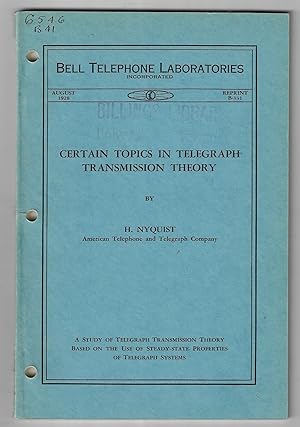
"Certain Topics in Telegraph Transmission Theory", Bell Telephone Laboratories
Published by American Institute of Electrical Engineers, 1928
Seller: JF Ptak Science Books, Hendersonville, NC, U.S.A.
Seller rating 5 out of 5 stars

Soft cover. Condition: Very Good. Harry Nyquist, "Certain Topics in Telegraph Transmission Theory", Bell Telephone Laboratories Reprint B-331, American Institute of Electrical Engineers, August 1928. 9 x 6 , 79pp. Original wrappers. There is a very light more than half-faded rubber stamp on the front cover, plus a small library number written ink at top left and again very small at the base of the spine. There is also a very slight indentation in a narrow stretch of text between pp 64 and 79. Also: this is three-hole punched, which is not unusual for this publication and at this point I do believe I can say that this was done at the printer and not by the owner. VG copy.__+__ In this "classic paper" Nyquist "the founding father of digital communications" (Lisa Maliniak, Electronic design, Oct 2005)--who holds an important place in the history of electrical engineering as a pioneer of the mathematical theory of communication -- gives a "mathematical" in addition to an "engineering" point of view of the subject matter.--(N.C. Beaulieu, Introduction to "Certain topics in telegraph transmission theory , Proceedings of the IEEE, vol 90 #2.) __+__ "The Nyquist Shannon sampling theorem is a theorem in the field of digital signal processing which serves as a fundamental bridge between continuous-time signals and discrete-time signals. It establishes a sufficient condition for a sample rate that permits a discrete sequence of samples to capture all the information from a continuous-time signal of finite bandwidth." --Nyquist-Shannon Sampling Theorem, Wikipedia. [It was proved by Claude E. Shannon (January 1949) and published in the paper "Communication in the presence of noise", Proceedings of the Institute of Radio Engineers. 37 (1): 10 21. Also, Shannon salutes Nyquist for his essential work in the very first paragraph of his great paper on the mathematical theory of communication (BSTJ 1948) noting "the basis for [this] theory is contained in the important papers of Nyquist and Hartley on this subject". __+__ It is in the section Analysis of D-c. Wave and Appendix I that the famous "Nyquist rate" is established and Nyquist's sampling result is found. (Beaulieu) (There are over 3500 papers addressing some aspect of the Nyquist rate in the IEEE alone.) __+__ Also in Section III and appendix I is the beginning of the Nyquist First, Second, and Third Criterion for distortionless digital transmission. ".we find in the paper an early statement that digital communication systems will clock signaling intervals and the concept that information will be conveyed by altering some property or condition of the signal in each signaling interval. Further, it is specified that there is a finite number of conditions and that in the case of the simple telegraph, the total number of conditions is two, open and close. This is in sharp distinction to the case of telephony where there are neither simple numerical relations between the various time intervals, nor a finite number of possible current values.The Preliminary Discussion concludes prophetically, asserting that In the illustrations given, the sent waves were voltage waves. This is not necessarily the case in order for the discussion to apply. The sent wave may be a current wave, or it need not even be electrical. By providing suitable coupling the sent wave may be in the form of variations of a light beam. Interestingly, the word variations perhaps suggests that Dr. Nyquist was thinking of more than a simple on-off light beam." __+__ Among the honors awarded Nyquist are the EE Hall of Fame (IEEE), IRE Medal of Honor, and many others.
-
Certain Factors Affecting Telegraph Speed
Published by American Institute of Electrical Engineers [ AIEE ], New York, 1924
Seller: Kuenzig Books ( ABAA / ILAB ), Topsfield, MA, U.S.A.
Association Member: ABAA ESA ILAB IOBA SNEAB
Seller rating 4 out of 5 stars

First Edition
Cloth. Condition: Very Good. First Edition. First Edition. [4], 1369 pages. 4to 9 1/2 x 11 1/2 inches. Publisher's blue cloth with 2 sets of blindstamped rules on front and rear covers and volume title and date in gilt on spine. Endpapers browned as usual, front blank flyleaf separated and laid in loosely. The entire volume #43 of the Transactions of the American Institute of Electrical Engineers, covering publications of the American Institute of Electrical Engineers (AIEE) from January to December 1924. Printed at the Press of Mellroy & Smith Inc, 22 Thames St. New York. Cloth. This volume publishes in chronological order "the papers and discussions presented at the four conventions and two regional meetings held under its [ American Institute of Electrical Engineers ] auspices during the year, 1924. The articles have all been printed in the Journal [of the American Institute of Electrical Engineers] either in full or abridged form; they are published here in their entirety with the addition of any discussions for each special group immediately following." On pages 412-422 we find "Certain Factors Affecting Telegraph Speed", one of two key Nyquist papers (the other being "Certain Topics in Telegraph Transmission Theory" from 1928) which Claude Shannon credited with being foundational works in information theory (along with a work by Hartley). Bibliographically, this paper appears in four places in the first year of publication. First, in the Journal of the AIEE, pages 124-130 (presumably an abridged text based on the page count and publication format), in February 1924. It was published two months later in the Bell System Technical Journal, and also printed separately in the Bell System Publications Monograph series (B-173, publication date unknown, but 1924). And finally, as here, the entire text published presumably at the end of 1924. This final and best publication [as offered here] includes a final page with discussion of a submitted letter about the paper and commentary by Nyquist, making this the most complete version of this first key paper we are aware of. "In an effort to improve the speed of data transmission over telegraph wires, Nyquist isolated two key factors - signal shaping and choice of codes.his work was important for presenting the first statement of a logarythmic law for communication and the first examination of the theoretical bounds for ideal codes for the transmission of information.In his 1948 paper 'A Mathematical theory of Communication', Claude Shannon credited Nyquist's paper as being one of the foundations of information theory." Origins of Cyberspace 343 (referring only to the 1924 Nyquist paper but offered in the Bell System Technical Journal). In our experience, the AIEE Journal and Transactions are far more difficult to find than the Bell System publications. A nice addition to any collection related to the History of Communication.


