Order Total (1 Item Items):
Shipping Destination:

Gamkrelidze Ivanov (8 results)
Skip to main search results
Search filters
Product Type
- All Product Types
- Books (8)
- Magazines & Periodicals (No further results match this refinement)
- Comics (No further results match this refinement)
- Sheet Music (No further results match this refinement)
- Art, Prints & Posters (No further results match this refinement)
- Photographs (No further results match this refinement)
- Maps (No further results match this refinement)
- Manuscripts & Paper Collectibles (No further results match this refinement)
Condition Learn more
- New (2)
- As New, Fine or Near Fine (1)
- Very Good or Good (No further results match this refinement)
- Fair or Poor (No further results match this refinement)
- As Described (5)
Binding
- All Bindings
- Hardcover (5)
- Softcover (No further results match this refinement)
Collectible Attributes
- First Edition (No further results match this refinement)
- Signed (No further results match this refinement)
- Dust Jacket (3)
- Seller-Supplied Images (5)
- Not Print on Demand (8)
Language (5)
Price
- Any Price
- Under £ 20 (No further results match this refinement)
- £ 20 to £ 35 (No further results match this refinement)
- Over £ 35
Free Shipping
- Free Shipping to U.S.A. (No further results match this refinement)
Seller Location
Seller Rating
-
![Stock image for Indo-European and the Indo-Europeans. A Reconstruction and Historical Analysis of a Proto-Language and a Proto-Culture. Part I [1]: The Text. With a Preface by Roman Jakobson. English version by Johanna Nichols. Edited by Werner Winter. for sale by Antiquariat Christoph Wilde](https://pictures.abebooks.com/isbn/9783110096460-uk-300.jpg)
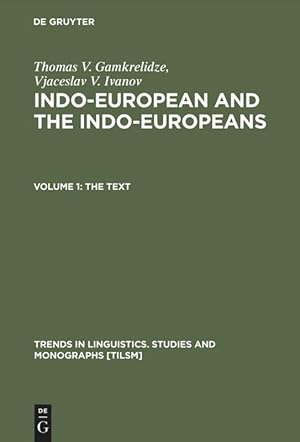
Indo-European and the Indo-Europeans. A Reconstruction and Historical Analysis of a Proto-Language and a Proto-Culture. Part I [1]: The Text. With a Preface by Roman Jakobson. English version by Johanna Nichols. Edited by Werner Winter.
Language: English
Published by Mouton de Gruyter, Berlin - New York,, 1995
ISBN 10: 3110096463 ISBN 13: 9783110096460
Seller: Antiquariat Christoph Wilde, Düsseldorf, Germany
Seller rating 5 out of 5 stars

CVI, 864, (2) S. Orig.-Leinenband (= Trends in Linguistics - Studies and Monographs 80). - Handschriftlicher Eintrag auf Vorsatz; ansonsten innen sauber. Sehr gut erhaltenes Exemplar. - Achtung: Bei Auslandsversand bitte Portokosten erfragen (höheres Gewicht)!
-
Gebunden. Condition: New.
-

Condition: Brand New. In the second part of the book, semantically organized presentation of material from the lexicon is combined with analyses of the use of forms and formulae in a broadly defined cultural context. Volume and II of the original Russian edition have been combined in the English version as Part I; 21 Dec 1995.
-

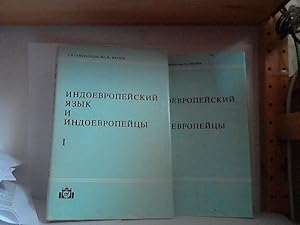
Indo-European and the Indo-Europeans: a reconstruction and historical typological analysis of a protolanguage and a proto-culture [2 vols. in Russian]
Published by Tbilisi, Isd-vo Tbilisskogo universiteta [Publishing house of the Tbilisi State University] 1984, 1984
Seller: Antiquariaat Pieter Judo (De Lezenaar), Hasselt, Belgium
Association Member: ILAB
Seller rating 5 out of 5 stars
Russian edition of this work: "Indoevropejskij jazyk i indoevropejcy: rekonstrukcija i istoriko-tipologiceskij analiz prajazyka i protokultury", complete in 2 volumes: xcvi + 1328pp.with ills. + 1 folding map in colour, 27cm., first and original 1984 edition in Russian of this reference work, edition of only 5000 copies, cloth, dustwrapper (minor wear), text in very good condition, [text in Russian in Cyrillic script], [Tamaz V. Gamkrelidze is a distinguished Georgian linguist and orientalist who published outstanding works in the fields of Indo-European linguistics; Viacheslav V. Ivanov is prominent Soviet-Russian philologist and one of the most influential scholars in the field of Indo-European studies; this reference work offers a revision of views on several central issues of Indo-European Studies, e.g. the glottalic theory and the proposal to place the Indo-European Urheimat in the region south of the Kaukasus], OCLC 639932865, T75487.
-
![Seller image for [Indo-european and the Indo-Europeans. A reconstruction and historical analysis of a protolanguage and a proto-culture. [En russe]. With a preface by Roman Jakobson. for sale by Librairie Le Trait d'Union sarl.](https://pictures.abebooks.com/inventory/md/md7155126948.jpg)
[Indo-european and the Indo-Europeans. A reconstruction and historical analysis of a protolanguage and a proto-culture. [En russe]. With a preface by Roman Jakobson.
Language: French
Publication Date: 1984
Seller: Librairie Le Trait d'Union sarl., TROYES, France
Association Member: ILAB
Seller rating 5 out of 5 stars
Tbilisi State University, 1984. 2 vol. in-8 reliure éditeur pleine toile sous jaquette, XCVI-1328 pp. en continu, bibliogr., index. Ouvrage entier en langue russe. /113A Bonne condition.
-
Indo-European and the Indo-Europeans. A Reconstruction and Historical Typological Analysis of a Protolanguage and a Proto-Culture.
Language: Russian
Published by Tbilisi: Publishing House of the Tbilisi State University,, 1984
Seller: COTTAGE Antiquariat - anbu.at, Langenzersdorf, Austria
Seller rating 5 out of 5 stars
= 2 Bände, komplett. 1328 Seiten. Russisch. This Two-Volume Work applies language typology and linguistic universals to theoretical problems of historical comparative linguistics and language reconstruction. Part one reconstructs the grammatical system of Pro-Indo-European on different sturctural levels: phonological, morphological, and syntactic. - Schutzumschläge randberieben, stellenweise leicht eingerissen und angefleckt, Titel mit hs Besitzervermerken. Insgesamt solides und seitensauberes Set. ****An unsere Kunden in Deutschland: Versand nach Deutschland einmal in der Woche ab Freilassing mit der Deutschen Post.*** - ru Gewicht in Gramm: 2600 Gr.-8°, Original-Ganzleinen mit Original-Schutzumschlag.
-
![Seller image for Indo-European and the Indo-Europeans. A Reconstruction and Historical Analysis of a Proto-Language and Proto-Culture. Part I: The Text. Part II: Bibliography, Indexes [ 2 volumes ]. for sale by Emile Kerssemakers ILAB](https://pictures.abebooks.com/inventory/md/md31875812756.jpg)
Indo-European and the Indo-Europeans. A Reconstruction and Historical Analysis of a Proto-Language and Proto-Culture. Part I: The Text. Part II: Bibliography, Indexes [ 2 volumes ].
Published by Mouton de Gruyter, Berlin / New York, 1995
Seller: Emile Kerssemakers ILAB, Heerlen, Netherlands
Seller rating 5 out of 5 stars
2 vols. Original hardcovers. cvi,864 pp. & xxxiv,264 pp.; 23.5x15.5 cm. Text in English - Very good condition, see picture 2160g.
-

Indo-European and the Indo-Europeans. A Reconstruction and Historical Typological Analasys of a Protolanguage and a Proto-Culture. / Indojewropejskij jasyk i Indo jewropejzy. Zwei Bände.
Language: German
Published by Tbilisi: State University, 1984
Seller: Fundus-Online GbR Borkert Schwarz Zerfaß, Berlin, Germany
Seller rating 5 out of 5 stars
Condition: Sehr gut. 1328 S. Umschlag berieben und zum Teil eingerissen, sonst gutes Exemplar. - Text in russischer Sprache - nut Titel und Klappentext auf Englisch. - Aus Wikipedia: "Laut der Glottaltheorie hatte die Indogermanische Ursprache anstelle der stimmhaften Plosive b d g der klassischen Rekonstruktion die Ejektive p' t' k'. Ein Vorgänger dieser Theorie wurde vom dänischen Linguisten Holger Pedersen vorgeschlagen, enthielt jedoch keine glottalisierten Laute. Auch wenn Linguisten wie André Martinet und Morris Swadesh früh das Potential erkannten, das mit der Ersetzung der unaspirierten stimmhaften Verschlusslaute durch glottalisierte Laute verbunden war, blieb dieser Vorschlag rein spekulativ, bis 1973 stichhaltige Beweise gleichzeitig und unabhängig voneinander von Paul Hopper (USA) in der Zeitschrift Glossa" und von Thomas Gamkrelidze und Wjatscheslaw Iwanow (UdSSR) in der Zeitschrift Phonetica" veröffentlicht wurden." - THIS TWO-VOLUME WORK applies language typology and linguistic universals to theoretical problems of historical comparative linguistics and language reconstruction. Diachronic linguistics is investigated hand-in-hand with ethno-cultural problems pertaining to establishing proto-homelands and time depths of protolanguages and their daughter dialects. The theoretical premises and methodology provide a new approach to linguistic and ethnogenetic reconstruction in general, and to traditional problems in comparative Indo-European studies in particular. PART ONE reconstructs the grammatical system of Proto-Indo-European on different structural levels: phonological, morphological, and syntactic. A new phonological reconstruction is proposed, one which radically restructures the received view of the Proto-Indo-European sound system, especially its consonantism. It necessitates a basic reinterpretation and reformulation of the principle neogramrnarian Sound Laws such as Grimm's Law, Grassmann's Law, etc. On the basis of comparative and typological evidence, the traditional and classical four-fold (later three-fold) system of Proto-Indo-European stops, which historically was patterned mainly on Sanskrit, is given a phonological reinterpretation whereby the "plain voiced stops" are viewed as initially glottalized. The three-fold stop series in the new interpretation are: I, glottalized; II, voiced (-aspirate); III, voiceless (-aspirate), where aspiration is a phonetically relevant, but phonemically redundant allophonic feature. This revision of the consonantism is known in current Indo-European comparative studies as the Glottalic Theory. This new consonantal pattern of Proto-Indo-European was advanced by the authors as early as 1972 and later elaborated upon in separate publications. The book sums up their work in this direction. In addition, the book presents an original mor-phosyntactic model of Proto-Indo-European and takes a new look at its diachronic transformations into the historical Indo-European languages. On the glottalic analysis these transformations prove to be totally different from those traditionally assumed. The archaic Proto-Indo-European stop inventory turns out to be closer to those of languages traditionally viewed as having undergone later consonant shifts or "Lautverschiebung" (Germanic, Armenian, Hittite), while languages traditionally considered phonologically conservative (especially Old Indian) prove to have undergone complex phonemic transformations in their consonantism. The book gives a complete reformulation of all the basic comparative work in Indo-European. PART TWO presents a semantic reconstruction of the Proto-Indo-European lexical system. It provides a vocabulary of Proto-Indo-European lexemes, reconstructed according to the new phonological pattern and arranged by semantic groups. The lexemes are structurally analyzed with respect to both their form and the material and cultural-historical content of their designata (signifies). The reconstructed semantic vocabulary gives a substantive basis for inquiry into the original homeland, areal contacts, and possible prehistoric migrations of the Proto-Indo-European-speaking tribes. Semantic analysis of the reconstructed vocabulary and its implications for the ecological environment and the material and spiritual culture of tribes speaking ancient Indo-European dialects places the center of diffusion of these dialects, and consequently the Proto-Indo-European homeland, somewhere in the broad area extending from the Balkans in the west to northern Mesopotamia and the Iranian plateau in the east, in the fifth to fourth millennia B.C. Numerous lexical items shared among Proto-Indo-European, Proto-Semitic, South Caucasian, and sometimes other ancient Near Eastern languages, further narrow down the potential homeland to a particular area in southwest Asia. This posited homeland necessitates a complete revision of the received view of the Proto-Indo-European speakers' migrations to their historical locations on the Eurasian continent. The concluding chapters of Part Two establish new trajectories for prehistoric migrations and a new picture of the Indo-European dialect break-up. (Klappentext). Sprache: Deutsch Gewicht in Gramm: 1550 Originalleinen mit Schutzumschlag.