Order Total (1 Item Items):
Shipping Destination:

Foreword Casimir (4 results)
Skip to main search results
Search filters
Product Type
- All Product Types
- Books (4)
- Magazines & Periodicals (No further results match this refinement)
- Comics (No further results match this refinement)
- Sheet Music (No further results match this refinement)
- Art, Prints & Posters (No further results match this refinement)
- Photographs (No further results match this refinement)
- Maps (No further results match this refinement)
- Manuscripts & Paper Collectibles (No further results match this refinement)
Condition Learn more
- New (1)
- As New, Fine or Near Fine (No further results match this refinement)
- Very Good or Good (2)
- Fair or Poor (No further results match this refinement)
- As Described (1)
Binding
- All Bindings
- Hardcover (4)
- Softcover (No further results match this refinement)
Collectible Attributes
- First Edition (2)
- Signed (No further results match this refinement)
- Dust Jacket (1)
- Seller-Supplied Images (2)
- Not Print on Demand (4)
Language (2)
Free Shipping
- Free Shipping to U.S.A. (No further results match this refinement)
Seller Location
Seller Rating
-

Electrical Breakdown of Insulating Liquids
Published by Interscience Publishers / Philips Technical Library, New York / Eindhoven:, 1961
First Edition
Hardcover. Condition: Very Good EX-LIBRARY. Dust Jacket Condition: No Jacket. First Edition. New York / Eindhoven:: Interscience Publishers / Philips Technical Library, 1961. Inner hinges are perfect. Corners are NOT bumped. "WITHDRAWN" stamp, and a few other library markings on the endpapers. Text pages are clean and crisp. No underlining. No highlighting. No margin notes. Illustrated with 44 figures in the text, and 4 photographic plates on glossy paper. Seven appendices. Bibliographical references. Author Index. Subject Index. Bound in the original maroon cloth, lettered in gold on the spine. From the preface: "This book describes a view on the mechanism of electrical breakdown of liquids serving as insulation or dielectrics. This theory may explain the features encountered in breakdowns and breakdown tests. The book aims at opening a direct and useful road toward a more complete understanding of the various problems connected with oil breakdown and deterioration.". First Edition. Hard Cover. Very Good EX-LIBRARY./No Jacket. 8vo. xii, 132pp.
-
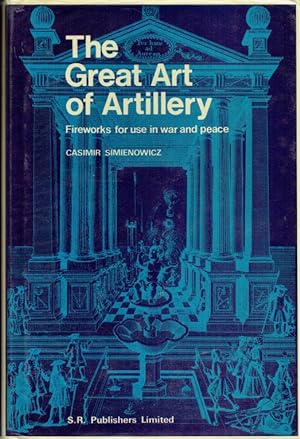
THE GREAT ART OF ARTILLERY : FIREWORKS FOR USE IN WAR AND PEACE (1729)
Seller: Paul Meekins Military & History Books, Stratford upon Avon, United Kingdom
Seller rating 5 out of 5 stars

Hardcover. Condition: Good. Dust Jacket Condition: Good. Hardback; boards dented, foxing to edge of pages, otherwise good in price-clipped, foxed and yellowed dustjacket. ; Facsimile reprint of the English edition published 1729. Originally written in Latin, circa 1650, translated from the French, by George Shelvocke. Casimir Simienowicz, one of the most notable firemasters of the seventeenth century, served as Lieutenant-General of the Ordnance to the King of Poland. Study devoted to military and civil fireworks. Illustrated; with fold-out plans. With New Foreword by Brigadier O. F. G. Hogg. ; 450 pages.
-

The Haitians: A Decolonial History (Latin America in Translation)
Book 23 of 24: Latin America in TranslationLanguage: English
Published by The University of North Carolina Press 2020-10-30, 2020
ISBN 10: 1469651548 ISBN 13: 9781469651545
Hardcover. Condition: New.
-

The 79th Survivor
Language: English
Published by Bachman & Turner, London, 1976
ISBN 10: 0859740307 ISBN 13: 9780859740302
First Edition
Hardcover. Condition: Very Good. 1st Edition. Hardcover, 246 pages. A foreign stamp on the title page. Interior in great shape, clean and bright with unmarked text, free of inscriptions, firmly bound. Gently age-toned upper outer page edges, a touch of minor yellowing on endpapers only. Dust jacket with a tear to the upper front edge. -- "This book needs no introduction. It is the authentic story of my brother-in-law, a Polish officer of the reserve (son of the composer and the well beloved conductor of the Warsaw Opera, Emil Mlynarski), captured at the end of the Polish-German Campaign in 1939 by the invading Red Army and detained in a Soviet camp for officers. Most of the inmates of these camps disappeared mysteriously and bodies of over 4,000 of them were later found in the Katyn Woods near Smolensk. They were identified and it was established that the victims had been inmates of one camp only, namely that of Kozyelsk [Kozelsk]. A similar fate befell officers in the two other camps, most of whom disappeared without trace. Mlynarski was held at the camp of Starobyelsk and for reasons unknown, with 78 other Polish officers, was allowed to survive and to tell his story. It is a tragic one. First came the treacherous and brutal blow struck by the Red Army in the back of the retreating and unsuspecting Polish troops belonging to a country with whom the Soviet Union not only was not in a state of war but bound by a non-aggression pact. Then came the no less brutal manner by which the prisoners were driven into Central Russia, first on foot, later in box-cars more apt for transporting cattle than human beings. And finally the sojourn in the Starobyelsk [Starobielsk] Camp. The author's account of his ghastly ordeal is not only gripping but offers an incisive insight into the workings of the secret police, known then as the NKVD, which ran the camp. The way in which, as one can assume, the decision of the ultimate annihilation of the Polish prisoners of war was slowly maturing in Stalin's mind, has the makings of a Greek tragedy of unsurpassed dimensions." (Arthur Rubinstein) -- Contents: 1 Warsaw, September 1939; 2 Direction - East; 3 A knife in our backs; 4 Deadly ambush; 5 Eye to eye with the enemy; 6 In Soviet captivity; 7 To the East in stages; 8 Our first contacts with Soviet reality; 9 Camp Starobyelsk; 10 A delegate from Moscow; 11 Everyday camp life; 12 Prisoners from Shepetovka; 13 Lavotchka, the green box; 14 Roubles; 15 My first interrogation; 16 The new barracks; 17 "Thank you, my friends"; 18 Dogs; Epilogue by Witold Kaczkowski -- "Prompted by a sense of evil foreboding a handful of officers who had been closely united through brotherhood, through suffering and distress, gave each other a solemn vow that if one of them should live to see freedom, he would remember the others. This proved to be our parting. For Providence chose to spare me only and to restore freedom to me alone." This book is the fulfilment of Mlynarski's promise to those friends. He was one of the 79 officers out of nearly 4,000 whose life was spared by the NKVD when they liquidated the Starobyelsk "special" prisoner-of-war camp in 1940. Caught between the German and Red Armies at the beginning of the ww2, some Poles hoped against hope that the Red Army was crossing the border to fight side by side with them against the Germans. Reality brought an invaded Poland, a defeated and imprisoned army and 3 special pow camps for the leaders of Polish society. In 1943 in the Katyn Woods the Germans dug up the corpses of the unlucky 4,254 Poles from one of the special camps. The bodies of the "other 10,000" from the other two camps have never been found. This is a tragic yet poetic story of a true patriot, imbued with a deep love for human beings, who also felt sympathy for the ordinary Russian people, themselves victims of the inhuman Stalin regime. It is also one of the most important contributions to a chapter in history which has been shrouded in secrecy, hidden behind an iron curtain of conspiracy.