Order Total (1 Item Items):
Shipping Destination:

Fizeau Hippolyte (26 results)
Skip to main search results
Search filters
Product Type
- All Product Types
- Books (26)
- Magazines & Periodicals (No further results match this refinement)
- Comics (No further results match this refinement)
- Sheet Music (No further results match this refinement)
- Art, Prints & Posters (No further results match this refinement)
- Photographs (No further results match this refinement)
- Maps (No further results match this refinement)
- Manuscripts & Paper Collectibles (No further results match this refinement)
Condition Learn more
- New (No further results match this refinement)
- As New, Fine or Near Fine (2)
- Very Good or Good (18)
- Fair or Poor (No further results match this refinement)
- As Described (6)
Binding
Collectible Attributes
- First Edition (2)
- Signed (2)
- Dust Jacket (No further results match this refinement)
- Seller-Supplied Images (7)
- Not Print on Demand (26)
Language (1)
Price
- Any Price
- Under £ 20 (No further results match this refinement)
- £ 20 to £ 35 (No further results match this refinement)
- Over £ 35
Free Shipping
Seller Location
Seller Rating
-

"Tableau des dilatations par la chaleur de divers corps simples métalliques ou non métalliques et de quelques composés hydrogénés du carbone" in Comptes rendus de l'Academie des Sciences.
Published by Gauthier-Villars, Paris, 1869
Seller: JF Ptak Science Books, Hendersonville, NC, U.S.A.
Seller rating 5 out of 5 stars

Soft cover. Condition: Good. FIZEAU, Hippolyte. "Tableau des dilatations par la chaleur de divers corps simples métalliques ou non métalliques et de quelques composés hydrogénés du carbone" in Comptes rendus de l'Academie des Sciences, Paris, Gauthier-Villars, 17 May 1869, t. 68 no. 20, p. 1125-1131 in the issue of pp 1125-1188. This is the full weekly issue, extracted from a larger bound volume., offered with the original wrappers (scarce, though detached).
-
"Sur une methode propre a recherche, si l'azimut de polarisation du rayon refracte, est influence par le mouvement du corps refringent, essai de cette methode" in Comptes Rendus des Sciences
Published by Mallet-Bachelier, 1859
Seller: JF Ptak Science Books, Hendersonville, NC, U.S.A.
Seller rating 5 out of 5 stars
Soft cover. Condition: Good. Fizeau, Hippolyte. "Sur une methode propre a recherche, si l'azimut de polarisation du rayon refracte, est influence par le mouvement du corps refringent, essai de cette methode" in Comptes Rendus.des Sciences, vol 49 no.20, 514 November 685-1859, pp 717-723 in the issue of pp 685 756. Extracted from a larger bound volume, offered with the original wrappers (detached). GOOD copy, though crisp. [++] OFFERED WITH: Faye (Fizeau). "Sur les experiences de M. Fizeau considerees au point de vue du mouvement de translation du systeme solaire" (commenting on the previous paper by Fizeau), in Comptes Rendus.des Sciences, vol 49 no. 23, 5 December 1859, pp 870-875 in the weekly issue of pp 869-908. Extracted from a larger bound volume, offered with the original wrappers (detached). GOOD copy, though crisp. [++] "Going Right and Making It Wrong: The Reception of Fizeau s Ether-Drift Experiment of 1859" by Jan Frercks, Boston Studies In The Philosophy Of Science book series (BSPS,volume 267) . "For Hippolyte Fizeau, everything in his ether-drift experiment of 1859 [one part of which is offered here in the CR, followed shortly thereafter the same year and in 1860 in the Annales de Chymie et de Physique] went right.1 He had expected a change in an optical effect caused by the motion of the Earth, and, indeed, he measured this change. The data corresponded neatly with his theory-based prediction. This was the first demonstration of the motion of the Earth with respect to the luminiferous ether. In fact, it remained the only experiment which proved such an effect. According to present-day knowledge, however, the effect deduced and measured by Fizeau is known not to exist, signaling that something must have gone fatally wrong in Fizeau s experiment. The problem is not that the experiment is based on the assumption of an ether, which is today is regarded as non-existent. The problem rather is that the data themselves must be judged as wrong in the sense of referring not to nature, but to some (unknown) property of the apparatus or the measuring procedure." Boston Studies In The Philosophy Of Science book series (BSPS, volume 267).
-
"L'Action des rayons rouges sur les plaques daguerriennes", in Comptes Rendus
Published by Bachelier, Imprimeur-Libraire, 1846
Seller: JF Ptak Science Books, Hendersonville, NC, U.S.A.
Seller rating 5 out of 5 stars
Soft cover. Condition: Very Good. Fizeau, Armand Hippolyte Louis. "L'Action des rayons rouges sur les plaques daguerriennes", in Comptes Rendus, 1846, the article occupying pp 679-682 in the weekly issue, and removed from a larger bound volume. There is some water staining to this volume, and so is in GOOD condition, only.
-

"Recherches sur plusieurs phénomènes relatifs à la polarisation de la lumière" in Annales de Chimie et de Physique. ++Important Paper in Polarization of Light++
Published by Paris, Victor Mason et Fils, Mallet-Bachelier, 1861
Seller: JF Ptak Science Books, Hendersonville, NC, U.S.A.
Seller rating 5 out of 5 stars
Soft cover. Condition: Very Good. Fizeau, Hippolyte. "Recherches sur plusieurs phénomènes relatifs à la polarisation de la lumière" in "Annales de Chimie et de Physique" Paris, Victor Mason et Fils, Mallet-Bachelier, 3rd series, vol 63; 512pp, with the Fizeau on pp 385-414. Original wrappers! Nice copy, crisp and fresh, and unopened. [++] This paper by Fizeau (1819-1896, of Foucault/Fizeau reknown, a pioneer in optics and establishing the speed of light), is a foundational paper in the history of the understanding of light polarization, a fundamental concept in optics.
-
"Sur une methode prepare a rechercher si l'azimut de polarization di rayon refracte est influence par le mouvement du corps refringent", in Comptes Rendus
Published by Bachelier, Imprimeur-Libraire, 1859
Seller: JF Ptak Science Books, Hendersonville, NC, U.S.A.
Seller rating 5 out of 5 stars
Soft cover. Condition: Very Good. Fizeau, Armand Hippolyte Louis. "Sur une methode prepare a rechercher si l'azimut de polarization di rayon refracte est influence par le mouvement du corps refringent", in Comptes Rendus, 1859, volume 49, occupying pp 717-723 in the weekly issue. Offered in the original wrappers, removed from a larger bound volume. Very Good.
-
"Sur le phenomene des interferences entre deux rayons de lumiere dans le case de randes differences de marche", in Comptes Rendus
Published by Bachelier, Imprimeur-Libraire, 1845
Seller: JF Ptak Science Books, Hendersonville, NC, U.S.A.
Seller rating 5 out of 5 stars
Soft cover. Condition: Very Good. Fizeau, Armand Hippolyte Louis. "Sur le phenomene des interferences entre deux rayons de lumiere dans le case de randes differences de marche", in Comptes Rendus, 1845, volume 21, offered in the weekly issue, the article occupying pp 1155-1158. The issue is removed from a larger bound volume, and offered without the wrappers. Very Good. __+__ "From 1844 Fizeau and Foucault undertook a series of precise and mechanically ingenious optical experiments that would ultimately have a profound effect on the course of physics. By the middle of the nineteenth century, most scientists had come to accept the wave theory of light, formulated near the beginning of the century by Thomas Young and Augustin Fresnel. There remained, however, several gaps in the investigation of the experimental consequences of the theory. For example, in the study of interference fringes produced by two rays of light issuing from the same source, only several dozen fringes on each side of the central band had been observed."--Dictionary of Scientific Biography.
-
"Sur les effets resultant de certaines procedes employes pour abreger le temps necessaire a la formation des images photographiques", in Comptes Rendus
Published by Bachelier, Imprimeur-Libraire, 1843
Seller: JF Ptak Science Books, Hendersonville, NC, U.S.A.
Seller rating 5 out of 5 stars
Soft cover. Condition: Very Good. Fizeau, Armand Hippolyte Louis. "Sur les effets resultant de certaines procedes employes pour abreger le temps necessaire a la formation des images photographiques", in Comptes Rendus, 1843, volume 16, pp 759-761. This is offered in the weekly issue, removed from a larger bound volume, and without wrappers. Very Good. __+__ "On 19 August 1839 Arago made public a description of a new process of "light painting" or heliography that had been invented by L.-J.-M. Daguerre. The daguerrotype, as the result of this process soon came to be called, was a crude forerunner of the modern photograph. Fizeau's earliest work in science was an attempt to improve Daguerre's process and to make the heliograph an instrument of science. He showed that by covering the surface of the developed plate with a salt of gold, oxidation of the surface chemicals could be prevented and the contrasts between light and dark could be considerably heightened. He is often credited with the first use of bromine vapors to hasten the development of the photographic image, but this seems uncertain. Fizeau also introduced a widely used but unpatented method for turning a photograph into a photoetching."--Dictionary of Scientific Biography.
-

FIZEAU EXPERIMENT: "Sur les hypothà ses relatives à lâà ther lumineux, et sur une expà rience qui paraît dà montrer que le mouvement des corps change la vitesse à laquelle la lumià re se propage dans leur intà rieur.â (Comptes Rendus Hebdomadaires des Sà ances de lâAcadà mie des Sciences, Vol. 33; pp. 349-355)
Published by Gauthier-Villars, Paris, 1851
First Edition
Hardcover. Condition: Very Good. First Edition. 760 pp. 4to. Pages 721-760 are copies of the original but bound in at rear of library binding. Blue cloth board library binding with gold embossed titling, call numbers pasted to spine. Ink library stamp on title page of volume, clean within. Text in French. Hippolyte Fizeau's (1819-1896) paper on what became known as the "Fizeau Experiment" and the first description of the experiment measuring the speed of light in a moving medium, water. This experiment provided early support that light is a wave, not a particle.
-
"Sur les effets resultant de certaines procedes employes pour abreger le temps necessaire a la formation des images photographiques", in Comptes Rendus.
Published by Gauthier, Parisq, 1843
Seller: JF Ptak Science Books, Hendersonville, NC, U.S.A.
Seller rating 5 out of 5 stars
Soft cover. Condition: Very Good. Fizeau, Armand Hippolyte Louis. "Sur les effets resultant de certaines procedes employes pour abreger le temps necessaire a la formation des images photographiques", in "Comptes Rendus", Paris, Gauthier, 1843, volume 16, pp 759-761. This is offered in the full weekly issue, removed from a larger bound volume, and without wrappers. Very Good, crisp. [++] "On 19 August 1839 Arago made public a description of a new process of light painting or heliography that had been invented by L.-J.-M. Daguerre. The daguerrotype, as the result of this process soon came to be called, was a crude forerunner of the modern photograph. Fizeau's earliest work in science was an attempt to improve Daguerre's process and to make the heliograph an instrument of science. He showed that by covering the surface of the developed plate with a salt of gold, oxidation of the surface chemicals could be prevented and the contrasts between light and dark could be considerably heightened. He is often credited with the first use of bromine vapors to hasten the development of the photographic image, but this seems uncertain. Fizeau also introduced a widely used but unpatented method for turning a photograph into a photoetching." --Dictionary of Scientific Biography.
-
"Note sur un procede de gravure photographique", in Comptes Rendus de l'Academie des Sciences
Published by Bachelier, Paris, 1844
Seller: JF Ptak Science Books, Hendersonville, NC, U.S.A.
Seller rating 5 out of 5 stars
Soft cover. Condition: Very Good. FIZEAU, Armand-Hippolyte-Louis (1819-1896). "Note sur un procede de gravure photographique", in Comptes Rendus de l'Academie des Sciences, vol 19, no. 2, 8 July 1844, with the Fizeau paper on pp 119-121 in the issue of pp (51)-140. With Augustin Cauchy, "Sur la methode logarithmique applique au developpement des fonctions en series", pp 51-67; AND WITH Cauchy, "Note sur les integrales euleriennes", pp 67-81. [++] "Unlike William Henry Fox Talbot's paper negative process, which allowed for multiple positives to be made from the same negative, the daguerreotype process produced only a single example with each use. In response to this limitation, several processes were developed to reproduce daguerreotypes in ink. Hippolyte Fizeau, a scientist and daguerreotypist, devised a method for etching directly into the copper daguerreotype plate, which created a printing plate but destroyed the daguerreotype in the process. The plate could then be used to make multiple prints on paper in permanent ink. "Metropolitan Museum of Art/Photography/Fizeau/online [++] "Hippolyte Fizeau was French physicist who became fascinated with the potential reproducibility of daguerreotype photography soon after it was announced in 1839. . Fizeau's experiments with photomechanical printing are often overshadowed by his work on the velocity of light and wavelengths."Fizeau" is one of the 72 names inscribed at the base of Eiffel Tower, and of the 72 scientists and engineers listed on the tower, Fizeau is the only one who was still alive when the tower was opened to the public for the 1889 World's Fair."--Wikipedia.
-
Sur les Hypothèses relatives a l'èther lumineux. Et sur une expérience qui parait démontrer que le mouvement des corps change la vitesse avec laquelle la lumiere se propage dans leur interieur", in Comptes Rendus 1851
Published by Comptes rendus hebdomadaires des séances de l Académie des sciences,, 1851
Seller: JF Ptak Science Books, Hendersonville, NC, U.S.A.
Seller rating 5 out of 5 stars
Soft cover. Condition: Very Good. Armand Hippolyte Fizeau. Sur les Hypothèses relatives a l'èther lumineux. Et sur une expérience qui parait démontrer que le mouvement des corps change la vitesse avec laquelle la lumiere se propage dans leur interieur; (Extrait par l'auteur). In: Comptes Rendus de l'Academie de Science, vol 33, no. 15, 29 September 1851, with the Fizeau paper occupying pp 349-355 in the weekly issue of pp (329)-360. This issue is cleanly removed from a larger bound volume and intact. Very crisp copy. In Very Good condition. $250 This is the first appearance of the results of what would become the renowned Fizeau Experiments on the speed of light in a moving media, a shorter version of the full paper that wouldn't appear until eight years later (in December 1859).
-
"Sur les hypotheses relatives a l'ether lumineux, et sur une experience qui parait demontrer que le mouvement des corps change la vitesse avec laquelle la lumiere se propage dans elur interieur", in Comptes Rendus
Published by Bachelier, Imprimeur-Libraire, 1851
Seller: JF Ptak Science Books, Hendersonville, NC, U.S.A.
Seller rating 5 out of 5 stars
Soft cover. Condition: Very Good. Fizeau, Armand Hippolyte Louis. "Sur les hypotheses relatives a l'ether lumineux, et sur une experience qui parait demontrer que le mouvement des corps change la vitesse avec laquelle la lumiere se propage dans elur interieur", in Comptes Rendus.,1851, volume 33, pp 349-355. The weekly issue removed from a larger bound volume, without the original printed wrappers. This is the first publication of the later, full report that appeared in 1859 in Annales de Chimie et de Physique, 3me Series - Tome LVII.__+__ "During most of pre-Galileo and Newton and for subsequent eras as well, it was supposed that in the interstitial spaces between objects of matter that there existed a "carrying medium" or aether for the transmission of light from source to reflecting object and thence to the human eye for perception. Two French physicists, Jean Bernard Léon Foucault ( 1819 -1868 ) and Armand Hippolyte Louis Fizeau ( 1819 - 1896 ), attempted the determination for the finite speed of light; Fizeau did so singly in 1849 and again in 1850 together with Foucault but thereafter independently sought the speed of light in his famous 1851 Fizeau Water Experiment whenever light was transmitted thru a high velocity flowing medium such as water. In essence, therefore, Fizeau attempted to confirm Augustin - Jean Fresnel ( 1788 - 1827 )'s "velocity drag coefficient" for light transmitted thru high - velocity ( at least / approx. 30 m/sec ) flowing water. It should be thus noted that Augustin - Jean Fresnel, French mathematical theorist and experimenter in optical wave physics, is the original mathematical discoverer in 1818 of the velocity drag coefficient."--Dictionary of Scientific Biography.
-
"Ueber die Hypothesen vom Lichtaether under ueber einen Versuch.", in Annalen der Physik
Published by Johann Barth, 1853
Seller: JF Ptak Science Books, Hendersonville, NC, U.S.A.
Seller rating 5 out of 5 stars
Soft cover. Condition: Very Good. Fizeau, Armand Hippolyte Louis. "Ueber die Hypothesen vom Lichtaether under ueber einen Versuch.", pp 457-465, in "Annalen der Physik und Chemie", Erganzungsband III, 1853, pp (322)-480, with one folding plate (IV). Removed from a bound volume, though complete in itself. Very Good, crisp copy. This is the German edition of Fizeau's "Sur les Hypothèthes relatives à l'éther lumineux, et sur une experience qui paraît démontrer que le mouvment des corps change la vitesse avec laquelle la lumière se propage dans leur intérieur", which was published September 29, 1851 in the "Comptes Rendus", and then published very soon after as "The Hypotheses Relating to the Luminous Aether, and an Experiment which Appears to Demonstrate that the Motion of Bodies Alters the Velocity with which Light Propagates itself in their Interior", in the Philosophical Magazine, vol 2, pp 568 573 (1851). "The Fizeau experiment was carried out by Hippolyte Fizeau in 1851 to measure the relative speeds of light in moving water. Fizeau used a special interferometer arrangement to measure the effect of movement of a medium upon the speed of light.".
-
"Sur l'Experience relative a la vitesse comparative de la lumiere dans l'air et dans l'eau." From: Comptes Rendus
Published by Bachelier, Imprimeur-Libraire, 1850
Seller: JF Ptak Science Books, Hendersonville, NC, U.S.A.
Seller rating 5 out of 5 stars
Soft cover. Condition: Very Good. Fizeau, Hippolyte and L. Brequet. "Sur l'Experience relative a la vitesse comparative de la lumiere dans l'air et dans l'eau." From: Comptes Rendus, 17 June 1850, vol 30 #24. The issue: pp 755-788. Fizeau contributio pp 771-774. Removed from larger bound volume. Offered with the original (front and rear) wrappers, which lack the spine.__+__ A corollary piece to the earlier and great contribution made in this same year to the CR, "Sur l'Experience relative a la vitesse comparative de la lumiere" cited by David Stern, Guide to Information Sources in the Physical Sciences, Important Works in the History of Physics, p 209.
-
"Ueber die zur Erzeugung der Moser'schen Bilder-beitragenden Ursachen" in Annalen der Physik
Published by Bachelier, Imprimeur-Libraire, 1843
Seller: JF Ptak Science Books, Hendersonville, NC, U.S.A.
Seller rating 5 out of 5 stars
Soft cover. Condition: Very Good. Fizeau, Armand Hippolyte Louis. "Ueber die zur Erzeugung der Moser'schen Bilder-beitragenden Ursachen", which is the first German edition of "Sur les causes qui concouraent a la production des images de Moser" from the Comptes Rendus 1842, volume 15.__+__ In "Annalen der Physik", volume 58, 1843, No. 4, part VII, pp 592-593 in the issue of pp (521)-668 (with one folding plate). This issue is removed from a larger bound volume, with no outer wrappers. Very Good.__+__ Other works include those of C.F. Naumann, G.B. Airy, Faraday, Arago, and a longer piece by Daguerre. ("Ueber ein neues Versahren, die zu photographischen Bildern bestimmten Platten zu poliren, welches, so lange di eSufsern Umstande gleich bleiben, einerlei Resultate gicht", pp 586-592, translated from the Comptes Rendus volume 16, p. 588.).
-
"Des effets mouvement sur le ton des vibrations sonores et sur la longeur d'onde des rayons de lumier", in "Annales de Chimie et de Physique."
Published by Paris, Crochard, 1870
Seller: JF Ptak Science Books, Hendersonville, NC, U.S.A.
Seller rating 5 out of 5 stars
Hardcover. Condition: Fine. FIZEAU, Hippolyte (1819-1896). "Des effets mouvement sur le ton des vibrations sonores et sur la longeur d'onde des rayons de lumier", in "Annales de Chimie et de Physique", Paris, Crochard, 1870, volume 19, pp 211-221 in the full volume of 516pp (with one folding plate). [++] The volume is newly rebound in calf-backed marbled boards, with a decorated spine. Provenance: The British Museum, with three of their stamps on the back of the title page (and one small stamp on the resverse of the folding plate. FINE copy. [++] "In 1848, Scottish engineer John Scott Russell (18081882) published a brief paper titled "On certain effects produced on sound by the rapid motion of the observer," in which he described an independent verification of the Doppler effect for sound and gave a clearer explanation of the effect than was provided by Doppler. French physicist Hippolyte Fizeau (18191896) independently discovered the Doppler effect for light in 1848 and in his presentation to the Société Philomathique de Paris he proposed that the motion of stars relative to the Earth can be measured through changes in their spectra. This led to astronomical spectrum analysis, perhaps the most important application of the Doppler effect. As a result, the Doppler effect is referred to in France as "effet Doppler-Fizeau." Fizeau's theory and proposal became known, but his presentation was not published until 1870 [the paper being offered for sale here]. The Doppler effect remained controversial for several decades, and Doppler died before his theory was finally accepted."--David Wenner, "The History of Physics, the Wenner Collection" (2nd ed), pp 691-2.
-
"Sur une expérience relative à la vitesse de propagation de la lumière" in "Comptes rendus hebdomadaires des séances de l'Académie des Sciences".
Published by Paris, Bachelier, 1849
Seller: JF Ptak Science Books, Hendersonville, NC, U.S.A.
Seller rating 5 out of 5 stars
Hardcover. Condition: Very Good. FIZEAU, (ARMAND HIPPOLYTE). "Sur une expérience relative à la vitesse de propagation de la lumière" in "Comptes rendus hebdomadaires des séances de l'Académie des sciences", Paris, Bachelier, 1849, vol. 29, with Fizeau's paper on pp. 90-92.[++] Bound in a modern standard blue library cloth; old German university rubber stamp on rear title page. Very crisp and bright. [++] "Fizeau was not satisfied merely with determining the relative velocities of light. He wanted to measure with some precision the absolute velocity. In 1849 he had conceived an ingenious mechanism that would enable him to achieve his goal: a large toothed wheel was spun rapidly about its axis, and a beam of light sent through the spaces between the teeth was reflected back to its source by a fixed mirror. When the wheel was rotated rapidly enough, the intermittent light rays returning from the mirror intersected the path of the teeth and thus became invisible to the observer stationed behind the wheel. As the mechanism was turned faster and faster, the light reappeared and disappeared alternately. The time required for the light to travel through the carefully measured distance was a simple function of the angular displacement of the wheel. In 1849 Fizeau made a trial of his new method between his father s house at Suresnes and Montmartre. The figure he obtained for the speed of light (about 315,000 kilometers per second) was not quite as accurate as the results of astronomical calculations, but the practicability of the method was established and became the basis of the more precise determinations made by Alfred Cornu in the 1870 s."--Complete DSB online ALSO IN THIS VOLUME: BLANQUART-ÈVRARD, (Louis-Desire)."Recherches photographiques." vol 29, pp. 215-217. [++] DUCHENNE DE BOULOGNE, Guillaume. "Recherches faites à l'aide du galvanisme sur l'etat de la contractilité et de la sensibilité électro-musculaires dans les paralysies des membres" vol. 29, Duchenne's appears on paper on pp. 667-70. (Duchenne Muscular Dystrophy) FNCH 005.
-
"Sur un expérience relative à la vitesse de propagation de la lumière." An important paper in the history of the measurement of the speed of light. In: Comptes Rendus de l'Academie des Sciences.
Published by Gauthier-Villars, Paris, 1849
Seller: JF Ptak Science Books, Hendersonville, NC, U.S.A.
Seller rating 5 out of 5 stars
Hardcover. Condition: Very Good. Fizeau, Hippolyte Louis. "Sur un expérience relative à la vitesse de propagation de la lumière." Offered in the full half-year volume of: Comptes Rendus de l'Academie des Sciences, volume 29, #4, 23 July 1849, pp 65-96, with the Fizeau on pp 90-92. Paris Bachelier, 1849. Good margins! 869pp. First edition. Nicely bound in stamped cloth, with gilt-stamped titles on spine. Ex-library, with an old paper label on the spine; there are also a few stamps on the pastedown and a bookplate. Lastly the hinges are somewhat sprung though the book is tight and sturdy. VG copy. [+] "Fizeau was not satisfied merely with determining the relative velocities of light. He wanted to measure with some precision the absolute velocity. In 1849 he had conceived an ingenious mechanism that would enable him to achieve his goal: a large toothed wheel was spun rapidly about its axis, and a beam of light sent through the spaces between the teeth was reflected back to its source by a fixed mirror. When the wheel was rotated rapidly enough, the intermittent light rays returning from the mirror intersected the path of the teeth and thus became invisible to the observer stationed behind the wheel. As the mechanism was turned faster and faster, the light reappeared and disappeared alternately. The time required for the light to travel through the carefully measured distance was a simple function of the angular displacement of the wheel. [+]In 1849 Fizeau made a trial of his new method between his father s house at Suresnes and Montmartre. The figure he obtained for the speed of light (about 315,000 kilometers per second) was not quite as accurate as the results of astronomical calculations, but the practicability of the method was established and became the basis of the more precise determinations made by Alfred Cornu in the 1870 s. [+] By substituting for teeth alternating bands of conducting and nonconducting materials, Fizeau attempted with little success to adopt his mechanism to the measurement of the speed of electricity. (A galvanometer, of course, replaced the eye of the observer.) In 1849 Fizeau tried the experiment with the engineer E. Gounelle, but the results were indecisive because of the complex way in which electricity is propagated through a conductor."--Dictionary of Scientific Biography online (Fizeau) [++] "[This paper] contains an account of the first successful attempt to measure the velocity of light by observations that do not involve astronomical constants. Fizeau's method was employed later by Cornu und by Forbes and Young, though it is generally held that more trustworthy results are to be obtained by the method introduced by Foucault."--Magie, Source Book in Physics. [+++] Bound with the following significant paper in the history of photography: Blanquart-Evrard,Louis D. "Recherches Photographiques" same volume. #8, pp 215-217, in the issue for 20 August 1849. According to Josef Maria Eder in his masterwork "History of Photography" (pp339-340) describes Blanquart-Evrard's 1849 paper: ."Blanquart-Evrard described, in 1849, a process very similar to that of Niepce de Saint-Victor, with minor changes, and called attention to the fact that the silver-iodized albumen could be used either moist or dry. He also invented the so-called amphitype process 5 and produced an underexposed Niepceotype on a dark background, which when looked at on the coated side showed as a positive, but from the back of the glass appeared as a negative." 714,3.
-
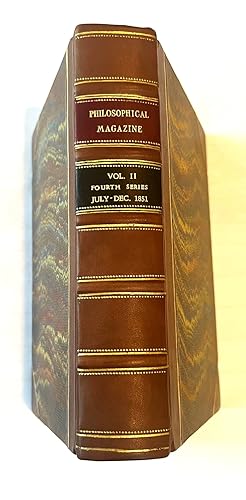
CLAUSIUS, Rudolf. "On the Moving Force of Heat and the Laws Regarding the Nature of Heat itself which are deducible therefrom" AND Hippolyte FIZEAU "On the hypotheses relating to the luminous ether, and an experiment which appears to demonstrate that the motion of bodies alters the velocity with which light propagates itself in their interior" in "The London, Edinburgh, and Dublin Philosophical Magazine and Journal of Science."
Published by Richard Taylor, 1851
Seller: JF Ptak Science Books, Hendersonville, NC, U.S.A.
Seller rating 5 out of 5 stars
Hardcover. Condition: Fine. CLAUSIUS and FIZEAU. CLAUSIUS, Rudolf. "On the Moving Force of Heat and the Laws Regarding the Nature of Heat itself which are deducible therefrom" in "The London, Edinburgh, and Dublin Philosophical Magazine and Journal of Science;" London, Richard Taylor, 1851, (fourth series) vol 2 pp 1-21 and 102-119. AND bound with Hippolyte Fizeau's "On the hypotheses relating to the luminous ether, and an experiment which appears to demonstrate that the motion of bodies alters the velocity with which light propagates itself in their interior" (same volume), pp 568-573. [++] The Clauisus is the first translation into English of his "Über die bewegende Kraft der Wärme und die Gesetze, welche sich daraus für die Wärmelehre selbst ableiten lassen" vol 79 pp. 368−397 and 500−524, 1850. In this paper, Clausius introduced the concept of entropy and stated the second law of thermodynamics in a form that is now widely recognized. He emphasized that heat does not spontaneously flow from a colder body to a hotter one, and he introduced the idea of entropy as a measure of the unavailability of energy for doing work. [++] "In 1851 [in the original appearance of the "Comptes Rendus." vol 33 pp 349-355, 1851, and which ap-pears here in translation I the same year] Fizeau found a way of overcoming the seemingly impossible difficulty of measuring the small increment in the velocity of light that in theory would be produced by a body in motion. His method was simply to produce interference fringes from rays of light that had passed through two parallel tubes containing a fluid moving in opposite directions. Even a relatively small difference in the velocity of the two light rays would cause a perceptible displacement of the interference fringes. Using air as the test medium, Fizeau discerned no change in the speed of light, a result that he expected because the refractive index of air is equal almost to one. With water, however, the velocity of light was altered by an amount that accorded reasonably well with Fresnel's formula. In 1886 A. A. Michelson and E. W. Morley repeated the experiment on a larger scale and confirmed Fizeau's results."--Complete DSB online.
-
"Ueber die Hypothesen vom Lichtaether under ueber einen Versuch", in Annalen der Physik
Publication Date: 1853
Seller: JF Ptak Science Books, Hendersonville, NC, U.S.A.
Seller rating 5 out of 5 stars
Soft cover. Condition: Very Good. FIZEAU, Armand Hippolyte Louis. "Ueber die Hypothesen vom Lichtaether under ueber einen Versuch.", pp 457-465, in Annalen der Physik und Chemie, Erganzungsband III, 1853, pp (322)-480, the Fizeau on pp 457-466, with one folding plate (IV). Removed from a bound volume, though complete in itself. Very Good, crisp copy. __+__ This is the German edition of Fizeau's "Sur les Hypothèthes relatives à l'éther lumineux, et sur une experience qui paraît démontrer que le mouvement des corps change la vitesse avec laquelle la lumière se propage dans leur intérieur", which was published September 29, 1851 in the Comptes Rendus, and then published very soon after as "The Hypotheses Relating to the Luminous Aether, and an Experiment which Appears to Demonstrate that the Motion of Bodies Alters the Velocity with which Light Propagates itself in their Interior", in the Philosophical Magazine, vol 2, pp 568 573 (1851). "The Fizeau experiment was carried out by Hippolyte Fizeau in 1851 to measure the relative speeds of light in moving water. Fizeau used a special interferometer arrangement to measure the effect of movement of a medium upon the speed of light.".
-
Sur les phénomène des interférences entre deux rayons de lumiere dans le cas de grandes differences de marche. (+) Sur les phénomène des interférences entre deux rayons de lumiere dans le cas de grandes differences de marche, et sur la polarisation ch.
Seller: Herman H. J. Lynge & Søn ILAB-ABF, Copenhagen, Denmark
Seller rating 4 out of 5 stars

Paris, Victor Masson, Imprimerie de Bachelier, 1849-50. No wrappers. In "Annales de Chimie et de Physique", 3me Series - Tome XXVI a. XXX., Juin 1849 a. Octobre 1850. (The entire issues offered). Titlepages to vol. 26 a. 30. Pp. 129-256 a. pp. 129-256. Fizeau & Foucault's paper: pp. 138-148 a. pp. 146-159, 2 folded engraved plates. Some scattred brownspots. First appearance of thispaper in which the authors demonstrated importent similarities between sound - and lightwaves, and that interference takes place between rays of light of different wavelenghts thus giving considerably evidence for the wave theory of light."By analyzing the white light source into simpler constituents by means of a spectroscope, Fizeau and Foucault were able to observe fringes produced by interfering light rays with a difference of travel equal to more than 7,000 wavelenghts, thus showing hat light waves, like sound waves, remain geometrically constant over a large number of periods. But light waves, because of their transverse vibrations, are more complex than sound waves. Light can assume different forms of planes of vibration as well as different intensities. Using the same spectroscopic apparatus as in the preceeding experiment, Fizeau and Foucault observed the interaction of two rays produced by passing a single polarized ray through a birefringent crystal. In this case, instead of obtaining alternating bands of light and dark, they obtained bands of light periodcally polarized in different planes of vibration."(DSB V, p. 19).
-
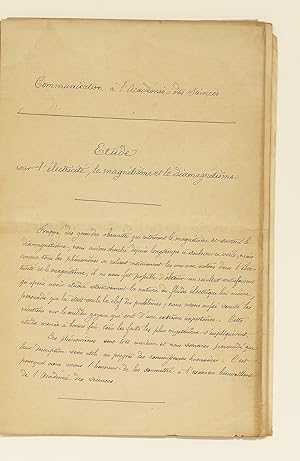
Étude sur l'électricité, le magnétisme et le diamagnétisme
Signed
Paris, c. 1850 ? Manuscrit in-8 de (2), 26 pages ; broché. Un inédit de Fizeau? Manuscrit, semble-t-il non autographe, d'une conférence ou d'une étude restée inédite d'Hippolyte Fizeau qui retranscrit une « Communication à l'Académie des Sciences» qui vise à «soulever le voile [.] des grandes obscurités qui entourent le magnétisme et surtout le diamagnétisme», en étudiant «la nature du fluide électrique» et «les réactions sur le milieu gazeux». Fizeau est connu notamment pour avoir mis au point une méthode de mesure de la vitesse de la lumière. Il est élu membre de l'Académie des Sciences en 1860. Nous n'avons pu trouver aucune trace de cette communication/étude de Fizeau sur l'électricité.
-
Sur les Hypothèses relatives a Lèther lumineux. Et sur une expérience qui parait démontrer que le mouvement des corps change la vitesse avec laquelle la lumiere se propage dans leur interieur" (Extrait par l'auteur). (The Hypotheses Relating to the Lu.
Seller: Herman H. J. Lynge & Søn ILAB-ABF, Copenhagen, Denmark
Seller rating 4 out of 5 stars
Paris, Bachelier, 1851. 4to. No wrappers. In: "Comptes Rendus Hebdomadaires des Séances de L'Academie des Sciences", Tome 33, No 13. With htitle and titlepage to tome 33. Pp. (329-) 360 (entire issue offered). Fizeau's paper: pp. 349-355. A stamp on upper right corner of title-page and a perforated stamp in lower margin of title-page. Clean and fine. First appearance of this paper, the first announcment of Fizeau's results of his experiments with the velocity of light."It (the paper) is less famous, for some reason, than the failure of Michelson and Morley to detect the aether drag, but NO LESS SIGNIFICANT. For it showed that the velocity of light increases in a medium according to the formula, v (1 - 1/n2), where v is the velocity of the medium, and n is the refractive index"(Gillespie in "The Edge of Objecticity" p. 427). Fizeau shows that the velocity of light is higher in water flowing in the direction of the beam than that of light propagating in the direction opposite the direction of flow. The paper offered is the shorter announcement of the research, the paper in full was published later in 1859 in "Annales de Chimie et de Physique". Albert Einstein later pointed out the IMPORTENCE OF THE EXPERIMENT FOR SPECIAL RELATIVITY.Fizeau's result was replicated by Albert Michelson and Edward Morley in 1886 repeated the experiment on a larger scale and confirmed Fizeau's results., and in 1914 it was confirmed by Pieter Zeeman. It was Arago in 1838, who suggested this "crucial experiment" to decide between the corpuscular and undulatory theories of light by comparing the speed of light in water and in air. It vindicated the undulatory position.It was shown by Hendrik Lorentz (1892, 1895) that the experiment can be explained by the reaction of the moving water upon the interfering waves without the need of any aether entrainment. On this occasion, Lorentz introduced a different time coordinate for moving bodies within the aether, the so called Local time (an early form of the Lorentz transformation for small velocities compared to the speed of light). In 1895, Lorentz went a step further and explained the coefficient by local time alone and without mentioning any interaction of light and matter.
-
Sur les Hypothèses relatives a Lèther lumineux. Et sur une expérience qui parait démontrer que le mouvement des corps change la vitesse avec laquelle la lumiere se propage dans leur interieur" (Extrait par l'auteur). (The Hypotheses Relating to the Lu.
Seller: Herman H. J. Lynge & Søn ILAB-ABF, Copenhagen, Denmark
Seller rating 4 out of 5 stars
Paris, Bachelier, 1851. 4to. No wrappers. In: "Comptes Rendus Hebdomadaires des Séances de L'Academie des Sciences", Tome 33, No 13. With htitle and titlepage to tome 33. Pp. 329-360 (entire issue offered). Fizeau's paper: pp. 349-355. A stamp on erso of titlepage. Titlepage with faint brownspots. First appearance of this paper, the first announcment of Fizeau's results of his experiments with the velocity of light."It (the paper) is less famous, for some reason, than the failure of Michelson and Morley to detect the aether drag, but NO LESS SIGNIFICANT. For it showed that the velocity of light increases in a medium according to the formula, v (1 - 1/n2), where v is the velocity of the medium, and n is the refractive index"(Gillespie in "The Edge of Objecticity" p. 427). Fizeau shows that the velocity of light is higher in water flowing in the direction of the beam than that of light propagating in the direction opposite the direction of flow. The paper offered is the shorter announcement of the research, the paper in full was published later in 1859 in "Annales de Chimie et de Physique". Albert Einstein later pointed out the IMPORTENCE OF THE EXPERIMENT FOR SPECIAL RELATIVITY.Fizeau's result was replicated by Albert Michelson and Edward Morley in 1886 repeated the experiment on a larger scale and confirmed Fizeau's results., and in 1914 it was confirmed by Pieter Zeeman. It was Arago in 1838, who suggested this "crucial experiment" to decide between the corpuscular and undulatory theories of light by comparing the speed of light in water and in air. It vindicated the undulatory position.It was shown by Hendrik Lorentz (1892, 1895) that the experiment can be explained by the reaction of the moving water upon the interfering waves without the need of any aether entrainment. On this occasion, Lorentz introduced a different time coordinate for moving bodies within the aether, the so called Local time (an early form of the Lorentz transformation for small velocities compared to the speed of light). In 1895, Lorentz went a step further and explained the coefficient by local time alone and without mentioning any interaction of light and matter.
-
Sur les Hypothèses relatives a Lèther lumineux. Et sur une expérience qui parait démontrer que le mouvement des corps change la vitesse avec laquelle la lumiere se propage dans leur interieur" Presenté à l'Academie des Sciences dans sa séance du 29 se.
Seller: Herman H. J. Lynge & Søn ILAB-ABF, Copenhagen, Denmark
Seller rating 4 out of 5 stars
First Edition
Paris, Victor Masson, Imprimerie de Bachelier, 1859. 8vo. Contemp. hcalf, raised bands, gilt spine. Light wear along edges. Small stamps on verso of titlepage and on verso of plates. In "Annales de Chimie et de Physique", 3me Series - Tome LVII. 512 pp. and 4 plates. (The entire volume offered). Fizeau's paper: pp. 385-404. Some scattered brownspots. First printing of a highly importent paper in the history of physics, "It is less famous, for some reason, than the failure of Michelson and Morley to detect the aether drag, but NO LESS SIGNIFICANT. For it showed that the velocity of light increases in a medium according to the formula, v (1 - 1/n2), where v is the velocity of the medium, and n is the refractive index"(Gillespie in "The Edge of Objecticity" p. 427). Fizeau shows that the velocity of light is higher in water flowing in the direction of the beam than that of light propagating in the direction opposite the direction of flow. The paper offered is the full text of the research, there appeared an extract of it in Comptes Rendus in 1851. Albert Einstein later pointed out the IMPORTENCE OF THE EXPERIMENT FOR SPECIAL RELATIVITY.Fizeau's result was replicated by Albert Michelson and Edward Morley in 1886 repeated the experiment on a larger scale and confirmed Fizeau's results., and in 1914 it was confirmed by Pieter Zeeman. It was Arago in 1838, who suggested this "crucial experiment" to decide between the corpuscular and undulatory theories of light by comparingthe speed of light in water and in air. It vindicated the undulatory position.It was shown by Hendrik Lorentz (1892, 1895) that the experiment can be explained by the reaction of the moving water upon the interfering waves without the need of any aether entrainment. On this occasion, Lorentz introduced a different time coordinate for moving bodies within the aether, the so called Local time (an early form of the Lorentz transformation for small velocities compared to the speed of light). In 1895, Lorentz went a step further and explained the coefficient by local time alone and without mentioning any interaction of light and matter.
-

Belle lettre de l'astronome Hippolyte Fizeau sur l'inauguration de la statue de Le Verrier
Signed
1 lettre autographe signée 3 In-8 07/04/1889 bon Bellelettre de l'astronome Hippolyte Fizeau à Mouchez au sujet de l'inauguration de la statue de Le Verrier à l'Observatoire de Paris. "Je dois d'abord vous remercier au nom du comité de souscription pour le bienveillant concours que vous lui avez prêté dans la question si longtemps indécise de l'emplacement où l'on devait définitivement ériger le monument consacré au grand astronome. Je crois que les savants français et étrangers ainsi que tous les souscripteurs, se féliciteront de la décision prise à ce sujet, laquelle me parait satisfaire à la fois aux honneurs dus à Leverrier, à la haute valeur de l'oeuvre de Chapu, ainsi qu'à l'ornement de la cour et de la façade nord de l'observatoire". Il l'entretient ensuite des questions pratiques relatives à l'inauguration du monument : discours et prises de parole, invitations. Il insiste sur le fait de ne pas inviter les représentants de la ville de Paris. "Il n'est pas possible d'oublier la brutalité avec laquelle ce conseil a refusé de prendre part à la souscription et s'est trop longtemps opposé à l'érection de la statue sur la voie publique à la place accordée par le ministre des Travaux publics [.]". Physicien et astronome, il travailla sur la lumière et découvrit l'effet Doppler-Fizeau, si précieux aux astronomes, qui permit de déterminer la vitesse et l'éloignement des étoiles.